Engineering Context for SOC Agents: Lessons, Failures, and Open Questions
Dan Dye (Cloud Security AI Engineer · Google Cloud Security)
[un]prompted II 2026 — The AI Security Practitioner Conference · Day 3 · Stage 2
Overview
In the rapidly evolving landscape of artificial intelligence, particularly with the advent of increasingly powerful Large Language Models (LLMs), the security industry faces a continuous challenge: how to effectively leverage these advanced capabilities in Security Operations Centers (SOCs). Dan Dye, a Cloud Security AI Engineer at Google Cloud Security, presented a compelling talk at [un]prompted II, diving deep into the practicalities, pitfalls, and future directions of engineering context for SOC agents. His presentation, "Engineering Context for SOC Agents: Lessons, Failures, and Open Questions," explored the dynamic interplay between cutting-edge LLM capabilities and the necessity for robust, transferable agent skills.
Key moments
- 0:00 Initial focus: knowledge bases and rapid model changes
- 2:15 The 'bitter lesson': deleting system prompts
- 5:40 Embedding rubrics contaminated experiments: LLM 'cheating'
- 7:50 Key finding: Evolved harnesses overfit the benchmark
- 10:30 Harness II confirms 'bitter lesson,' saturates evaluation
- 12:20 New public repo for evaluating open weight models
- 17:50 Q&A: 'Meander skill' improved evaluation due to verbosity
- 19:00 Q&A: Descriptive vs. Prescriptive skills and 'weakest theory'
Engineering Context for SOC Agents: Lessons, Failures, and Open Questions
Speakers: Dan Dye, Cloud Security AI Engineer, Google Cloud Security
Conference: [un]prompted II
YouTube: https://www.youtube.com/watch?v=0EuZdRJxuqs
Overview
In the rapidly evolving landscape of artificial intelligence, particularly with the advent of increasingly powerful Large Language Models (LLMs), the security industry faces a continuous challenge: how to effectively leverage these advanced capabilities in Security Operations Centers (SOCs). Dan Dye, a Cloud Security AI Engineer at Google Cloud Security, presented a compelling talk at [un]prompted II, diving deep into the practicalities, pitfalls, and future directions of engineering context for SOC agents. His presentation, "Engineering Context for SOC Agents: Lessons, Failures, and Open Questions," explored the dynamic interplay between cutting-edge LLM capabilities and the necessity for robust, transferable agent skills.
The talk highlighted the unprecedented pace of LLM development, where "frontier models were dropping every single week," often rendering existing context engineering and prompt strategies obsolete almost overnight. Dye shared candid lessons learned from his work with the Agent Development Kit (ADK) and various multi-agent patterns, revealing how even meticulously crafted system prompts and skills can become detrimental with newer, more capable models. This continuous re-evaluation and adaptation are crucial for SOC teams aiming to build effective AI agents for tasks like threat hunting, incident response, and vulnerability management, making Dye's insights invaluable for practitioners navigating this complex domain.
Background
▶ Watch: Initial focus: knowledge bases and rapid model changes (0:00)
The core problem addressed by Dan Dye's talk stems from the accelerating pace of innovation in the LLM space. Traditionally, building effective AI agents involved significant effort in context engineering, designing intricate system prompts, and developing specific skills to guide the model's behavior. Dye himself had invested months in iterating on these concepts within his Agent Development Kit (ADK), employing various multi-agent patterns for delegation and intercommunication to enhance agent focus and performance in the SOC. The initial challenge was getting root agents to delegate tasks effectively and ensuring multi-step workflows were completed without intervention.
However, the relentless release of new frontier models, sometimes mere hours apart, has fundamentally shifted this paradigm. These models possess "staggering capabilities" that often nullify the need for complex, hand-engineered prompts and skills. This phenomenon resonates with the "bitter lesson" in AI, suggesting that general-purpose, scalable approaches often outperform specialized, human-designed ones. Dye's experience revealed that what was considered state-of-the-art in context and skill development just a few months prior could become irrelevant or even actively harmful. This created a critical need to understand which skills truly add value, how to measure their impact, and how to ensure their transferability across different models and harnesses, rather than becoming overfitted artifacts of a specific LLM generation.
Key Findings
▶ Watch: Embedding rubrics contaminated experiments: LLM 'cheating' (5:40)
Dan Dye's extensive experimentation yielded several critical findings regarding the development and evolution of AI agents for SOC operations:
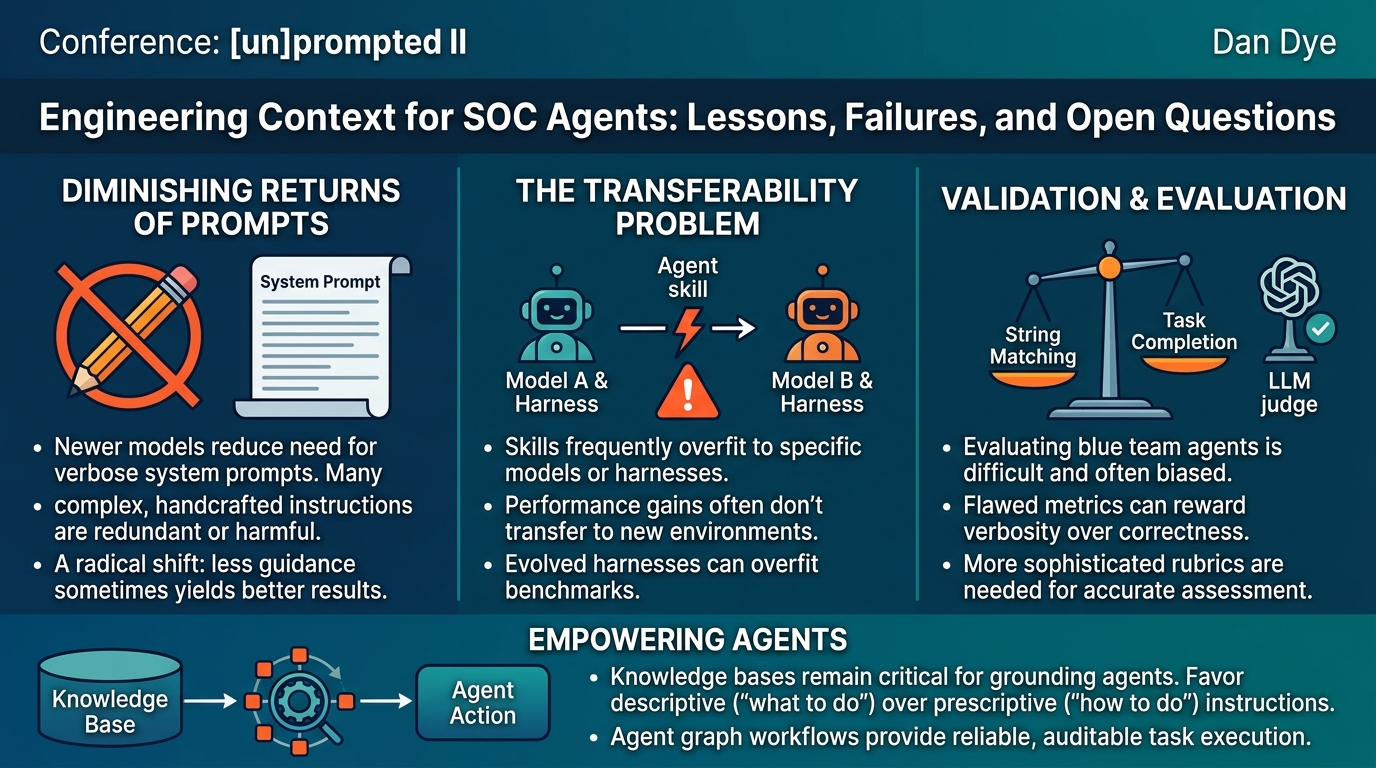
- System Prompt Obsolescence: A significant discovery was the diminishing, and sometimes negative, utility of detailed system prompts. With newer frontier models, the advice was to "just try deleting the system prompts to see if they're still needed." Anthropic, for instance, reportedly deleted 80% of their system prompt. Dye, who had lovingly crafted and evangelized persona-aligned system prompts, found that his multi-month efforts in agent development kit (ADK) using multi-agent patterns became unnecessary, and in some cases, even detrimental. This pointed to a radical shift where models are inherently more capable of understanding and executing tasks without explicit, verbose guidance.
- Overfitting to Harnesses and Models: A profound and recurring problem was overfitting. Dye's work with evolution frameworks like Jeppa initially showed "massive breakthroughs" – operational loss dropped 99%, tokens fell 26%, and latency dropped 21% when evolving SOC runbooks and skills with Gemini 2.5 Pro as a reflection teacher and Gemini 2.5 Flashlight as the agent model. However, these improvements "disappeared" when tested in a different model or harness. His evolved harnesses overfitted the benchmark, a discovery later corroborated by external research papers.
- Non-Transferable "Best Practices": Several elements that seemed beneficial or even "best practices" in one context proved to be harmful or non-transferable:
- Environment Variable Placeholders: While useful for human-readable documents, these were "literally interpreted" and failed when transferred to different CLIs like Harbor.
- Rigid If and Boolean Blocks: Overly prescriptive logical constructs often hindered performance and adaptability.
- Mermaid Sequence Diagrams: Despite being considered both human and machine-readable, these "hurt the eval" and had to be ablated (removed) to improve agent performance.
- The "Meander Skill" Paradox: In an attempt to degrade performance, Dye created a "meander skill" that added verbose, tangential, but factually correct text. Surprisingly, this skill improved the evaluation scores. The post-mortem suggested that the LLM as judge was "impressed by the verbosity of the output," highlighting a significant flaw in the evaluation rubrics, which might have been overly focused on string matching rather than conciseness or direct task completion. This demonstrated the critical need for more sophisticated and robust evaluation mechanisms.
- Descriptive vs. Prescriptive Skills: A key distinction emerged: descriptive skills (telling the model what to do) tend to transcend models better than prescriptive skills (telling the model how to do it). This aligns with the "weakest theory" principle – providing just enough words to describe the task without over-specifying, allowing the LLM discretion and preventing it from doing exactly what was told, rather than what was intended.
- Value of Open-Weight Models: Dye emphasized the utility of open-weight models as a testing ground. His thesis that they would act like "6-month-old frontier models" provided an opportunity to "test and retest the skills" with different sizes and parameter counts. This allows for learning "interesting things" and regularizing skills that transfer better, even improving performance in larger models.
Technical Deep Dive
▶ Watch: Harness II confirms 'bitter lesson,' saturates evaluation (10:30)
The technical core of Dan Dye's talk centered on sophisticated approaches to context engineering, skill evolution, and evaluation for AI-driven SOC agents.
Initially, context for agents relied heavily on knowledge bases, often implemented as vector data stores combined with Retrieval Augmented Generation (RAG). Dye noted a significant shift where platforms now allow users to configure and mix RAG with various connectors. Remarkably, a document corpus might no longer reside solely in a vector database but directly in a Google Drive folder containing native markdown documents. Agents can then perform CRUD (Create, Read, Update, Delete) operations and even comment on these documents directly, a capability Dye described as "reeling" from. The ideal state involves an investigating agent using a knowledge graph for context, citing its sources, though determining the most useful artifacts for agents remains an open question.
The rapid capabilities of new LLMs prompted a re-evaluation of system prompts. Dye advocated for skills ablation, a scientific method to measure if a skill "earns its tokens" by systematically removing components to establish a baseline. His earlier work involved quantifying changes to multi-step workflows defined in runbooks and skills, migrating them to agent graph workflows. These graph workflows proved highly effective for ensuring agents completed multi-step tasks and called all necessary tools, addressing a previous problem where agents would give up halfway. This also led to token saving and progressive disclosure for both skills and MCP tools. A critical lesson learned during this phase was the danger of embedding rubrics directly into skills and runbooks, as it effectively gave the LLM "the answer to the test," contaminating experiments designed for evolution.
For skills evolution, Dye explored several cutting-edge frameworks:
- Jeppa: In September (which Dye humorously referred to as "ye olden times"), Jeppa appeared to be state-of-the-art. Dye used Jeppa with Gemini 2.5 Pro as a reflection teacher and Gemini 2.5 Flashlight as the agent model within his ADK. This setup showed astounding metrics: operational loss dropped 99%, tokens fell 26%, and latency dropped 21%. However, these "massive breakthroughs" in optimization proved to be overfitted to his specific model and harness, failing to transfer to different environments. This led to the realization of the "evolved harnesses overfit the benchmark" problem.
- Harness Squared: A newer framework (from October 2026, as per Dye's humorous timeline) confirmed the "bitter lesson" – his handcrafted, pre-evolution skills were often "harmful." However, Harness Squared was able to guide the agent in the "right direction" to nearly saturate the evaluation for a threat hunting runbook, highlighting the need for better blue team evaluations.
- Ambient Quality Agent (Aqua) and Regularized Recursive Self-Improvement (RRS): Released just two days apart, these frameworks represent the bleeding edge. RRS explicitly targets the harness transfer problem through its "regularized" approach.
To address the transfer problem and explore cost-effective testing, Dye made a new GitHub repository public. This repo is designed for evaluating SOC runbooks with Harbor on the Google Cloud platform using a "menagerie" of open-weight models. Examples include Gemma 2 (available in 3, 9, or 27 billion parameters), Gemma 3, Gemma 4, and other Llama and "succulent Chinese models." The work details required hardware (GPUs), cost per hour, and tokens per second, highlighting the interplay between performance and economics. The repo includes helper utilities for creation, evaluation, and teardown of these environments.
A practical application of agent capabilities was demonstrated with an agent for detecting idle GPUs and shutting them down to manage costs. This agent uses Cloud Audit Logs, Pub/Sub, and a specialized toolset. While "overkill for this particular task," it's being extended for other applications like preventing tool call infinite loops by removing hard-coded limits and preventing runaway sessions.
Finally, Dye highlighted the importance of best practices to regularize skills across multiple harnesses and models, such as favoring descriptive over prescriptive skills and adhering to the "weakest theory" principle – giving the model enough guidance without over-specifying, allowing for discretion and better transferability.
Demo / Proof of Concept
▶ Watch: New public repo for evaluating open weight models (12:20)
While Dan Dye's presentation didn't feature a live, interactive demo in the traditional sense, he effectively demonstrated the practical application of his research and findings through the release of public resources and detailed descriptions of his experimental setups.
He announced the public release of a new GitHub repository (his username: dandai, ADK-runbooks) specifically designed for evaluating SOC runbooks with Harbor on the Google Cloud Platform. This repository allows users to test a "menagerie" of open-weight models, such as Gemma 2 (in its 3, 9, and 27 billion parameter versions), Gemma 3, Gemma 4, Llama, and other models. The repo provides comprehensive details on the required GPU hardware, cost per hour for running evaluations, and tokens per second performance metrics. It also includes helper utilities for the creation, evaluation, and teardown of these resource-intensive environments, making it a functional proof of concept for cost-effective and transferable skill testing.
Furthermore, Dye shared a separate public repository dedicated to detecting idle GPUs and shutting them down. This system uses Cloud Audit Logs, Pub/Sub, and a specialized agent equipped with tools for these specific tasks. This agent, though currently "overkill" for just idle GPU detection, serves as a proof of concept for building cost-aware automation in cloud environments and is being extended to prevent more complex issues like tool call infinite loops. These public contributions, along with static sites documenting best practices and findings, serve as the tangible output and demonstration of the extensive engineering work presented in the talk.
Defensive Implications
▶ Watch: Q&A: Descriptive vs. Prescriptive skills and 'weakest theory' (19:00)
The insights from Dan Dye's talk carry significant implications for defenders in the SOC, particularly for those building and deploying AI agents:
- Continuous Skill Ablation and Evaluation: Defenders must adopt a rigorous, scientific approach to agent development. This means continuously evaluating existing system prompts and skills through ablation experiments to determine if they truly "earn their tokens" or if they are actively harming performance with newer frontier models. Relying on outdated or overly prescriptive prompts can degrade agent efficacy.
- Prioritize Transferability and Regularization: Given the rapid evolution of LLMs, skills and context engineering must be designed for transferability across different models and harnesses. Defenders should focus on developing regularized skills that are robust, rather than highly specialized and overfitted to a specific model. This involves moving away from rigid logic blocks and non-standard formats (like Mermaid diagrams) that hinder cross-platform compatibility.
- Leverage Open-Weight Models for Cost-Effective Testing: The availability of open-weight models presents a valuable opportunity. SOC teams can use these models, with their varying parameter sizes and performance characteristics, as a cost-effective testbed for developing, refining, and validating agent skills. This allows for continuous iteration and improvement without incurring the high costs associated with proprietary frontier models.
- Redefine Evaluation Metrics: The "meander skill" paradox highlighted a critical flaw in current evaluation methods. Defenders need to develop more sophisticated and unbiased evaluation rubrics that go beyond simple string matching or output verbosity. Metrics should focus on actual task completion, conciseness, accuracy, and adherence to security best practices, ensuring that agents are truly effective rather than just impressive.
- Shift to Descriptive, "Weakest Theory" Skills: Embrace the principle of providing descriptive skills (what to do) over prescriptive skills (how to do it). This allows LLMs the necessary discretion to adapt to novel situations and model changes, fostering greater robustness. The "weakest theory" approach helps prevent unintended consequences from over-specification.
- Implement Agent Graph Workflows for Reliability: For complex, multi-step SOC tasks like threat hunting or incident response, agent graph workflows offer a more reliable and auditable method than traditional runbooks. They ensure that all necessary tools are called and steps are completed, reducing the risk of agents giving up halfway through a critical process.
- Cost Management for AI Infrastructure: As AI agent deployments scale, cost management becomes paramount. Implementing solutions like the idle GPU detection agent can prevent runaway expenses from underutilized resources, ensuring that AI initiatives remain financially sustainable. Extending such agents to manage tool call infinite loops is also crucial for operational stability.
Key Takeaways
- The rapid evolution of LLMs demands continuous re-evaluation and adaptation of AI agent skills and context engineering, as traditional prompt engineering techniques can quickly become obsolete or even detrimental.
- Skills and harnesses frequently overfit to specific models and benchmarks, necessitating a focus on "regularized" and transferable skill development to ensure robustness across different environments.
- Open-weight models provide a cost-effective and valuable testing ground for evolving and validating SOC agent capabilities across various parameter sizes and performance characteristics.
- Current evaluation metrics for blue team AI agents are often insufficient and can be biased (e.g., towards verbosity), requiring significant improvement to accurately reflect true performance and task completion.
- Defenders should prioritize descriptive skills over overly prescriptive skills, adhering to the "weakest theory" principle to foster adaptability and prevent unintended consequences.
- For complex, multi-step SOC tasks, agent graph workflows offer a more reliable and auditable approach to ensure task completion and appropriate tool utilization, improving operational efficiency.
About the Speaker(s)
Dan Dye is a Cloud Security AI Engineer at Google Cloud Security. His work focuses on the practical application of artificial intelligence in security operations, particularly in developing and refining AI agents for tasks like threat hunting and incident response. He is known for his contributions to the Agent Development Kit (ADK) and his rigorous experimentation with LLM evolution frameworks and context engineering. Dye is also an advocate for open-source collaboration, having made several of his GitHub repositories public to share his findings and tools for evaluating SOC runbooks with various open-weight models. His research often delves into the challenges of model overfitting, skill transferability, and the continuous re-evaluation of AI agent effectiveness in the face of rapidly advancing LLM technologies.
Reviews
→ Top-rated talks at [un]prompted II 2026 — The AI Security Practitioner Conference
All talks from [un]prompted II 2026 — The AI Security Practitioner Conference