Building Security Review Agents: the Models are the Reliable Part
Gabe Bello (Enterprise Security · Twilio)
[un]prompted II 2026 — The AI Security Practitioner Conference · Day 3 · Stage 2
Overview
In this insightful talk from [un]prompted II, Gabe Bello from Twilio's Enterprise Security team presented "Building Security Review Agents: the Models are the Reliable Part." The presentation delved into Twilio's journey of constructing an in-house, AI-powered security review process specifically designed to tackle the complex challenges of SaaS marketplace application integration risk. While much of the recent innovation in AI-driven security agents has focused on product security domains like threat modeling and code review, Bello highlighted a significant gap in the enterprise security space, particularly concerning the burgeoning "integration debt" accumulated from years of connecting third-party SaaS applications.
Key moments
- 0:00 Introduction: Tackling SaaS marketplace risk
- 2:00 High-level workflow and AI review panel design
- 4:50 Failure mode: Data quality impacts AI verdicts
- 9:00 Defining panel inputs, policies, and output contract
- 13:30 Why a multi-model panel improves security
- 14:30 Program impact: Coverage, automation, cost efficiency
- 22:00 Future: Moving to usage-based risk analysis
Building Security Review Agents: the Models are the Reliable Part
Speakers: Gabe Bello, Enterprise Security, Twilio
Conference: [un]prompted II
YouTube: https://www.youtube.com/watch?v=fVGkxfI5eSE
Overview
In this insightful talk from [un]prompted II, Gabe Bello from Twilio's Enterprise Security team presented "Building Security Review Agents: the Models are the Reliable Part." The presentation delved into Twilio's journey of constructing an in-house, AI-powered security review process specifically designed to tackle the complex challenges of SaaS marketplace application integration risk. While much of the recent innovation in AI-driven security agents has focused on product security domains like threat modeling and code review, Bello highlighted a significant gap in the enterprise security space, particularly concerning the burgeoning "integration debt" accumulated from years of connecting third-party SaaS applications.
The core problem addressed is the inconsistent and often overwhelming task of assessing the risk associated with marketplace apps (e.g., Google Workspace apps accessing Drive or Gmail) that employees can authorize. Faced with a massive backlog and a lack of consensus among security vendors on proper risk assessment methodologies, Twilio's team engineered a novel solution. This solution combines a user-friendly conversational agent with an advanced AI-enabled security review panel, aiming to provide transparent risk analysis, automate decision-making, and drastically improve the efficiency and consistency of their third-party risk management (TPRM) program. The talk's provocative title, "the models are the reliable part," sets the stage for a deep dive into the unexpected challenges and successes encountered beyond the AI models themselves.
Background
▶ Watch: Introduction: Tackling SaaS marketplace risk (0:00)
The landscape of enterprise IT has evolved dramatically, with SaaS applications becoming ubiquitous. This proliferation introduces a significant security challenge: managing the risks associated with third-party integrations. Many enterprises, including Twilio, have accumulated a substantial "integration debt" – a backlog stretching over a decade, comprising thousands of marketplace applications whose security posture and access permissions have not been adequately reviewed. The Google Marketplace, for instance, allows employees to authorize applications that can connect to critical corporate resources like Google Drive and Gmail, often with broad access scopes.
The inherent difficulty in assessing this risk stems from several factors. Firstly, there's a significant lack of industry consensus. As Bello noted, asking multiple vendors how to assess risk properly yields "12 different answers from 12 different vendors," each with varying opinions on coalescing information and reaching a verdict. Google itself provides labels like "restricted scope" or "sensitive scope," but the interpretation and aggregation of such information remain complex. Secondly, traditional manual review processes are slow, inconsistent, and resource-intensive, leading to median review times measured in days for individual applications. This bottleneck prevents security teams from keeping pace with the rapid adoption of new SaaS tools. Twilio's initiative sought to fill this void, adapting the concept of AI security agents, typically seen in product security (threat modeling, code review), to the unique demands of corporate and enterprise security, specifically focusing on Third-Party Risk Management (TPRM) and integration risk.
Key Findings
▶ Watch: Failure mode: Data quality impacts AI verdicts (4:50)
Twilio's journey in building their security review agents yielded several crucial findings, particularly regarding the architecture and efficacy of AI models in a security context:
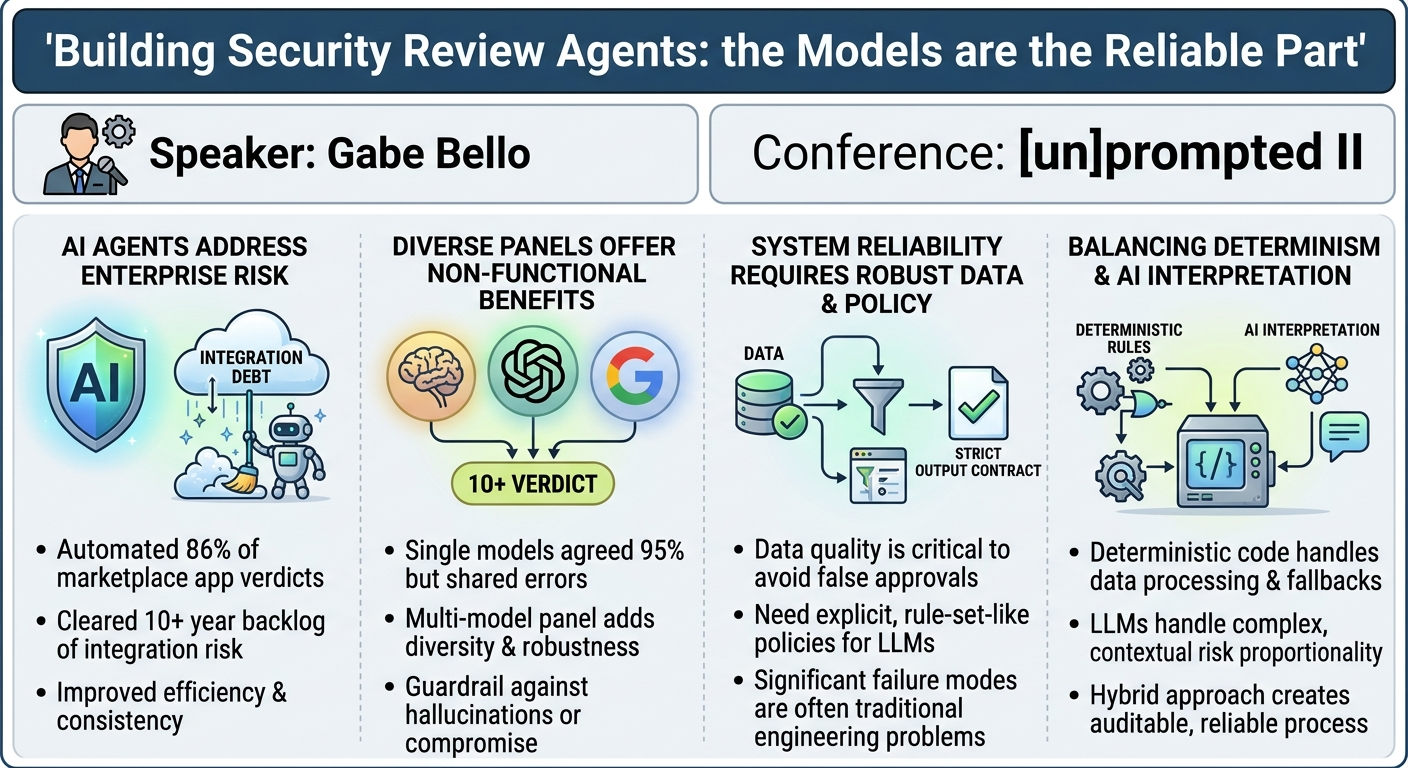
- The Panel's True Value Lies in Non-Functional Benefits: The initial hypothesis was that a panel of multiple AI models would significantly improve output quality and accuracy compared to a single model. However, testing revealed that the panel agreed 95% of the time, and in the 5% of cases where they disagreed, both models were often incorrect. Functionally, in terms of raw accuracy, a panel was not demonstrably superior to a single model. The real advantage of the panel approach, surprisingly, was in its non-functional benefits:
- Diversity and Robustness: Utilizing different models from different providers (e.g., OpenAI, Anthropic, Google) introduces diversity, which acts as a crucial security guardrail. If one model hallucinates or exhibits a particular weakness, the others are less likely to replicate that error when running concurrently.
- Resilience Against Compromise: A panel provides a degree of resilience against a model compromise or poisoning. If one model's integrity is compromised, the independent conclusions of the other panelists are likely to flag inconsistencies, preventing a single point of failure.
- Significant Business Impact and Efficiency Gains: Despite the initial challenges, the AI-powered review agent delivered remarkable results for Twilio:
- 95% Coverage: The system reviewed over 4,000 applications, addressing a previously untouched backlog of risk.
- 86% Automated Decisions: The panel achieved a high confidence verdict in 86% of cases, enabling automated approval or rejection when sufficient data and context were provided.
- Reduced Time to Resolution: Manual reviews, which previously took a median of multi-day efforts (ranging from hours to days), were streamlined into a consistent Service Level Agreement (SLA).
- Cost-Effectiveness: The panel proved incredibly cheap, averaging 10 cents per run. Twilio was able to clear its entire backlog for less than $1,000, demonstrating an exceptional return on investment.
- Deterministic Components are Critical for AI Reliability: The "models are the reliable part" title was ironic, as many of the actual failure modes encountered were not AI-specific, but rather resembled traditional software engineering problems. The reliability of the overall system hinges on robust deterministic components and clear policies:
- Data Quality (Enrichment Library): Malformed or missing data in the inventory or enrichment library (e.g., a null field indicating a failed run) was identified as a primary failure mode. The AI panel might ignore such empty fields and, worse, reach an undesired "approved" conclusion based on incomplete information. This highlighted the need for explicit expectations on how data is used.
- Contextual Policies for LLMs: Early attempts with loose, broad policies for LLMs led to inconsistent risk analysis, as the models lacked sufficient enterprise-specific context. Identical applications received different verdicts. The solution involved providing more structured guidance through policies that resemble rule sets, including statements of intent, risk patterns linked to enrichment context, and universal fallback policies for escalation. This required significant upfront effort to define the problem statement and threat models, but resulted in high-fidelity reviews.
In essence, while the AI models provided the interpretive and analytical capabilities, the overall success and reliability of the system were profoundly influenced by the quality of input data, the clarity of guiding policies, and the robust design of the surrounding software infrastructure.
Technical Deep Dive
▶ Watch: Defining panel inputs, policies, and output contract (9:00)
Twilio's security review agent is a sophisticated system comprising two main parts: a conversational agent and an AI-enabled security review panel.
The conversational agent, currently running in Slack, serves as the primary user interface. It manages the entire review workflow for employees, handling review creation, status checks, and providing transparent risk analysis. This agent acts as the initial intake mechanism, gathering essential information from the requester.
The core of the system is the Security Review Panel, an AI-driven engine designed to assess application risk and reach a verdict. This panel operates within AWS infrastructure, leveraging standard components to funnel intake data into the AI review process.
Panel Architecture and Data Flow
The panel's architecture is an intentional choice, employing three different Large Language Model (LLM) providers and models (e.g., from OpenAI, Anthropic, Google). Each model receives the same intake payload, functioning like "blind reviewers to a CFP." They independently arrive at their own conclusions regarding the application's risk.
Following the independent reviews, a designated critic model scrutinizes these individual conclusions. The critic's sole job is to identify if any panelist missed crucial information or misrepresented certain risks. This multi-stage review process, where independent analyses are then cross-referenced, is designed to yield a more consistent verdict aligned with Twilio's specific risk tolerance, policies, and expectations for enterprise application connectivity.
All the coalesced information, including the individual panelist conclusions and the critic's synthesis, is then summarized and stored in a Postgres database. This database serves as the observability layer, capturing extensive metadata about how the panel reached its conclusion. This metadata allows Twilio to track key metrics like confidence and verdict over time, enabling continuous monitoring and identification of potential issues.
Input Data for the Panel
The panel's effectiveness is heavily reliant on the quality and completeness of the data it receives. The fundamental piece of input is the grant itself, which for an OAuth application includes:
- App Name
- Publisher
- Client ID
- Set of Scopes (e.g., read Google Drive, access Gmail contacts)
This grant information acts as the primary key for all records, enabling consistent tracking of reviews, approvals, and rejections. While technically optional, the following additional data points are crucial for automated decision-making:
- Enrichment Data: This includes critical context such as vendor trust scores, records of third-party security approvals, and ownership information for the application or vendor.
- Preconditions: This is a layer of deterministic code that computes and mutates fields gathered from enrichment sources. By pre-processing this data, the agent doesn't have to perform these dynamic computations, ensuring consistency and offloading complex logic.
- Intake Answers from the Requester: For information that cannot be gathered programmatically, the conversational agent prompts the employee for specific answers.
The panel is "baked in" with instructions that include Twilio's specific security rules, known good and known bad patterns, and critically, an output contract.
Output Contract and Verdict
The output contract is a vital component for ensuring the panel's effectiveness can be consistently tracked. It dictates that every review must exit with four discrete fields:
- Verdict: One of four predefined options: approve, escalate, reject, or abstain.
- Confidence: The panel's confidence level in its own output, which can vary based on the available information.
- Rule: The specific rule or policy that the panel referenced to justify its decision.
- Reasoning: A natural language explanation detailing the justification for the verdict and confidence, mapping to the inputs used.
Failure Modes and Engineering Solutions
Bello emphasized that the most significant failure modes were not inherent to the AI models themselves but rather to the surrounding software engineering components.
- Inventory/Enrichment Library Issues:
- Problem: Malformed, missing, or unavailable data in the enrichment catalog. For example, a null field in an enrichment table due to a failed data pipeline run. If this null field was a criterion for certain decisions, the panel might ignore it and incorrectly reach an "approved" conclusion. This is particularly problematic if missing data should actually indicate a lack of trust or an inability to approve.
- Solution: The critical takeaway is to establish explicit expectations on how all data fields are to be used in the AI review process. This prevents the agent from making arbitrary interpretations or undesired inferences from missing data.
- LLM Context Limitations:
- Problem: Early prototypes used very loose, broad policies ("can you help us solve this without giving it too much direction?"). This resulted in LLMs inconsistently prioritizing different input data (e.g., sometimes focusing on publisher trust, other times on requested scopes). This inconsistency led to identical applications receiving different verdicts, which is unacceptable in an enterprise context requiring a consistent user experience.
- Solution: Provide the panel with more robust guidance and context. Policies were refined to resemble rule sets, offering flexibility for interpretation but within defined boundaries. These policies now include:
- Statement of intent: Clearly articulating the goal of the review.
- Risk patterns: Defining specific patterns of risk and linking them to relevant enrichment context.
- Universal fallback policy: Instructions for escalation when the panel cannot confidently reach a decision.
- This approach requires the security team to perform significant upfront threat modeling and understand the problem statement thoroughly, establishing patterns that are most critical to the business. The result is higher-fidelity reviews with greater consensus.
In summary, the technical deep dive reveals a system where the AI models are powerful interpreters, but their output is only as reliable as the deterministic data inputs and the carefully crafted policies that guide their decision-making. The panel approach, while not revolutionary for raw accuracy, provides crucial non-functional security benefits through diversity and resilience.
Demo / Proof of Concept
▶ Watch: Program impact: Coverage, automation, cost efficiency (14:30)
During the talk, Gabe Bello illustrated the system's operational view through a lab environment admin console. This interface is what Twilio's security team uses for oversight and manual review when an application is escalated.
The demo showcased a sample OAuth app that had been processed by the panel. The console clearly displayed an "almost unanimous approval state" from the panel. Users could expand any of the panelist's individual reviews to get granular details, revealing "under the hood thinking" of each model. This provides valuable observability into how each AI model contributed to the overall decision.
Crucially, the interface highlighted the synthesis of all panelist inputs. This included a concise decision summary that allows a human reviewer to quickly grasp the core findings and make a final decision, especially in escalated scenarios. A more detailed analysis further elaborated on key factors considered, such as third-party security assessments, the scopes requested by the application, the associated risk, and the panel's agreement on these points. This visual representation underscores how the system facilitates rapid human intervention and understanding when full automation isn't possible, providing context and justification for the AI's conclusions.
Defensive Implications
▶ Watch: Future: Moving to usage-based risk analysis (22:00)
The deployment of Twilio's security review agent offers several critical defensive implications for organizations grappling with third-party application risk and looking to leverage AI in enterprise security:
- Embrace Agent-Based Security for Enterprise Problems: While much of the AI security focus has been on product security, this talk demonstrates the immense potential of applying agentic workflows to enterprise security challenges like TPRM. Organizations should identify their own "integration debt" or similar backlogs and explore how AI agents can automate and standardize these processes.
- Prioritize Diverse AI Panels for Robustness: Instead of relying on a single AI model, organizations should strongly consider a multi-model, multi-provider panel architecture. The primary benefit isn't necessarily increased accuracy but enhanced security and resilience. A diverse panel acts as a robust guardrail against single-model weaknesses like hallucination, bias, or even potential compromise/poisoning, ensuring a more consistent and trustworthy output.
- Invest Heavily in Data Quality and Contextual Policies: The "models are the reliable part" is a misnomer; the reliability of the system depends on the quality of the data feeding the models and the clarity of the guiding policies.
- Explicit Data Expectations: Define strict schemas and explicit rules for how all input data (especially enrichment data) is to be interpreted. Missing or malformed data should trigger specific, pre-defined actions (e.g., escalation, rejection), rather than being left to the AI's arbitrary interpretation.
- Detailed, Rule-Set-Like Policies: Move beyond vague prompts for LLMs. Develop comprehensive policies that function like rule sets, incorporating statements of intent, identified risk patterns, and pointers to specific contextual information. This requires upfront threat modeling and a deep understanding of the enterprise's risk posture.
- Balance Determinism with AI Non-Determinism: The most effective AI security agents integrate both deterministic code (e.g., preconditions for data mutation, explicit fallback rules) and the non-deterministic interpretive power of LLMs. Deterministic components ensure consistency for known scenarios and structured data, while LLMs handle the nuanced, contextual risk proportionality that is difficult to over-engineer with traditional code. This hybrid approach yields a more reliable and auditable process.
- Build Robust Observability and Auditing: Implement comprehensive logging and storage of all review metadata, including individual panelist verdicts, confidence levels, and reasoning. This observability layer (e.g., in a Postgres database) is crucial for:
- Performance Monitoring: Tracking confidence and verdict consistency over time.
- Failure Analysis: Diagnosing issues, especially when panels disagree or confidence is low.
- Compliance and Auditing: Providing a clear, traceable record of how decisions were made.
- Prioritize human review for cases where confidence is split or low.
- Evolve Towards Usage-Based Risk Assessment: While point-in-time grant approvals are a good starting point, the future of TPRM lies in understanding actual application usage. Defenders should prepare to integrate activity data to determine if an application, even if authorized for high-risk actions (e.g., "read all of Google Drive"), is actually executing those actions on critical assets. This shift will enable a more granular and accurate risk assessment based on real-world behavior.
By adopting these defensive implications, organizations can transform their third-party risk management from a manual, bottlenecked process into an automated, consistent, and highly scalable security capability, freeing up security teams to focus on higher-value strategic initiatives.
Key Takeaways
- AI agents are highly effective for enterprise security problems: Twilio successfully applied AI agents to resolve a decade-long backlog of SaaS marketplace application integration risk, demonstrating significant improvements in coverage, automation, and efficiency.
- Panel architecture offers crucial non-functional benefits: While not necessarily improving raw accuracy over a single model, a diverse panel of AI models from different providers acts as a robust security guardrail against issues like hallucination, bias, and potential model compromise.
- Data quality and explicit policies are paramount: The reliability of AI-driven security systems hinges on clean, well-defined input data and detailed, rule-set-like policies that provide necessary context and guidance to LLMs, preventing inconsistent or incorrect verdicts.
- Balance determinism and AI interpretation: A hybrid approach, combining deterministic code for data processing and known rules with the non-deterministic interpretive power of LLMs for nuanced risk analysis, creates a more robust and reliable security review process.
- Cost-effectiveness and scalability are achievable: Twilio's system cleared over 4,000 application reviews for less than $1,000, showcasing the immense potential for cost savings and scalability in automating security workflows.
- Focus on system-level security, not just AI security: Many failure modes are rooted in traditional software engineering problems (e.g., malformed data) rather than AI-specific issues, emphasizing the need for holistic system scrutiny.
About the Speaker(s)
Gabe Bello is a member of the Enterprise Security team at Twilio. In his role, he focuses on building innovative security solutions to address the unique challenges faced by large organizations. His work, as highlighted in this talk, demonstrates a practical application of AI and agentic workflows to solve complex problems in Third-Party Risk Management (TPRM) and manage integration risk within an enterprise context. He is actively involved in engineering solutions that enhance corporate security posture and streamline security review processes.
Reviews
→ Top-rated talks at [un]prompted II 2026 — The AI Security Practitioner Conference
All talks from [un]prompted II 2026 — The AI Security Practitioner Conference