Threat modeling-based application security pipeline
Larkins Carvalho (Product Security Engineer · Plaid), Nielet D'mello (Security Engineer · Datadog)
AppSec Village @ DEF CON 31 · Day 3 · AppSec Village
Overview
In the rapidly evolving landscape of modern software development, where cloud-native architectures and continuous delivery are the norm, integrating robust application security practices presents a significant challenge. This talk, "Threat modeling-based application security pipeline," delivered by Nielet D'mello of Datadog and Larkins Carvalho of Plaid, tackles this very issue. It delves into how security teams in fast-paced, engineering-heavy organizations can build comprehensive and effective application security programs that scale without impeding development velocity.
Key moments
- 1:20 Challenges in fast-paced engineering organizations
- 3:30 Comprehensive application security review activities
- 9:00 Secure SDLC challenges and isolation consequences
- 10:30 The AppSec Trio of Success: Tools, Processes, People
- 13:00 Scaling the AppSec pipeline: "Thou shall not block"
- 20:15 Code playground example: practical design review and sandboxing
- 28:00 Key takeaways and achieving secure software by design
Threat modeling-based application security pipeline
Speakers: Larkins Carvalho (Product Security Engineer, Plaid); Nielet D'mello (Security Engineer, Datadog)
Conference: AppSec Village @ DEF CON 31
YouTube: https://www.youtube.com/watch?v=6GJozfKxyPw
Overview
In the rapidly evolving landscape of modern software development, where cloud-native architectures and continuous delivery are the norm, integrating robust application security practices presents a significant challenge. This talk, "Threat modeling-based application security pipeline," delivered by Nielet D'mello of Datadog and Larkins Carvalho of Plaid, tackles this very issue. It delves into how security teams in fast-paced, engineering-heavy organizations can build comprehensive and effective application security programs that scale without impeding development velocity.
The core premise of the presentation is that traditional, isolated security activities often fail to keep pace with the sheer volume and speed of new service deployment. The speakers emphasize the disproportionate ratio of engineering to security personnel in many organizations, necessitating a strategic approach to security investments. They propose a holistic, threat modeling-based pipeline that integrates security early and continuously throughout the Software Development Life Cycle (SDLC), leveraging a combination of tools, processes, and people to drive down residual risk and foster a culture of shared security ownership.
This article provides a detailed exploration of their proposed framework, highlighting the critical role of secure design reviews, collaborative threat modeling, and continuous calibration. It offers practical insights into establishing an effective AppSec program, from intake processes and technical deep dives into specific security controls to the strategic importance of security champions and measurable progress indicators. The talk ultimately aims to shift the paradigm from security teams validating software after development to developers proactively shipping inherently secure products.
Background
▶ Watch: Challenges in fast-paced engineering organizations (1:20)
Modern software development is characterized by speed, frequency, and a cloud-native orientation. Organizations are shipping new services and prototypes at an "insane" volume, often with lean security teams struggling to keep up with large engineering departments. This environment necessitates that security teams make calculated bets, focusing their efforts where impact, return on investment, and value are highest.
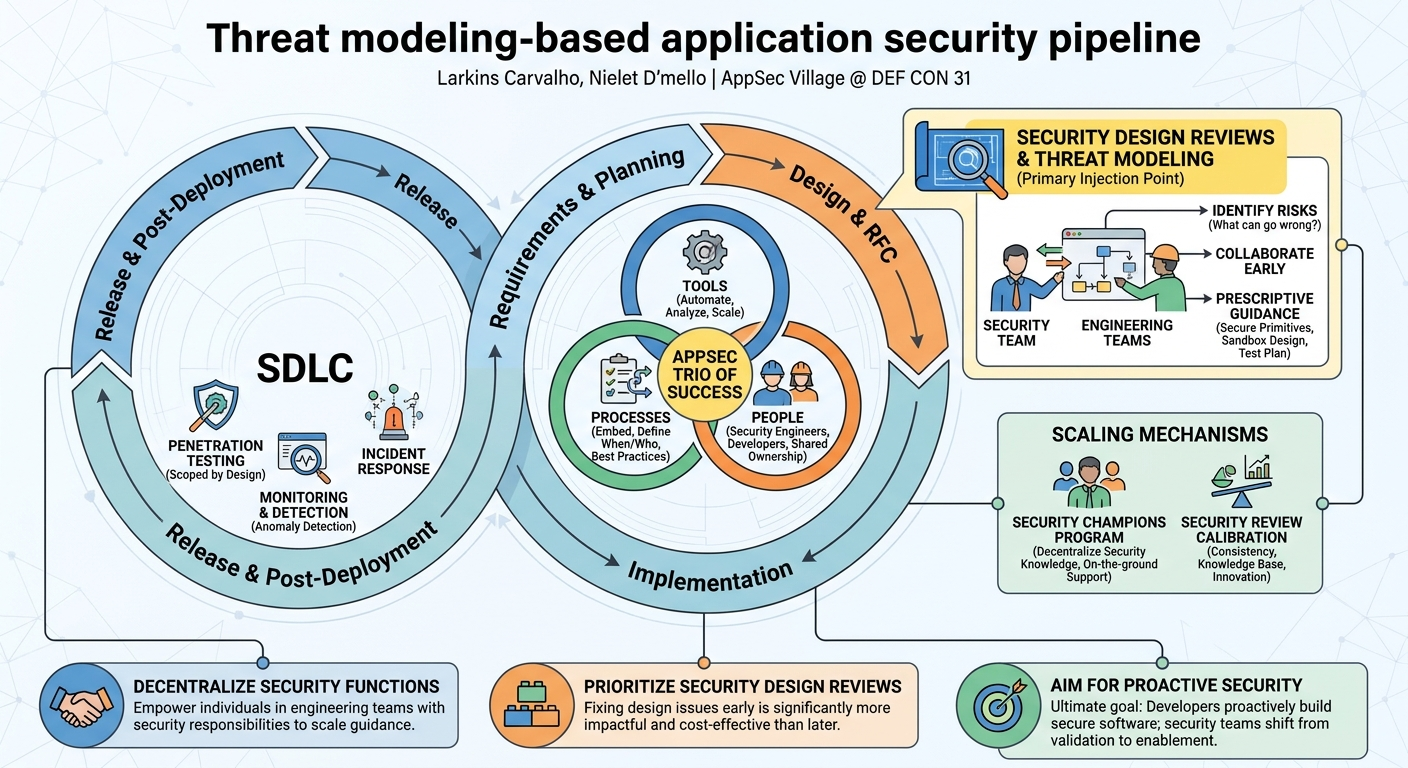
Historically, application security reviews have encompassed a range of activities, including secure design reviews, threat modeling, implementation guidance, code reviews (both automated SAST and manual), and dynamic testing (e.g., DAST, API security testing, fuzzing, penetration testing). While these activities are crucial, they often occur in isolation within the traditional Software Development Life Cycle (SDLC). The speakers illustrate how security can be injected at various phases:
- Requirements/Planning: Defining security requirements and allocating resources.
- Design/RFC: Conducting architecture reviews, threat modeling, and formulating a security test plan.
- Implementation: Performing secure code reviews and security testing.
- Release: Optionally including external or internal penetration tests.
- Post-Deployment: Adding detective controls, security monitoring, and incident response for feature-based assessments and anomaly detection.
However, adopting and executing all these activities comprehensively is challenging. When security activities happen in isolation, security best practices are often not followed, leading to an accumulation of security bugs, vulnerabilities, technical debt, inconsistent outcomes, internal security events, and ultimately, a loss of customer trust and reputation. The speakers highlight that design and architecture issues are particularly difficult to find with tools alone and are far more complicated to fix than code-level issues, underscoring the need for early intervention and collaborative approaches.
Key Findings
▶ Watch: Secure SDLC challenges and isolation consequences (9:00)
The central insight presented by Carvalho and D'mello is the concept of the "AppSec Trio of Success": a synergistic combination of Tools, Processes, and People.
- Tools: Essential for automating security activities, performing code analysis, and identifying vulnerabilities at scale.
- Processes: Critical for embedding security best practices, defining when security activities occur, and who is involved.
- People: The most vital component, encompassing security engineers with diverse skill sets and domain expertise, alongside development teams who understand the importance and rationale behind security requirements. Without engaged people, neither tools nor processes can truly succeed.
Another key finding is the emphasis on integrating security as early as possible within the SDLC, specifically through security design reviews. Fixing design issues is significantly more complex and costly than resolving code-level bugs. By collaborating with engineers from the outset, security teams can proactively address potential weaknesses and ensure that security requirements are baked into the architecture, rather than bolted on as an afterthought.
The speakers also introduce the "Commandment" for fast-paced environments: "Thou shall not block." This principle acknowledges that security must enable, not hinder, rapid development. The proposed pipeline focuses on scaling security without becoming a bottleneck, shifting from a serialized, reactive approach to a parallel, proactive, and iterative model. This involves continuous calibration of security reviews to ensure consistency, expand knowledge bases, and foster innovation in security practices. The concept of Security Champions within product teams is also highlighted as a crucial mechanism for scaling security guidance and fostering a decentralized security culture.
Technical Deep Dive
▶ Watch: The AppSec Trio of Success: Tools, Processes, People (10:30)
The proposed threat modeling-based application security pipeline is designed to overcome the limitations of traditional, serialized security activities. It centers on the security design review as the primary injection point for comprehensive security engagement.
The pipeline, initially appearing vanilla (security design review → security code review → dynamic testing), is transformed into a highly collaborative and parallelized process. During the security design review phase, security engineers are encouraged to break free from isolation and engage with other experts focused on privacy, risk, security operations (SecOps), and supply chain security. This multidisciplinary approach ensures a holistic understanding of potential implications and informs the creation of comprehensive security and privacy requirements.
Threat modeling is positioned as a core activity within the design review. It involves close collaboration with engineering teams to identify "what can go wrong with a system" and "how attackers or bad users can abuse a system and then create havoc." The output of this process, combined with identified mitigations, directly informs the implementation guidance. This guidance is prescriptive, detailing safe primitives, secure framework usage, correct cryptographic implementations, and considerations for supply chain issues. A crucial aspect of this guidance is the development of a security test plan, which outlines how the identified risks and mitigations will be validated.
The talk details a structured security design review process with defined entry points:
- Launch of a new service.
- Major updates to existing services.
- Services with security-sensitive context.
- Periodic evaluations of services.
A critical component of scaling this process is Security Review Calibration. Drawing from successful practices at organizations like AWS, calibration ensures consistency in identifying vulnerabilities, assigning severities, and addressing gaps in existing processes. It fosters a shared context among engineers across different services and provides opportunities to build knowledge bases and innovate new security processes.
To further scale and mature the pipeline, two key programs are introduced:
- Partnership Program: Security engineers directly partner with product teams or critical services. This allows for the co-definition of security review processes, streamlining code reviews, and scoping penetration tests for specific organizational contexts. It provides a focused way to measure progress and demonstrate impact.
- Security Champions Program: This decentralizes security knowledge by training security-minded individuals within product teams. These champions act as "eyes and ears," providing on-the-ground support, escalating anti-patterns, and scaling security guidance across the organization, freeing up dedicated security engineers for more complex challenges.
The overarching technical goal is to drive down residual risk by proactively embedding security, making remediations more precise, and ultimately empowering developers to ship secure software by design.
Demo / Proof of Concept
▶ Watch: Code playground example: practical design review and sandboxing (20:15)
While no live code demo was performed, the speakers used an illustrative example of a "code playground" feature to demonstrate the pipeline in practice. This served as a practical proof of concept for how the theoretical framework translates into real-world application security.
The scenario begins with a development team proposing a new "code playground" feature, which inherently involves handling arbitrary, untrusted user-supplied code. This triggers the Security Review Intake process. During intake, the security team collects critical context:
- Data stores involved.
- Internet exposure.
- Types of untrusted inputs.
- Service interfaces (server, client).
- Authentication and access control model.
- Cryptographic usage.
- Handling of customer data.
- APIs involved.
Based on this intake, the feature is immediately identified as a high-risk, critical feature requiring a full security design review and assessment. The security team then collaborates closely with the development team. Instead of merely listing requirements, they become prescriptive and collaborative. For instance, the immediate security concern for a code playground is sandboxing. The speakers emphasize that a "sandbox environment" must be carefully designed to limit the blast radius in case of a compromise, moving beyond a superficial implementation like just virus scanning uploaded code.
This collaborative design phase also clearly defines the scope for future penetration testing. By identifying high-risk areas and specific mitigations (e.g., sandbox design) during the design phase, the pen-test team receives a well-defined scope, allowing them to focus on critical aspects rather than broad, unfocused testing.
Following implementation, an implementation review is conducted. Here, the security team evaluates whether the agreed-upon security requirements have been met and provides guidance on secure usage of libraries and frameworks, highlighting potential insecure patterns that might not be obvious from documentation. This iterative process of design, implementation, and review, underpinned by threat modeling, ensures that residual risk is significantly reduced and remediations are prioritized effectively.
Defensive Implications
▶ Watch: Key takeaways and achieving secure software by design (28:00)
The framework presented by Carvalho and D'mello offers several crucial defensive implications for organizations aiming to strengthen their application security posture:
- Shift Left for Maximum Impact: By prioritizing security design reviews and integrating threat modeling early in the SDLC, defenders can identify and mitigate architectural and design flaws before they become expensive and complex to fix in code. This proactive approach significantly reduces the overall risk profile of applications.
- Context-Rich Security Assessments: The detailed intake process ensures that security teams have comprehensive context (data stores, internet exposure, untrusted inputs, authentication models, etc.). This enables more accurate risk assessments and targeted security controls, moving beyond generic checklists.
- Proactive Risk Reduction through Prescriptive Guidance: Instead of merely identifying vulnerabilities, security teams provide prescriptive implementation guidance (e.g., specific sandbox designs, secure library usage). This empowers developers to build securely from the ground up, limiting the blast radius of potential compromises.
- Optimized Penetration Testing: Early threat modeling and design reviews directly inform the scope of penetration tests. By pinpointing critical areas and high-risk functionalities, organizations can ensure that their expensive pen-testing efforts are focused on the most impactful attack vectors, maximizing their return on investment.
- Continuous Improvement through Calibration and Knowledge Sharing: Implementing Security Review Calibration fosters consistency in vulnerability identification and severity assignment. This process also creates opportunities to build a centralized knowledge base of insecure patterns, secure solutions (e.g., a standardized sandbox environment), and fine-tuned SAST rules. This collective intelligence strengthens the entire defensive ecosystem.
- Enhanced Monitoring and Detection: The insights gained from threat modeling and design reviews can be used to develop new monitoring test cases and alerting rules for malicious behavior. For instance, understanding potential attack vectors like SSRF (Server-Side Request Forgery) allows for the creation of specific detection mechanisms to identify and respond to such threats.
- Scalable Security with Security Champions: Establishing a Security Champions program decentralizes security ownership, extending the reach of the security team without increasing headcount. Champions act as force multipliers, identifying anti-patterns and escalating critical issues, thereby enhancing the organization's overall defensive capabilities.
- Measurable Progress: The pipeline encourages quantitative and qualitative measurement of security progress, including metrics like bugs shipped pre-GA, vulnerabilities addressed in design, and the effectiveness of pen tests. This data-driven approach allows defenders to continuously refine their strategy and demonstrate tangible improvements in security posture.
Key Takeaways
- Decentralize Security Functions: Empower key individuals across engineering teams with security knowledge and responsibilities to scale guidance effectively.
- Build Security Context Early: Design a crisp intake process to gather comprehensive information about new features and services, enabling accurate risk assessment.
- Leverage Tools, Processes, and People Effectively: The "AppSec Trio of Success" is crucial for scaling. Continuously evaluate if issues stem from tooling, process, or people, and debug accordingly.
- Adopt an Iterative Approach: Security pipeline development is not a one-time project; it requires patience, continuous iteration, and ongoing refinement.
- Prioritize Security Design Reviews: Fixing design and architectural issues early is significantly more impactful and less costly than addressing them later in the development cycle.
- Aim for Proactive Security: The ultimate goal is for developers to proactively build and ship secure software, rather than security teams retrospectively validating its security.
About the Speaker(s)
Nielet D'mello is a Security Engineer at Datadog, where she works on the security design and guidance team, focusing on securely engineering new products. Her previous experience includes roles at Intel and McAfee. Nielet is passionate about writing and mentors graduate students at San Jose State.
Larkins Carvalho is a Product Security Engineer at Plaid. Prior to this, he was an Application Security Engineer at AWS and also worked at Intel, initially as a software engineer before transitioning into security research. Larkins is an outdoor enthusiast who enjoys camping and hiking, often accompanied by his golden retriever.
Reviews
Dr. Zero (Offensive Security Researcher) — WEAK
Plaid and DataDog engineers get on stage to reinvent the wheel and call it the "AppSec Trio of Success." It's literally just People, Process, and Technology with a fresh coat of corporate paint and a side of "shift left" bumper stickers. If you've run an AppSec program anytime in the last decade, you already know everything in this deck.
Heather Calloway (CISO) — SOLID
Plaid and DataDog engineers outline a pragmatic AppSec program built around design-phase threat modeling and decentralized security ownership. It is a competent blueprint for organizations struggling with engineering-to-security headcount ratios. While the core concepts are established industry practice, the emphasis on non-blocking security gates makes it a solid operational refresher for your product security leads.