Cloud Defense Reality Check: From Tactics to Tenets
Swathi Joshi (Cloud Security Executive with experience at Oracle, Netflix, and Mandiant · Oracle)
Black Hat Middle East & Africa 2025 (Executive Summit) · Executive Summit
Overview
In "Cloud Defense Reality Check: From Tactics to Tenets," Swathi Joshi, a seasoned Cloud Security Executive with extensive experience at Oracle, Netflix, and Mandiant, delivers a critical assessment of contemporary cloud security practices. The talk confronts the escalating challenges posed by the rapid acceleration of cloud adoption, the embedding of machine learning across all layers, and the increasingly complex and costly recovery processes following security incidents. Joshi argues that traditional cybersecurity tactics, honed over two decades, are no longer sufficient to contend with the scale, speed, and inherent complexity of modern cloud environments.
Key moments
- 1:50 Introducing 10 principles to modernize cyber defense operations
- 4:45 Tenet 1: Shift from ROI work to reducing opportunity cost
- 5:45 Netflix's RiskQuant: quantifying risk with FAIR methodology
- 8:15 Solution versus Platform: build for long-term scalability
- 9:45 Proactive threat intelligence and focused forecasting
- 13:05 Centralize risk tracking, decentralize mitigation for scale
- 14:10 Scale security with horizontal foundational strategy
- 15:05 Conclusion: Think platform, horizontal, foresight, consistent execution
Cloud Defense Reality Check: From Tactics to Tenets
Speakers: Swathi Joshi, Cloud Security Executive, Oracle
Conference: Black Hat MEA
YouTube: https://www.youtube.com/watch?v=-g5tGR5TQIQ
Overview
In "Cloud Defense Reality Check: From Tactics to Tenets," Swathi Joshi, a seasoned Cloud Security Executive with extensive experience at Oracle, Netflix, and Mandiant, delivers a critical assessment of contemporary cloud security practices. The talk confronts the escalating challenges posed by the rapid acceleration of cloud adoption, the embedding of machine learning across all layers, and the increasingly complex and costly recovery processes following security incidents. Joshi argues that traditional cybersecurity tactics, honed over two decades, are no longer sufficient to contend with the scale, speed, and inherent complexity of modern cloud environments.
This keynote presentation advocates for a fundamental shift in approach, reframing cloud defense around core principles rather than reactive tactics. Joshi outlines ten foundational tenets designed to help security teams cut through the noise, significantly reduce the impact of security events, and operate with greater agility and effectiveness. The principles are categorized across technical, leadership, and risk management lenses, providing a holistic framework for modernizing cyber defense programs.
The importance of this talk lies in its pragmatic call to action. It moves beyond incremental improvements to demand a strategic re-evaluation of how organizations secure their cloud assets. By focusing on what truly matters—reducing opportunity cost, building scalable platforms, adopting proactive intelligence, and reframing risk—Joshi provides a roadmap for organizations to build resilient, future-proof defense systems capable of anticipating and mitigating threats in an ever-evolving threat landscape.
Background
▶ Watch: Introducing 10 principles to modernize cyber defense operations (1:50)
For the past two decades, the practice of cyber defense has largely followed a consistent methodology: reactive incident response, detection engineering focused on building or acquiring SIEM (Security Information and Event Management) systems, extensive telemetry collection, and the creation of rule-based detections. This traditional paradigm, while effective in its time, is now struggling to keep pace with the dramatic shifts in the technological landscape.
The early phases of cloud adoption brought about significant changes. Code was pushed multiple times a day, leading to the merging of development, engineering, and security functions into DevSecOps models. Simultaneously, as infrastructure costs plummeted, the cost of launching attacks also decreased, leading to a proliferation of threats like phishing and Ransomware-as-a-Service (RaaS). The current cloud journey is characterized by even greater complexity: applications are highly interconnected via APIs, and while the concept of "shifting left" security has gained traction, its practical implementation often demands substantial time, energy, and commitment. Critically, when incidents do occur in these complex environments, recovery is not just difficult but also significantly more expensive and time-consuming than ever before.
This confluence of factors—accelerated cloud adoption, pervasive machine learning, increased attack surface, and the prohibitive cost of recovery—has created a "reality check" for cybersecurity. The traditional reliance on broad, generic threat feeds, isolated security solutions, and reactive incident handling is proving inadequate. The existing approaches generate excessive noise, fail to effectively reduce impact, and ultimately hinder security teams from moving at the speed required to protect dynamic cloud infrastructures. Joshi's talk directly addresses this critical gap, proposing that a fundamental shift from tactical responses to strategic, principle-driven defense is imperative for survival and resilience in the modern threat landscape.
Key Findings
▶ Watch: Netflix's RiskQuant: quantifying risk with FAIR methodology (5:45)
Swathi Joshi's presentation outlines ten core tenets that form the backbone of a modernized cyber defense program, emphasizing a strategic shift from traditional, often reactive, security tactics. These tenets provide a framework for organizations to build more effective, scalable, and resilient cloud security postures:
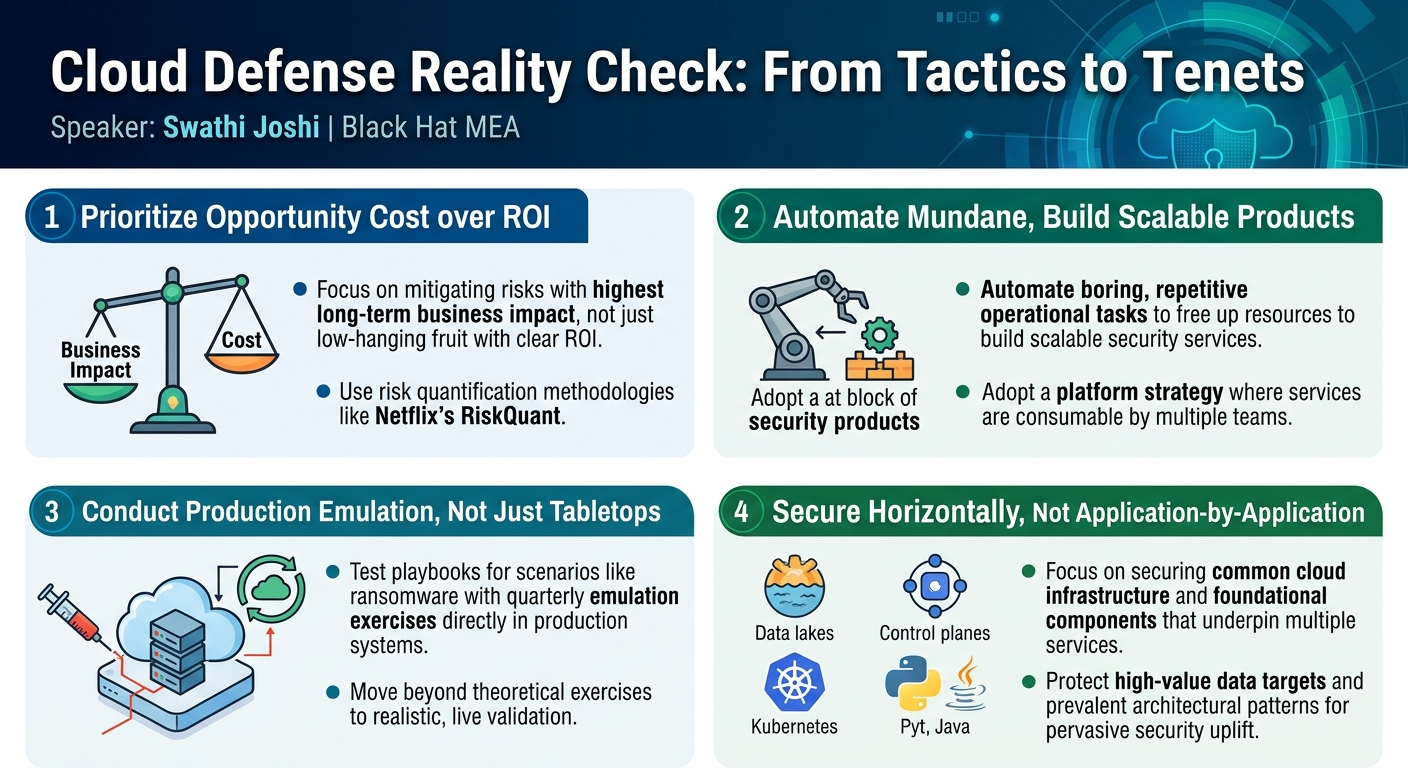
- Prioritize Opportunity Cost over ROI: Instead of solely chasing low-hanging fruit with clear Return on Investment (ROI), security teams should focus on work that reduces opportunity cost. This involves identifying and mitigating risks that, if realized, would incur the highest long-term business impact, even if their initial remediation seems more complex. Netflix's RiskQuant methodology exemplifies this by quantifying risks based on frequency and magnitude of loss.
- Automate Mundane, Build Products for Scale: Security teams often face the dilemma of maintaining operational tasks versus building innovative solutions. Joshi advocates for automating boring, repetitive operational work to free up resources, enabling teams to build scalable security products and services. Oracle's Detection as a Service platform is cited as an example, providing robust, near real-time detection capabilities by automating underlying processes.
- Buy Specific, Integrate Broadly: When acquiring security tools, the philosophy should be to purchase specific products tailored for particular use cases. However, these specialized tools must integrate seamlessly into the broader security ecosystem. This approach allows organizations to select best-of-breed solutions without creating siloed, unmanageable security stacks.
- Embrace Platform Strategy: While point solutions address immediate problems, a platform strategy offers long-term value and scalability. Security services and products should be built to be consumable by multiple teams, fostering collaboration and preventing silos. Examples include a forensics test platform shared across red teams and pen testers, and a threat intelligence platform utilized by SOC, adversarial engineering, and threat detection teams.
- Proactive, Targeted Threat Intelligence: Threat intelligence must evolve beyond post-incident attribution. It needs to be proactive and highly targeted, focusing on adversaries with demonstrated interest in the specific organization, its tech stack, and TTPs (Tactics, Techniques, and Procedures). This involves leveraging OSINT (Open-Source Intelligence) and external sharing communities to build high-confidence threat forecasts, enabling both forward and backward hunting (90-120 days).
- Emulate in Production: Traditional tabletop exercises are insufficient. Security teams should conduct emulation exercises directly within production systems, injecting live attacks to test playbooks for scenarios like ransomware or credential stuffing. These quarterly exercises must include a feedback loop to drive automation and continuous improvement, ensuring teams "train as they fight."
- Reframe Tech Debt as Residual Risk: Technical debt should not be viewed merely as a backlog of undone tasks. Instead, it must be reframed by asking: "What residual risk does this tech debt leave behind?" For instance, un-decommissioned infrastructure isn't just tech debt; the real risk lies in the absence of authentication controls or EDR (Endpoint Detection and Response) on those systems. This shifts focus from managing debt to managing actual business risk.
- Centralize Risk Tracking, Decentralize Mitigation: While the security team is ultimately responsible for reducing overall organizational risk, mitigation efforts should be decentralized. Risk tracking, data, and reporting should be centralized, providing a unified view. However, the actual implementation of controls and patches should be decentralized, empowering, educating, and recruiting stakeholders across engineering, operations, and data science teams, and holding them accountable. This is essential for scaling security.
- Scale Horizontally, Not Vertically: Instead of securing applications or services one by one, organizations should adopt a horizontal, foundational strategy. This involves identifying and securing common architectural components such as data lakes, control planes, and prevalent tech stacks (e.g., Kubernetes, serverless, Java, Python). The focus should be on protecting high-value data targets and common infrastructure, creating a lift for all dependent workflows.
- Anticipate, Don't Just React: The complexities, cheap attacks, and expensive recoveries seen in security are not merely obstacles but critical signals. Organizations must convert these signals from hindsight to foresight, anticipating future threats and proactively building defenses rather than merely reacting to incidents. This continuous, consistent execution of upgrades, automations, and strategic decisions builds a modern defense system.
Technical Deep Dive
▶ Watch: Proactive threat intelligence and focused forecasting (9:45)
The tenets presented by Swathi Joshi are not abstract principles but are grounded in concrete technical and operational methodologies. A key technical contribution highlighted is Netflix's RiskQuant methodology, an open-source framework for risk quantification that leverages the FAIR (Factor Analysis of Information Risk) methodology. RiskQuant involves forecasting two critical metrics: the frequency of loss (how many times per year a specific loss event is expected to occur) and the magnitude of loss (the estimated dollar value range if that loss event materializes). By quantifying risks in this manner, organizations can move beyond qualitative assessments to prioritize security investments based on their potential financial impact, directly addressing the opportunity cost tenet.
Oracle's development of a Detection as a Service platform illustrates the automation and product-building tenet. This platform aimed to bridge a gap in near real-time detection capabilities, providing a seamless detection authoring capability that previously existed primarily for "at rest" SIEM detections. By productizing detection engineering, Oracle enabled faster, more consistent deployment of security controls and freed up engineers from repetitive tasks, allowing them to focus on more strategic initiatives.
The emphasis on a platform strategy over point solutions has significant technical implications. Joshi details how security services should be built for broad consumption. For instance, a forensics test platform designed to be shared across the red team, pen testing, and utilized during tabletop exercises eliminates redundant efforts and standardizes forensic capabilities. Similarly, a unified threat intelligence platform consumable by the SOC, adversarial engineering, and threat detection teams ensures consistent and actionable intelligence across the security organization, moving away from siloed data and efforts.
Proactive, targeted threat intelligence is another area with deep technical requirements. This goes beyond generic threat feeds or Indicators of Compromise (IoCs). It demands monitoring adversaries specifically targeting an organization's unique tech stack and identified TTPs. This intelligence must be built upon a focused knowledge base, incorporating OSINT (Open-Source Intelligence) and insights from external sharing communities to generate high-confidence threat forecasts. Technically, this involves advanced threat hunting capabilities, enabling both "left of boom" (forward hunting) to detect emerging threats and "right of boom" (backward hunting) to analyze historical data for 90 to 120 days post-incident, using this ongoing intel to refine detection and response.
The tenet of emulation in production represents a significant technical leap from traditional security testing. Instead of theoretical tabletops, organizations are encouraged to develop tools and processes to inject live attacks into production systems. This allows for realistic testing of critical playbooks, such as those for ransomware or credential stuffing. The technical challenge here lies in safely and effectively simulating these attacks without causing actual damage, while ensuring that the learnings from these quarterly tests feed directly into automation and system improvements. This requires robust tooling, isolated testing environments, and carefully defined scope.
Finally, the horizontal scaling of security demands a deep technical understanding of cloud architecture. Instead of securing individual applications, the focus shifts to foundational components that underpin multiple services. This includes securing data lakes that house the majority of an organization's data, the control planes of cloud environments, and the common tech stacks in use, such as Kubernetes, serverless functions, and dominant programming languages like Java and Python. By securing these high-value, shared targets, organizations can implement controls that lift the security posture of an entire ecosystem, rather than patching individual vulnerabilities in isolated applications. This approach leverages architectural commonalities to achieve scalable and efficient security.
Demo / Proof of Concept
▶ Watch: Centralize risk tracking, decentralize mitigation for scale (13:05)
While the talk did not feature a live demonstration or a specific proof-of-concept tool, Ms. Joshi referenced several practical applications and methodologies developed by her teams that serve as tangible examples of the tenets in action. She highlighted Netflix's RiskQuant methodology, which was open-sourced, as a concrete framework for risk quantification based on the FAIR methodology. This methodology, involving forecasting the frequency and magnitude of loss, functions as a conceptual proof of how organizations can prioritize risks based on quantifiable business impact.
Additionally, Ms. Joshi mentioned Oracle's initiative to build a Detection as a Service product, designed to enhance near real-time detection capabilities. This represents a productized solution born from the tenet of automating mundane tasks to enable the creation of scalable security offerings. While not a live demo, these examples serve to illustrate the practical application of the principles discussed, demonstrating that these "tenets" are not just theoretical but have been successfully implemented in large, complex organizations. The talk emphasizes strategic frameworks and product development rather than a specific tool showcase.
Defensive Implications
▶ Watch: Conclusion: Think platform, horizontal, foresight, consistent execution (15:05)
The insights shared by Swathi Joshi carry profound implications for security defenders seeking to modernize their practices in the cloud era. The shift from tactics to tenets demands a strategic re-evaluation and overhaul of existing security programs:
- Strategic Risk Prioritization: Defenders must move beyond simple risk registers and adopt robust risk quantification methodologies like Netflix's RiskQuant (based on FAIR). This enables them to identify and prioritize risks based on their potential financial and operational impact (opportunity cost) rather than just ease of remediation or traditional ROI. Security leaders need to translate technical risks into organizational risks that boards can understand and act upon.
- Embrace Automation and Productization: Security teams should actively seek opportunities to automate mundane operational tasks. This frees up valuable engineering talent to focus on building scalable security products and services, such as a Detection as a Service platform, which can provide near real-time capabilities and consistent security controls across the organization. This reduces burnout and fosters innovation.
- Platform-Centric Tooling Strategy: When investing in security tools, defenders should prioritize specialized products that offer strong integration capabilities over generalized, monolithic solutions. Critically, these tools should contribute to an overarching platform strategy, enabling shared services like a forensics test platform or a unified threat intelligence platform, thereby breaking down silos and fostering collaboration across security functions (e.g., SOC, red team, pen testing).
- Proactive, Targeted Threat Intelligence: Defenders must transition from consuming broad, often noisy, threat feeds to developing highly targeted, proactive threat intelligence. This involves actively monitoring adversaries with demonstrated interest in the organization's specific tech stack and TTPs, leveraging OSINT and external sharing. Implementing capabilities for both forward and backward threat hunting (90-120 days) is crucial to anticipate and respond to threats effectively.
- Realistic Security Validation: Traditional tabletop exercises are insufficient. Organizations must invest in capabilities to conduct emulation exercises within production systems, safely injecting live attacks to test critical playbooks (e.g., ransomware, credential stuffing). These quarterly, realistic tests, coupled with a strong feedback loop for automation, ensure that teams are truly prepared for real-world incidents, training as they fight.
- Reframing Technical Debt: Security teams need to reframe discussions around technical debt. Instead of simply listing unaddressed issues, they should articulate the residual risk associated with that debt. For example, un-decommissioned infrastructure should be framed in terms of missing authentication controls or EDR coverage, providing a clear business context for remediation efforts.
- Empower Distributed Security Ownership: While core risk tracking, data, and reporting should remain centralized within the security team, risk mitigation responsibilities must be decentralized. Defenders should empower, educate, and recruit stakeholders across engineering, operations, and data science teams to own and implement security controls. Holding these teams accountable is vital for scaling security effectively across large organizations.
- Horizontal Security Strategy: Instead of securing individual applications, defenders should adopt a horizontal, foundational security strategy. This involves identifying and securing common architectural components such as data lakes, control planes, and prevalent tech stacks (e.g., Kubernetes, serverless, Java, Python). Focusing on these high-value, shared targets provides a pervasive uplift to the overall security posture, ensuring that controls are applied consistently and efficiently across the entire cloud environment.
- Cultivate Foresight: Finally, defenders must develop the ability to turn security signals (e.g., increased complexity, cheap attacks, expensive recoveries) into foresight. This means moving beyond reactive incident response to actively anticipate future threats and build proactive defenses. This requires consistent execution, continuous improvement, and a commitment to building the future of defense one strategic decision at a time.
Key Takeaways
- Prioritize Opportunity Cost in Risk Management: Shift focus from low-hanging fruit to mitigating risks that, if realized, would incur the highest long-term business impact, leveraging methodologies like Netflix's open-source RiskQuant for quantification.
- Embrace Automation and Platform Thinking: Automate mundane operational tasks to free up engineers to build scalable security products (e.g., Oracle's Detection as a Service) and adopt a platform strategy where security services are consumable by multiple teams (e.g., shared forensics or threat intel platforms).
- Focus on Targeted, High-Fidelity Threat Intelligence: Move beyond generic threat feeds to develop proactive, highly specific intelligence based on adversaries targeting your organization's unique tech stack and TTPs, enabling effective forward and backward threat hunting (90-120 days).
- Conduct Realistic Security Exercises via Production Emulation: Replace traditional tabletop exercises with quarterly emulation exercises directly within production systems, injecting live attacks to test critical playbooks (e.g., ransomware) and incorporating feedback loops for continuous improvement.
- Address Tech Debt Through the Lens of Residual Risk: Reframe technical debt discussions by articulating the residual risk it leaves behind (e.g., missing authentication controls on un-decommissioned infrastructure), providing clear business context for remediation.
- Scale Security Horizontally by Securing Foundational Cloud Elements: Instead of application-by-application security, focus on securing common architectural components like data lakes, control planes, and prevalent tech stacks (e.g., Kubernetes, serverless, Java, Python) to achieve pervasive and efficient security.
About the Speaker(s)
Swathi Joshi is a highly experienced Cloud Security Executive. She has held significant roles at prominent technology and security companies, including Oracle, Netflix, and Mandiant. With 17 years dedicated to cybersecurity engineering, and the last 10 years specifically focused on cyber defense engineering and operations, Ms. Joshi brings a wealth of practical knowledge and strategic insight to the challenges of modern cloud security. Her expertise spans developing and implementing robust security programs in complex, fast-paced environments.
Reviews
Dr. Zero (Offensive Security Researcher) — SOLID
Competent executive-track talk that packages two decades of conventional wisdom into a clean 'ten tenets' framework. Nothing here will surprise anyone running a mature cloud security program, but the framing is clear and the speaker has the operational credibility to deliver it. Fills a slot; won't change anyone's roadmap.
Heather Calloway (CISO) — SOLID
Competent framework talk from a credible practitioner, but it's ten principles when three would land harder. The RiskQuant callout is actionable; most of the rest is well-articulated conventional wisdom that won't change how your program operates tomorrow.
→ Top-rated talks at Black Hat Middle East & Africa 2025 (Executive Summit)
All talks from Black Hat Middle East & Africa 2025 (Executive Summit)