Securing the Digital Enterprise
Ahmad Halabi (Managing Director · Resecurity)
Black Hat Middle East & Africa 2025 (Executive Summit) · Executive Summit
Overview
In "Securing the Digital Enterprise," Ahmad Halabi, the Managing Director of Resecurity, delivers a compelling presentation on the critical need for an "overwatch" approach to cybersecurity. The talk emphasizes a holistic strategy that integrates threat intelligence, brand monitoring, and fraud prevention with offensive security capabilities like zero-day discovery, red teaming, and application security testing. Halabi argues that traditional internal security measures, such as firewalls and EDR solutions, are insufficient to combat the increasingly sophisticated and externally orchestrated attacks that leverage AI, automation, and psychological manipulation to exploit vulnerabilities.
Key moments
- 0:00 Introduction and scope of advanced threat monitoring
- 2:00 Resecurity's comprehensive threat intelligence and services portfolio
- 5:00 Deep and dark web investigation for precursor breach intelligence
- 9:00 Hacking Blacklock ransomware group to disrupt operations
- 11:00 Real-time dark web monitoring and botnet intelligence
- 13:00 Weaponizing AI to extract compromised personal data
- 14:00 Specialized fraud intelligence for financial sector and money laundering
- 16:00 Summary: Data aggregation and integration for blind spot protection
Securing the Digital Enterprise
Speakers: Ahmad Halabi, Managing Director, Resecurity
Conference: Black Hat MEA
YouTube: https://www.youtube.com/watch?v=kPMcPMfDLJo
Overview
In "Securing the Digital Enterprise," Ahmad Halabi, the Managing Director of Resecurity, delivers a compelling presentation on the critical need for an "overwatch" approach to cybersecurity. The talk emphasizes a holistic strategy that integrates threat intelligence, brand monitoring, and fraud prevention with offensive security capabilities like zero-day discovery, red teaming, and application security testing. Halabi argues that traditional internal security measures, such as firewalls and EDR solutions, are insufficient to combat the increasingly sophisticated and externally orchestrated attacks that leverage AI, automation, and psychological manipulation to exploit vulnerabilities.
Halabi, recognized by the US Department of Defense as the top world hacker in 2019, brings a unique perspective shaped by extensive experience supporting government, intelligence, and military sectors in vulnerability discovery. His presentation underscores that a significant portion of cyber threats originates and evolves outside an organization's immediate network perimeter, in the deep and dark web. Data breaches, infections, compromises, and leaks frequently occur in these unseen territories, necessitating a proactive and external monitoring capability to detect precursor events and mitigate risks before they materialize into full-blown incidents.
The core message revolves around understanding and addressing blind spots that exist beyond the corporate firewall. Resecurity's approach, as detailed by Halabi, involves aggressive intelligence gathering, deep dark web engagement, and even offensive operations against criminal groups. This comprehensive strategy aims not just to react to threats but to anticipate, understand, and neutralize them by monitoring threat actors, their methodologies, and the marketplaces where vulnerabilities and compromised data are traded, thereby providing organizations with an extended arm of protection into the digital underworld.
Background
▶ Watch: Introduction and scope of advanced threat monitoring (0:00)
The contemporary cybersecurity landscape is characterized by an escalating sophistication of attacks that transcend traditional defenses. Organizations are increasingly confronted with threats that operate beyond their visible network perimeters, often originating from the deep web and dark web. These hidden layers of the internet serve as breeding grounds for cybercriminals, nation-state actors, and fraud rings, where zero-day vulnerabilities are traded, compromised credentials are sold, and elaborate attack plans are orchestrated. The problem is exacerbated by the evolution of attack vectors, which now frequently incorporate artificial intelligence (AI), automation, and intricate social engineering tactics designed to manipulate human psychology.
Traditional security measures, such as firewalls, endpoint detection and response (EDR) systems, and intrusion prevention systems, are primarily designed to protect an organization's internal infrastructure. While essential, these tools inherently lack visibility into external activities that precede or enable a breach. Data often moves "from the inside to the outside" through various channels, leading to breaches, infections, and compromises that an organization may not even be aware of until significant damage has occurred. This creates a critical blind spot, where precursor activities – like the sale of a specific zero-day affecting a company's software or a discussion about targeting an executive – go undetected.
The necessity for a robust external intelligence gathering capability arises from this gap. The talk posits that organizations need an "overwatch program" to monitor the vast expanse of the internet beyond their control. This includes tracking threat actors, understanding their motivations, techniques, and targets, and identifying emerging threats before they impact the enterprise. Without such a capability, organizations remain vulnerable to sophisticated, externally planned attacks that bypass internal defenses, leaving them in a reactive posture rather than a proactive one. Resecurity's model addresses this by establishing an intelligence fusion center that aggregates billions of artifacts from diverse sources, including human intelligence, signal intelligence, and deep/dark web monitoring, with a team capable of understanding over 40 languages and their associated slangs to penetrate criminal communities effectively.
Key Findings
▶ Watch: Deep and dark web investigation for precursor breach intelligence (5:00)
The talk presents several key findings and capabilities that collectively define a proactive and comprehensive security posture against modern threats:
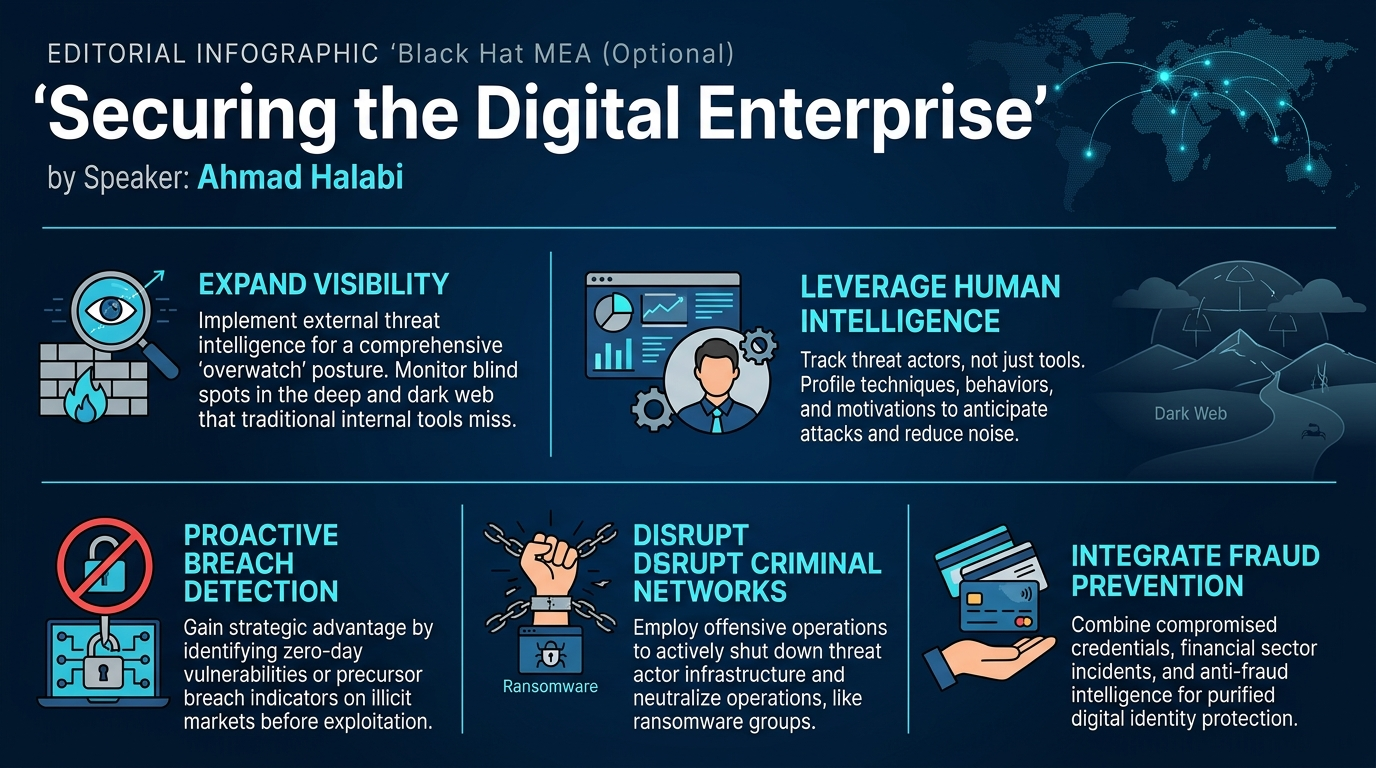
- Holistic External Visibility: Resecurity emphasizes the critical need to monitor threats originating outside the corporate network, including the dark web, deep web, social media, and open-source intelligence. This "overwatch" program aggregates billions of artifacts daily, providing insights into blind spots that traditional internal security tools cannot cover.
- Human-Centric Threat Intelligence: A significant finding is the importance of monitoring threat actors themselves, not just their tools or methods. By tracking over 40-50 million threat actors globally, including their profiles, techniques, attitudes, and behaviors, organizations can anticipate their next moves, reduce noise, and minimize false positives, leading to more actionable intelligence.
- Proactive Zero-Day and Vulnerability Discovery: The presentation highlights the ability to actively discover zero-day vulnerabilities through extensive research and development, covering not only traditional cyber vectors but also Operational Technology (OT) and Industrial Control Systems (ICS) (e.g., gas stations, submarine controls, power grids, HVAC, medical X-rays). Furthermore, it details a passive intelligence gathering method to identify zero-days being sold on the dark web, providing specific details like pricing, affected vendors, and actor profiles.
- Offensive Operations and Disruption: A crucial capability demonstrated is the active disruption of criminal operations. The talk details hacking ransomware groups (e.g., Blacklock ransomware) to shut down their infrastructure, access victim data, and help companies recover encrypted files without paying ransom. This shows a proactive stance in neutralizing threats rather than merely observing them.
- Detailed Botnet Intelligence: The platform offers granular visibility into compromised machines within botnets, providing details such as infection dates, credentials leaked, machine specifications, and extracted files (cookies, keyloggers, screenshots). This capability allows for root cause analysis and targeted remediation, moving beyond mere detection to problem-solving.
- AI-Driven Data Acquisition and Analysis: The integration of AI and machine learning enables rapid profiling of individuals or entities by querying leaked data across the fusion center. This allows for quick extraction of Personally Identifiable Information (PII) like credit card numbers, emails, and phone numbers, which is critical for fraud prevention and identity protection.
- Integrated Fraud Prevention: The talk distinguishes fraud intelligence as a specialized domain, integrating compromised credentials (payment gateways, banking portals), financial sector incidents, fraudster communities, leaked credit cards, botnet intelligence with banking signatures, passive DNS for phishing domains, and IP reputation. This comprehensive approach, combined with human intelligence to identify mule accounts, provides a purified anti-fraud capability.
Technical Deep Dive
▶ Watch: Real-time dark web monitoring and botnet intelligence (11:00)
Resecurity's approach to securing the digital enterprise hinges on a sophisticated multi-layered intelligence gathering and operational framework. At its core is the intelligence gathering life cycle, which involves offensive operations. This isn't passive data collection; it includes actively developing "chain of assets," establishing "upstream access," and directly engaging with threat actors to acquire critical data. This human intelligence (HUMINT) aspect is crucial for gaining deep insights into criminal methodologies and intentions.
The internet is fundamentally divided into three layers: the surface web, deep web, and dark web. While the surface web is publicly accessible, Resecurity’s focus is closer to the deep and dark web, particularly P2P (peer-to-peer) communication channels and vetted forums. These forums are often invite-only, requiring a credible "hacker persona" to gain access. The goal is to acquire precursor intelligence – information about a potential breach or incident, such as a zero-day vulnerability being sold – before it becomes public or is exploited. This provides organizations with a significant leverage advantage.
One of the most compelling technical capabilities is the monitoring of zero-day vulnerabilities. Resecurity employs a passive intelligence collection method that scours dark web marketplaces and forums. Through this, they can identify specific zero-days being sold, obtaining precise details such as the asking price, the targeted vendors or products, and extensive information about the vulnerability itself. This process is augmented by AI and machine learning to generate rapid and detailed reports. Beyond the vulnerability, the platform profiles the threat actor or broker selling it, correlating known aliases, profiles, contacts, historical records, Indicators of Compromise (IOCs), and even geo-location data, to construct a comprehensive adversary profile.
A standout example of offensive operation involves the disruption of the Blacklock ransomware group. Following an attack on a customer, Resecurity conducted an in-depth investigation into the group's Tor network. They identified a local file inclusion (LFI) vulnerability on the ransomware operators' server. Exploiting this LFI, they were able to dump sensitive server files, including /etc/host/passwd, which led to the discovery of the threat actors' email addresses. With these emails, Resecurity gained access to the ransomware group's cloud storage, where they found details of current and future victims. This enabled them to help numerous companies recover their encrypted files without paying the ransom, effectively "hacking the hackers."
The platform also provides a dark web monitoring and threat hunting workbench, allowing analysts to conduct forward hunting and in-depth investigations without directly accessing Tor. For instance, querying for "Saudi Arabia" on the platform can reveal illegal trafficking activities, such as vehicle sales, complete with Bitcoin addresses and broker emails, which could pose national security threats.
Another critical component is botnet intelligence. The platform monitors thousands of infected computers, providing extensive details for each compromised machine. This includes the exact date of infection, the date access was sold, leaked credentials, machine specifications, and files extracted by attackers (e.g., cookies, keyloggers, screenshots). Crucially, it identifies the specific location where malware is installed, enabling precise remediation and addressing the root cause rather than just detecting symptoms.
Furthermore, Resecurity leverages AI to weaponize data acquisition. Users can command the platform to retrieve compromised personal data. By simply inputting a person's name, the AI maps this against the aggregated data in the fusion center, extracting relevant Personally Identifiable Information (PII) like full names, email addresses, phone numbers, and credit card details. This capability is invaluable for identity protection and fraud prevention.
For fraud intelligence, the system integrates a specific set of data points: compromised credentials tied to payment gateways and banking portals, security incidents in the financial sector, profiles of fraudsters and their communities, leaked credit cards, botnet intelligence with banking signatures, passive DNS records of fraudulent/phishing domains, and IP reputation for fraudulent addresses. This data, combined with human intelligence to identify mule accounts used by fraudsters, creates a highly refined anti-fraud capability, even extending to tracking cryptocurrency addresses for money laundering investigations.
Finally, the talk emphasizes that all this aggregated data from the fusion center is designed for seamless integration. Whether it's a Threat Intelligence Platform (TIP), Security Information and Event Management (SIEM), Security Orchestration, Automation, and Response (SOAR), vulnerability management tool, firewall, or EDR, the data can be ingested in any chosen format, making it highly adaptable to existing security infrastructures.
Demo / Proof of Concept
▶ Watch: Weaponizing AI to extract compromised personal data (13:00)
While "Securing the Digital Enterprise" did not feature a live, interactive demonstration, Ahmad Halabi effectively presented several illustrative examples and screenshots from Resecurity's platform, serving as powerful proofs of concept for their capabilities. These virtual demonstrations highlighted the actionable intelligence and operational effectiveness of their integrated approach.
One key demonstration involved the dark web hunting workbench. Halabi showed how an analyst could query the platform for specific keywords, such as "Saudi Arabia," and immediately surface relevant illegal activities. The example displayed illegal vehicle trafficking, providing critical details like the Bitcoin address used for transactions and the email address of the broker involved. This illustrated the platform's ability to penetrate illicit markets and extract actionable intelligence that could be vital for national security or law enforcement.
Another compelling example was drawn from their botnet intelligence capabilities. Screenshots were presented depicting thousands of infected computers, each with a detailed profile. These profiles included the exact date of infection, the date when access to the compromised machine was sold, and a trove of extracted data such as leaked credentials, cookies, keyloggers, and screenshots of the victim's desktop. A specific screenshot of an infected computer was shown, along with a view detailing the malware installation path, underscoring the platform's ability to pinpoint the root cause for effective remediation.
The offensive operation against the Blacklock ransomware group was also visually supported. Halabi presented screenshots of what appeared to be login interfaces to the threat actors' cloud environment, demonstrating their successful infiltration and control over the criminals' infrastructure. This provided concrete evidence of their ability to "hack the hackers" and retrieve victim data.
Furthermore, the power of AI for personal data extraction was demonstrated. Halabi showed an interface where a user could input a person's name and, through the platform's AI, quickly retrieve leaked Personally Identifiable Information (PII). The screenshot revealed a full name, email address, phone number, and even a credit card number associated with the queried individual, showcasing the platform's capacity for rapid and comprehensive data aggregation for identity protection and fraud prevention.
These examples, visually reinforced by screenshots, effectively conveyed the depth and breadth of Resecurity's intelligence, monitoring, and offensive capabilities, illustrating how their "overwatch" program translates into tangible security outcomes.
Defensive Implications
▶ Watch: Summary: Data aggregation and integration for blind spot protection (16:00)
The insights shared in "Securing the Digital Enterprise" carry profound defensive implications for organizations grappling with an evolving threat landscape. The primary takeaway for defenders is the urgent need to expand their visibility beyond the traditional network perimeter. Firewalls, EDR, and other internal tools are foundational but insufficient. Organizations must adopt an "extension arm" approach, integrating external threat intelligence, brand monitoring, and fraud prevention to cover the "blind spots" where sophisticated attacks are planned and executed.
Defenders should prioritize proactive threat hunting on the deep and dark web. This involves actively seeking out precursor indicators of compromise, such as the sale of zero-day vulnerabilities affecting their systems or discussions about targeting their executives or critical infrastructure. Leveraging specialized intelligence platforms that can penetrate vetted criminal forums and P2P networks can provide invaluable lead time to patch vulnerabilities or enhance defenses before an attack materializes.
Furthermore, the talk highlights the importance of understanding the adversary's perspective. By utilizing human intelligence to profile threat actors – their aliases, techniques, motivations, and geographical locations – defenders can gain a clearer picture of who might be targeting them and why. This adversary-centric approach helps in anticipating next moves, refining threat models, and allocating defensive resources more effectively, moving beyond generic threat feeds to highly tailored intelligence.
The emphasis on Operational Technology (OT) and Industrial Control Systems (ICS) security is also a critical defensive implication. Organizations operating critical infrastructure (e.g., power grids, gas stations, medical devices) must recognize that these systems are increasingly targeted. Their security strategies need to extend beyond IT to encompass OT-specific intelligence gathering and vulnerability management, as compromises in these areas can have severe real-world consequences.
Integrating external intelligence into existing security operations is paramount. Data aggregated from dark web monitoring, botnet intelligence, and fraud prevention should not remain siloed. It must be seamlessly fed into SIEM, SOAR, and TIP platforms to enrich internal alerts, automate responses, and improve the overall efficiency of incident response teams. This integration transforms raw intelligence into actionable defensive measures.
Finally, defenders should embrace a strategy that focuses on root cause remediation, not just detection. The botnet intelligence capability, which identifies malware installation paths and extracted data, exemplifies this. By understanding precisely how and where a system was compromised, organizations can implement targeted fixes that prevent recurrence, rather than merely cleaning up symptoms. This shift towards addressing the fundamental vulnerabilities that enable attacks will lead to more resilient security postures.
Key Takeaways
- External "Overwatch" is Essential: Traditional internal security tools are insufficient against sophisticated threats originating from the deep and dark web. Organizations need an external "extension arm" for comprehensive threat intelligence, brand monitoring, and fraud prevention.
- Human Intelligence Drives Deeper Insights: Proactive monitoring of 40-50 million threat actors, including their profiles, techniques, and behaviors, is crucial for anticipating attacks, reducing false positives, and understanding adversary motivations.
- Zero-Day and Precursor Breach Detection Offers Strategic Advantage: Identifying zero-day vulnerabilities being sold on the dark web or other precursor attack indicators before exploitation provides critical lead time for patching and strengthening defenses across IT and OT/ICS environments.
- Offensive Operations Can Disrupt Criminal Networks: Actively engaging with and disrupting criminal groups, such as hacking ransomware operations (e.g., Blacklock ransomware) to shut down their infrastructure and aid victims, demonstrates a powerful proactive defense strategy.
- Integrated Platforms Provide Holistic Protection: Combining diverse intelligence streams (threat intel, brand monitoring, fraud prevention, botnet data) into a unified fusion center, enhanced by AI and machine learning, enables a more complete and adaptable security posture, easily integrated with existing security tools.
- Focus on Root Cause and Actionable Remediation: Beyond detection, intelligence should guide precise remediation efforts, identifying specific malware installation paths and understanding the full scope of a compromise to address the root cause and prevent future incidents.
About the Speaker(s)
Ahmad Halabi is the Managing Director at Resecurity, a cybersecurity company focused on threat intelligence, brand monitoring, and fraud prevention. He is also recognized as a prominent figure in the hacking community, having been ranked by the US Department of Defense as the top world hacker in 2019. Halabi's extensive experience includes supporting numerous government, intelligence, and military sectors in the discovery and mitigation of vulnerabilities. He describes himself as a hacker, bringing a unique, offensive-minded perspective to the challenges of securing digital enterprises.
Reviews
Dr. Zero (Offensive Security Researcher) — HARD PASS
This is a vendor pitch dressed as a talk. Halabi spends 90% of the time describing what Resecurity's platform can do — dark web monitoring, botnet intel, fraud prevention — without teaching anything transferable. The Blacklock ransomware 'hack' is the only concrete claim, and even that's presented as a capability advertisement rather than a technical walkthrough anyone could learn from.
Heather Calloway (CISO) — WEAK
This is a vendor pitch dressed as thought leadership. The strategic claims are real — external visibility matters, dark web monitoring has value — but the talk exists to sell Resecurity's platform, not to equip security leaders with actionable frameworks they can apply regardless of vendor choice.
→ Top-rated talks at Black Hat Middle East & Africa 2025 (Executive Summit)
All talks from Black Hat Middle East & Africa 2025 (Executive Summit)