Who's Protecting the Story Before It Hits the Screen
Daniel Meacham (VP, Information and Content Security · Legendary Entertainment)
Black Hat Middle East & Africa 2025 (Executive Summit) · Executive Summit
Overview
In an era where digital content reigns supreme and production workflows span the globe, securing intellectual property in the entertainment industry presents a unique and formidable challenge. Daniel Meacham, VP of Information and Content Security at Legendary Entertainment, delivered a compelling talk at Black Hat MEA, "Who's Protecting the Story Before It Hits the Screen," shedding light on the unseen vulnerabilities within the modern entertainment ecosystem. Meacham's presentation meticulously unraveled the complex journey of a multi-million dollar asset, from initial script development through production, post-production, and final distribution, highlighting how a single breach at any stage can lead to devastating leaks before a project ever reaches its audience.
Key moments
- 2:30 Real-world examples of movie leaks
- 3:30 Understanding the movie production workflow
- 10:00 98% of content leaks are human-related
- 11:00 Supply chain security for visual effects
- 15:00 Securing cutting-edge virtual production sets
- 18:30 Merchandise reveals major movie spoilers
- 20:30 Advanced anti-piracy measures for screenings
- 22:00 When a leak becomes free marketing
Who's Protecting the Story Before It Hits the Screen
Speakers: Daniel Meacham, VP, Information and Content Security, Legendary Entertainment
Conference: Black Hat MEA
YouTube: https://www.youtube.com/watch?v=jaHvpJSlyxA
Overview
In an era where digital content reigns supreme and production workflows span the globe, securing intellectual property in the entertainment industry presents a unique and formidable challenge. Daniel Meacham, VP of Information and Content Security at Legendary Entertainment, delivered a compelling talk at Black Hat MEA, "Who's Protecting the Story Before It Hits the Screen," shedding light on the unseen vulnerabilities within the modern entertainment ecosystem. Meacham's presentation meticulously unraveled the complex journey of a multi-million dollar asset, from initial script development through production, post-production, and final distribution, highlighting how a single breach at any stage can lead to devastating leaks before a project ever reaches its audience.
The talk underscored that the entertainment industry, much like global gaming, is not merely about protecting a central platform but about securing a vast web of dependencies, partners, and third-party services. Meacham, drawing from Legendary Entertainment's experiences with major productions like Godzilla vs. Kong and Detective Pikachu, illustrated that the primary vectors for content leaks are often not sophisticated technological exploits but rather human factors and overlooked supply chain vulnerabilities. This deep dive into the practical realities of content security offers critical insights for any industry grappling with complex digital supply chains and the pervasive threat of information compromise.
The significance of Meacham's insights extends beyond Hollywood. His discussion of securing ephemeral, high-value assets across a distributed, temporary workforce, and a global network of vendors, provides a blueprint for understanding and mitigating risks in any enterprise that creates, processes, or distributes sensitive information through a complex ecosystem. The talk serves as a stark reminder that resilience isn't just about robust internal security, but about securing the entire perimeter of collaboration and partnership.
Background
▶ Watch: Real-world examples of movie leaks (2:30)
The entertainment industry operates on a unique model where each major production is akin to launching a temporary startup. As Meacham explained, "every movie is pretty much treated as if it's its own company," complete with its own tech stack, equipment, budget, and a transient workforce that can range from a dozen people in the development phase to hundreds during pre-production and principal photography. This inherent dynamism and the project-based nature of filmmaking create a constantly shifting security landscape, making traditional, static security models largely ineffective.
Historically, content leaks were often associated with physical copies, but the digital transformation of the industry has introduced new, more pervasive vectors. From cloud-based editing suites and global content delivery networks to the proliferation of personal devices on set, the attack surface has expanded dramatically. The problem is exacerbated by the reliance on a global supply chain encompassing visual effects studios, localization services, merchandise manufacturers, and various on-location crews, each introducing their own security posture and potential vulnerabilities.
Meacham cited real-world examples, such as the leak of Godzilla vs. Kong through Legendary's supply chain and the unauthorized release of set photos from public filming locations. These incidents underscore a critical point: the industry's primary challenge isn't just protecting "the vault" but rather safeguarding content as it flows through a highly interconnected, often geographically dispersed, and technologically diverse ecosystem. The problem exists because the creative process demands collaboration and flexibility, often at odds with stringent security controls, leading to a constant tension between creative enablement and risk mitigation. This tension is further complicated by the short-term nature of production teams and the rapid adoption of new technologies, which can outpace the implementation of mature security practices.
Key Findings
▶ Watch: 98% of content leaks are human-related (10:00)
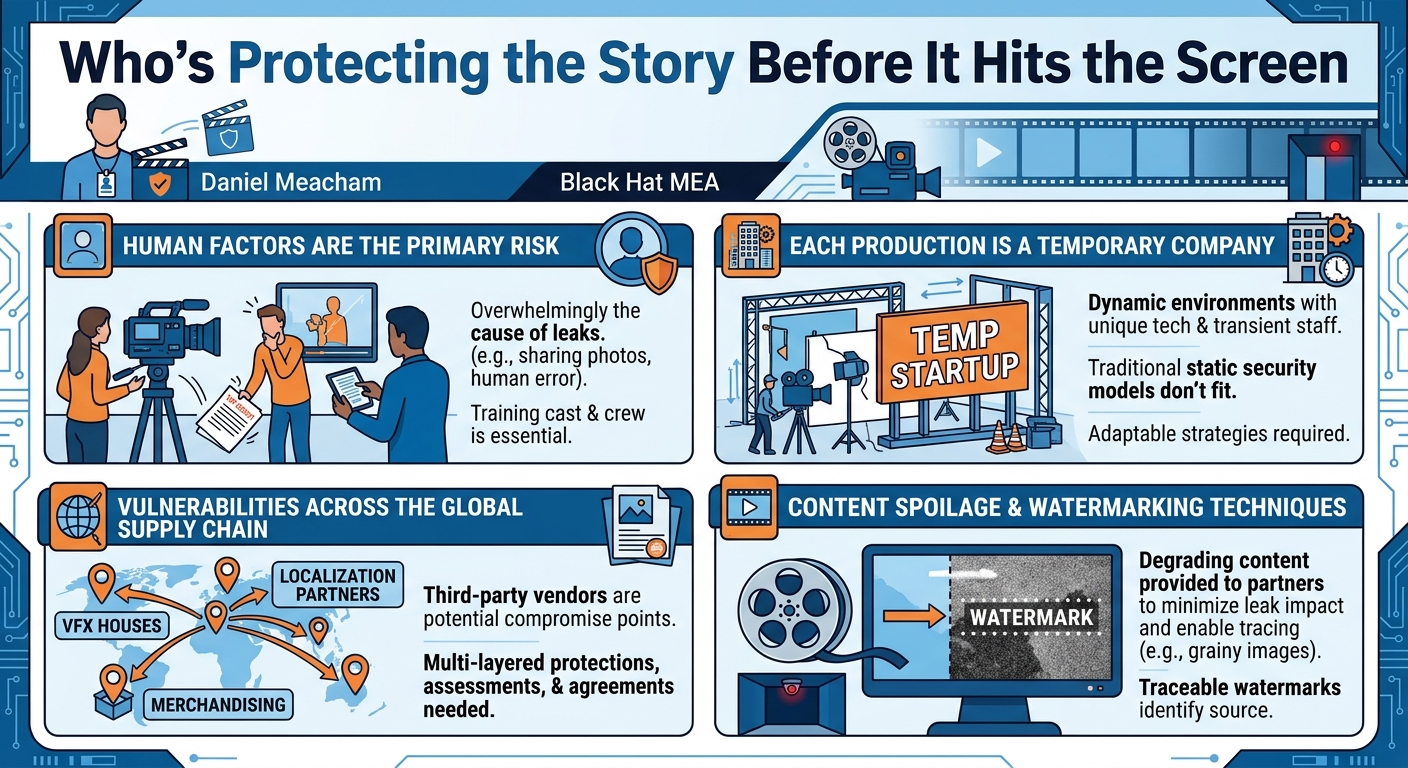
Daniel Meacham's presentation revealed several critical findings regarding content security in the entertainment industry. Foremost among these is the stark reality that human factors are overwhelmingly the primary cause of leaks, accounting for "98% of them" and not necessarily technology issues. This highlights the paramount importance of robust communication, awareness, and training programs for cast and crew, emphasizing that technical controls alone are insufficient.
Another key finding centers on the ephemeral and distributed nature of production security. Each film project essentially spins up a new "company" with unique technology, staff, and locations, requiring security teams to constantly adapt and implement controls for temporary environments. This necessitates a flexible yet rigorous approach to security assessments and policy enforcement across diverse, often local, third-party teams and technologies.
The talk also detailed the complex and layered supply chain vulnerabilities. From visual effects (VFX) houses receiving raw footage to localization partners handling sensitive audio and visual elements, and even merchandise manufacturers getting early access to character designs, each vendor represents a potential point of compromise. Meacham demonstrated how content owners must implement multi-layered protections, including security assessments for all third parties and innovative content spoiling techniques like watermarks, black-and-white versions, and high-contrast, grainy images for less critical distribution points.
Finally, the advent of virtual production technologies, such as volume walls utilizing engines like Unreal Engine, while offering immense creative and efficiency benefits, introduces new security challenges related to real-time global streaming, secure collaboration platforms (e.g., Zoom, Teams), and the protection of massive digital assets. These findings collectively paint a picture of an industry where security must be deeply embedded into every stage of a dynamic, people-centric, and globally distributed creative process.
Technical Deep Dive
▶ Watch: Securing cutting-edge virtual production sets (15:00)
The technical deep dive into entertainment content security reveals a fascinating interplay of cutting-edge production methods and the persistent challenges of data protection across a complex digital supply chain. Meacham meticulously outlined the five phases of movie production: Development, Pre-Production, Production (Principal Photography), Post-Production, and Distribution, detailing the unique security considerations for each.
In the Development and Pre-Production phases, the primary assets are scripts, character designs, budgets, and schedules. While these are often managed through standard cloud collaboration platforms, the sheer volume and sensitivity of information, combined with a growing team (from 8-12 to ~100 people), necessitate robust access controls and data loss prevention (DLP) measures. The use of code names for projects is a basic but effective security measure to prevent early spoilers.
Principal Photography introduces significant technical challenges. On-set, high-resolution cameras (e.g., 8K cameras) stream footage to devices like iPads or iPhones for continuity checks. Meacham highlighted the critical vulnerability here: personal devices used by crew members. Screenshots taken on these devices can easily propagate to personal photo libraries, cloud backups (Google Photos), or even third-party applications with broad permissions (e.g., a solitaire game accessing photos for background images). To mitigate this, high-profile films enforce strict policies: no personal devices for streaming on set, instead providing checked-out, managed equipment. Furthermore, content spoilage techniques are employed, such as embedding watermarks directly into the streamed footage, ensuring any leak can be traced and its impact minimized.
The Post-Production phase is a nexus of advanced technology and third-party reliance. Visual effects (VFX) studios receive raw digital assets to create elaborate scenes, often involving green screens replaced by photorealistic environments generated by tools like Unreal Engine. This transfer of high-value, unreleased content to external vendors necessitates rigorous security assessments and contractual agreements. Similarly, localization services (dubbing, subtitles) receive near-final cuts. Here, Legendary employs advanced content spoiling: providing localization partners with black-and-white, watermarked, grainy, high-contrast, or even reversed-image versions of the film. This ensures that if a leak occurs from a localization vendor, the content is visually degraded, traceable, and less appealing for unauthorized distribution.
A significant technical innovation discussed is virtual production, exemplified by volume walls. These are massive 10K LED screens running real-time virtual environments, often powered by game engines like Unreal Engine. This technology allows directors to shoot actors against dynamic, photorealistic backgrounds that react to camera movement and lighting changes instantly, effectively replacing traditional green screens. While this dramatically shortens post-production time (e.g., reducing a 6-8 week VFX process to 4-5 days), it introduces new security vectors. Real-time streaming of these virtual sets and actor performances to remote producers or graphic artists across the globe (e.g., Japan) requires secure, encrypted channels. The choice of collaboration platforms (e.g., Zoom, Teams) and the underlying network security for these global streams become paramount.
Finally, during Distribution, even before a film's public release, merchandise manufacturers receive early access to character designs and plot elements to prepare products. Meacham cited an instance where a kaiju spoiler for Godzilla vs. Kong leaked from a toy convention, revealing a major plot point. This highlights the need for supply chain security extending to non-digital assets and the careful management of information flow to non-traditional partners. Test screenings, while crucial for audience feedback, present another leak risk, necessitating physical controls like device collection and the use of night vision goggles to detect hidden recording devices, as infrared cameras on phones act as "beacons of light." Advanced digital watermarking techniques with embedded, imperceptible dots allow studios to trace the source of camcorded leaks back to specific theaters or regions.
The technical landscape of film production is a dynamic, multi-faceted environment where securing "the story" requires a holistic approach, integrating physical, digital, and human-centric controls across an ever-evolving technological infrastructure and global supply chain.
Demo / Proof of Concept
▶ Watch: Merchandise reveals major movie spoilers (18:30)
While Daniel Meacham's talk did not feature a live technical demonstration or a traditional proof of concept in the form of code execution or a live exploit, the entire presentation served as an elaborate and highly practical "proof of concept" through real-world examples and the detailed exposition of Legendary Entertainment's defensive strategies.
Meacham used specific instances of past leaks, such as the Godzilla vs. Kong film leak via the supply chain, the Detective Pikachu set photo issues, and the Godzilla X Kong kaiju merchandise spoiler, to illustrate the vulnerabilities and the efficacy of various countermeasures. For example, he described the practical application of content spoilage – showing how localization partners receive black-and-white, watermarked, and grainy versions of films – as a demonstrated strategy to minimize impact and trace leaks. Similarly, the discussion of night vision goggles and hidden digital watermarks in test screenings implicitly demonstrated the methods employed to combat camcorded piracy.
The detailed walk-through of the virtual production process with volume walls and Unreal Engine also served as a conceptual demonstration of how new technologies are integrated into the workflow, immediately followed by a discussion of the security implications and the need for secure streaming and collaboration. Thus, the talk provided a comprehensive, experience-based "proof of concept" for understanding and mitigating complex content security risks in a real-world, high-stakes environment.
Defensive Implications
▶ Watch: When a leak becomes free marketing (22:00)
The defensive implications derived from Daniel Meacham's talk are comprehensive, touching upon people, process, and technology. For defenders in the entertainment industry and beyond, the key takeaway is the necessity of a holistic security strategy that extends far beyond the corporate perimeter.
Firstly, human factors demand paramount attention. Given that "98% of leaks are people related issues," robust security awareness training is non-negotiable. This isn't just about compliance; it's about fostering a culture of security among transient cast and crew. Legendary Entertainment proactively manages social media risks by providing a dedicated email for content review before public posting, demonstrating a balanced approach that enables celebration while maintaining control.
Secondly, supply chain security is critical and multi-layered. Defenders must implement rigorous security assessments for all third-party vendors, including visual effects studios, localization partners, and even merchandise manufacturers. This involves not only contractual obligations but also continuous monitoring and a clear understanding of subcontractors. A key defensive technique is content spoilage: providing vendors with intentionally degraded versions (e.g., black-and-white, watermarked, grainy, or reversed images) of content, making any unauthorized release traceable and less impactful.
Thirdly, device management on set is crucial. To combat leaks from personal devices, high-profile productions should enforce policies prohibiting the use of personal phones for on-set streaming. Instead, managed, checked-out equipment should be provided, ensuring that all content captured or streamed is controlled and offloaded securely. The implementation of digital watermarks directly into streamed footage from cameras further enhances traceability.
Fourthly, physical security during sensitive events like test screenings remains vital. Despite digital advancements, physical recording is a persistent threat. Defenders should implement strict device collection policies and utilize tools like infrared cameras/night vision goggles to detect hidden recording devices. Sophisticated, imperceptible digital watermarks embedded into the projected film itself enable precise tracing of camcorded leaks to their source.
Finally, the adoption of virtual production technologies necessitates a focus on secure global collaboration and streaming. As production moves to virtual sets and real-time streaming across continents, defenders must ensure that collaboration platforms (e.g., Zoom, Teams) are configured securely, and that all data transmission is encrypted. The security architecture must account for the real-time movement of massive digital assets and the transient nature of global teams.
In essence, defenders must shift from a perimeter-centric view to an ecosystem-wide perspective, integrating security into every phase of content creation and distribution, with a strong emphasis on human behavior, vendor risk management, and adaptive technological controls.
Key Takeaways
- Human Factors are the Primary Risk: Approximately 98% of content leaks stem from human errors or actions, not technical exploits, underscoring the critical need for robust security awareness and training programs across all cast and crew.
- Each Production is a Unique Security Challenge: Every movie or show operates like a temporary startup with its own tech stack and transient workforce, requiring adaptable and project-specific security strategies rather than a one-size-fits-all approach.
- Comprehensive Supply Chain Security is Essential: From VFX houses and localization partners to merchandise manufacturers, every third-party vendor represents a potential leak point, necessitating rigorous security assessments, contractual agreements, and continuous monitoring.
- Content Spoilage is a Key Mitigation Technique: Intentionally degrading content provided to less trusted supply chain partners (e.g., black-and-white, watermarked, grainy, or reversed images) is an effective strategy to minimize impact and trace the source of leaks.
- Virtual Production Introduces New Security Vectors: While technologies like volume walls and Unreal Engine offer immense creative benefits, they require secure global streaming, encrypted collaboration platforms, and careful management of real-time digital asset movement.
- Physical and Digital Controls Must Converge: Combating leaks requires a blend of physical security (e.g., device collection, night vision goggles at screenings) and advanced digital techniques (e.g., imperceptible watermarks for traceability) across the entire production lifecycle.
About the Speaker(s)
Daniel Meacham is the Vice President of Information and Content Security at Legendary Entertainment. In this role, he is responsible for overseeing the cyber security, operations, and content security for the global media company, which produces movies, television shows, comic books, and digital content. Meacham's expertise spans the entire content lifecycle, from initial development through post-production and distribution, navigating the unique security challenges presented by a highly collaborative, project-based industry that operates on a global scale. His insights are grounded in practical experience, addressing both technological vulnerabilities and the significant human element in content protection.
Reviews
Dr. Zero (Offensive Security Researcher) — SOLID
A competent industry case study that delivers genuine insider perspective on entertainment supply chain security, but ultimately stays at the awareness/overview level rather than providing actionable technical depth. Worth catching if you work in media or complex supply chains; skippable if you're looking for novel security research.
Heather Calloway (CISO) — SOLID
A credible industry-specific treatment of content security in entertainment production. Useful for CISOs managing creative workflows or complex supply chains, but the insights are mostly domain-specific and don't break new ground for enterprise security leaders outside media.
→ Top-rated talks at Black Hat Middle East & Africa 2025 (Executive Summit)
All talks from Black Hat Middle East & Africa 2025 (Executive Summit)