Exploring Retail’s Cyber Threat Landscape
Alexandra Forsyth (Security Delivery Senior Analyst · Accenture)
Security BSides London 2023 · Day 1 · Rookie Track
Overview
In an increasingly digitized world, the retail and e-commerce sectors stand as prime targets for a diverse and evolving array of cyber threats. Alexandra Forsyth, a Security Delivery Senior Analyst with Accenture’s Cyber Intelligence team, delivered a compelling talk at BSides London, meticulously dissecting the current threat landscape facing these industries. Her presentation, "Exploring Retail’s Cyber Threat Landscape," provided a strategic overview of the key trends, attack methodologies, and defensive considerations pertinent to retailers operating in a complex, multi-channel environment. Forsyth, notably from a criminology background rather than traditional technology, brought a unique analytical perspective to the motivations and behaviors of cyber adversaries.
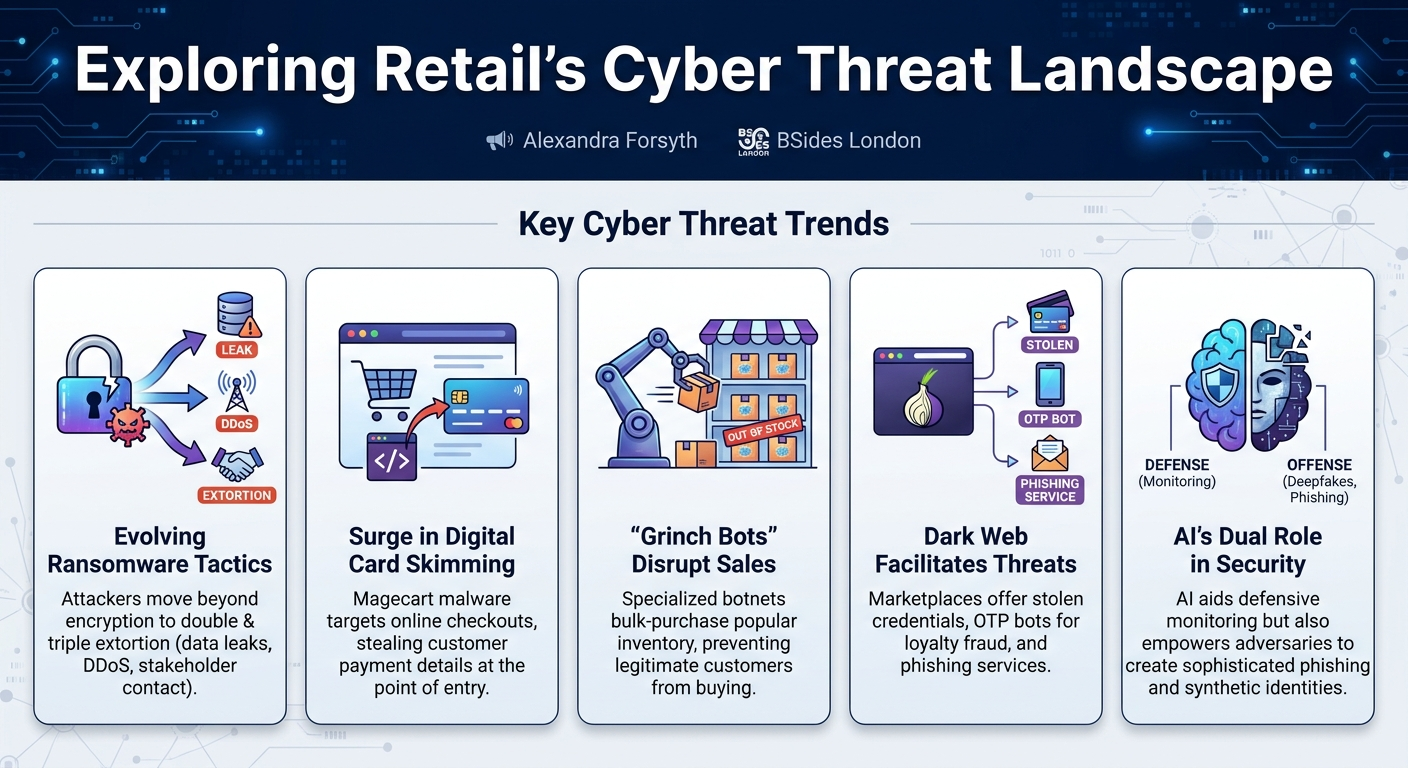
Key moments
- 0:00 Introduction and talk agenda
- 1:15 Key cyber threat trends for retail
- 4:00 Accenture's retail cyber threat value chain
- 6:35 Prominent dark web carding marketplaces and services
- 7:45 AI's dual role in fraud and cybersecurity
- 9:00 Top-down cybersecurity actions for retailers
- 11:15 Advice for starting a career in CTI
Exploring Retail’s Cyber Threat Landscape
Speakers: Alexandra Forsyth, Security Delivery Senior Analyst, Accenture
Conference: BSides London
YouTube: https://www.youtube.com/watch?v=yOrbvu7wKMg
Overview
In an increasingly digitized world, the retail and e-commerce sectors stand as prime targets for a diverse and evolving array of cyber threats. Alexandra Forsyth, a Security Delivery Senior Analyst with Accenture’s Cyber Intelligence team, delivered a compelling talk at BSides London, meticulously dissecting the current threat landscape facing these industries. Her presentation, "Exploring Retail’s Cyber Threat Landscape," provided a strategic overview of the key trends, attack methodologies, and defensive considerations pertinent to retailers operating in a complex, multi-channel environment. Forsyth, notably from a criminology background rather than traditional technology, brought a unique analytical perspective to the motivations and behaviors of cyber adversaries.
The talk highlighted several critical trends shaping the retail cyber threat landscape, including the proliferation of ransomware (with a growing emphasis on double and triple extortion), persistent Distributed Denial of Service (DDoS) attacks, the rise of specialized Grinch bots, and a significant surge in card skimming activities, particularly those leveraging Magecart malware. Forsyth underscored the pivotal role of e-commerce in today’s economy, noting that digital channels are central to customer experience, service delivery, and loyalty. However, this digital expansion also introduces an expanded attack surface, making retailers vulnerable across numerous touchpoints, from social commerce to mobile applications.
This deep dive into the retail and e-commerce threat landscape is crucial for anyone involved in cybersecurity, business operations, or risk management within these sectors. Forsyth’s insights, drawn from Accenture’s extensive threat intelligence work—combining open-source data with proprietary internal databases—offer a pragmatic roadmap for understanding the adversary, anticipating future attacks, and implementing proactive defensive strategies. The discussion moved beyond mere identification of threats, delving into the tactical and strategic actions that organizations must undertake to protect their brand, customer data, and bottom line against increasingly sophisticated cyber adversaries.
Background
▶ Watch: Introduction and talk agenda (0:00)
The rapid digital transformation of the retail sector has fundamentally reshaped both consumer behavior and the cyber threat landscape. E-commerce accounted for 19% of worldwide retail sales in 2022, a figure that has "skyrocketed" in 2023, with mobile commerce specifically experiencing significant growth. This pervasive shift towards digital channels, while offering unparalleled convenience and global reach, has simultaneously exposed retailers to an intricate web of cyber risks. The concept of an omni-channel retail experience – encompassing social media, dedicated websites, loyalty apps, and mobile applications – creates numerous entry points for attackers, each representing a potential vulnerability that must be secured.
Accenture’s Cyber Intelligence team, where Alexandra Forsyth works, employs a bespoke value chain analysis to map industry-specific assets against potential threat levels. This high-level overview allows for a nuanced understanding of where vulnerabilities are most concentrated. For instance, processes like "brand marketing" are typically assigned a medium threat level, whereas "point of sale" and "customer support" are deemed high or very high due to the prevalence of threats such as spoofing, phishing, card skimming, and brand impersonation. This framework helps to identify primary threat actors, categorizing them into groups like cyber criminals (e.g., ransomware groups) and Insider threats (who might aid criminal organizations or steal goods for resale). Their motivations are primarily financial gain and disruption.
The historical context of cyber threats in retail highlights a continuous arms race. Attacks like ransomware have evolved from simple encryption to sophisticated double and triple extortion schemes, where data exfiltration and public shaming are leveraged alongside encryption. Similarly, DDoS attacks have long plagued retailers, particularly during peak shopping seasons like Black Friday and Cyber Monday, demonstrating their capacity for significant financial disruption. The enduring challenge of card skimming, initially a physical threat, has seamlessly transitioned into the digital realm with the emergence of Magecart malware. This continuous evolution necessitates a proactive and adaptive approach to cybersecurity, moving beyond reactive measures to anticipate and mitigate emerging threats before they materialize into costly breaches.
Key Findings
▶ Watch: Accenture's retail cyber threat value chain (4:00)
Alexandra Forsyth's presentation illuminated several critical findings that define the current retail and e-commerce cyber threat landscape, emphasizing the escalating sophistication and diverse methodologies employed by adversaries.
One of the most significant findings is the evolution of ransomware. Attackers are increasingly moving beyond mere data encryption to double extortion, where sensitive data is exfiltrated and threatened to be leaked if the ransom is not paid. Furthermore, the emergence of triple extortion adds further pressure, potentially involving DDoS attacks or direct communication with a victim's customers or partners. This shift signifies a greater focus on data extortion as a primary lever, rather than just the disruption caused by encryption. Prolific ransomware groups like Conti, LockBit, and BlackCat are consistently observed targeting the retail sector.
Distributed Denial of Service (DDoS) attacks remain a pervasive threat, particularly during high-traffic retail periods. Forsyth highlighted a specific use case during Black Friday where a retailer lost approximately £60 million in sales due to persistent DDoS activity. This underscores the immediate and substantial financial impact of such attacks, which aim to disrupt operations and prevent legitimate customer transactions.
A notable and growing threat is card skimming, which has seen a dramatic increase of around 77% this year. This threat manifests in both physical forms (e.g., devices placed on POS terminals or ATMs to capture card details) and, more critically, in digital form through Magecart malware. Magecart specifically targets the checkout processes on e-commerce sites, collecting customer credit card information as it is entered. Accenture has identified approximately 13 distinct Magecart groups actively operating and developing custom tools, which they monitor through dark web discussions.
The dark web plays a crucial role in enabling these attacks. Accenture's dark web team identified prominent carding marketplaces: Verified and CRD Club, among others. These platforms offer a range of illicit goods and services, including SMS spam (for phishing campaigns), One-Time Password (OTP) bots (used for targeted attacks against loyalty programs), reshipping schemes, and the direct buying and selling of stolen credit card details. The availability of such tools lowers the barrier to entry for attackers and enables more sophisticated, automated fraud.
Beyond these direct attacks, the talk also addressed the double-edged sword of Artificial Intelligence (AI). While AI is being adopted by retailers to monitor suspicious activity and automate defensive processes, there is a clear concern that adversaries could leverage AI to enhance phishing campaigns, create custom malware, or generate deepfakes and synthetic identities. While the sophistication required for AI-driven offensive capabilities is currently high, Forsyth cautioned that 2024 could see a rise in such attacks.
Finally, a positive finding was the observed increase in cybersecurity awareness among retail clients. Organizations are not just seeking to understand the threat landscape but are actively looking for concrete, actionable steps to enhance their defenses, moving beyond strategic intelligence to practical implementation.
Technical Deep Dive
▶ Watch: Prominent dark web carding marketplaces and services (6:35)
The technical underpinnings of the retail cyber threat landscape reveal a sophisticated interplay of malware, botnets, dark web infrastructure, and evolving attack methodologies. Understanding these mechanisms is crucial for developing effective countermeasures.
Central to the digital card skimming threat is Magecart malware. This malicious JavaScript code is injected into e-commerce websites, specifically targeting the checkout pages. When a customer enters their payment details (credit card number, expiry date, CVV), the Magecart script intercepts this information before it is encrypted and sent to the legitimate payment processor. The stolen data is then exfiltrated to an attacker-controlled server. The talk highlighted the existence of approximately 13 distinct Magecart groups, each potentially employing unique variations of the malware, custom tools, and evasion techniques. Their activities are tracked through dark web monitoring, where discussions about new techniques and compromised sites often occur.
Ransomware in the retail sector has moved beyond simple data encryption. Double extortion involves attackers first exfiltrating sensitive data (e.g., customer lists, financial records, intellectual property) and then encrypting the victim's systems. The ransom demand then comes with a dual threat: pay to decrypt your data, and pay again to prevent the public release of your stolen data. Triple extortion extends this by adding further pressure, such as launching DDoS attacks against the victim's infrastructure or directly contacting stakeholders (customers, partners, media) to expose the breach. Prominent groups like Conti, LockBit, and BlackCat are known for these aggressive tactics, causing not only operational disruption but also severe reputational and legal consequences.
Distributed Denial of Service (DDoS) attacks aim to overwhelm a retailer's online infrastructure, making websites and services unavailable to legitimate customers. This is typically achieved by flooding servers with a massive volume of malicious traffic from a network of compromised devices (botnet). For retailers, DDoS attacks during critical periods like Black Friday or Cyber Monday can lead to substantial financial losses, as demonstrated by the £60 million impact on one retailer. These attacks can be volumetric (overwhelming bandwidth), protocol-based (exploiting network protocol weaknesses), or application-layer (targeting specific web applications).
Another significant automated threat is the Grinch bot. These specialized botnets are designed to target retail and e-commerce platforms with the specific goal of bulk purchasing inventory. By rapidly acquiring large quantities of popular or limited-edition items, Grinch bots prevent legitimate customers from making purchases and allow the operators to resell these items at inflated prices on secondary markets. This not only causes direct financial loss for the retailer (in terms of missed sales) but also damages customer loyalty and brand reputation.
The dark web serves as a vital ecosystem for cybercriminals, facilitating the trade of stolen data and attack tools. Marketplaces like Verified and CRD Club, among others offer a variety of illicit services:
- SMS spam services: Used to distribute phishing links or malware through text messages, often designed to mimic legitimate retailer communications.
- One-Time Password (OTP) bots: These automated tools intercept or bypass OTPs, enabling attackers to take over accounts, particularly those associated with loyalty programs, to redeem points or make fraudulent purchases.
- Reshipping schemes: Involve using stolen credit cards to purchase goods and then having them shipped to an intermediary (the "mule") who then forwards them to the actual fraudster, complicating traceability.
- Direct sales of stolen credit cards, often categorized by bank, country, and balance.
The increasing role of Artificial Intelligence (AI) presents a dual challenge. While AI can be used defensively for fraud detection, anomaly monitoring, and automating security responses, its offensive potential is also growing. Adversaries could leverage AI for more sophisticated phishing campaigns (generating highly convincing emails), creating novel custom malware that evades traditional signatures, or generating deepfakes and synthetic identities for social engineering and identity fraud. While such advanced AI-driven attacks currently require a high level of sophistication, the potential for their proliferation in the near future is a significant concern.
The omni-channel nature of modern retail also presents a complex technical challenge. Each channel—social media, mobile apps, websites, loyalty programs—represents a distinct attack surface. Ensuring consistent security policies, robust authentication mechanisms, secure API integrations, and continuous vulnerability management across all these diverse platforms is a monumental task. Accenture's value chain analysis helps prioritize these technical defenses by highlighting high-risk areas like point-of-sale systems and customer support interfaces, which are frequently targeted due to their direct access to sensitive customer and transaction data.
Demo / Proof of Concept
▶ Watch: Top-down cybersecurity actions for retailers (9:00)
This presentation focused on strategic threat intelligence analysis and the identification of pervasive cyber threats rather than demonstrating specific exploits or proof-of-concept attacks. Alexandra Forsyth presented findings from Accenture's extensive research, including monitoring of dark web activities and analysis of real-world attack trends, to illustrate the current state of the retail and e-commerce threat landscape. The insights provided were based on observed attacker methodologies and their impact, rather than live technical demonstrations.
Defensive Implications
▶ Watch: Advice for starting a career in CTI (11:15)
Understanding the complex threat landscape is only the first step; effective defense requires a proactive and multi-layered approach. Alexandra Forsyth outlined a comprehensive "top-down approach for action" for retailers, moving from immediate, strategic responses to long-term, technical implementations.
At the most immediate and strategic level, retailers must monitor their social media channels for "adverse commentary." This includes detecting instances of brand impersonation, brand infringement, or fraudulent accounts that could be used for phishing or scamming customers. Proactive monitoring helps protect brand reputation and prevent customers from falling victim to scams using the retailer’s identity.
Crucially, cyber awareness training is not just an internal necessity but should extend to the public. Forsyth suggested that retailers consider public-facing campaigns to educate consumers about common threats like phishing, card skimming, and loyalty program fraud. Empowering both employees and customers with knowledge is a powerful first line of defense against social engineering tactics.
Moving to more technical and long-term considerations, securing the software development lifecycle (SDLC) is paramount. This involves integrating security best practices from the initial design phase through deployment, ensuring that applications are built with security in mind to minimize vulnerabilities that Magecart and other web attacks exploit.
Securing payment processes is another critical area, especially given the rise in card skimming. This includes ensuring PCI DSS compliance, implementing strong encryption for payment data, and carefully vetting third-party payment processors. For physical stores, regular inspection of point-of-sale (POS) systems for skimming devices is essential.
Robust endpoint detection and response (EDR) capabilities, integrated with Security Information and Event Management (SIEM) and Security Orchestration, Automation, and Response (SOAR) systems, are vital for detecting and responding to sophisticated threats like ransomware and advanced persistent threats. These tools enable real-time monitoring, threat intelligence correlation, and automated incident response workflows.
Finally, establishing and regularly reviewing comprehensive protocols and policies is fundamental. This includes incident response plans, data breach notification procedures, access control policies, and vendor risk management frameworks. These foundational elements ensure that security is embedded into the organizational culture and operational processes.
Beyond these general recommendations, specific defensive strategies against identified threats include:
- Magecart and web skimming: Implement Content Security Policies (CSPs) to restrict the sources from which scripts can be loaded, use Subresource Integrity (SRI) to ensure the integrity of third-party scripts, conduct regular vulnerability scanning of e-commerce platforms, and deploy client-side security solutions.
- Ransomware: Maintain immutable backups, implement strong network segmentation, enforce multi-factor authentication (MFA), and conduct regular tabletop exercises for incident response.
- DDoS attacks: Invest in DDoS protection services from cloud providers, implement traffic filtering, and employ rate limiting to mitigate the impact of volumetric and application-layer attacks.
- Grinch bots and automated fraud: Deploy advanced bot management solutions that use behavioral analysis and machine learning to differentiate legitimate traffic from malicious bots.
- Dark web intelligence: Proactively monitor dark web forums and marketplaces for mentions of the organization, stolen credentials, and discussions related to specific attack tools or campaigns that could target the retail sector. This intelligence can inform proactive defenses.
- AI-enhanced threats: Develop strategies to counter potential AI-driven phishing and malware, while also exploring how AI can be leveraged for defensive capabilities, such as advanced threat detection and anomaly analysis.
In essence, defenders must recognize that the threat landscape is dynamic. As Forsyth noted, 2024 will likely bring "more sophisticated cyber attacks, more ransomware definitely targeting retail, Magecart malware and just malware in general." The shift towards clients being more aware and wanting actionable insights signifies a positive trend, but it necessitates continuous collaboration between strategic intelligence teams and technical implementation teams to fortify defenses effectively.
Key Takeaways
- Evolving Threat Landscape: The retail and e-commerce sectors face a sophisticated and diverse array of cyber threats, including evolving ransomware tactics (double and triple extortion), persistent DDoS attacks, and specialized botnet activities.
- Card Skimming Surge: Digital card skimming, particularly through Magecart malware, has seen a dramatic 77% increase, affecting both retailers and consumers by targeting the checkout process on e-commerce sites. Physical skimming remains a concern.
- Dark Web as an Enabler: Prominent carding marketplaces like Verified and CRD Club facilitate a wide range of illicit activities, including the sale of stolen credentials, OTP bots for loyalty program fraud, and SMS spam services.
- AI's Dual Role: Artificial Intelligence presents both powerful opportunities for retailers to enhance security monitoring and automation, as well as a potential avenue for adversaries to develop more sophisticated phishing, custom malware, and synthetic identities.
- Financial and Reputational Impact: Cyberattacks, such as DDoS during peak shopping periods, can result in significant financial losses (e.g., £60 million for a single retailer) and severe damage to brand reputation and customer trust.
- Multi-Layered Defense is Crucial: Effective cybersecurity requires a comprehensive, top-down approach, combining strategic initiatives like public cyber awareness campaigns with robust technical controls such as secure software development, advanced endpoint detection, and proactive dark web monitoring.
About the Speaker(s)
Alexandra Forsyth is a Security Delivery Senior Analyst within Accenture’s Cyber Intelligence team. In her role, she specializes in threat intelligence, conducting strategic research that draws from both open-source data and Accenture's internal, proprietary databases. She is responsible for collecting these findings and delivering actionable insights to clients, helping them understand and navigate the complex cyber threat landscape.
With approximately two and a half years of experience in the threat intelligence industry, including a year with Accenture, Forsyth emphasizes that her journey into cybersecurity did not follow a conventional technological path; she studied criminology at university. This background provides her with a unique perspective on understanding the motivations and behaviors of cyber adversaries. She advocates for persistence, curiosity, and passion for those looking to enter the field, recommending open-source learning resources like Udemi and Cybrary.
Reviews
Dr. Zero (Offensive Security Researcher) — HARD PASS
Accenture sent an analyst to read a marketing brochure at BSides. Ransomware is bad, Magecart exists, and AI is scary—tell me something we didn't already know in 2019. If your actionable takeaway for a room full of hackers is 'cyber awareness training' and 'buy EDR', you're in the wrong room.
Heather Calloway (CISO) — WEAK
This is a 101-level threat briefing disguised as strategic intelligence. If your leadership team still needs to be told that e-commerce faces ransomware and card skimming, your program is already underwater. There is nothing new here for an operating CISO.