Game hackers and you: Knowledge extraction from toxic places
Morgan Brazier (Student Researcher)
Security BSides London 2023 · Day 1 · Rookie Track
Overview
In this insightful talk from BSides London, student researcher Morgan Brazier delved into the often-overlooked world of game hacking, arguing for its critical relevance to the broader cybersecurity community. Drawing from his unique background as a former game cheat developer, Brazier posited that these ostensibly "toxic" online communities are, in fact, fertile ground for advanced exploit development and a potent, albeit unconventional, source of threat intelligence. The presentation highlighted how sophisticated techniques, including zero-day exploits and novel bypasses for security mechanisms, frequently emerge within game hacking circles long before they enter the mainstream infosec consciousness or are weaponized by advanced persistent threat (APT) groups.
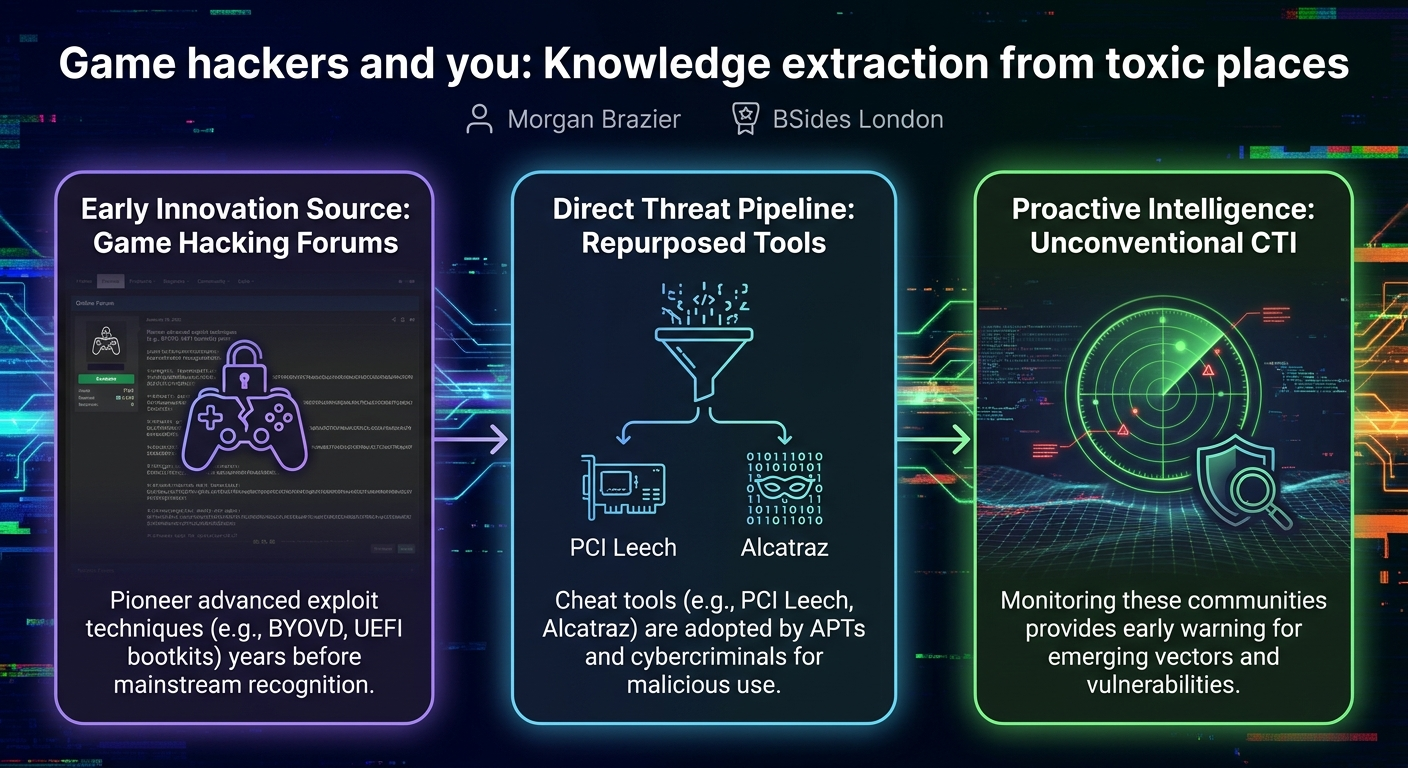
Key moments
- 0:00 Introduction, speaker background, and game hacking overview
- 3:20 Anti-cheat as EDR for games and security risks
- 5:20 BYOVD timeline from game hacking to APT use
- 9:20 Undisclosed Logitech zero-days found in game hacking
- 10:20 Understanding the 'cheater to threat' actor pipeline
- 11:30 Key takeaways and monitoring game hacking for CTI
- 13:20 Q&A: Game hacking as fertile ground for exploit dev
Game hackers and you: Knowledge extraction from toxic places
Speakers: Morgan Brazier, Student Researcher
Conference: BSides London
YouTube: https://www.youtube.com/watch?v=7-pa4M6lmUY
Overview
In this insightful talk from BSides London, student researcher Morgan Brazier delved into the often-overlooked world of game hacking, arguing for its critical relevance to the broader cybersecurity community. Drawing from his unique background as a former game cheat developer, Brazier posited that these ostensibly "toxic" online communities are, in fact, fertile ground for advanced exploit development and a potent, albeit unconventional, source of threat intelligence. The presentation highlighted how sophisticated techniques, including zero-day exploits and novel bypasses for security mechanisms, frequently emerge within game hacking circles long before they enter the mainstream infosec consciousness or are weaponized by advanced persistent threat (APT) groups.
Brazier's core premise is that the intense, high-stakes cat-and-mouse game between cheat developers and anti-cheat systems drives innovation in reverse engineering and exploit development. This environment, characterized by low legal repercussions (in most Western countries) but high motivation, fosters rapid discovery and dissemination of cutting-edge attack methodologies. The talk aimed to bridge the perceived gap between these two communities, demonstrating concrete overlaps and advocating for a proactive approach to monitoring game hacking forums as an early warning system for emerging threats.
The significance of this perspective cannot be overstated. By illustrating how techniques like Bring Your Own Vulnerable Driver (BYOVD) and UEFI bootkits gained traction and public discussion within game hacking forums years before their widespread recognition in infosec, Brazier challenged the audience to reconsider traditional sources of threat intelligence. His presentation served as a compelling call to action for security researchers and defenders to look beyond conventional channels and explore these "toxic places" for vital knowledge that could preempt future cyberattacks.
Background
▶ Watch: Introduction, speaker background, and game hacking overview (0:00)
The landscape of video games has evolved into a colossal industry, boasting a market worth over half a trillion US dollars. Within this competitive arena, players often invest significant time and effort, leading some to seek advantages through illicit means. This demand fuels an underground economy of game cheats, giving rise to distinct communities and sophisticated technical challenges. Morgan Brazier, with his personal history as a cheat developer seven years prior, offered an insider's perspective on this ecosystem.
Brazier clarified key terminology, distinguishing between a "cheater" and a "hacker" within the gaming context. Cheaters are typically unskilled users who purchase or utilize pre-made game cheats. In contrast, hackers (in this domain) possess the technical prowess to create their own cheats, demonstrating skills in exploit development and reverse engineering. This distinction is crucial, as the latter group is where significant security innovations often originate.
The economic drivers for game hacking are substantial. The "cheats as a service" market, often referred to as P2C (Pay-to-Cheat), represents a closed-source, highly secretive business model. Brazier estimated that only about 100 genuine P2C developers existed worldwide during his time in the scene, with many others acting as resellers. These larger P2C operations can be backed by legitimate businesses and, alarmingly, sometimes have ties to genuine cybercriminals, threat actors, and even APTs. In China alone, this underground economy was valued at approximately half a billion US dollars last year.
However, Brazier's talk focused primarily on the open-source game hacking community, which serves as a repository for shared knowledge and collaborative development. Key forums in this space include Unknown Cheats, Multiplayer Game Hacking Forum, and Guided Hacking. Unlike the P2C model, these forums prioritize knowledge sharing, making them invaluable resources for security researchers. Brazier specifically recommended Unknown Cheats for its consistently high-quality posts.
Central to the game hacking narrative is the concept of anti-cheat systems, which Brazier likened to EDR (Endpoint Detection and Response) for video games. Modern multiplayer competitive games almost universally employ anti-cheat measures, often incorporating both server-side and client-side components. The most robust systems feature always-on, kernel-level client-side anti-cheat, which runs with elevated privileges on a player's machine. While designed to prevent cheating, the pervasive and privileged nature of these systems introduces significant security concerns. Brazier cited the infamous case of ESEA, a prominent anti-cheat provider, which was caught installing Bitcoin miners on clients' PCs, effectively creating a 500,000-member botnet for two weeks without facing legal repercussions. This incident starkly illustrates the potential for abuse and the inherent risks associated with kernel-level software designed to police user behavior. The constant struggle to bypass these sophisticated anti-cheat mechanisms is precisely what propels the game hacking community to the forefront of exploit development.
Key Findings
▶ Watch: BYOVD timeline from game hacking to APT use (5:20)
Morgan Brazier's presentation unveiled several critical findings that underscore the game hacking community's unexpected role as a harbinger of advanced cybersecurity threats. The most significant discovery is that this community frequently uncovers and develops sophisticated exploit techniques, including zero-day vulnerabilities, well in advance of their recognition or widespread use by mainstream infosec or malicious actors.
One striking example is Log4j, a vulnerability that rocked the cybersecurity world. Brazier asserted that Log4j was first discovered and discussed within the game hacking community before its broader public disclosure, highlighting how these niche groups can serve as early warning indicators for critical flaws. Another contemporary example is RedLotus, a new UEFI bootkit explicitly designed for anti-cheat bypass, directly inspired by the infamous BlackLotus bootkit. While its immediate intention is game-related, the underlying technology has clear and immediate repurposing potential for more devious cybercriminal activities.
The timeline of BYOVD (Bring Your Own Vulnerable Driver) further solidifies this point. Brazier meticulously detailed how BYOVD was first publicly discussed on the Unknown Cheats forum in 2015 as a theoretical anti-cheat bypass. By 2017, a public guide on its practical application emerged within the community. In 2019, the "vulnerable driver megathread" on Unknown Cheats listed over 130 drivers, making the technique accessible to less technical users. It wasn't until Q1 2022 that ESET documented the Lazarus APT group using a vulnerable Dell driver (a CVE from 2021) in a BYOVD attack, marking its entry into the broader infosec zeitgeist. This timeline demonstrates a significant lag between the technique's practical adoption in game hacking and its recognition by security researchers as a serious threat.
Beyond BYOVD and UEFI bootkits, Brazier highlighted other notable security innovations originating from the game hacking scene:
- PCI Leech: A DMA attack framework initially conceived as a forensic toolkit, it was massively popularized by the cheating community and subsequently repurposed for creating implants and other malicious activities.
- Alcatraz: A binary obfuscator that, while useful for protecting cheat code, offers direct utility for malware developers seeking to evade detection. Brazier explicitly noted that both PCI Leech and Alcatraz have already been observed in the wild by cybercriminal groups, confirming the direct pipeline from game hacking to malicious use.
- Undisclosed Zero-Days: Brazier revealed a shocking instance where a DMA hacking framework, released by a game hacker who abandoned its maintenance, contained two zero-day exploits for Logitech devices. While one was responsibly reported and received a CVE, the developer found the reporting process too cumbersome and left the second zero-day unaddressed on a public GitHub repository for approximately three years before it was eventually resolved. This anecdote underscores the potential for critical vulnerabilities to lie dormant and undiscovered within these communities.
Finally, Brazier introduced the concept of the "cheater to threat pipeline" – an observed pattern of behavior where individuals seeking advantages in games evolve into game hackers, diversify their skills into broader hacking domains (reverse engineering, exploit development), become exposed to underground forums, and sometimes transition into actual cybercrime. This pipeline illustrates a concerning pathway for skilled individuals to become sophisticated threat actors, making the early identification of their methods even more critical.
Technical Deep Dive
▶ Watch: Undisclosed Logitech zero-days found in game hacking (9:20)
The technical depth of the game hacking community is often underestimated, yet it consistently produces and refines advanced techniques that directly impact the broader cybersecurity landscape. Brazier's talk provided a compelling overview of these methods, emphasizing their sophistication and potential for repurposing.
At the core of game hacking is the constant battle against anti-cheat systems. These security measures, analogous to EDR in enterprise environments, operate with significant privileges. Best-in-class anti-cheats often run at kernel-level, providing pervasive monitoring and control over a user's system. This deep integration means anti-cheat bypass techniques often involve highly privileged operations, making them directly transferable to bypassing other kernel-level security products like EDR. The ESEA Bitcoin miner incident, where a legitimate anti-cheat leveraged its kernel-level access to install malware, perfectly illustrates the inherent risks and the power wielded by such software.
Bring Your Own Vulnerable Driver (BYOVD) stands out as a prime example of a technique popularized by game hackers before its widespread recognition in infosec. The method involves loading a legitimate, but vulnerable, signed driver onto a system. Once loaded, the attacker can exploit a known vulnerability in that driver to gain elevated privileges, typically kernel-level access. This allows for disabling or manipulating security software, including anti-cheat and EDR. Brazier detailed the BYOVD timeline within the game hacking community:
- 2015: First public discussion on Unknown Cheats, theorizing its use for anti-cheat bypass.
- 2017: First public guide on how to implement BYOVD for anti-cheat bypass.
- 2019: The "vulnerable driver megathread" on Unknown Cheats, compiling over 130 vulnerable drivers from various manufacturers, significantly lowered the barrier to entry for this technique.
The significance for infosec became apparent much later, with the Lazarus APT group utilizing a vulnerable Dell driver (associated with a CVE) in 2021, a development only widely reported by ESET in Q1 2022. This lag demonstrates the game hacking community's role as an early adopter and innovator in the BYOVD space, proving its effectiveness for privilege escalation and security product evasion. The ability to "unhook EDR" using BYOVD is a particularly potent threat.
UEFI bootkits represent another frontier explored by game hackers. While the first documented UEFI bootkit in a lab environment dates back to 2010 and ESET reported the first publicly documented UEFI bootkit in the wild (LoJax) in 2018, Brazier noted that the game hacking community was exploring and using UEFI bootkits for anti-cheat bypass a year before LoJax. The recent development of RedLotus, a UEFI bootkit inspired by BlackLotus and intended specifically for anti-cheat bypass, further underscores this trend. UEFI bootkits are particularly insidious as they operate at the firmware level, making them extremely persistent and difficult to detect or remove, often bypassing traditional operating system-level security controls.
DMA (Direct Memory Access) attacks are also prominent. Brazier highlighted PCI Leech, a DMA attack framework initially developed as a forensic tool. However, it gained immense popularity within the game hacking community, where it was repurposed for real-time memory manipulation to gain advantages in games. Its utility for attackers extends far beyond games, enabling advanced implants, data exfiltration, and other malicious operations by directly accessing system memory via hardware.
Beyond these specific techniques, the game hacking community fosters broader skills:
- Exploit Development: The constant need to bypass evolving anti-cheat systems drives continuous innovation in finding and exploiting vulnerabilities in software and hardware.
- Reverse Engineering: Understanding game binaries and anti-cheat mechanisms necessitates advanced reverse engineering skills, including static and dynamic analysis, debugger usage, and code patching.
- Binary Obfuscation: Tools like Alcatraz, a binary obfuscator, are developed to protect cheat code from detection and reverse engineering by anti-cheat systems. This technology is directly applicable to malware development for evading antivirus and EDR solutions.
- Automated Vulnerable Driver Discovery: Scripts and methodologies for automatically finding vulnerable drivers are openly shared, accelerating the development of new BYOVD attack vectors.
The open-source forums like Unknown Cheats are not just discussion boards; they are living repositories of guides, code snippets, full exploit frameworks, and even undisclosed zero-days. The case of the Logitech zero-day left on a GitHub repo for three years because the developer found the reporting process too tedious is a stark reminder of the valuable, yet hidden, intelligence residing within these communities. This technical prowess, born out of a desire for competitive advantage in games, directly translates into capabilities for sophisticated cyberattacks, making these "toxic places" an undeniable source of advanced technical knowledge.
Demo / Proof of Concept
▶ Watch: Key takeaways and monitoring game hacking for CTI (11:30)
The talk did not feature a live demonstration or proof of concept. Instead, Morgan Brazier focused on providing historical context, outlining the technical evolution of exploits within the game hacking community, and detailing specific examples of how these techniques have subsequently impacted the broader cybersecurity landscape. His presentation relied on a compelling narrative built from his personal experience and extensive research into public forums and documented incidents, rather than an active technical demonstration. This approach effectively communicated the depth and relevance of the findings without needing a live show-and-tell.
Defensive Implications
▶ Watch: Q&A: Game hacking as fertile ground for exploit dev (13:20)
The insights gleaned from the game hacking community offer actionable intelligence for defenders seeking to bolster their security posture against advanced threats. Morgan Brazier's talk highlighted several key defensive implications:
- Proactive Threat Intelligence Monitoring: The most significant implication is the necessity of monitoring open-source game hacking forums, particularly Unknown Cheats, as a legitimate source of Cyber Threat Intelligence (CTI). These communities often discuss, develop, and share advanced exploit techniques, vulnerable drivers, and bypass methods well before they are adopted by mainstream threat actors or publicly disclosed to the infosec community. By actively tracking these discussions, defenders can gain early warnings of emerging attack vectors, potentially months or even years in advance.
- Enhanced BYOVD Mitigation: Given the extensive use and development of BYOVD techniques within game hacking, defenders must prioritize robust mitigations.
- Driver Blocklisting: Implementing and regularly updating a comprehensive driver blocklist is crucial. This involves identifying and preventing the loading of known vulnerable drivers. Organizations should monitor new vulnerable driver disclosures, including those found in game hacking communities, and swiftly add them to their blocklists. Submitting file hashes of newly discovered vulnerable drivers to security vendors and public databases can also aid collective defense.
- Virtualization-Based Security (VBS): Technologies like Virtualization-Based Security (VBS), including Hypervisor-Protected Code Integrity (HVCI), can help protect kernel integrity by isolating critical system processes and preventing unauthorized code execution at the kernel level. This makes BYOVD attacks significantly harder to execute effectively.
- UEFI/Firmware Security: The prevalence of UEFI bootkit development, exemplified by RedLotus, underscores the need for strengthened firmware security. Defenders should:
- Ensure Secure Boot is enabled and properly configured to prevent the loading of unsigned or malicious bootloaders.
- Implement firmware integrity monitoring to detect unauthorized modifications to the UEFI/BIOS.
- Regularly apply firmware updates from vendors to patch known vulnerabilities.
- DMA Attack Awareness and Mitigation: With tools like PCI Leech being popularized by game hackers for malicious purposes, organizations must be aware of DMA attack vectors.
- Implement Input/Output Memory Management Units (IOMMUs) where possible to restrict direct memory access by peripherals.
- Educate users about the risks of connecting untrusted devices to their systems.
- Understanding the "Cheater to Threat Pipeline": While not a direct technical defense, understanding the "cheater to threat pipeline" is vital for intelligence agencies and law enforcement. Recognizing that skilled game hackers can transition into cybercrime provides context for potential future threat actor profiles and motivations. This understanding can inform strategic interventions or educational initiatives.
- Tool and Exploit Identification: Defenders should be vigilant for specific tools and exploits mentioned, such as Alcatraz (binary obfuscator) and the nature of the Logitech zero-days. This involves staying updated on new obfuscation techniques and being aware that seemingly innocuous public code repositories might harbor unpatched vulnerabilities.
By adopting a proactive stance and integrating intelligence from these unconventional sources, cybersecurity professionals can gain a significant advantage in anticipating and defending against the next wave of sophisticated attacks.
Key Takeaways
- Game hacking communities are a leading edge for exploit development: These environments, driven by intense competition and a constant cat-and-mouse game with anti-cheat systems, foster rapid innovation in reverse engineering and exploit creation, often preceding mainstream infosec discoveries.
- Advanced techniques originate here first: Methods like Bring Your Own Vulnerable Driver (BYOVD) and UEFI bootkits were discussed, developed, and publicly used within game hacking forums years before they became widely recognized threats in the broader cybersecurity landscape.
- Unconventional CTI source: Monitoring open-source game hacking forums, especially Unknown Cheats, provides invaluable early warning intelligence for emerging attack vectors, vulnerable drivers, and sophisticated bypass techniques that can later be weaponized by APTs and cybercriminals.
- Clear overlap with infosec threats: Tools and techniques like PCI Leech (DMA attacks) and Alcatraz (binary obfuscators), popularized by game hackers, have already been observed in the wild by cybercriminal groups, demonstrating a direct pipeline from game hacking innovation to real-world cyberthreats.
- Defensive actions are crucial: Defenders should implement driver blocklisting, leverage virtualization-based security (VBS), strengthen UEFI/firmware security, and be aware of DMA attack vectors to mitigate threats originating from these advanced techniques.
- The "cheater to threat pipeline" is a real phenomenon: The observed pattern of gamers evolving into game hackers, diversifying their technical skills, and potentially transitioning into cybercrime highlights a concerning pathway for the development of future threat actors.
About the Speaker(s)
Morgan Brazier is a Student Researcher with a unique and highly relevant background that informs his perspective on the intersection of game hacking and cybersecurity. He identifies as a self-proclaimed hacker who began his journey into exploit development and reverse engineering approximately seven years ago as a cheat developer for video games. Although he no longer engages in cheat development, this foundational experience provided him with firsthand knowledge of the technical challenges, community dynamics, and innovative spirit within the game hacking world. His personal history allows him to offer an insider's view on how advanced techniques and zero-day discoveries emerge from these communities and their often-unforeseen implications for broader cybersecurity.
Reviews
Dr. Zero (Offensive Security Researcher) — STRONG ACCEPT
The infosec bubble loves to pretend APTs invent everything, but this talk proves we're getting out-researched by teenagers bypassing anti-cheats. It's a high-signal mapping of how kernel techniques migrate from pay-to-cheat forums to nation-state operators. Mandatory viewing for threat intel teams who think scraping ransomware blogs is enough.
Heather Calloway (CISO) — MUST SEE
This research fundamentally challenges where enterprise security teams should look for early warning signals. The speaker proves that game hacking forums function as a leading indicator for kernel-level EDR bypasses, making this required viewing for CTI and endpoint defense leaders.