Cyber Resilience in Industry 4.0: Strengthening Standards and Embracing Emerging Tech
Shaza Al-Haddad (Security Innovation and Development Engineer · Fujitsu)
Security BSides London 2023 · Day 1 · Rookie Track
Overview
In an era defined by rapid technological advancement, the fourth industrial revolution, or Industry 4.0, is profoundly transforming traditional sectors through mass digitalization. This shift, characterized by the widespread adoption of technologies like the Internet of Things (IoT), machine learning (ML), and cloud computing, brings unprecedented efficiency and innovation. However, as Shaza Al-Haddad, a Security Innovation and Development Engineer at Fujitsu, highlighted in her BSides London talk, this progress comes with a significant expansion of the cyber attack surface, posing critical challenges to national security and essential services.
Key moments
- 1:50 Industry 4.0's expanded attack surface
- 3:55 WannaCry ransomware's impact on Critical National Infrastructure
- 7:25 Cybersecurity standards lack CNI simulation guidance
- 9:00 Introducing Digital Twin technology for real-time security
- 10:00 Call to standardize high-fidelity simulations in CNI legislation
- 13:00 Q&A: Addressing challenges for CNI operators
Cyber Resilience in Industry 4.0: Strengthening Standards and Embracing Emerging Tech
Speakers: Shaza Al-Haddad, Security Innovation and Development Engineer, Fujitsu
Conference: BSides London
YouTube: https://www.youtube.com/watch?v=KevecIzBAWQ
Overview
In an era defined by rapid technological advancement, the fourth industrial revolution, or Industry 4.0, is profoundly transforming traditional sectors through mass digitalization. This shift, characterized by the widespread adoption of technologies like the Internet of Things (IoT), machine learning (ML), and cloud computing, brings unprecedented efficiency and innovation. However, as Shaza Al-Haddad, a Security Innovation and Development Engineer at Fujitsu, highlighted in her BSides London talk, this progress comes with a significant expansion of the cyber attack surface, posing critical challenges to national security and essential services.
Al-Haddad's presentation delves into the urgent need for enhanced cyber resilience within Critical National Infrastructure (CNI), which forms the backbone of modern society. She argues that while Industry 4.0 offers immense potential, the security measures and standards governing these crucial systems have not kept pace. Her research exposes a critical gap: existing cybersecurity frameworks largely fail to address the unique complexities of CNI in a digitalized landscape, particularly regarding effective security assessment through simulation.
The talk makes a compelling case for integrating advanced simulation techniques, specifically Digital Twin technology, into cybersecurity standards and legislation. Al-Haddad advocates for defining clear parameters, such as fidelity and real-time data integration, to ensure that simulated environments accurately reflect operational realities. By doing so, organizations can proactively identify vulnerabilities and bolster their defenses without risking the integrity of live CNI systems, ultimately safeguarding national essential services against an ever-evolving threat landscape.
Background
▶ Watch: Industry 4.0's expanded attack surface (1:50)
Industry 4.0 signifies a monumental shift, ushering in an era of interconnectedness and automation that impacts sectors traditionally characterized by physical operations or network isolation. This mass digitalization movement integrates advanced technologies like IoT, ML, and cloud platforms into manufacturing, energy, healthcare, and other vital industries. While promising efficiency and innovation, this transformation inadvertently creates an exponentially larger attack surface. As Al-Haddad vividly puts it, industries once protected by "ten doors" now face "a million doors" for potential attackers, making comprehensive security an overwhelming challenge where 100% security is an unattainable ideal.
The speaker emphasizes that prioritizing security efforts within this vast new landscape is paramount, leading directly to the focus on Critical National Infrastructure (CNI). CNI, often referred to as CI or CNI, encompasses the information systems, processes, networks, and people whose disruption, compromise, or loss could lead to severe economic, social, or even life-threatening consequences. These are the systems that underpin essential services, and their failure would, as Al-Haddad starkly states, leave society "kind of screwed."
The threat to CNI is not theoretical. Al-Haddad cites the infamous WannaCry ransomware attack of 2017 as a stark reminder of CNI vulnerability. This attack, which even penetrated public consciousness beyond the security community, cost the UK approximately £92 million to recover from and led to 19,000 health cancellations across the National Health Service (NHS). Even years later, the threat continues to escalate. The National Cyber Security Centre (NCSC) reported a 64% increase in national cyber threats detected from the previous year. Furthermore, a 2021 survey by Bridewell Consulting revealed that 86% of UK CNI operators detected cyber threats, with a staggering 93% experiencing at least one successful attack. The UK, alarmingly, ranks as the third most targeted country globally for critical infrastructure attacks.
A fundamental challenge in securing CNI stems from the inherent difficulty of testing these systems. Due to their critical nature, CNI components cannot be easily taken offline for security assessments. Directly testing on live systems carries unacceptable risks, potentially causing the very disruption security teams aim to prevent. The logical solution, therefore, lies in simulation: creating highly accurate, isolated environments to test security measures without impacting operational services. Recognizing this, Al-Haddad embarked on a comprehensive research project to investigate how cybersecurity standards, frameworks, and policies currently address security assessments, particularly simulation, within the context of CNI.
Key Findings
▶ Watch: Cybersecurity standards lack CNI simulation guidance (7:25)
Al-Haddad's detailed analysis of various cybersecurity standards, regulations, and frameworks revealed a profound and concerning gap in current security practices for Critical National Infrastructure. Despite the escalating cyber threats faced by CNI operators and the inherent risks of Industry 4.0, her research uncovered that almost none of the standards examined made any explicit reference to CNI within their security assessment sections. This indicates a significant oversight, failing to acknowledge the unique operational constraints and existential risks associated with protecting essential national services.
Even more critically, the speaker found that none of the analyzed standards discussed simulation environments at all. This absence extends beyond basic simulation, failing to provide guidance on high-level simulation, or the specific standards that such environments should embody. There was no clear or distinct separation in these documents regarding security assessments on simulated environments, nor any effort to introduce, address, or differentiate how simulated security assessments should look like for CNI. This means that, for a domain where live system testing is largely impossible, the foundational guidelines for safe and effective testing are entirely missing.
The implications of this vacuum are twofold: either CNI operators are not conducting security assessments at all (which Al-Haddad deems unlikely given the criticality), or, more plausibly, they are performing security testing based on their own interpretations of policies. While individual initiative is commendable, this ad-hoc approach fundamentally undermines the purpose of policies and frameworks, which is to establish a base-level standardization across the board. Without such standardization, there's no consistent minimum security posture, no common benchmark for measurement, and no shared understanding of what constitutes a robust security assessment in a simulated CNI environment. This lack of uniformity leaves CNI vulnerable to inconsistent protection levels and makes it exceedingly difficult to gauge overall national cyber resilience.
Technical Deep Dive
▶ Watch: Introducing Digital Twin technology for real-time security (9:00)
The core technical solution proposed by Shaza Al-Haddad to address the identified gaps in CNI security testing is the strategic adoption of Digital Twin technology. A Digital Twin is essentially a virtual replica, or "copy," of a physical asset, process, or system. In the context of CNI, this could involve creating a digital twin of a smart city, a power grid, a manufacturing plant, or any complex operational technology (OT) system. The aim is to emulate the physical counterpart as closely as possible within a digital environment.
The crucial differentiator between a Digital Twin and traditional simulated environments lies in its ability to handle real-time data. Traditional simulations are often static, limited by the designer's capabilities, their initial scope, and a finite amount of information. They might deal with an older version of the system rather than its current state, meaning a simulation based on data from "three weeks ago can look quite different to today." This inherent latency renders them less effective for dynamic security assessments where threats and system states evolve continuously.
A Digital Twin, by contrast, continuously ingests real-time data from its physical counterpart. This stream of live operational data allows the digital twin to mature, adapt, and accurately reflect the current state of the physical system, including its configuration, performance, and any changes or anomalies. This dynamic mirroring provides an unparalleled environment for security testing. Attack scenarios can be run against the digital twin, allowing security teams to:
- Monitor the system's reaction to attacks in real-time.
- Identify vulnerabilities that might only emerge under specific operational conditions.
- Test defensive measures and their effectiveness without risking disruption to the live CNI.
- Make informed decisions based on current, accurate security insights.
Al-Haddad highlights the importance of fidelity in this context. Fidelity refers to how closely the simulated environment relates to the original physical system. It can range from 50% similarity to a much higher percentage, though achieving 100% is often unrealistic. The challenge, and the proposed standard, is to define a baseline for this fidelity. What percentage of similarity is required for a simulation to be considered realistic and reliable for CNI security testing? What constitutes "real-time" data in a practical sense, and what are the acceptable latency thresholds?
These are critical questions that current standards fail to answer. Al-Haddad argues that legislation and standards must not only talk about simulation but explicitly define the standards of simulation. This includes specifying acceptable levels of fidelity, outlining requirements for real-time data integration, and establishing metrics for measuring the realism and effectiveness of these simulated environments. Technologies like IoT sensors feeding data, ML algorithms analyzing system behavior, and cloud platforms providing scalable infrastructure are all integral to building and maintaining high-fidelity Digital Twins for CNI. By incorporating these specifics, security standards can move beyond generic guidelines to provide actionable, measurable requirements for safeguarding Industry 4.0 CNI.
Demo / Proof of Concept
▶ Watch: Call to standardize high-fidelity simulations in CNI legislation (10:00)
This talk was a research presentation focused on identifying a critical gap in current cybersecurity standards for Critical National Infrastructure and proposing a strategic technical solution. As such, it did not include a live demonstration or proof of concept of a Digital Twin in action.
Defensive Implications
▶ Watch: Q&A: Addressing challenges for CNI operators (13:00)
The insights shared by Shaza Al-Haddad carry profound defensive implications for both CNI operators and policymakers responsible for national cybersecurity. The overarching message is a call to action: the current ad-hoc approach to CNI security testing is insufficient and unsustainable in the face of Industry 4.0's expanded attack surface.
For Critical National Infrastructure operators, the message is clear:
- Embrace Advanced Simulation: It is no longer acceptable to avoid comprehensive security testing due to operational constraints. Operators must actively adopt and invest in advanced simulation techniques, particularly Digital Twin technology, to build robust cyber resilience.
- Demand Standardized Guidance: Operators should advocate for and contribute to the development of standardized approaches to security testing in simulated environments. This includes understanding and implementing concepts like fidelity and real-time data integration to ensure their simulations are truly representative and effective.
- Proactive Vulnerability Management: Digital Twins enable a proactive security posture, allowing for continuous monitoring and testing of systems against emerging threats without risking live operations. This shifts the paradigm from reactive incident response to predictive threat mitigation.
- Resource Allocation: While implementing new technologies like Digital Twins may seem challenging or costly, Al-Haddad stresses that the cost of inaction (as seen with WannaCry) far outweighs the investment. Governments are committing to making such tools more accessible and affordable, and operators should leverage these initiatives.
For policymakers and standard-setting bodies, the implications are equally significant:
- Update and Augment Standards: Existing cybersecurity standards (e.g., ISO 27001, NIST CSF, NCSC guidance) must be updated to specifically address the unique challenges of CNI security testing in the Industry 4.0 context. This means moving beyond generic guidelines to provide detailed, prescriptive guidance.
- Legislate Simulation Requirements: There is a critical need to include explicit requirements for simulation environments in legislation, defining parameters such as minimum fidelity levels, real-time data integration standards, and acceptable methodologies for simulated security assessments. This would establish a consistent baseline across all CNI sectors.
- Foster Collaboration: The development of these standards requires collaboration between government, industry, and academia to ensure they are technically sound, practically implementable, and address the evolving threat landscape.
- Accountability: As mentioned by Al-Haddad, the government's own Cyber Strategy Annual Review of 2022 acknowledges CNI as a major concern and aims to hold operators more accountable for security testing. This signals a governmental intent to raise the bar, aligning perfectly with the call for standardized, high-fidelity simulation.
Ultimately, the defensive strategy must evolve to match the complexity of Industry 4.0. By embracing Digital Twin technology and standardizing its application in security testing, CNI can move towards a more resilient future, capable of withstanding sophisticated cyber threats while continuing to deliver essential services.
Key Takeaways
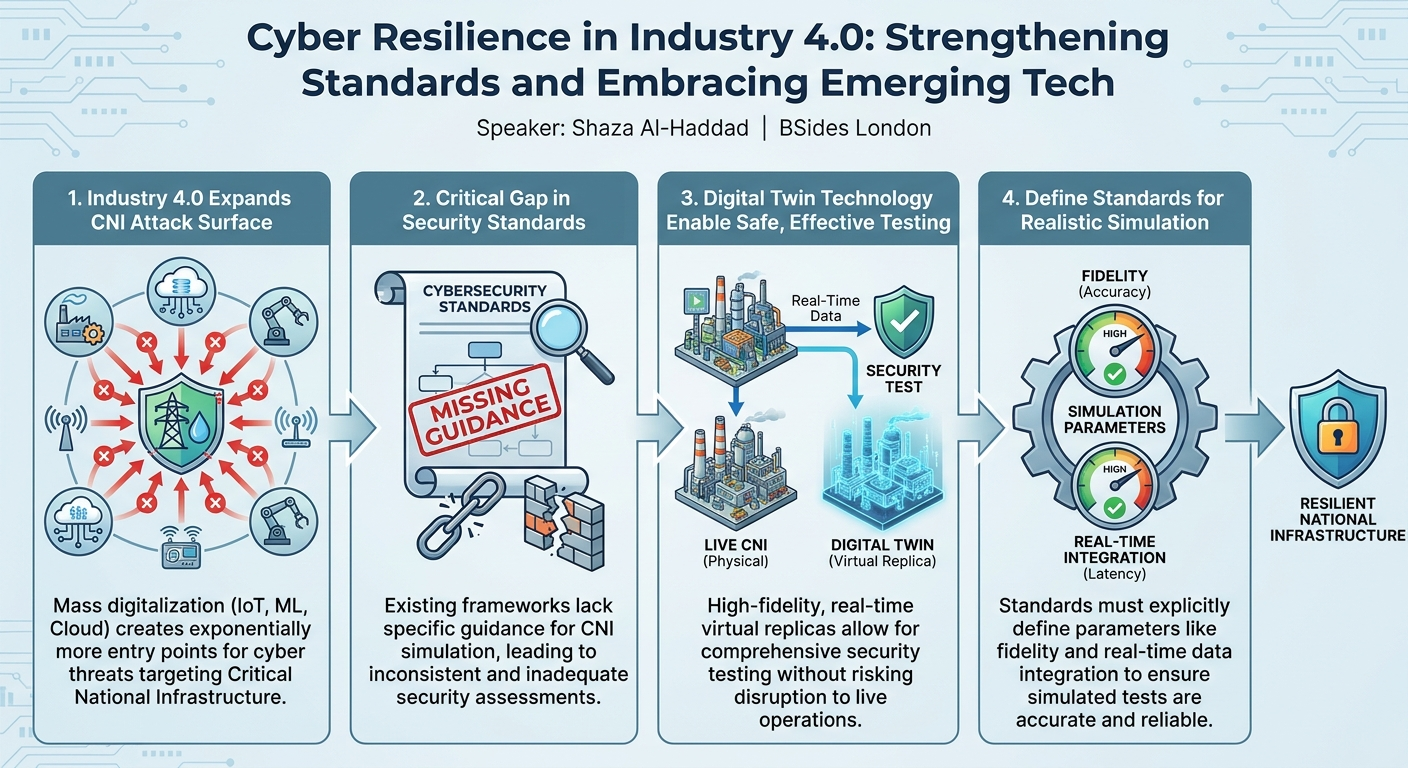
- Industry 4.0 Significantly Expands Attack Surface: The rapid digitalization and integration of IoT, ML, and cloud technologies in traditionally isolated sectors have created an unprecedented number of entry points for cyber threats, particularly for Critical National Infrastructure (CNI).
- Critical Gap in Current Standards: Existing cybersecurity standards and legislation largely fail to provide specific guidance for CNI security assessments, especially concerning the use and requirements of simulation environments. This leads to inconsistent and potentially inadequate security testing practices.
- Digital Twin Technology as a Solution: High-fidelity Digital Twins, which are real-time virtual replicas of physical systems, offer a powerful and safe environment for conducting comprehensive security testing without risking disruption to live CNI operations.
- Need for Standardization of Simulation: To be effective, standards must define critical parameters for simulation, such as fidelity (how closely the simulation mirrors reality) and the requirements for real-time data integration, ensuring simulated tests are accurate and reliable.
- Governmental and Industry Collaboration is Crucial: Updating legislation and frameworks to include explicit, actionable guidance on advanced simulation for CNI security testing is imperative. This requires commitment from both governments and CNI operators to invest in and adopt these essential measures.
About the Speaker(s)
Shaza Al-Haddad is a Security Innovation and Development Engineer at Fujitsu, bringing a fresh perspective to complex cybersecurity challenges. She graduated in 2022 with a degree in Cyber Security Digital Forensics. Her diverse background includes experience as a programming tutor, a security internship with the Home Office, and a role as a Junior Information Security Consultant at the Northwest Cyber Resilience Center, where she contributed to building cyber resilience for local SMEs. Her presentation at BSides London was based on a significant personal research project, reflecting her deep interest and expertise in securing critical infrastructure in the age of Industry 4.0.
Reviews
Dr. Zero (Offensive Security Researcher) — WEAK
A 20-minute exercise in buzzword bingo masquerading as policy research. We're told that testing live ICS is dangerous and we should use staging environments—rebranded here as 'Digital Twins'—but we're provided exactly zero technical architecture or regulatory frameworks to actually make that happen.
Heather Calloway (CISO) — SOLID
The speaker correctly identifies a blind spot in compliance frameworks: they fail to prescribe how to safely test Critical National Infrastructure without taking down live environments. The proposed solution—mandating high-fidelity Digital Twins—is a fascinating engineering concept but an operational fantasy for most CNI providers who still struggle with basic asset inventory.