Ethical Hacking: Navigating the Modern Ethical and Moral Landscape
Muhammed Aanish Butt (BSc Cyber Security Student)
Security BSides London 2023 · Day 1 · Rookie Track
Overview
Muhammed Aanish Butt, a final-year BSc Cyber Security student, delivered an insightful talk at BSides London, delving into the multifaceted world of ethical hacking and its critical ethical and moral dimensions. The presentation, titled "Ethical Hacking: Navigating the Modern Ethical and Moral Landscape," served as a foundational exploration of a field that is indispensable in today's increasingly digital-dependent society. Butt articulated the core principles of ethical hacking, emphasizing its role not as a tool for malicious exploitation but as a proactive measure to fortify digital defenses against an ever-evolving threat landscape.
Key moments
- 0:00 Defining ethical hacking and talk overview
- 2:00 Exploring ethical and moral aspects of hacking
- 2:50 WordPress case study: responsible vulnerability disclosure
- 4:40 Disadvantages and drawbacks of ethical hacking
- 5:20 Personal experience and bug bounty programs
- 7:50 Advice for researchers disclosing vulnerabilities to companies
- 10:00 Responsible disclosure: a two-way street dilemma
- 12:40 Recommendations for learning platforms: TryHackMe, HackTheBox
Ethical Hacking: Navigating the Modern Ethical and Moral Landscape
Speakers: Muhammed Aanish Butt, BSc Cyber Security Student
Conference: BSides London
YouTube: https://www.youtube.com/watch?v=dOfnchOmyQw
Overview
Muhammed Aanish Butt, a final-year BSc Cyber Security student, delivered an insightful talk at BSides London, delving into the multifaceted world of ethical hacking and its critical ethical and moral dimensions. The presentation, titled "Ethical Hacking: Navigating the Modern Ethical and Moral Landscape," served as a foundational exploration of a field that is indispensable in today's increasingly digital-dependent society. Butt articulated the core principles of ethical hacking, emphasizing its role not as a tool for malicious exploitation but as a proactive measure to fortify digital defenses against an ever-evolving threat landscape.
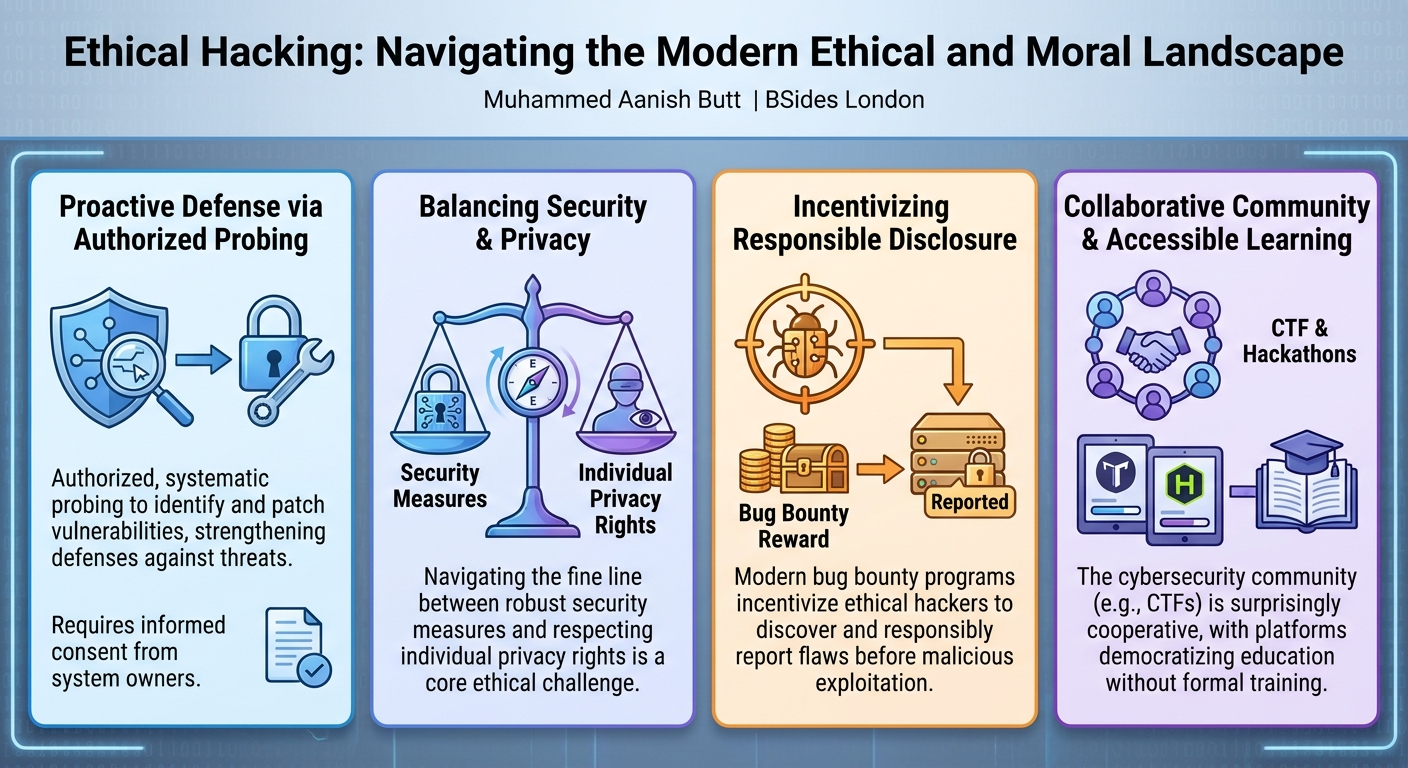
The talk meticulously defined ethical hacking as the authorized probing of computer systems and networks to identify and report security vulnerabilities. This process is distinct from malicious hacking due to its strict adherence to legal frameworks, informed consent from system owners, and a primary objective to enhance security, not inflict harm. Butt's discussion underscored the growing importance of this discipline, given the pervasive reliance on technology across domestic and commercial sectors, where data protection has become a paramount concern.
Why this talk matters is rooted in its timely address of the complex dilemmas faced by cybersecurity professionals. As technology permeates every aspect of life, the line between robust security measures and individual privacy rights often blurs. Butt navigated these controversial issues, providing practical examples through real-world case studies that highlighted both exemplary ethical conduct and severe unethical transgressions. His personal reflections on participating in hackathons and Capture The Flag (CTF) events, coupled with observations on the accessibility of cybersecurity education and the rise of bug bounty programs, offered a fresh perspective from an emerging professional in the field, making the topic relatable and actionable for both aspiring and seasoned practitioners.
Background
▶ Watch: Defining ethical hacking and talk overview (0:00)
The pervasive integration of technology into every facet of modern life has rendered data protection a primary risk factor for individuals and organizations alike. From personal communications to global financial transactions, digital systems form the bedrock of contemporary society. This escalating reliance on technology has, in turn, amplified the sophistication and frequency of cyber attacks, making the prevention of such incidents a critical imperative. Ethical hacking emerges as a vital countermeasure in this landscape, enabling organizations to proactively identify and mitigate security vulnerabilities before they can be exploited by malicious actors. By patching and resolving highlighted weaknesses earlier rather than later, ethical hacking significantly strengthens the overall cyber defense posture of a network, allowing entities to stay one step ahead of adversaries.
However, the practice of ethical hacking is not without its intricate ethical and moral challenges. A cornerstone of ethical conduct in this field is the absolute obligation to obtain informed consent from system owners before commencing any testing. This foundational principle ensures that all activities are authorized and understood, setting a clear boundary between legitimate security assessment and unauthorized intrusion. Coupled with consent is the adherence to responsible disclosure practices, which mandate that vulnerabilities discovered are reported to the affected parties and allowed to be fixed, rather than being immediately exploited or publicly revealed without prior notification. This delicate balancing act between uncovering weaknesses for security enhancement and respecting the privacy and operational integrity of individuals and organizations forms the core of the ethical dilemma.
Several factors complicate this balance. Diverse stakeholders often have differing expectations and concerns regarding data privacy and security. Legal and regulatory frameworks vary significantly across jurisdictions, creating a complex web of compliance requirements for ethical hackers operating internationally. Furthermore, ethical dilemmas frequently arise when cybersecurity measures, such as extensive information collection, appear to encroach on personal privacy. Maintaining transparency about cybersecurity practices and fostering trust within the community are crucial for navigating these challenges. An illustrative example of ethical conduct in practice was highlighted through a 2018 update to the popular website creation software WordPress. This update, intended for social media adaptation, inadvertently leaked user social media credentials, leading to Twitter account takeovers. The ethical obligation of the researcher who discovered this flaw was to disclose the incident directly to Twitter through appropriate communication channels, rather than exploiting the vulnerability for personal gain or misuse. This case exemplifies the critical role of responsible disclosure in protecting a wide user base from potential harm.
Contrastingly, the talk presented an infamous unethical case from 2015 involving a Lithuanian threat actor. This individual and his co-conspirators leveraged false doctored companies using reputed official brand names of computer manufacturers in Taiwan. They coerced employees who regularly conducted multi-million dollar transactions into paying out over $100 million between 2013 and 2015. This incident starkly demonstrates how an unethical approach, despite its potential for lucrative returns, can cause profound financial and economic damage. Although the crime remained unnoticed for two years, it was eventually uncovered and exposed, underscoring that even sophisticated illicit activities are often ultimately brought to justice. These contrasting case studies underscore the severe consequences of operating outside ethical boundaries and highlight the fundamental importance of moral navigation within the cybersecurity landscape.
Key Findings
▶ Watch: WordPress case study: responsible vulnerability disclosure (2:50)
The talk, while not presenting new technical discoveries, offered profound insights and observations into the contemporary landscape of ethical hacking, particularly from the perspective of an emerging professional. One of the speaker's key findings revolved around the unexpectedly friendly and cooperative nature of the cybersecurity community, especially within hackathons and Capture The Flag (CTF) events. Despite the inherently "dangerous potential" of hacking and the demanding technical challenges these events present, Butt was surprised to find a mentally positive space where individuals, regardless of their background or skill level, were accommodating and collaborative. This observation highlights a vibrant, supportive ecosystem that fosters learning and mutual growth, challenging common perceptions of the solitary hacker.
Another significant finding was the increasing adoption and effectiveness of bug bounty programs by modern companies and organizations. These programs represent a proactive and incentivized approach to security, encouraging bug bounty hunters to discover and report potential flaws in products and websites. The speaker noted that these programs are designed to "preemptively thwart malicious cyber attacks" by offering rewards, credit, and enhanced reputation to ethical hackers. This shift signifies a growing recognition within the industry of the value of external security research and the strategic advantage of leveraging a global community of experts to identify vulnerabilities before they are maliciously exploited. Platforms like HackerOne and Bugcrowd were cited as key enablers of these programs, facilitating seamless communication between researchers and organizations.
Perhaps one of the most empowering findings for aspiring cybersecurity professionals is the accessibility of becoming an ethical hacker with almost no formal or paid education. Butt emphasized the vast variety of resources and courses available online, which have made introductions into cybersecurity an "extremely easy Gateway" for determined participants. He personally attested to the efficacy of platforms such as TryHackMe and Hack The Box, which he found "extremely helpful in understanding complicated topics and mentoring through common challenges in an interactive and easy to understand way." This underscores a democratization of cybersecurity education, enabling individuals from diverse backgrounds to acquire essential skills and contribute to the field, thereby broadening the talent pool and fostering continuous innovation in digital defense.
Technical Deep Dive
▶ Watch: Personal experience and bug bounty programs (5:20)
Ethical hacking, at its core, involves the authorized and systematic probing of computer systems and networks to uncover and identify key security vulnerabilities. Unlike malicious hacking, its explicit purpose is to strengthen security measures and highlight significant points of concern, not to maliciously exploit discovered weaknesses. Ethical hackers operate strictly within a legal framework, always securing permission from system owners to ensure no real harm is done to affected networks or data. This process often entails simulating real-world attack scenarios to test the resilience of an organization's defenses against various threats, ranging from network intrusions to application-level vulnerabilities.
The talk referenced several technical scenarios that highlight the operational scope of ethical hacking. The 2018 WordPress update vulnerability serves as a prime example. This specific update, designed to facilitate social media adaptation and integration, inadvertently led to the leakage of users' social media credentials. Such a compromise could enable Twitter account takeovers, demonstrating a critical flaw in authentication or data handling mechanisms. An ethical hacker discovering this would meticulously document the vulnerability, including its nature, potential impact, and steps to reproduce, before responsibly disclosing it to the vendor (WordPress or Twitter in this case) through established communication channels. This technical process ensures the vulnerability is understood and can be effectively patched, preventing widespread user compromise.
Another facet of technical engagement mentioned is participation in bug bounty programs, where ethical hackers actively seek out specific types of vulnerabilities. While not deeply elaborated, the speaker noted engaging in "simple ones like cross-site scripting (XSS)." XSS is a common web security vulnerability that allows attackers to inject malicious client-side scripts into web pages viewed by other users. This could lead to session hijacking, defacement of websites, or redirection to malicious sites. Identifying an XSS vulnerability involves techniques such as input validation testing, payload injection, and analysis of how user-supplied data is rendered by the web application. The technical report for such a finding would detail the exact input that triggers the vulnerability and the specific output observed, along with proof-of-concept code.
The discussion also touched upon high-stakes technical challenges, such as Apple's bug bounty program for hacking iPhone Face ID, which offers a "million-dollar bounty." This illustrates the extreme complexity and advanced technical skills required to circumvent sophisticated biometric security systems. Such research would involve deep dives into cryptographic protocols, hardware-level security, and potentially reverse engineering to identify obscure bypasses or implementation flaws. This level of ethical hacking pushes the boundaries of current security technology, contributing significantly to hardening cutting-edge systems.
In contrast, the unethical Lithuanian incident from 2015 demonstrates a different kind of "technical" engagement, though malicious. This was not a system vulnerability exploit but rather a sophisticated business email compromise (BEC) or CEO fraud scheme. The perpetrators used falsely doctored fake companies and reputed official brand names to coerce employees into making unauthorized multi-million dollar transactions. While not a conventional software vulnerability, it exploited human vulnerabilities through social engineering and meticulous impersonation, demonstrating how attackers can leverage perceived legitimacy and internal processes to achieve financial gain. This highlights that "hacking" extends beyond technical system breaches to include sophisticated manipulation of organizational trust and human psychology, an area ethical hackers also study to understand and defend against.
Furthermore, the speaker highlighted the technical learning opportunities provided by platforms like TryHackMe and Hack The Box. These platforms offer interactive "rooms" and "pathways" that guide users through practical cybersecurity challenges. For instance, the "Rick and Morty" room on TryHackMe is a popular example of a hands-on lab designed to teach concepts like web enumeration, privilege escalation, and basic exploitation techniques. Pathways, such as those for "Linux escalation," provide structured learning paths to master specific technical skills, moving beyond theoretical knowledge to practical application in a controlled environment. These resources are crucial for developing the practical skills necessary for ethical hacking, bridging the gap between academic understanding and real-world technical proficiency.
Demo / Proof of Concept
▶ Watch: Advice for researchers disclosing vulnerabilities to companies (7:50)
While Muhammed Aanish Butt's talk did not include a live demonstration or a specific proof of concept within the presentation itself, he extensively referenced his practical engagement with cybersecurity challenges through hackathons and Capture The Flag (CTF) events. These activities, as he described, provide firsthand experience in the "dangerous potential" of ethical hacking, allowing participants to apply technical skills in a competitive yet cooperative environment.
Furthermore, his personal involvement with bug bounty programs on platforms like HackerOne was highlighted. Although he couldn't disclose specific details due to the sensitive nature of the information, he indicated that he had engaged in finding "simple ones like cross-site scripting" vulnerabilities. This practical experience serves as an indirect proof of concept of the methods and effectiveness of ethical hacking in identifying real-world flaws in live systems. His discussions with company representatives on platforms like HackerOne also underscore the collaborative, albeit sometimes challenging, nature of vulnerability disclosure, which is a key outcome of ethical hacking efforts.
Defensive Implications
▶ Watch: Recommendations for learning platforms: TryHackMe, HackTheBox (12:40)
The insights shared in this talk carry significant defensive implications for organizations and individuals striving to secure their digital assets. Foremost among these is the critical importance of proactive security measures, particularly the implementation and active management of bug bounty programs. As highlighted by the speaker, modern companies are increasingly leveraging these programs to "preemptively thwart malicious cyber attacks." Organizations should view bug bounties not as a cost center but as a strategic investment in their security posture, incentivizing ethical hackers to find vulnerabilities that internal teams might overlook. Establishing clear guidelines, offering fair compensation, and providing accessible communication channels (like those on HackerOne or Bugcrowd) are essential for fostering a positive relationship with the security research community.
A crucial defensive implication for organizations is the need to cultivate a culture of responsible disclosure that is a "two-way street." While security researchers bear the responsibility of reporting vulnerabilities ethically, organizations have an equal responsibility to acknowledge, prioritize, and address these disclosures. Stonewalling or ignoring vulnerability reports, as mentioned in the context of the Bluetooth lock example, can lead to public disclosure and reputational damage. Organizations must have clear internal protocols for receiving, validating, and remediating reported vulnerabilities, ensuring that affected users are informed when necessary. This transparency builds trust with both the research community and the end-users of their products and services.
Furthermore, organizations must meticulously define the scope of any ethical hacking engagement, whether through internal penetration testing, external security audits, or bug bounty programs. Consent is a key factor, and the scope dictates what systems, networks, and applications are fair game for testing. For instance, a company might consent to testing their public-facing web applications but explicitly exclude their production databases or critical infrastructure from the scope. This clarity protects both the ethical hacker from legal repercussions and the organization from unintended operational disruptions.
The talk also implicitly underscores the defensive value of continuous learning and community engagement. Organizations should encourage their security teams to participate in and learn from platforms like TryHackMe and Hack The Box, which offer hands-on training in identifying and mitigating various vulnerabilities. By understanding attacker methodologies and common weaknesses, defenders can better design resilient systems and implement effective countermeasures. The open and cooperative nature of the ethical hacking community, as observed by the speaker, can also serve as a valuable resource for sharing threat intelligence and best practices.
Finally, the talk highlighted the inherent legal obligations and lawful responsibilities that govern ethical hacking. Defenders must be acutely aware of relevant acts and policies, such as data protection regulations (e.g., GDPR), to ensure their security practices are compliant. Understanding these legal boundaries helps organizations define what constitutes ethical engagement and protects them from potential legal liabilities arising from either their own security activities or the actions of unethical actors. This comprehensive approach, encompassing proactive testing, responsible disclosure, clear scoping, continuous learning, and legal compliance, forms the bedrock of a robust defensive strategy in the modern digital landscape.
Key Takeaways
- Ethical Hacking is a Proactive Defense: It's a vital tool for authorized probing of systems to identify and strengthen security vulnerabilities, not to maliciously exploit them, thereby staying ahead of malicious threat actors.
- Consent and Responsible Disclosure are Paramount: Ethical hackers must obtain informed consent and follow responsible disclosure practices, ensuring vulnerabilities are reported and fixed rather than exploited, balancing security needs with individual privacy.
- The Cybersecurity Community is Collaborative: Despite the technical challenges and "dangerous potential" of hacking, the community, especially in hackathons and CTFs, is remarkably friendly, cooperative, and supportive, fostering a positive learning environment.
- Bug Bounty Programs are Effective: Modern organizations are increasingly adopting bug bounty programs to preemptively thwart cyber attacks, incentivizing ethical hackers to uncover flaws and contributing significantly to proactive security.
- Ethical Hacking Education is Accessible: Resources like TryHackMe and Hack The Box provide an extremely easy and interactive gateway into learning ethical hacking skills, demonstrating that formal education is not always a prerequisite for entry into the field.
- Ethical Decisions are a Two-Way Street: Both researchers and organizations share responsibility in the disclosure process; researchers must report ethically, and organizations must respond responsibly and transparently to protect affected users.
About the Speaker(s)
Muhammed Aanish Butt is currently a university student in his final year of a Bachelor of Science (BSc) degree in Cyber Security. As an aspiring professional in the field, he brings a fresh perspective to the ethical and moral considerations of hacking. His experience includes active participation in various hackathons and Capture The Flag (CTF) events, where he has gained firsthand experience in the practical application of cybersecurity principles. He also has engagement with bug bounty programs, having utilized platforms like HackerOne to identify vulnerabilities such as cross-site scripting (XSS). Butt is actively seeking open roles within cyber security for post-graduation, looking for positions that offer opportunities for growth and learning, as well as scale projects to gain further technical practice and experience. He is proficient with and recommends online learning platforms like TryHackMe and Hack The Box for interactive cybersecurity education.
Reviews
Dr. Zero (Offensive Security Researcher) — WEAK
This is a glossary read aloud by a university undergrad. It defines 'ethical hacking,' mentions that HackerOne exists, and reveals the shocking truth that you need permission before popping a box. Harmless for a student track, but offers zero value to anyone who actually works in this industry.
Heather Calloway (CISO) — PASS
This is a 101-level primer on responsible disclosure and bug bounties delivered by a university student. It rehearses basic definitions of ethical hacking and points to decade-old case studies without introducing new operational or strategic insights. There is no reason for a security leadership team or senior practitioner to spend time on it.