What’s the worst that could happen? Cyber Consequence Analysis for Critical Infrastructure
Virginia Wright (Idaho National Laboratory (INL))
Critical Effect DC 2025 · Day 2 · Track II: Strategic Effect
Overview
In this compelling talk, Virginia "Ginger" Wright from the Idaho National Laboratory (INL) introduces a critical methodology for securing operational technology (OT) and industrial control systems (ICS): Cyber Consequence Analysis through Cyber-Informed Engineering (CIE). The presentation challenges traditional cybersecurity paradigms, which often focus on the confidentiality, integrity, and availability (CIA) of data, by highlighting their inherent limitations when applied to the physical processes governed by OT. Wright argues that while IT cybersecurity is essential for mitigating the likelihood of a cyberattack, it often fails to address the physical consequences that can arise when an attack successfully breaches these defenses in an OT environment.
Key moments
- 0:00 Introduction to Cyberinformed Engineering (CIE)
- 1:00 Colonial Pipeline: IT attack causing OT shutdown
- 4:35 Engineers' unique role in reducing cyber attack damage
- 11:45 Quantifying consequences: financial, operational, safety scales
- 16:00 Visualizing organizational risk with spider charts
- 20:50 Real-world examples of engineering controls for safety
- 24:35 Identifying residual risk and cybersecurity collaboration
- 30:50 The critical need for engineering schools to adapt
What’s the worst that could happen? Cyber Consequence Analysis for Critical Infrastructure
Speakers: Virginia Wright (Idaho National Laboratory (INL))
Conference: Critical Effect DC 2025
YouTube: https://www.youtube.com/watch?v=w2g6DLZHwSo
Overview
In this compelling talk, Virginia "Ginger" Wright from the Idaho National Laboratory (INL) introduces a critical methodology for securing operational technology (OT) and industrial control systems (ICS): Cyber Consequence Analysis through Cyber-Informed Engineering (CIE). The presentation challenges traditional cybersecurity paradigms, which often focus on the confidentiality, integrity, and availability (CIA) of data, by highlighting their inherent limitations when applied to the physical processes governed by OT. Wright argues that while IT cybersecurity is essential for mitigating the likelihood of a cyberattack, it often fails to address the physical consequences that can arise when an attack successfully breaches these defenses in an OT environment.
The core premise of Wright's talk is that engineers, with their deep understanding of physical processes, materials, and safety systems, are a crucial, often overlooked, component in defending critical infrastructure. She advocates for integrating engineering principles and controls directly into cybersecurity strategies to proactively limit the real-world damage an adversary could inflict. The talk provides a structured workflow for organizations to identify, quantify, and mitigate potential cyber-physical consequences, emphasizing a shift from merely preventing access to controlling impact.
This approach is particularly relevant in an era of escalating cyber threats against critical infrastructure, where attacks can lead to tangible, severe outcomes such as environmental damage, financial losses, operational disruptions, and even threats to human health and safety. By empowering engineers to design systems with inherent resilience against digital subversion, Cyber-Informed Engineering offers a potent strategy to enhance the security posture of vital industrial systems, moving beyond reactive measures to a proactive, consequence-focused defense.
Background
▶ Watch: Introduction to Cyberinformed Engineering (CIE) (0:00)
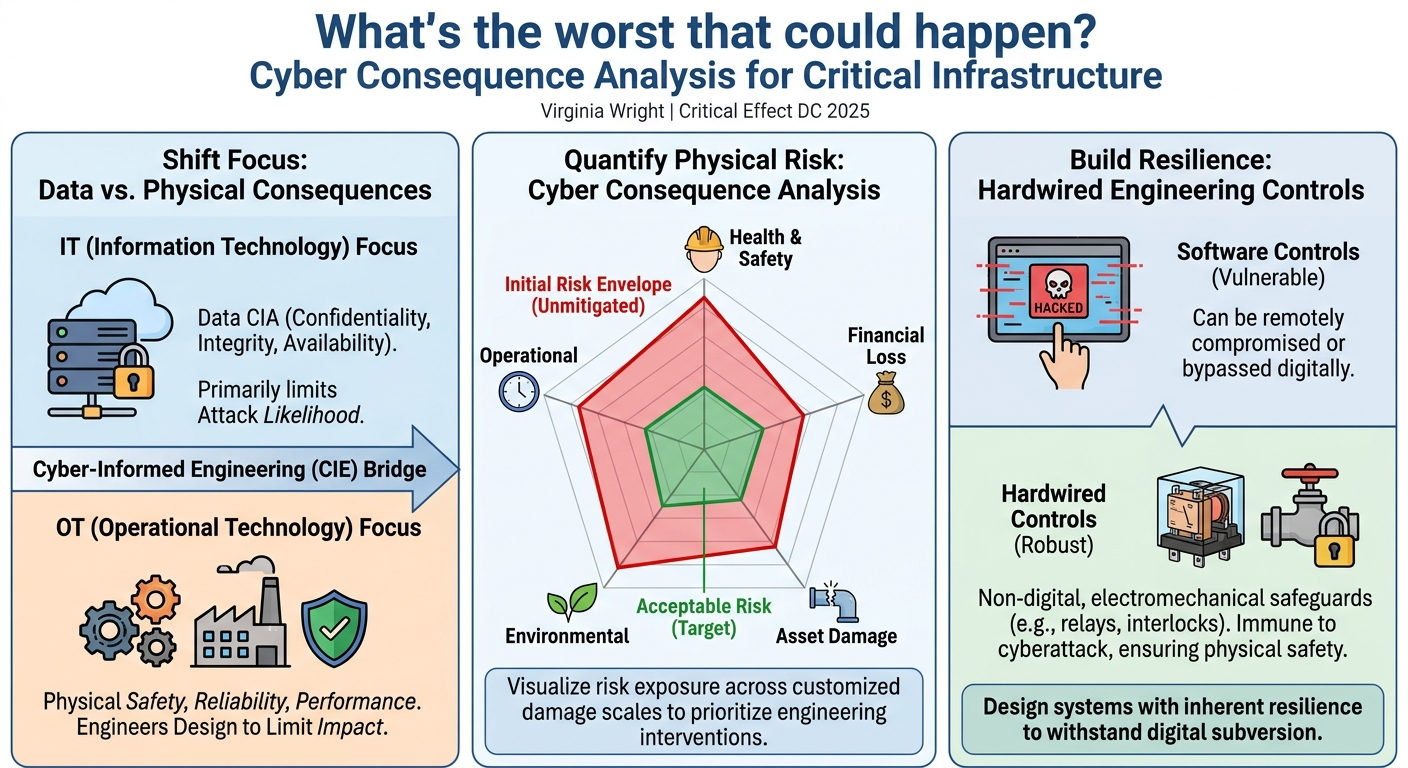
The foundational distinction between information technology (IT) and operational technology (OT) cybersecurity forms the bedrock of Wright's argument. In IT, the primary concerns revolve around the confidentiality, integrity, and availability (CIA) of data. This model is well-suited for business networks, web servers, and data management. However, as illustrated by the Colonial Pipeline attack, an IT-centric compromise, such as ransomware on business networks, can have profound operational consequences, forcing a shutdown even without directly impacting OT systems. The attacker made a key file containing product information unavailable, leading Colonial to cease operations due to an inability to guarantee product delivery accuracy. This incident starkly demonstrates how IT vulnerabilities can cascade into critical operational failures.
In contrast, OT environments — which control physical processes like manufacturing, energy distribution, and chemical processing — prioritize safety, reliability, and performance. While CIA of data is still important, the paramount concern is preventing physical harm, equipment damage, or operational disruption. Traditional cybersecurity tools, designed for IT's CIA objectives, often fall short in this specialized domain. They are effective at creating an "obstacle course" for adversaries, reducing the probability of a successful attack, but they do not inherently control the effect an adversary could have if they bypass these digital defenses.
This gap led to the development of Cyber-Informed Engineering (CIE). The Department of Energy (DOE) formalized CIE into a national strategy in 2020, with INL and the National Renewable Energy Laboratory (NREL) leading its implementation. CIE introduces engineers as a "missing piece" in cybersecurity, leveraging their expertise to design and implement physical controls that can inherently limit the damage from a cyberattack, regardless of digital compromise. The methodology focuses on consequence-focused design, one of CIE's 12 principles, aiming to identify critical functions that must always be ensured and consequences that must never occur, even under digital duress. This approach integrates with existing enterprise risk management (ERM) frameworks, allowing organizations to quantify and manage cyber-physical risks within their broader corporate risk planning. Much of the material presented, including graphics and workflow, draws from the work of Andrew Ort and his team at West Yoast, who contributed significantly to this analytical framework.
Key Findings
▶ Watch: Engineers' unique role in reducing cyber attack damage (4:35)
The central finding presented by Virginia Wright is the imperative and practicality of integrating engineering principles into cybersecurity for critical infrastructure, shifting the focus from merely preventing digital intrusion to actively mitigating physical consequences. This paradigm, Cyber-Informed Engineering (CIE), represents a profound re-evaluation of how organizations protect their most vital operational assets.
A key discovery is that while traditional cybersecurity excels at reducing the likelihood of a successful cyberattack, it often lacks mechanisms to control the impact if an adversary does penetrate digital defenses. CIE directly addresses this by empowering engineers to design systems with inherent physical protections. This means leveraging engineering controls such as pressure relief valves, pipe sizing, and material selection to limit the extent of damage, even if digital control systems are subverted. The talk emphasizes that this requires engineers to possess "excruciating details" about the physical processes involved, a level of understanding typically absent in pure cybersecurity roles.
Furthermore, the presentation introduces a structured, quantifiable methodology for cyber consequence analysis that seamlessly integrates with existing enterprise risk management (ERM) frameworks. This allows organizations to move beyond abstract notions of risk to concrete, measurable impacts on asset damage, financial losses, environmental safety, operational continuity, human health, and reputation. By defining clear scales for these damage types, organizations can visualize their "risk envelope" using spider charts (polygons), making complex risk profiles accessible and actionable for both technical teams and corporate leadership.
The methodology also highlights the critical role of identifying residual risk. After engineers have implemented all possible controls to mitigate impacts, any remaining unacceptable risk can then be strategically addressed by cybersecurity teams (to reduce probability) or through risk transfer mechanisms like insurance. This collaborative model ensures that resources are allocated efficiently, targeting the most severe, unmitigated consequences. Ultimately, the talk underscores that engineers, by applying their domain-specific knowledge to digitally initiated hazards, are not just supporting cybersecurity but are fundamental to building a truly resilient and safe critical infrastructure.
Technical Deep Dive
▶ Watch: Visualizing organizational risk with spider charts (16:00)
The technical core of Wright's presentation lies in the detailed workflow for cyber consequence analysis, a structured approach for integrating Cyber-Informed Engineering (CIE) into an organization's enterprise risk management (ERM). This methodology, specifically focusing on "step C2" of a broader ERM process, aims to characterize and evaluate the consequences of an operational technology (OT) cyberattack.
The first step in this analysis is to define organizational damage scales. These are customized, multi-point scales that describe the severity of potential impacts across various categories. Wright provides generic examples, but stresses the importance of tailoring these to an organization's specific context and risk appetite. Key categories include:
- Asset Damage and Loss: From insignificant to catastrophic loss of critical infrastructure.
- Financial Losses: Quantifying monetary impact, exemplified by a manufacturer losing $200 million due to ransomware and its customer claiming an additional $250 million, totaling $450 million in damage, even without direct infrastructure damage.
- Environmental Risk: Assessing the impact of uncontrolled releases of hazardous materials.
- Operational Risk: Defining disruptions to critical services, from minor delays to complete business continuity failures.
- Health and Safety Impacts: Ranging from minor injuries to severe harm or fatalities, particularly relevant in industrial settings where uncontrolled processes can injure workers.
- Reputation: Measuring damage to public perception and the ability to conduct business.
Once these scales are established, organizations can visualize their initial risk envelope using a spider chart (or polygon graph). Each axis of the chart represents one of the damage categories, scaled according to the defined impact levels. The resulting polygon illustrates the organization's overall exposure. Crucially, Wright notes that not all axes need to be weighted equally; for example, a cash-constrained business might have a larger surface area for financial risk, while a public utility might prioritize reputation. This visualization helps leadership understand the company's inherent risk profile.
Next, the organization defines its acceptable magnitude of risk, typically a smaller, inner polygon on the same spider chart. This represents the level of risk the company is willing to tolerate through its standard operational procedures and existing safeguards. The space between the initial risk envelope and the acceptable risk polygon highlights areas requiring mitigation.
When introducing new technology or upgrading systems, engineers then consider engineered controls. This involves identifying existing physical safeguards (e.g., pressure relief valves, inherent material properties) and potential new ones that can limit the impact of a cyberattack. This is distinct from cybersecurity controls, which primarily reduce likelihood. For example, a hardwired relay in a chemical dosing system at a groundwater well site can prevent an adversary from remotely controlling chemical pumps via SCADA. This ensures that even if the digital system is compromised, the physical relay prevents overdosing or underdosing of chemicals, directly mitigating a health and safety impact. Similarly, hardwired low-level interlocks for lift station pumps can prevent them from running dry or overrunning, even if software-based level indicators are unreliable due to a cyberattack. Another example is designing for planned resilience by ensuring an intertie with a neighboring system, providing a backup if local pumps are taken offline by an adversary.
Beyond engineered controls, process controls are also considered. These include staff training, mission planning, and procedural checklists that help ensure desired outcomes and prevent consequences even under duress.
After implementing these engineering and process controls, a residual risk envelope is calculated and plotted. This new polygon represents the remaining impacts that engineers could not mitigate through physical design. If this residual risk, particularly in critical areas like health and safety, exceeds the organization's acceptable risk threshold, it signals a critical point for collaboration. At this juncture, the engineering team engages the cybersecurity team to focus their efforts on reducing the probability of an attack that would exploit these remaining vulnerabilities. If even targeted cybersecurity measures (e.g., enhanced monitoring, improved incident response) cannot bring the risk within acceptable bounds, other risk mitigation strategies, such as insurance, may be considered to transfer the financial burden of potential damages.
This iterative process of assessing, designing, mitigating, and re-assessing allows organizations to systematically reduce cyber-physical risks, ensuring that critical infrastructure remains safe and reliable even in the face of sophisticated digital threats. The methodology provides a clear framework for identifying where to invest resources for maximum impact on overall resilience.
Demo / Proof of Concept
▶ Watch: Real-world examples of engineering controls for safety (20:50)
The talk did not feature a live demonstration or a specific proof-of-concept exploit. Instead, it focused on presenting a comprehensive methodology for Cyber Consequence Analysis and Cyber-Informed Engineering (CIE). Virginia Wright illustrated the practical application of this framework through detailed hypothetical examples and case studies, such as the chemical dosing system and lift station pumps, to demonstrate how engineering controls could mitigate digitally initiated hazards. The emphasis was on the analytical process and design principles rather than a real-time technical execution.
Defensive Implications
▶ Watch: The critical need for engineering schools to adapt (30:50)
The implications of Cyber-Informed Engineering (CIE) for critical infrastructure defense are profound, advocating for a fundamental shift in cybersecurity strategy.
- Shift from IT-Centric to OT-Centric Defense: Defenders must recognize that the primary goals in OT are safety, reliability, and performance, not solely CIA. This requires moving beyond traditional IT cybersecurity tools and frameworks that may not adequately address physical consequences.
- Mandatory Integration of Engineering and Cybersecurity: The talk underscores that engineers are not merely consultants but essential partners in cybersecurity. Cybersecurity teams should actively collaborate with engineers, leveraging their deep understanding of physical processes, material science, and operational constraints to identify vulnerabilities and design robust controls. Engineers identify what physical harm could occur, and cyber teams then focus on preventing digital means to cause that harm.
- Proactive, Consequence-Focused Design: Instead of reacting to threats, organizations should proactively design systems with inherent resilience. This means incorporating CIE principles from conceptual design through to system retirement, ensuring that physical processes are safeguarded against digital subversion from the outset.
- Deployment of Hardened Physical Controls: Defenders should prioritize and implement non-digital, electromechanical, or inherent physical safeguards that are immune to cyberattacks. Examples include hardwired relays for critical functions (like chemical dosing or pump control) and low-level interlocks that physically prevent dangerous states, even if software controls are compromised. These "air-gapped" physical controls provide a last line of defense.
- Quantifying and Visualizing Risk: Adopting the detailed organizational damage scales and spider charts presented allows defenders to quantify cyber-physical risks in a way that resonates with business leadership. This clear visualization helps prioritize investments, articulate residual risks, and justify the allocation of resources for both engineering and cybersecurity mitigations.
- Enhanced Operational Resilience through Engineering: Beyond preventing attacks, CIE emphasizes building resilience. This includes engineering solutions like interties with neighboring systems for backup power or control, ensuring continuity of critical services even if a primary system is compromised.
- Investing in Education and Training: There is a critical need to educate engineers about digitally initiated hazards and their role in managing them. Cybersecurity professionals also need to develop a better understanding of OT processes to effectively collaborate with engineers. Wright highlights INL's work with universities to integrate these concepts into engineering curricula.
- Leveraging Available Tools and Resources: Organizations should explore and utilize the open-source tools and guides developed by INL, such as the CIE implementation guide with its 1178 questions covering the entire systems engineering lifecycle, and specialized tools for microgrids, battery energy storage systems, solar systems, and natural gas compressor stations. These resources provide a structured starting point for applying CIE principles.
- Strategic Risk Management: For residual risks that cannot be engineered out or fully mitigated by cybersecurity, organizations should strategically consider risk transfer mechanisms like cyber insurance, ensuring financial recovery in the event of catastrophic physical consequences.
By embracing these defensive implications, critical infrastructure owners can move towards a more holistic and robust security posture, one that effectively bridges the gap between digital threats and their real-world physical impacts.
Key Takeaways
- OT Security Differs Fundamentally from IT Security: While IT focuses on data confidentiality, integrity, and availability (CIA), operational technology (OT) prioritizes safety, reliability, and performance of physical processes.
- Engineers are Critical to OT Cybersecurity: Cyber-Informed Engineering (CIE) empowers engineers to design and implement physical controls that directly mitigate the impact of cyberattacks, a capability traditional IT cybersecurity often lacks.
- Consequence Analysis is Paramount: Organizations must identify, quantify, and visualize potential physical consequences (e.g., asset damage, financial loss, health and safety impacts) using customized damage scales and spider charts to understand their true risk exposure.
- Hardwired Engineering Controls Offer Robust Defense: Non-digital, electromechanical solutions like hardwired relays and interlocks can provide robust, cyber-immune safeguards against digitally initiated hazards, ensuring physical safety even if software controls are compromised.
- Integrated Risk Management is Essential: CIE integrates with enterprise risk management (ERM) to provide a structured workflow for identifying initial risks, applying engineering and process controls, and then evaluating residual risks to inform further cybersecurity efforts or risk transfer strategies.
- Resources and Collaboration are Available: The Idaho National Laboratory (INL) offers open-source tools, implementation guides (including one with 1178 questions for the systems engineering lifecycle), and communities of practice to help organizations adopt CIE, emphasizing the need for collaboration between engineering and cybersecurity teams.
About the Speaker(s)
Virginia "Ginger" Wright is a distinguished expert from the Idaho National Laboratory (INL), a leading center for nuclear energy research and development, and a key contributor to national security. In her role, Wright is at the forefront of sharing information and advancing the practice of Cyber-Informed Engineering (CIE), particularly focusing on cyber consequence analysis for critical infrastructure.
Her work involves implementing the Department of Energy's (DOE) 2020 CIE strategy through various initiatives: developing educational programs, building awareness among engineers, establishing a body of knowledge for CIE application, and collaborating directly with asset owners to apply these principles to existing and future technologies. Wright is also actively involved in research to generate new CIE technologies. She champions the integration of CIE into engineering education, working with universities to ensure future engineers are equipped to manage digital risks as an engineering activity, rather than solely deferring to cybersecurity experts. Furthermore, she fosters communities of practice and encourages organizations to engage with INL for assistance in applying CIE to their projects, demonstrating her commitment to practical, real-world impact.
Reviews
Dr. Zero (Offensive Security Researcher) — MUST SEE
Wright drops the IT security delusions and brings actual physics to the ICS gunfight. This isn't about stopping the breach; it’s about making sure that when your digital controls get popped, the plant doesn't physically explode. Mandatory viewing for anyone touching critical infrastructure.
Heather Calloway (CISO) — MUST SEE
Wright provides the exact framework CISOs need to bridge the gap between digital vulnerability and physical catastrophe in OT environments. By shifting the focus from preventing access to engineering physical guardrails, this talk translates cyber risk directly into enterprise risk management. If you oversee critical infrastructure, manufacturing, or physical supply chains, your board risk committee needs to understand this methodology yesterday.