Critical Infrastructure Security as a Key Enabler for Resilience
Vivek Ponnada (Frenos)
Critical Effect DC 2025 · Day 2 · Track II: Strategic Effect
Overview
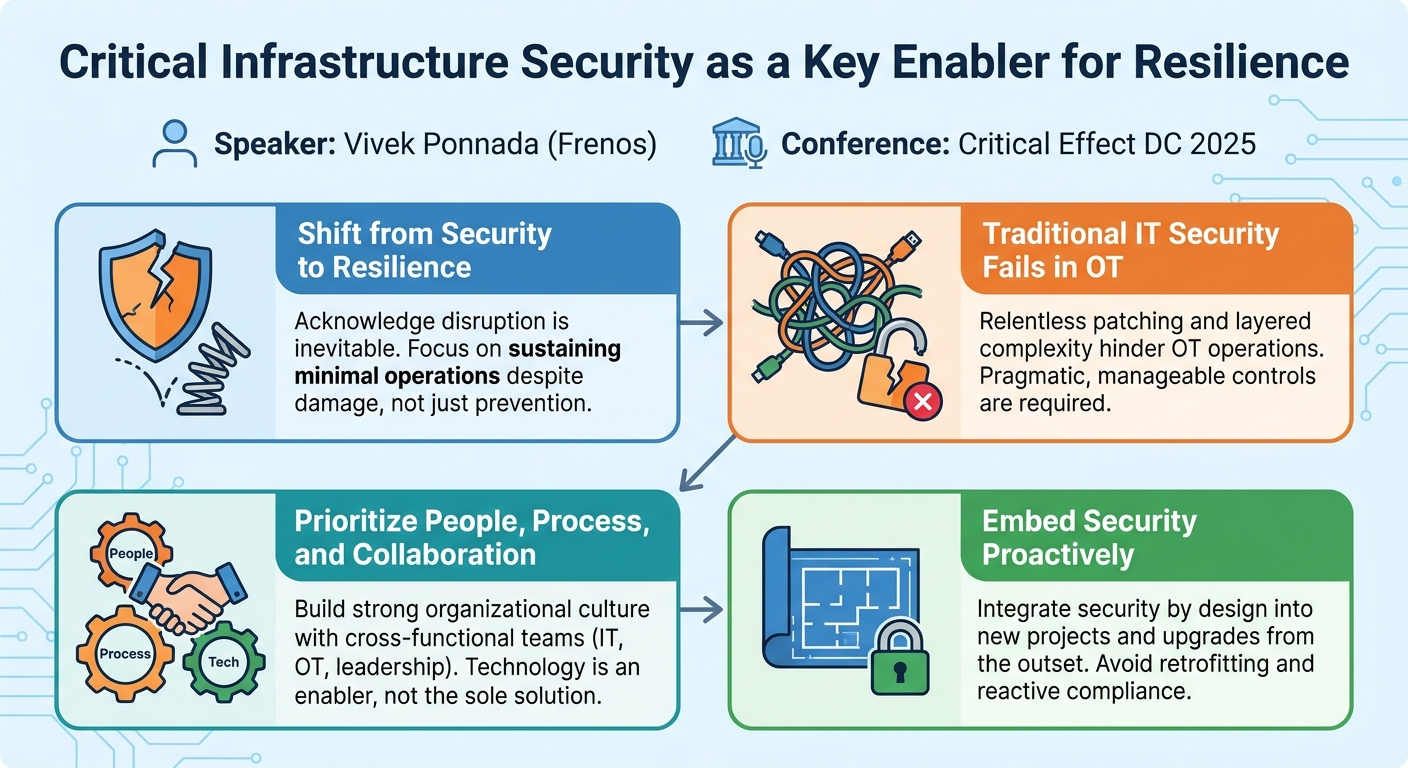
Vivek Ponnada, an experienced engineer and OT security professional from Frenos, delivered a compelling talk at Critical Effect DC 2025, advocating for a fundamental shift in how critical infrastructure organizations approach cybersecurity. Titled "Critical Infrastructure Security as a Key Enabler for Resilience," Ponnada argued that the traditional focus on OT security has largely failed to deliver tangible improvements over the past 15 years. Instead, he proposed that organizations must pivot towards resilience, recognizing that disruptions are inevitable and the primary goal should be to sustain damage while maintaining essential operational functions.
Key moments
- 0:00 Introduction: OT/IT disconnect and resilience focus
- 2:00 Current 'State of the Union' for OT security
- 8:00 Why resilience, not just security, is critical
- 11:00 Why traditional vulnerability management fails OT
- 17:00 Practical strategies: People, process, and policies first
- 20:00 Don't wait for regulations; learn from safety history
- 23:00 Audience Q&A: Legal strategies for cyber risk
- 26:30 Audience Q&A: Identifying key stakeholders for OT security
Critical Infrastructure Security as a Key Enabler for Resilience
Speakers: Vivek Ponnada (Frenos)
Conference: Critical Effect DC 2025
YouTube: https://www.youtube.com/watch?v=cG1GWJx8tpU
Overview
Vivek Ponnada, an experienced engineer and OT security professional from Frenos, delivered a compelling talk at Critical Effect DC 2025, advocating for a fundamental shift in how critical infrastructure organizations approach cybersecurity. Titled "Critical Infrastructure Security as a Key Enabler for Resilience," Ponnada argued that the traditional focus on OT security has largely failed to deliver tangible improvements over the past 15 years. Instead, he proposed that organizations must pivot towards resilience, recognizing that disruptions are inevitable and the primary goal should be to sustain damage while maintaining essential operational functions.
Ponnada's presentation highlighted the unique challenges of operational technology (OT) environments, where safety, reliability, and efficiency have historically overshadowed security concerns. He contended that attempting to apply conventional IT security methodologies, such as relentless vulnerability patching or adding layers of defense, often introduces unmanageable complexity and operational friction in OT. This article delves into Ponnada's critique of current practices, his rationale for embracing resilience, and the actionable strategies he proposed for building robust, adaptable critical infrastructure systems capable of withstanding modern threats.
The talk resonated deeply with the conference's overarching theme of resilience, underscoring the urgency for critical infrastructure operators to re-evaluate their defensive strategies. Ponnada's insights, drawn from his extensive background as a gas turbine controls engineer and his current role in OT risk assessments, provided a practical and pragmatic roadmap for organizations grappling with escalating cyber threats and the inherent complexities of their industrial control systems.
Background
▶ Watch: Introduction: OT/IT disconnect and resilience focus (0:00)
Ponnada opened by reflecting on the inherent resilience of pre-digital industrial systems, noting that engineers "screwed the pooch" by integrating digital controls without adequate engagement with cyber and risk professionals. While digital technologies brought accuracy and efficiency, they simultaneously introduced a host of cyber vulnerabilities that earlier, more rudimentary systems did not possess. This historical context sets the stage for the current predicament in OT security.
The State of the Union for OT security, as Ponnada described it, is far from ideal. He pointed out that OT personnel—traditional industrial control system operators, control instrumentation technicians, and plant managers—do not naturally relate to the term "OT," which was coined by IT. Their ingrained priorities are safety, quality, and reliability, not security. Consequently, training on security has lagged significantly compared to these other core tenets. A pervasive issue is the "copy-paste" mentality in new OT deployments; multi-billion dollar projects, such as new LNG plants, often replicate existing designs that are decades old, inherently perpetuating security weaknesses rather than integrating modern defenses. This neglect, compounded by a historical lack of collaboration between IT, networking, and OT functions, has resulted in disparate priorities and an inability to achieve a unified security posture. Furthermore, OT cyber security rarely reaches the board level, diminishing its strategic importance and resource allocation.
Ponnada also critiqued the unclear outcomes of past OT security investments. Many organizations start with technology, buying "shiny new gadgets" without a clear understanding of the problem they're solving. This often leads to tool sprawl, with overlapping capabilities and fragmented systems that don't communicate effectively. The talent gap in OT security further exacerbates the problem, as processes built around a few key individuals crumble when those individuals inevitably move on.
Given this landscape, Ponnada argued for a paradigm shift: "Why do I think resilience should be the focus and not security?" He asserted that the past 15+ years of focusing on OT security have yielded insufficient change. The motivations of threat actors (ranging from ransomware groups to nation-states) are high, and the costs of disruption are disproportionate for any single company to bear. He emphasized that process disruptions and downtime are bound to happen; the question is "not if, but when." This inevitability necessitates a resilience-focused approach, where the ability to sustain damage and continue providing some minimal level of production is paramount.
He further elaborated on the limitations of traditional security strategies:
- Rapidly changing attack vectors mean that defense investments simply cannot keep up. Chasing the "next fix" is a losing battle.
- The prevalent "no as a service" mentality among security teams alienates engineers and operators, leading them to bypass security protocols rather than engage with them.
- Chasing vulnerabilities has never worked in OT. Ponnada cited the Log4j incident as an example of how even IT struggles with this, let alone OT systems with "tens of thousands of vulnerabilities."
- More layers of defense introduce unmanageable complexity. He illustrated this with a controls technician needing to troubleshoot a blinking red light at 2 AM; adding authentication or networking layers turns a simple device swap into a multi-hour engineering task, causing frustration and production delays.
- A prevention focus has diminishing returns; minimizing impact becomes a more effective strategy at a certain point.
Finally, Ponnada highlighted the significant differences amongst industry verticals. OT security is not monolithic; it's distinct for oil and gas, power, manufacturing (continuous vs. discrete), and even within these. The concept of tightly coupled supply chains and their cascading effects was vividly illustrated by the 2021 February outage in Houston, where seemingly diverse power sources all failed due to interconnected dependencies (frozen pipes cutting natural gas, nuclear plant outages, wind turbines designed for heat failing in cold). This complexity means "no universal solutions or regulations can be effective." However, regional differences and diversity can also be an advantage, offering opportunities for mutual support during outages.
Key Findings
▶ Watch: Why resilience, not just security, is critical (8:00)
Ponnada's presentation crystallized several critical findings regarding the state of critical infrastructure security and the imperative for change:
- OT Security Maturity is Stagnant: Despite over 15 years of focus, OT security has not achieved significant maturity across industries. Traditional IT-centric approaches and a lack of understanding of OT operational priorities have hindered progress.
- Disruption is Inevitable: Critical infrastructure organizations must accept that cyberattacks and operational disruptions are not a matter of "if," but "when." The focus must shift from absolute prevention to the ability to withstand, adapt, and recover.
- Traditional Security Fails in OT: Methodologies like exhaustive vulnerability patching (e.g., trying to address tens of thousands of vulnerabilities) and layering defenses (which adds unmanageable complexity for operators) are fundamentally ill-suited and counterproductive in OT environments.
- Resilience is the Pragmatic Goal: The core objective should be resilience – the capacity to sustain damage and continue providing some minimal level of production, rather than attempting to achieve 100% security. Minimizing impact is more effective than solely reducing likelihood.
- Holistic Approach Required: Effective resilience demands a comprehensive strategy encompassing people, process, and technology, with a strong emphasis on the human element and robust, organization-specific policies. Technology alone is not a panacea and can lead to tool sprawl and unclear outcomes.
- Collaboration is Non-Negotiable: A severe lack of collaboration between IT, OT, networking, and leadership functions is a major impediment. Building cross-functional teams and fostering mutual understanding of priorities and responsibilities is essential.
- Proactive Engagement Over Reactive Compliance: Waiting for "regulations written in blood" (like safety regulations after major incidents such as Piper Alpha in the mid-80s) is a dangerous strategy. Organizations must proactively embed security into their culture and leverage new projects and upgrades to build security frameworks from the ground up.
Technical Deep Dive
▶ Watch: Practical strategies: People, process, and policies first (17:00)
Ponnada's technical deep dive, while not presenting specific code or network architectures, focused on the fundamental engineering and operational principles that underpin critical infrastructure and how they must inform a resilience strategy. He contrasted the core tenets of traditional security with the pragmatic demands of OT resilience.
Historically, OT systems were designed for safety, reliability, and efficiency. These systems, often analog or air-gapped, possessed an inherent, albeit accidental, form of cyberproof resilience. The advent of digital controls, while boosting accuracy and precision, inadvertently introduced complex attack surfaces. Ponnada highlighted that modern OT systems, unlike their IT counterparts, cannot simply be patched or updated frequently due to stringent uptime requirements and the risk of operational disruption. This makes the IT strategy of "chasing vulnerabilities" utterly unworkable; an OT system might have "tens of thousands of vulnerabilities," making a comprehensive patching regimen impossible and potentially destabilizing.
The concept of layered defense, a cornerstone of IT security, also faces significant challenges in OT. Ponnada argued that adding more layers often equates to "more complexity that cannot be managed." He provided an illustrative scenario: a controls technician responding to a 2 AM alarm. In a simple, pre-digital setup, a blinking red light means unplugging and replacing a component. With added layers of defense – networking, authentication-based systems – a simple fix becomes a multi-hour task requiring an engineer, leading to prolonged downtime and operational frustration. Resilience, in this context, would focus on ensuring the system can continue operating minimally even if a component is compromised, or that replacement/recovery is streamlined despite security controls.
Ponnada emphasized the critical role of supply chain security, particularly given the "tightly coupled supply chains" in critical infrastructure. He referenced the 2021 Texas winter storm outage, where the failure of natural gas supplies due to frozen pipes cascaded to nuclear plants, steam turbines, and even wind farms (designed for high heat, not cold), demonstrating how seemingly independent systems are deeply interconnected. A truly resilient system must account for these cascading effects and interdependencies. This implies a need for diverse and redundant supply sources, not just within an organization but across an entire regional infrastructure.
He also pointed out that universal solutions or regulations are largely ineffective due to the vast differences across industry verticals. What works in a continuous chemical plant (operating for a decade without outage) is vastly different from discrete manufacturing (8 AM to 4 PM operations with nightly maintenance windows). Resilience strategies must be unique and tailored. For example, distributed generation (like solar farms) might rely on isolation to ensure localized grid segments can sustain themselves. Fuel diversity in transportation (natural gas vehicles vs. electric vehicles) provides resilience against disruptions to a single energy source. These are not just security measures but fundamental design principles that enhance overall system robustness.
To transition to a resilience-first approach, Ponnada proposed a framework centered on people, process, and technology:
- People:
- Organization-wide focus: Elevating security to the same cultural status as safety and quality (e.g., "security day" or "security week" campaigns, currently rare in OT).
- Informal OT security teams: Fostering collaboration between IT, OT, maintenance, and operators to enhance mutual understanding of priorities and problems.
- Operators as first line of defense: Recognizing that day-to-day operators are crucial for identifying and responding to incidents. HR and legal also play a critical "first line" role in hiring the right people.
- Process:
- Policies and humans first: Prioritizing well-defined, organization-specific policies and human training over technology acquisition. "Most people make the mistake of thinking technology is going to be the first thing to solve."
- Training and awareness: Still a "low-hanging fruit" for immediate impact, though its importance will evolve.
- Tech investments aligned with risk appetite: Ensuring security technology purchases are directly tied to the organization's specific operational risks and financial tolerance, collaborating with CFOs and legal teams.
- Proactive regulation engagement: Not waiting for "regulations written in blood," but actively shaping regulatory discussions and using legal contracts to mitigate vendor risk.
- Technology:
- Avoid technology dependence as a sole solution: A single tool or gadget won't solve complex OT security problems.
- Prevent tool sprawl: Avoid duplicating capabilities through uncoordinated purchases across different divisions or regions.
- Clear outcomes: Ensure security investments have measurable, understandable outcomes.
- Leverage new projects/upgrades: Integrate security frameworks from the outset during new builds or significant system modernizations, rather than retrofitting.
- Embed security: The ultimate goal is for security to be so ingrained in the organizational culture and processes that it becomes second nature, like safety protocols in a power plant.
This technical deep dive underscores that resilience in critical infrastructure is less about a specific piece of software or hardware, and more about a holistic, culturally embedded approach to engineering, operations, and risk management.
Demo / Proof of Concept
▶ Watch: Don't wait for regulations; learn from safety history (20:00)
The talk "Critical Infrastructure Security as a Key Enabler for Resilience" by Vivek Ponnada did not include a live demonstration or a proof of concept. The presentation focused on a strategic shift in philosophy and operational approaches rather than showcasing specific tools or technical implementations.
Defensive Implications
▶ Watch: Audience Q&A: Identifying key stakeholders for OT security (26:30)
The shift from a pure security focus to a resilience-centric mindset carries profound defensive implications for critical infrastructure operators. Ponnada's talk provides a clear mandate for defenders to re-evaluate their strategies:
- Embrace "Not If, But When": Defenders must stop aiming for 100% prevention, which is an unattainable goal in complex OT environments. Instead, assume breaches will occur and prioritize minimizing their impact and ensuring rapid recovery. This means investing in capabilities like robust backup and restore, segmented architectures, and operational continuity plans that allow for degraded but functional states.
- Rethink Traditional IT Security in OT: Discontinue the direct application of IT security practices like aggressive vulnerability patching and adding excessive layers of defense without considering OT operational realities. Each proposed security control must be evaluated for its impact on safety, reliability, and operational complexity. The focus should be on practical, manageable controls that enhance resilience rather than hinder operations.
- Prioritize People and Process Over Technology: Defenders should focus significant resources on building a strong human firewall and robust, custom-tailored policies. This includes:
- Cultural Integration: Elevate security to the same level as safety and quality through organization-wide campaigns and continuous awareness training.
- Cross-Functional Teams: Establish formal or informal OT security teams comprising representatives from IT, OT, engineering, maintenance, operations, HR, and legal. This fosters mutual understanding and shared responsibility.
- Empower Operators: Recognize day-to-day operators as the first line of defense. Provide them with the training and tools to identify anomalies and respond effectively, ensuring security doesn't impede their critical functions.
- Integrate Security from Inception: Leverage new projects and system upgrades as opportunities to embed security by design, rather than attempting to retrofit it later. This involves asking "what could we do differently?" at the project's outset to build a secure and resilient framework. Avoid the "copy-paste" mentality that perpetuates legacy vulnerabilities.
- Develop Industry-Specific and Regionally Diverse Solutions: Acknowledge that "no universal solutions or regulations can be effective" across all critical infrastructure sectors. Defensive strategies must be tailored to the specific operational context, risk profile, and interdependencies of each industry (e.g., continuous manufacturing vs. discrete, power generation vs. oil and gas). Furthermore, leverage regional diversity in infrastructure design (e.g., different power generation types) to enhance overall system resilience against widespread failures.
- Proactive Risk Management and Legal Engagement: Don't wait for "regulations written in blood." Proactively engage with legal and finance teams to align tech investments with risk appetite. Utilize legal contracts not just for liability transfer, but as a cyber risk mitigation mechanism by setting clear security parameters and requirements for vendors and internal stakeholders. This proactive stance also positions organizations to effectively engage in and influence future regulatory processes.
- Focus on Impact Minimization: Shift the emphasis from solely reducing the likelihood of an attack to minimizing its potential impact. This includes robust segmentation, isolated recovery environments, and the development of manual fallback procedures to ensure essential services can continue even if automated systems are compromised.
By adopting these defensive implications, critical infrastructure organizations can move beyond a reactive security posture to build truly resilient systems capable of navigating the complex and evolving threat landscape.
Key Takeaways
- Resilience is Paramount: Critical infrastructure must shift its focus from merely achieving "OT security" to building resilience, acknowledging that disruptions are inevitable and the goal is to sustain minimal operations despite damage.
- Traditional IT Security Models Fail in OT: Concepts like relentless vulnerability patching and layering defenses, effective in IT, introduce unmanageable complexity and operational friction in OT environments, making them counterproductive.
- People and Process Precede Technology: Effective resilience is built first on a strong organizational culture, well-defined policies, and trained personnel (operators, engineers, IT, HR, legal), with technology serving as an enabler rather than the primary solution.
- Collaboration is Essential: Breaking down silos between IT, OT, and leadership is critical. Establishing cross-functional OT security teams and fostering mutual understanding of priorities are key to a unified defense.
- Integrate Security Proactively: Organizations should embed security into new projects and system upgrades from the outset, rather than attempting reactive compliance or retrofitting, and proactively engage in shaping future regulations.
- Tailored and Diverse Solutions: Given the vast differences across industry verticals and regional dependencies, resilience strategies must be highly specific, leveraging diversity in infrastructure design and avoiding one-size-fits-all approaches.
About the Speaker(s)
Vivek Ponnada is an experienced professional in the field of industrial control systems and OT cybersecurity. He began his career as a gas turbine controls engineer for GE, a role that provided him with deep insights into the operational realities and engineering complexities of critical infrastructure. He later transitioned into sales for GE, focusing on control system upgrades, which further broadened his understanding of the business and technological needs of industrial clients. It was through these experiences that he eventually moved into cybersecurity. Currently, Vivek Ponnada works for Frenos, a company specializing in OT risk assessments, where he applies his extensive background to help organizations understand and mitigate their operational technology risks. He has a keen interest in the historical resilience of pre-digital systems and advocates for a pragmatic, resilience-focused approach to modern critical infrastructure protection.
Reviews
Dr. Zero (Offensive Security Researcher) — PASS
Vivek Ponnada from Frenos gets on stage in 2025 to tell us IT patching doesn't work in OT and we need to focus on 'people, process, and technology.' I haven't heard a premise this tired since 2012. It's a consulting brochure dressed up as a keynote.
Heather Calloway (CISO) — STRONG ACCEPT
This is a required framing for any executive team overseeing physical operations, manufacturing, or critical infrastructure. Ponnada correctly diagnoses why applying enterprise IT security practices to operational technology (OT) environments fails and proposes a necessary shift from preventative security to operational resilience. It's a clear mandate to stop funding tool sprawl and start funding downtime mitigation.