Securing Rural America: Supporting Electric Cooperatives of all Sizes
Adrian McNamara (National Rural Electric Cooperative Association (NRECA))
Critical Effect DC 2025 · Day 2 · Track II: Strategic Effect
Overview
In this insightful talk at Critical Effect DC 2025, Adrian McNamara from the National Rural Electric Cooperative Association (NRECA) presented a comprehensive overview of NRECA's multi-faceted approach to bolstering cybersecurity for its vast and diverse membership. Titled "Securing Rural America: Supporting Electric Cooperatives of all Sizes," the presentation highlighted the unique challenges faced by rural electric cooperatives in maintaining robust cyber defenses and outlined the innovative programs NRECA has developed to address these issues, ultimately ensuring the lights stay on for millions of Americans.
Key moments
- 0:00 Introduction & unique challenges of rural co-ops
- 1:59 Project Guardian: 'No cooperative left behind' initiative
- 4:20 Categorizing co-ops by People, Process, Technology maturity
- 6:00 NRECA's 20 Cyber Security Goals for basic maturity
- 8:00 Financial cyber risk quantification for leadership understanding
- 10:20 Threat Analysis Center: Curated intelligence for co-ops
- 14:00 Q&A: Categorization nuances and self-assessment challenges
Securing Rural America: Supporting Electric Cooperatives of all Sizes
Speakers: Adrian McNamara (National Rural Electric Cooperative Association (NRECA))
Conference: Critical Effect DC 2025
YouTube: https://www.youtube.com/watch?v=DsFz7shMd_Q
Overview
In this insightful talk at Critical Effect DC 2025, Adrian McNamara from the National Rural Electric Cooperative Association (NRECA) presented a comprehensive overview of NRECA's multi-faceted approach to bolstering cybersecurity for its vast and diverse membership. Titled "Securing Rural America: Supporting Electric Cooperatives of all Sizes," the presentation highlighted the unique challenges faced by rural electric cooperatives in maintaining robust cyber defenses and outlined the innovative programs NRECA has developed to address these issues, ultimately ensuring the lights stay on for millions of Americans.
The core of NRECA's mission, as articulated by McNamara, is to support over 900 rural electric cooperatives across the nation, which vary dramatically in size and resources. From large generation and transmission (G&T) cooperatives serving hundreds of thousands or even millions of meters, down to small distribution cooperatives with only hundreds or thousands of members, the landscape is incredibly varied. This diversity, coupled with inherent resource constraints driven by the cooperatives' member-owned model—where keeping costs low for members is paramount—makes a one-size-fits-all cybersecurity strategy impractical. NRECA, with its lean team of six, cannot provide individual, daily support to each cooperative, necessitating scalable and adaptable solutions.
To tackle these formidable challenges, NRECA has embarked on Project Guardian, a significant five-year, $4 million program funded by the Department of Energy’s CESAR office. Operating under the mantra "no cooperative left behind," Project Guardian aims to meet every cooperative at its current cybersecurity maturity level. This initiative is guided by a diverse working group of 20 members, encompassing not just cybersecurity and IT/OT professionals, but also representatives from accounting, finance, operations, and HR, underscoring the belief that cybersecurity implications touch every facet of an organization. The talk detailed the four key focus areas of Project Guardian: a novel categorization effort, the Cyber Champions program, comprehensive assessments, training, and tabletop exercises, and dedicated workforce development.
Background
▶ Watch: Introduction & unique challenges of rural co-ops (0:00)
The landscape of rural electric cooperatives presents a unique set of cybersecurity challenges that diverge significantly from those faced by larger, investor-owned utilities or federal entities. As McNamara explained, over 900 such cooperatives operate across the United States, each playing a critical role in delivering power to rural communities. A key distinction is that these organizations serve "members," not "customers," meaning that cost-efficiency and member value are central to their operational philosophy. This often translates into significant resource constraints, limiting budgets for dedicated cybersecurity staff, advanced technologies, and extensive training programs.
Compounding this, the sheer number and disparate sizes of cooperatives make direct, individualized support from NRECA's small team virtually impossible. Traditional cybersecurity frameworks, such as NIST Special Publication 800-53 or the CIS Controls, while comprehensive, often contain hundreds of controls that can be overwhelming and impractical for smaller cooperatives with limited personnel and expertise. Early attempts to categorize cooperatives by size for targeted support proved ineffective because size alone does not correlate with cybersecurity maturity. A small distribution cooperative, for instance, might have mature people, processes, and technology in place, while a much larger G&T cooperative could possess substantial financial resources but lack the foundational people and process elements necessary for effective cyber defense. This disparity highlighted the critical need for a more nuanced and practical approach to assessing and enhancing cybersecurity maturity across the cooperative ecosystem.
Key Findings
▶ Watch: Categorizing co-ops by People, Process, Technology maturity (4:20)
NRECA's efforts under Project Guardian have led to several pivotal developments aimed at addressing the unique cybersecurity needs of rural electric cooperatives. These initiatives collectively form a robust framework for enhancing resilience across the sector.
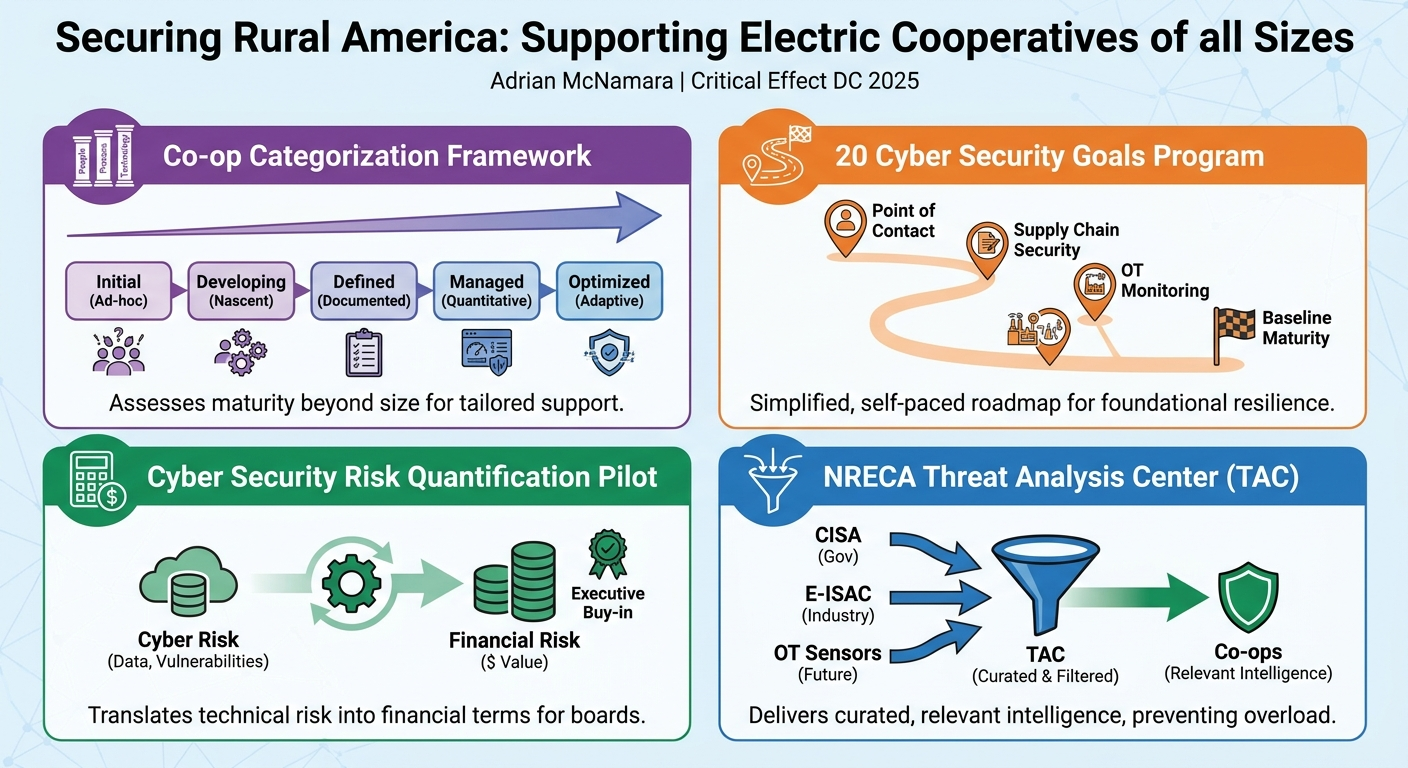
A primary contribution is the development of a novel Co-op Categorization Framework, which moves beyond simplistic size metrics. This framework evaluates cooperatives based on three fundamental pillars: People, Process, and Technology. It defines five distinct maturity levels: Initial, Developing, Defined, Managed, and Optimized. NRECA's immediate focus with Project Guardian is on supporting cooperatives in the first three categories, recognizing that those in the Managed and Optimized states generally possess a higher baseline of cybersecurity maturity. This categorization allows NRECA to tailor resources and support effectively, ensuring that assistance is provided where it is most needed. The speaker expressed hope that this framework could eventually be adopted by the U.S. government to assess the cybersecurity maturity of a broader range of utilities.
Complementing the categorization framework is the NRECA Co-op Cyber Security Goals Program. This program distills the complexity of established frameworks like NIST 800-53 and the CIS Controls into 20 actionable cybersecurity goals designed to be attainable by any cooperative. These goals aim to establish a base level of cybersecurity maturity and range from foundational elements, such as designating a cyber security point of contact, to more advanced measures like implementing OT monitoring solutions in industrial control systems. A particularly emphasized goal involves developing robust contract language to address supply chain cybersecurity risks, a critical concern across all sectors. The program is self-paced, allowing cooperatives to tackle goals in an order and timeframe that best suits their individual capabilities and priorities.
NRECA is also pioneering a Cyber Security Risk Quantification Pilot program, collaborating with the company Dexus. This pilot, involving 10 initial cooperatives, addresses a crucial communication gap: translating technical cybersecurity risks into financial terms understandable by CEOs and board members. As McNamara highlighted, many executives, more familiar with traditional business metrics, struggle to understand the value of cybersecurity investments. Dexus's model takes various operational and security data from cooperatives and generates a report quantifying potential financial losses from cyber incidents. For example, it might illustrate that a lack of Multi-Factor Authentication (MFA) poses a $1 million financial risk, which could be reduced to $250,000 by implementing specific security controls. This approach aims to secure executive buy-in and justify necessary cybersecurity expenditures.
Further enhancing the cooperative's defensive posture is the NRECA Threat Analysis Center (TAC). The TAC provides unique, curated threat intelligence specifically tailored for the co-op community. It maintains machine-to-machine connections with key entities like CISA (Cybersecurity and Infrastructure Security Agency) and the E-ISAC (Electricity Information Sharing and Analysis Center), ensuring a flow of relevant, timely information. Future plans, supported by ICS-RECs (Industrial Control Systems for Rural Electric Cooperatives) funding, include establishing machine-to-machine connections with OT monitoring solutions to provide even more granular and contextualized intelligence. This curated approach prevents cooperatives from being overwhelmed by generic threat feeds and ensures the intelligence is directly applicable to their operational environments.
Finally, the Cyber Champions Program is being established to create a network of individuals across the country who can serve as bidirectional communication nodes for NRECA. These champions will provide NRECA with an "ear to the ground," offering insights into regional cybersecurity challenges and needs, while also helping to disseminate information about NRECA's services and programs to their local communities. This fosters a collaborative, community-driven approach to cybersecurity improvement.
Technical Deep Dive
▶ Watch: NRECA's 20 Cyber Security Goals for basic maturity (6:00)
The technical underpinnings of NRECA's initiatives are designed to be pragmatic, scalable, and directly applicable to the diverse operational realities of rural electric cooperatives. At the core of their strategy is the Co-op Categorization Framework, built upon the pillars of People, Process, and Technology. This framework offers a nuanced assessment of an organization's cybersecurity maturity beyond simple size metrics.
The five maturity levels—Initial, Developing, Defined, Managed, and Optimized—provide a clear progression:
- Initial: Characterized by ad-hoc, reactive security practices, minimal dedicated cybersecurity personnel, and basic, often unmanaged technology. Security is not systematically addressed.
- Developing: Some awareness of cybersecurity, with nascent processes being established, perhaps a part-time security contact, and a reliance on foundational technologies.
- Defined: Documented cybersecurity policies and procedures, dedicated (even if small) security staff, and a standardized set of security technologies. Security is integrated into some operational aspects.
- Managed: Quantitative management of security processes, performance metrics, and continuous improvement. Robust security teams and advanced, integrated technologies are in place.
- Optimized: Proactive, adaptive security posture with continuous innovation, advanced threat intelligence integration, and a culture of security embedded throughout the organization.
This structured categorization allows NRECA to pinpoint specific areas where a cooperative needs assistance, whether it's developing formal processes, investing in appropriate technology, or training personnel. For instance, a cooperative categorized as "Initial" in Technology might be prioritized for resources related to implementing Multi-Factor Authentication (MFA) or foundational network segmentation.
The 20 Co-op Cyber Security Goals serve as a practical roadmap for advancing through these maturity levels. While not "technical" in the sense of specific code, the goals dictate the implementation of technical controls and the establishment of technical management practices. Examples include:
- Designating a Cyber Security Point of Contact: A "people" goal, ensuring accountability and a clear channel for security communications.
- Developing Proper Contract Language: A "process" goal with significant technical implications for supply chain security, requiring vendors to adhere to specific security standards and practices.
- Installing OT Monitoring: A direct "technology" goal, emphasizing the need for visibility into Industrial Control Systems (ICS) and Operational Technology (OT) environments. This involves deploying specialized sensors, data collectors, and analytical platforms to detect anomalies, unauthorized access, and potential threats within critical infrastructure.
The Cyber Security Risk Quantification Pilot with Dexus represents a technical approach to risk management. Dexus's platform ingests various data points from the cooperative's environment—such as asset inventory, existing security controls, incident history, and industry threat intelligence—and applies a proprietary risk model. This model, likely based on methodologies like FAIR (Factor Analysis of Information Risk), translates technical vulnerabilities and threat likelihoods into quantifiable financial impact. For example, the model might calculate the Annualized Loss Expectancy (ALE) for various cyber scenarios, such as a ransomware attack or a data breach, and then demonstrate how implementing a control like endpoint detection and response (EDR) or security information and event management (SIEM) would reduce that ALE by a specific monetary value. This allows boards to make data-driven investment decisions, comparing the cost of a security control against its tangible financial risk reduction.
The NRECA Threat Analysis Center (TAC) is a critical technical backbone for information sharing. Its machine-to-machine connections with CISA and the E-ISAC are vital for automated, timely exchange of threat intelligence. These connections typically involve standardized protocols and formats (e.g., STIX/TAXII for structured threat information exchange) to ensure interoperability and efficient consumption of data. The future integration with OT monitoring solutions will elevate the TAC's capabilities further. By establishing machine-to-machine links directly with the SCADA (Supervisory Control and Data Acquisition) and DCS (Distributed Control System) monitoring systems within cooperatives, the TAC can receive telemetry and alerts specific to the unique OT environment. This enables the TAC to process, analyze, and disseminate highly curated intelligence—for instance, identifying specific malware variants targeting a particular brand of RTU (Remote Terminal Unit) or PLC (Programmable Logic Controller) common within the co-op community, providing actionable insights that generic intelligence feeds cannot match. The ICS-RECs funding specifically supports these advanced integrations, recognizing the distinct security requirements of OT.
Demo / Proof of Concept
▶ Watch: Threat Analysis Center: Curated intelligence for co-ops (10:20)
While Adrian McNamara's presentation did not feature a live, interactive technical demonstration or a software-based proof of concept, the talk itself served to demonstrate the conceptual validity and practical implementation of NRECA's programs. The most prominent "proof of concept" discussed is the ongoing Cyber Security Risk Quantification Pilot with Dexus.
This pilot represents a real-world application of financial risk modeling in the cybersecurity domain. By engaging 10 cooperatives in this initial phase, NRECA is effectively running a controlled experiment to validate the utility and effectiveness of translating complex cyber risks into tangible financial impacts. The process involves Dexus's risk model taking in specific data points from participating cooperatives—such as their existing security posture, asset values, and operational characteristics—and then generating reports that quantify potential financial losses from various cyber scenarios. The demonstration of this concept lies in the ability of these reports to show, for example, a reduction in projected financial risk from $1 million to $250,000 upon the hypothetical or actual implementation of specific security controls like Multi-Factor Authentication (MFA). This pilot, while not a live demo in the traditional sense, serves as a crucial validation of a methodology designed to bridge the communication gap between technical cybersecurity teams and executive leadership, proving that cyber investments can be justified with clear financial metrics.
Other initiatives, such as the Co-op Categorization Framework and the 20 Co-op Cyber Security Goals Program, function as programmatic proofs of concept. Their successful adoption and ongoing refinement by cooperatives demonstrate that a simplified, tailored approach to cybersecurity maturity can be effective for resource-constrained organizations. The NRECA Threat Analysis Center (TAC) and its machine-to-machine connections with CISA and E-ISAC also serve as an operational proof of concept for effective, curated threat intelligence sharing within a specific critical infrastructure sector.
Defensive Implications
▶ Watch: Q&A: Categorization nuances and self-assessment challenges (14:00)
The initiatives presented by Adrian McNamara offer critical defensive implications for rural electric cooperatives and broader lessons for other critical infrastructure sectors facing similar resource constraints.
For rural electric cooperatives, the immediate defensive actions are clear:
- Self-Assess Maturity: Cooperatives should utilize NRECA's People, Process, Technology categorization framework to objectively assess their current cybersecurity maturity level across the five stages (Initial, Developing, Defined, Managed, Optimized). This self-assessment is the foundational step to understanding where targeted improvements are most needed.
- Adopt the 20 Cyber Security Goals: The NRECA Co-op Cyber Security Goals Program provides a pragmatic, self-paced roadmap for achieving a baseline level of cybersecurity. Defenders should prioritize implementing these 20 goals, focusing on areas like designating a cyber security point of contact, ensuring robust supply chain security through contract language, and deploying OT monitoring solutions for industrial control systems.
- Quantify Risk for Executive Buy-in: Leverage the insights from the Cyber Security Risk Quantification Pilot (and potentially similar services) to translate technical vulnerabilities into financial risk. This approach empowers cybersecurity specialists to communicate effectively with CEOs and boards, justifying budget requests for security tools and personnel with clear monetary value.
- Utilize Curated Threat Intelligence: Actively engage with the NRECA Threat Analysis Center (TAC). The TAC's curated intelligence, tailored specifically for the co-op community and integrating data from CISA and E-ISAC, provides actionable insights that are more relevant than generic threat feeds. Future integrations with OT monitoring solutions will further enhance this capability, providing context-specific threat data for critical operational environments.
- Engage in Collaborative Programs: Participate in the Cyber Champions Program to foster bidirectional communication with NRECA, sharing regional insights and accessing tailored support. Furthermore, cooperatives should consider joining the Cyber Mutual Assistance (CMA) program, a broader industry initiative that facilitates mutual support and resource sharing during cyber incidents, as mentioned in the Q&A.
- Focus on Comprehensive Security: Recognize that cybersecurity is not solely an IT function. The involvement of accounting, finance, operations, and HR in NRECA's working group underscores the need for a holistic security approach where every department understands its role in the overall cyber defense.
More broadly, the NRECA model offers valuable lessons for other critical infrastructure sectors and small-to-medium enterprises (SMEs) with limited resources:
- Tailored Frameworks are Essential: Generic, overly complex security frameworks are often impractical. Developing simplified, sector-specific categorization models and actionable goal sets is crucial for effective adoption and maturity progression.
- Financial Risk Communication is Key: Bridging the gap between technical teams and executive leadership through financial risk quantification can unlock necessary investments and elevate cybersecurity to a strategic business imperative.
- Curated Intelligence Drives Action: For specific sectors, generic threat intelligence can be overwhelming. Providing highly curated, contextualized intelligence significantly increases its utility and allows defenders to prioritize relevant threats.
- Collaboration is Non-Negotiable: As McNamara emphasized, cybersecurity is a team sport. Government, industry associations, and individual entities must collaborate to share information, resources, and best practices to strengthen collective defense.
Key Takeaways
- NRECA addresses the unique challenges of over 900 diverse, resource-constrained rural electric cooperatives through targeted, scalable cybersecurity programs.
- The People, Process, Technology categorization framework (Initial, Developing, Defined, Managed, Optimized) provides a crucial method for assessing cooperative maturity and tailoring support.
- The 20 Co-op Cyber Security Goals Program offers a simplified, self-paced, and actionable roadmap for cooperatives to achieve a foundational level of cyber maturity, including critical elements like supply chain security and OT monitoring.
- NRECA's Cyber Security Risk Quantification Pilot with Dexus translates complex cyber risks into clear financial terms, empowering executives and boards to make informed investment decisions.
- The NRECA Threat Analysis Center (TAC) delivers curated, relevant threat intelligence to cooperatives, leveraging machine-to-machine connections with CISA, E-ISAC, and future OT monitoring solutions.
- Programs like Cyber Champions and Cyber Mutual Assistance (CMA) underscore the critical importance of collaboration and community-driven efforts in strengthening the overall cybersecurity posture of rural America.
About the Speaker(s)
Adrian McNamara is a representative of the National Rural Electric Cooperative Association (NRECA), where he is actively involved in developing and implementing cybersecurity initiatives for electric cooperatives across the United States. His work focuses on addressing the unique challenges faced by these diverse, often resource-constrained organizations. McNamara brings a wealth of experience from the public power sector, having previously worked at the American Public Power Association (APPA), indicating a deep understanding of utility cybersecurity landscapes and the operational realities of power providers. His expertise lies in translating complex cybersecurity concepts into practical, actionable programs for critical infrastructure stakeholders.
Reviews
Dr. Zero (Offensive Security Researcher) — SOLID
McNamara lays out the DOE-funded Project Guardian and how NRECA is trying to defend 900+ rural co-ops on a shoestring budget. It's high-level association strategy, not a technical deep dive, but it actually names programs, vendors, and funding lines instead of just preaching abstract resilience.
Heather Calloway (CISO) — SOLID
NRECA is doing the hard, unglamorous work of securing under-resourced critical infrastructure by abandoning massive compliance checklists in favor of prioritized goals and financial risk quantification. If you manage a complex, low-maturity supply chain or franchise ecosystem, this is a masterclass in how to drive actual security improvements instead of just paper compliance. Worth your third-party risk team's time.