Cyber-Physical Digital Twins for Intrusion Detection
Jason Hollern (Electric Power Research Institute (EPRI))
Critical Effect DC 2025 · Day 2 · Track III: Tactical Mastery
Overview
In an era where cyber threats increasingly target the physical world, the Electric Power Research Institute (EPRI) is pioneering the use of cyber-physical digital twins for advanced intrusion detection in operational technology (OT) environments. Presented by Jason Hollern at Critical Effect DC 2025, this talk delves into EPRI's innovative approach to augmenting traditional physics-based digital twins with cybersecurity context, specifically focusing on control and communication layers. The core objective is to detect anomalous activity that could signify a cyber attack by observing deviations in the physical system's expected behavior, thereby reducing adversary dwell time in critical infrastructure.
Key moments
- 0:00 Introduction and EPRI's mission
- 2:00 Distinguishing visual vs. first principles digital twins
- 8:00 Developing cyber-physical digital twins: a process map
- 14:00 Leveraging digital twins for cyber security detection
- 16:00 Challenges: Modeling control and communication layers
- 21:00 Building attack libraries using MITRE ATT&CK for ICS
- 25:00 Two-step implementation: lab flow loop to field simulator
- 29:00 Q&A: Securing the digital twin from attackers
Cyber-Physical Digital Twins for Intrusion Detection
Speakers: Jason Hollern (Electric Power Research Institute (EPRI))
Conference: Critical Effect DC 2025
YouTube: https://www.youtube.com/watch?v=4BPuH3CWNks
Overview
In an era where cyber threats increasingly target the physical world, the Electric Power Research Institute (EPRI) is pioneering the use of cyber-physical digital twins for advanced intrusion detection in operational technology (OT) environments. Presented by Jason Hollern at Critical Effect DC 2025, this talk delves into EPRI's innovative approach to augmenting traditional physics-based digital twins with cybersecurity context, specifically focusing on control and communication layers. The core objective is to detect anomalous activity that could signify a cyber attack by observing deviations in the physical system's expected behavior, thereby reducing adversary dwell time in critical infrastructure.
EPRI, a 501c3 non-profit organization, plays a crucial role in the electric power industry, conducting fact and science-based research for over 435 electric utilities globally. Their work spans cybersecurity for transmission, distribution, behind-the-meter assets, and various generation types, including nuclear. This talk highlights a non-commercial, technical endeavor to bridge the gap between physical system modeling and cyber threat intelligence, offering a proactive defense mechanism against sophisticated attacks on industrial control systems (ICS).
The significance of this research lies in its potential to revolutionize how critical infrastructure operators identify and respond to cyber attacks. By creating a high-fidelity digital replica that incorporates both the physical dynamics and the cyber control mechanisms of an asset, EPRI aims to provide an early warning system. This allows defenders to differentiate between normal equipment failures and malicious manipulations, a distinction often blurred by adversaries seeking to mask their activities within the complexities of industrial operations.
Background
▶ Watch: Introduction and EPRI's mission (0:00)
The concept of a digital twin has gained significant traction across industries, yet its definition often varies. As Hollern notes, the term can be ambiguous, encompassing different types of digital representations. One common type is the visual digital twin, which provides a 3D graphical representation of a physical asset, plant, or building. These twins can be overlaid with operational data—such as pressures, power levels, or temperatures—serving as visual aids for field personnel or for design purposes. While useful, these visual models typically lack the deep behavioral understanding required for advanced anomaly detection.
EPRI's work, however, centers on the first principles digital twin. This type of twin is built upon rigorous mathematical and physics-based equations that empirically model the fundamental processes occurring within a piece of equipment. For instance, modeling a pump involves understanding its pump head, bore size, and impeller characteristics, all derived from mechanical engineering and physics equations. These first principles provide a "ground truth" understanding of how a physical asset should operate under various conditions. This foundational physics-based modeling is crucial because it allows for predictions and comparisons that go beyond simple data overlays, enabling the detection of subtle deviations that might indicate a cyber-physical attack.
The challenge in applying digital twins to cybersecurity lies in integrating the cyber domain into these traditionally physical models. While first principles digital twins are adept at predicting equipment performance and degradation for operations and maintenance, they typically do not account for the intricate control and communication layers that govern industrial systems. These layers, encompassing everything from human-machine interface (HMI) interactions to distributed control system (DCS) logic, are the primary targets for cyber adversaries. Therefore, extending the utility of digital twins for intrusion detection requires a novel approach that explicitly models these cyber-physical interdependencies.
Key Findings
▶ Watch: Developing cyber-physical digital twins: a process map (8:00)
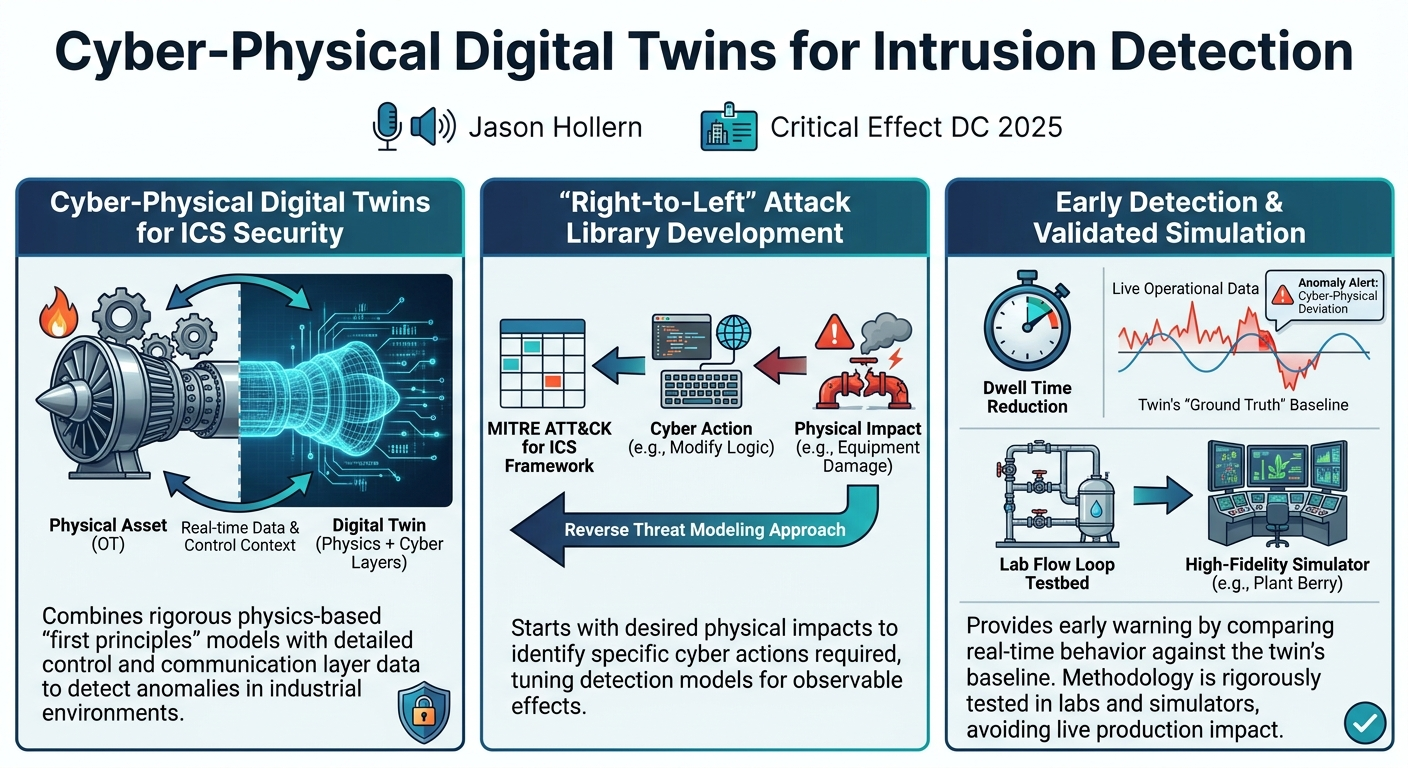
EPRI's research introduces a pioneering methodology for transforming traditional physics-based digital twins into cyber-physical digital twins capable of detecting intrusions in OT environments. The core innovation lies in augmenting these first principles models with critical control and communication layer data, which has not been widely achieved for this purpose previously. This hybrid approach enables a deeper understanding of system behavior under both normal and anomalous conditions.
One of the most significant contributions is the development of an attack library using a "right-to-left" approach, leveraging the MITRE ATT&CK for ICS framework. Traditional threat modeling often starts from initial access and moves towards impact. However, for building a detection model, EPRI reverses this, beginning with desired physical impacts (e.g., equipment damage, process disruption) and then working backward to identify the specific cyber actions required to achieve those impacts. This impact-driven methodology ensures that the digital twin is tuned to recognize the observable physical effects of cyber attacks, which often mimic legitimate equipment failures.
The ultimate goal of this initiative is to provide early warning of cyber-physical attacks, thereby significantly reducing the dwell time of adversaries within critical OT networks. By continuously comparing the real-time operational data of a physical asset against its high-fidelity digital twin, operators can identify discrepancies that fall outside expected physical parameters or control logic. These deviations can then trigger alerts, allowing for prompt investigation and response, minimizing potential damage and operational disruption. The ability to distinguish between a genuine equipment malfunction and a cyber-induced anomaly is a fundamental and critical finding of this research.
Technical Deep Dive
▶ Watch: Challenges: Modeling control and communication layers (16:00)
Building an effective cyber-physical digital twin involves integrating multiple layers of data and modeling. EPRI's approach starts with a base first principles digital twin, which is then progressively enriched.
The architecture of EPRI's digital twin for a specific asset, such as a gas turbine, involves several layers:
- Historian Data: This layer captures time-series data from sensors and transmitters within the control system. This historical operational data is crucial for fine-tuning a generic digital twin model to precisely match the unique characteristics of a specific physical asset. For example, while gas turbines of the same make and model share common designs, individual units will have slight variations due to manufacturing tolerances. Historian data allows the digital twin to reflect these specific nuances, making it a highly accurate replica of the deployed physical equipment.
- Additional Data Sets: Beyond operational data, external factors like weather data and maintenance history are integrated. Weather can influence equipment performance, while maintenance records provide insight into an asset's degradation over time and its operational lifecycle, further refining the twin's predictive capabilities.
- Physics-Based Equations: This is the core of the first principles model, comprising complex mathematical equations derived from mechanical engineering and physics. For a gas turbine, this includes modeling the compressor, combustor, and turbine sections, which are connected by a single shaft to a large generator. These models account for operational parameters such as rotational speed (e.g., 3000 RPM for 50 Hz systems, 3600 RPM for 60 Hz systems) and power output (typically 150-300 MW, or higher in combined cycle plants). The system is often modeled in "bite-sized pieces" for manageability, with individual digital twins for each component assembled into a comprehensive system model.
- Calculational and Output Layers: This final layer defines the purpose and utility of the digital twin, generating outputs for various applications, including cybersecurity detection.
A critical and challenging aspect of this research is modeling the control and communication layers—a domain often overlooked by traditional digital twins. These layers are where adversaries interact with the physical system. EPRI categorizes the control logic within a DCS into two main types:
- Protection Logic: This logic is designed to safeguard the system and maintain its integrity. It governs critical functions like safe startups and shutdowns, ensuring operating parameters remain within boundaries to prevent equipment damage or environmental releases (e.g., controlling chemical injections like ammonia).
- Continuous Logic: This encompasses five primary control loops: temperature, speed, acceleration, manual, and startup. These loops maintain the system within specified operational ranges and facilitate transitions between power levels. Hollern emphasizes that deviations from these control loops can trigger automatic mode shifts (e.g., from normal operation to manual, or even shutdown) or could be exploited by an attacker to cause damage by tricking the system (e.g., forcing a startup state when inappropriate). Modeling these intricate control interactions from a first principles standpoint is a non-trivial task.
To build the attack library, EPRI employs a novel "right-to-left" approach using the MITRE ATT&CK for ICS framework. Instead of starting with initial access and progressing to impact, the methodology begins by defining desired impacts on the physical system. For example, to achieve "manipulation of control," researchers work backward:
- Impact: Manipulation of control (e.g., causing a turbine to operate outside safe limits).
- Action: Modify control logic.
- Mechanism: Inhibit a response function.
- Technical Target: Modify coils or registers associated with a protocol like Modbus within the DCS.
- Tool: Develop an exploit using frameworks like Metasploit.
This backward approach dictates the types of data needed and the specific attack scenarios to be tested. It also inherently assumes the attacker has already gained access to the control level and possesses the necessary background information to execute such exploits.
Demo / Proof of Concept
▶ Watch: Building attack libraries using MITRE ATT&CK for ICS (21:00)
EPRI's methodology for developing and validating these cyber-physical digital twins involves a phased, scientific approach, starting with laboratory environments and scaling up to high-fidelity simulators.
The initial proof of concept takes place in EPRI's Charlotte cyber and ICS lab. Here, researchers utilize a simple flow loop system. This loop, while seemingly basic (flowing water in a circle), is highly representative of a real-world OT system. It incorporates essential industrial components such as pumps, motors, valves, digital valve controllers, heaters, and tanks, all equipped with extensive instrumentation. Crucially, it is controlled by multiple DCS systems and monitored by various OT cybersecurity products, allowing for the generation of rich security-level data.
The process for this lab-based validation involves:
- Building a digital twin model for the simple flow loop.
- Physically attacking the flow loop using malware and other cyber security operations.
- Collecting the output data from these physical attacks.
- Using this data to fine-tune the digital twin model, thereby validating the scientific method, scalability, and repeatability of the process. This critical feedback loop ensures the methodology is robust before applying it to more complex systems.
Following successful validation in the lab, the next step involves scaling the approach to actual industrial assets. EPRI takes existing digital twin models developed for gas turbines (which are used for purposes like smart dispatch, equipment maintenance, and health monitoring) and integrates the newly developed cybersecurity layers.
For field validation, EPRI partners with Southern Company at Plant Berry near Mobile, Alabama. While directly attacking an operational combined cycle unit is not feasible, Plant Berry hosts a high-fidelity simulator of these units. This simulator provides a safe and realistic environment to:
- Simulate cyber attacks on the digital twin.
- Determine the resulting physical outputs and impacts as if they were occurring on the actual machine.
- Gather feedback to further refine and enhance the digital twin models.
This two-step process, moving from a controlled lab environment to a realistic simulator, ensures that the cyber-physical digital twin technology is thoroughly tested and validated before its eventual commercialization and widespread adoption across the electric power industry.
Defensive Implications
▶ Watch: Q&A: Securing the digital twin from attackers (29:00)
The development of cyber-physical digital twins for intrusion detection offers profound defensive implications for critical infrastructure, particularly in OT environments. The primary benefit is the ability to provide early warning of cyber attacks by detecting anomalous physical behavior that deviates from the digital twin's expected "ground truth." This capability is crucial for reducing adversary dwell time, which is the period an attacker remains undetected within a network. By enabling faster detection, operators can respond more quickly, mitigating potential damage and restoring normal operations.
A key advantage of this technology is its potential to resolve the ambiguity between legitimate equipment failures and cyber-induced manipulations. As Hollern highlighted, many cyber attacks on ICS are designed to mimic normal operational issues, making them incredibly difficult to detect using traditional IT security tools alone. The digital twin's deep understanding of physical processes allows it to flag inconsistencies that would otherwise go unnoticed, providing a clearer signal of malicious activity.
However, the power of a cyber-physical digital twin also presents a new defensive challenge: the twin itself becomes a high-value target. If an attacker gains access to or exfiltrates a digital twin, especially one augmented with control and communication layers, it essentially provides them with a "playbook" or "cliff's notes" of the target network and its physical processes. This could drastically reduce the attacker's reconnaissance time and aid in developing more potent exploits. Therefore, the digital twin must be protected with the same rigor as the physical systems it models, adhering to secure by design principles. This includes:
- Network Segmentation: Deploying the digital twin on highly secure, isolated networks, distinct from general IT networks.
- Data Security: Protecting the integrity and confidentiality of the real-time data feeds that populate the digital twin, as these come from various disparate sources (IT, OT, historians, security monitoring systems).
Beyond intrusion detection, the Q&A session revealed another promising defensive application: patch regression testing. While not the initial focus, a fully modeled cyber-physical digital twin, with its detailed control and communication layers, could eventually be used to simulate the impact of applying patches. By establishing a baseline of system behavior before a patch and then observing changes in the digital twin after its virtual application, operators could assess potential disruptions or unforeseen consequences before deploying patches in a live production environment. This capability would be particularly valuable for non-DCS equipment where OEM testing might be less comprehensive.
Ultimately, the commercialization plan for this technology is vital for its widespread defensive impact. By making these advanced digital twin capabilities available to OEMs, third parties, and utilities, EPRI aims to accelerate the adoption of a new paradigm in industrial cybersecurity, enhancing the resilience of critical infrastructure against evolving threats.
Key Takeaways
- Cyber-Physical Digital Twins for ICS Security: EPRI is developing a novel approach using physics-based digital twins augmented with cybersecurity context for advanced intrusion detection in operational technology (OT) environments.
- First Principles & Hybrid Modeling: The foundation is laid on first principles digital twins (mathematics and physics-based equations) which are then enhanced with real-time operational data, external factors, and crucially, detailed models of control and communication layers.
- "Right-to-Left" Attack Library Development: Utilizing the MITRE ATT&CK for ICS framework, EPRI reverses traditional threat modeling by starting with desired physical impacts and working backward to identify the specific cyber actions required, allowing for focused detection model tuning.
- Early Detection and Dwell Time Reduction: The primary goal is to provide early warning of cyber attacks by identifying anomalous physical system behavior that deviates from the digital twin's predicted "ground truth," thereby significantly reducing adversary dwell time.
- Validation Through Lab and Simulation: The methodology is rigorously tested, starting with physical attacks on a simple flow loop in EPRI's lab, then scaling to high-fidelity simulators at sites like Plant Berry to validate the models without impacting live production systems.
- Protecting the Digital Twin: The digital twin itself is a high-value target; if compromised, it could serve as a "playbook" for attackers. Therefore, it requires robust protection through secure by design principles, including secure networks and data integrity.
About the Speaker(s)
Jason Hollern is a representative from the Electric Power Research Institute (EPRI), a 501c3 non-profit organization dedicated to conducting scientific research for the electric power industry. EPRI works with over 435 electric utilities worldwide, focusing on fact and science-based research without lobbying or endorsing specific products. Hollern's work, and EPRI's broader mission, includes extensive research into cybersecurity for all aspects of the power grid, from transmission and distribution to behind-the-meter assets, non-nuclear generation, renewables, hydro, and nuclear facilities. His talk reflects EPRI's commitment to developing non-commercial, technical solutions to enhance the resilience and security of critical energy infrastructure.
Reviews
Dr. Zero (Offensive Security Researcher) — STRONG ACCEPT
EPRI actually built a physics-based model that detects OT attacks by measuring physical reality against control system lies. They didn't just slap a 3D dashboard on some sensor data and call it a 'digital twin'—they modeled the thermodynamics and attacked it on actual flow loops and turbine simulators. It's a highly practical, defensively grounded approach to ICS security.
Heather Calloway (CISO) — SOLID
EPRI is bridging the gap between physics-based equipment modeling and cyber threat detection in OT environments. It is forward-looking R&D, but it gives critical infrastructure operators a mathematical way to distinguish malicious manipulation from normal mechanical failure.