Operationalizing MITRE EMB3D: Threat Modeling to Create and Acquire Secure-by-Design Devices
Jack Cyprus (MITRE), Wyatt Ford (Red Balloon Security)
Critical Effect DC 2025 · Day 2 · Track III: Tactical Mastery
Overview
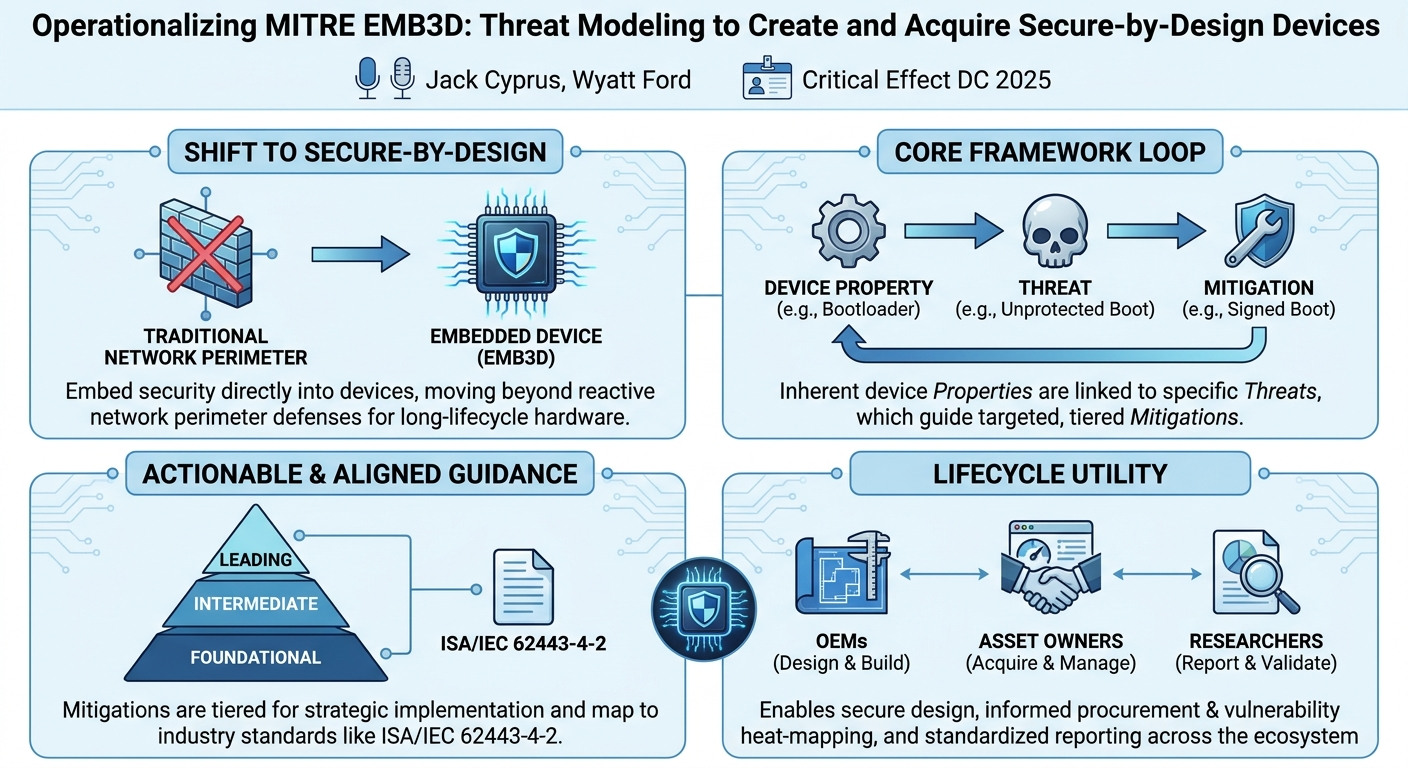
The "Operationalizing MITRE EMB3D" talk at Critical Effect DC 2025, presented by Jack Cyprus from MITRE and Wyatt Ford from Red Balloon Security, delved into the practical applications and profound impact of MITRE EMB3D, an embedded device threat model designed to bake security directly into devices. Unlike traditional threat models that often focus on network perimeter defenses, EMB3D shifts the paradigm to secure-by-design principles, addressing the inherent vulnerabilities of embedded systems themselves. This talk is crucial for anyone involved in the lifecycle of embedded devices, from original equipment manufacturers (OEMs) and security researchers to asset owners, as it provides a standardized language and actionable framework for proactive security.
Key moments
- 0:50 Introduction to MITRE EMB3D's core purpose
- 4:30 Understanding EMB3D's tiered mitigations
- 8:30 Operationalizing EMB3D for secure device design
- 14:10 Vulnerability management and guiding security investments
- 16:00 Property-based approach for attack surface reduction
- 20:30 Industry-specific application and completeness assurance
- 22:40 Call to action: contribute and shape EMB3D's future
- 28:10 Q&A: Engaging product management for secure design
Operationalizing MITRE EMB3D: Threat Modeling to Create and Acquire Secure-by-Design Devices
Speakers: Jack Cyprus (MITRE); Wyatt Ford (Red Balloon Security)
Conference: Critical Effect DC 2025
YouTube: https://www.youtube.com/watch?v=HGdRZUT_0ps
Overview
The "Operationalizing MITRE EMB3D" talk at Critical Effect DC 2025, presented by Jack Cyprus from MITRE and Wyatt Ford from Red Balloon Security, delved into the practical applications and profound impact of MITRE EMB3D, an embedded device threat model designed to bake security directly into devices. Unlike traditional threat models that often focus on network perimeter defenses, EMB3D shifts the paradigm to secure-by-design principles, addressing the inherent vulnerabilities of embedded systems themselves. This talk is crucial for anyone involved in the lifecycle of embedded devices, from original equipment manufacturers (OEMs) and security researchers to asset owners, as it provides a standardized language and actionable framework for proactive security.
The core motivation behind EMB3D stems from the recognition that embedded devices often have extremely long lifecycles—10, 15, even 20 years—making them prime targets for evolving threats. The speakers highlighted the inadequacy of relying solely on network segmentation or reactive "whack-a-mole" approaches to security. Instead, EMB3D aims to raise the security floor for these devices by correlating device properties with potential threats and offering specific, tiered mitigations. This forward-looking approach incorporates both observed adversary tactics and cutting-edge cybersecurity research, anticipating future attack vectors before they materialize in the wild.
Cyprus and Ford meticulously walked through the structure of EMB3D, demonstrating its utility not just as a theoretical framework but as a tangible tool for secure product development, acquisition, and vulnerability management. They showcased real-world examples of its adoption by industry players, underscoring its role in standardizing embedded device threat modeling. By providing a common language and a structured methodology, EMB3D empowers organizations to move beyond superficial security measures and integrate robust defenses from the earliest stages of design, fundamentally altering the security posture of critical infrastructure and industrial control systems (ICS).
Background
▶ Watch: Introduction to MITRE EMB3D's core purpose (0:50)
The landscape of embedded device security has long been plagued by significant challenges, primarily due to the unique characteristics of these systems. As Wyatt Ford eloquently put it, embedded systems are often perceived as a "black box component," a "thing that does a thing," with little understanding of their internal security posture. This opacity, combined with their extended operational lifecycles, creates a fertile ground for vulnerabilities that can persist for decades. Traditional security approaches, which often prioritize network-level defenses, prove insufficient when the device itself is inherently insecure. The speakers emphasized that relying on network segmentation alone is a "Silicon Valley approach to security," impractical for critical infrastructure where devices will inevitably be connected and exposed.
MITRE EMB3D was conceived to address these systemic issues by providing a common language and a structured methodology for embedded device threat modeling. Jack Cyprus, a core member of both EMB3D and MITRE ATT&CK for ICS, highlighted a key distinction: while ATT&CK for ICS focuses on observed adversary tactics in the wild, EMB3D integrates both real-world examples and cybersecurity research—including conference talks and papers. This forward-looking perspective is crucial because research-based threats today can easily become adversary threats tomorrow, especially given the long operational lifespan of embedded devices. The aim is to "turn the dial on actors" proactively, rather than constantly playing "firefighter and whack-a-mole."
The foundational concept of EMB3D revolves around three interconnected elements: threats, properties, and mitigations. Device properties are inherent characteristics or functionalities (e.g., having a bootloader, Wi-Fi connectivity) that expose the device to specific threats. These threats are then correlated to mitigations, which are secure-by-design solutions intended to be built directly into the device, not merely layered on top. This recursive process ensures that security is an intrinsic part of the device's architecture. The framework is designed primarily for device OEMs, who possess the direct ability to build in security, but also serves security researchers, testers, and asset owners, fostering a holistic approach across the entire embedded device security lifecycle.
Key Findings
▶ Watch: Operationalizing EMB3D for secure device design (8:30)
The central findings presented in the talk underscore EMB3D's transformative potential for embedded device security. The framework's ability to provide a standardized way to handle embedded device threat modeling was repeatedly highlighted as a significant contribution. Industry partners, according to Jack Cyprus, have long struggled with a lack of standardization in this domain, and EMB3D directly addresses this gap.
A key finding is EMB3D's proactive and forward-looking approach to threat intelligence. Unlike models solely based on observed attacks, EMB3D incorporates cutting-edge cybersecurity research, anticipating threats that may not yet be prevalent in the wild but could become critical over the long lifecycles of embedded devices. This enables organizations to implement defenses before adversaries exploit vulnerabilities, shifting from reactive incident response to proactive risk reduction.
The property-based security model is another critical finding. By focusing on inherent device properties, EMB3D allows for a granular understanding of exposure and enables targeted mitigation strategies. This often leads to the simplest yet most effective security measure: removing unnecessary properties to reduce the attack surface. Examples cited included physically disabling Wi-Fi capabilities or restricting the use of removable media. This approach directly challenges the tendency to add complex security layers to an already bloated feature set, advocating for a minimalist, secure-by-default design philosophy.
Furthermore, EMB3D provides actionable, tiered mitigation guidance. The framework categorizes mitigations into foundational, intermediate, and leading tiers, offering a clear roadmap for implementation. Foundational mitigations are common, often open-source or open-standard solutions; intermediate mitigations are more complex, potentially requiring dedicated hardware; and leading mitigations represent advanced, often research-based concepts. This tiered approach allows organizations to prioritize and plan security investments effectively, aligning short-term goals with long-term security aspirations. Wyatt Ford emphasized that the goal is for today's "intermediate" mitigations to become tomorrow's "foundational" standards, continuously elevating the security baseline.
Finally, the talk demonstrated EMB3D's versatility across the entire security ecosystem:
- For OEMs: Facilitates secure design from inception, integrating security by default.
- For Asset Owners/Buyers: Enables informed procurement decisions, allowing them to seek products with robust, verifiable security.
- For Security Researchers: Provides a common language to communicate findings, mapping vulnerabilities to specific threats and mitigations.
- For Management: Offers a heat map to justify security investments by linking specific properties to the most frequently exploited vulnerabilities, as demonstrated by a semiconductor manufacturer use case.
These findings collectively position EMB3D as a pivotal tool for elevating the security posture of embedded devices across industries.
Technical Deep Dive
▶ Watch: Property-based approach for attack surface reduction (16:00)
MITRE EMB3D is structured around a meticulously designed framework that interlinks device characteristics, potential attack vectors, and defensive measures. At its core, the model is driven by threats, which are categorized into four main areas: hardware, system software (low-level operating software), application software (running on the device), and networking (device communication capabilities). These threats are not merely theoretical but are backed by evidence and assigned a maturity tier, ranging from "adversary use" (observed in the wild) to "theoretic" (based on research). This comprehensive threat intelligence is further enriched by mappings to industry-standard identifiers like CWE (Common Weakness Enumeration) and CVE (Common Vulnerabilities and Exposures), providing a familiar lexicon for security practitioners.
The link between threats and device characteristics is established through properties. These are inherent features or functionalities of an embedded device. For instance, a device might have a bootloader, a web server, or specific communication interfaces. The absence of a property generally means the device is not exposed to threats correlated with that property (e.g., no web server, no web server threats). The talk provided a concrete example: a device with a bootloader might be exposed to Threat 2011, "Inadequate bootloader protection and verifications." This cyclical relationship allows users to input their device's properties and receive a tailored list of relevant threats.
Once threats are identified, EMB3D provides specific mitigations designed to address them. These mitigations are also tiered, reflecting their complexity and adoption:
- Foundational: Widely accepted, often open-source or open-standard solutions. Wyatt Ford noted these are "things we can do in the next 12 to 16 months." An example could be using a signed bootloader.
- Intermediate: More complex, potentially requiring dedicated hardware or proprietary information, and less commonly seen. A hardware-backed bootloader authentication falls into this category.
- Leading: Cutting-edge, often derived from research papers and representing the forefront of embedded security. These are "what we should do so that we're not doing an 18-month sprint 5, 10, 15 years from now."
Each mitigation entry includes a detailed description, notes and considerations (e.g., how it might introduce new properties that need further threat modeling), and references to trusted sources or implementation guidance. Critically, EMB3D includes mappings to ISA/IEC 62443-4-2, the standard concerning security for industrial automation and control systems, specifically at the component level. This integration ensures alignment with broader industry standards, a feature highly requested by industry partners. The recursive nature of the model is evident here: implementing a mitigation (like hardware-backed authentication) might introduce new hardware components, which become new properties, potentially leading to new threats and further mitigations.
To facilitate large-scale implementation and integration into existing security workflows, EMB3D data is available in a machine-readable format, specifically STIX (Structured Threat Information Expression). This allows for automation, enabling organizations to integrate EMB3D into their scripts, products, or other security tools without manual clicking through the website. This technical architecture ensures that EMB3D is not just a conceptual framework but a highly practical and integratable tool for enhancing embedded device security.
Demo / Proof of Concept
▶ Watch: Industry-specific application and completeness assurance (20:30)
While the talk did not feature a live code demonstration in the traditional sense, the speakers effectively showcased the operationalization of MITRE EMB3D through several compelling real-world use cases and industry adoptions, serving as practical proofs of concept for its utility.
One significant example came from Zyllem, a manufacturer predominantly in the water sector. Zyllem is integrating EMB3D as a data artifact into its new threat modeling process, which leverages Large Language Models (LLMs). Their workflow involves feeding old threat models, EMB3D artifacts, and new product descriptions into an LLM. The LLM then generates a new threat model, complete with mappings back to MITRE EMB3D and Zyllem's proprietary information, which is subsequently evaluated using an internal rubric. This demonstrates EMB3D's role in standardizing and enhancing automated threat modeling, particularly for OEMs developing new products. Similarly, IUIS Risk, a company specializing in threat modeling, uses EMB3D as a data source within its software.
A powerful use case for asset owners and manufacturers was illustrated by a semiconductor manufacturer. This company used EMB3D to perform vulnerability and attack surface management. They analyzed publicly disclosed vulnerabilities, mapped their CWEs to EMB3D properties, and identified which properties were most frequently associated with vulnerabilities requiring disclosure. This analysis created a "heat map" of their devices, enabling them to make data-driven decisions about security investments and justify these to management. It also prompted questions about the necessity of certain properties, such as Wi-Fi or Bluetooth connectivity, suggesting opportunities for attack surface reduction.
For security researchers, Wyatt Ford explained how Red Balloon Security, in its device assessments (including DARPA PROVERS red team engagements), maps all findings back to EMB3D properties and threats. This approach naturally leads to discussions about specific mitigations, providing a clear and actionable way to communicate vulnerabilities and recommended defenses, especially for hardware-related issues.
The talk also highlighted EMB3D's role in conformance validation and alignment with industry standards. A report was cited that used both Attack for IC and EMB3D to inform the threat landscape for OT and ICS devices. This report made recommendations to improve ISA/IEC 62443-4-2 by advocating for property-based changes, such as physically disabling Wi-Fi capabilities, not enabling SSID broadcast by default, restricting removable media, and encrypting all external interfaces. These examples underscore how EMB3D's property-centric view leads to tangible, actionable security improvements.
Finally, the SAE (Society of Automotive Engineers) is actively cross-walking with EMB3D for the automotive space. In a draft document concerning thermal sensors in EV chargers, SAE is using EMB3D to build assurance arguments. This involves demonstrating that they have systematically considered potential threats to thermal management systems and implemented appropriate security measures, leveraging EMB3D to provide a "completeness assurance argument" that their threat model is robust and repeatable, not an "ad hoc one-off." These diverse applications clearly demonstrate EMB3D's practical value across various stakeholders in the embedded device ecosystem.
Defensive Implications
▶ Watch: Q&A: Engaging product management for secure design (28:10)
MITRE EMB3D offers profound defensive implications across the entire embedded device lifecycle, shifting the focus from reactive patching to proactive, secure-by-design principles.
For Original Equipment Manufacturers (OEMs), EMB3D serves as a critical design tool. By integrating EMB3D early in the product development process, OEMs can identify potential threats correlated with specific device properties and bake in foundational mitigations from the outset. This moves beyond simply meeting compliance checklists to genuinely enhancing the security posture of their products. The talk highlighted the importance of a property-based approach to security: if a device property (e.g., Wi-Fi, Bluetooth, removable media support) is not strictly necessary for functionality, it should be removed to significantly reduce the attack surface. For instance, physically disabling Wi-Fi capabilities or restricting removable media are simple yet highly effective defensive measures derived from this mindset. OEMs can also use the tiered mitigation guidance (foundational, intermediate, leading) to strategically plan security feature implementation, aligning with product roadmaps and investment cycles.
Asset owners and buyers can leverage EMB3D for more informed procurement and vulnerability management. Instead of relying on generic security claims, buyers can use EMB3D as a framework to evaluate the inherent security of devices. They can specifically inquire about which EMB3D properties are present, what threats these expose, and what corresponding mitigations (and their tiers) have been implemented. This empowers them to demand products with robust security by default, avoiding those that "rely entirely on a threat actor never accessing the OT network." For existing deployments, asset owners can use EMB3D, as demonstrated by the semiconductor manufacturer, to map disclosed vulnerabilities (CWEs) back to device properties, creating a heat map to prioritize security investments and justify them to management. This helps in understanding which device features contribute most to vulnerability exposure and where to focus hardening efforts.
Security researchers and penetration testers can use EMB3D to enhance the impact and clarity of their findings. By mapping discovered vulnerabilities or attack paths to specific EMB3D threats and properties, they can directly point to relevant mitigations. This provides actionable advice to manufacturers and asset owners, translating complex technical findings into a standardized language that facilitates remediation. The Red Balloon Security example underscores this, showing how mapping findings to EMB3D naturally leads to discussions about holistic hardware security.
Furthermore, EMB3D facilitates alignment with industry standards and regulations, particularly ISA/IEC 62443-4-2, which focuses on device-level security. This cross-referencing helps organizations meet compliance requirements while simultaneously implementing truly effective security measures. The framework also aids in generating assurance arguments, as shown by the SAE's use case with EV chargers, demonstrating a systematic and repeatable approach to ensuring security for critical components.
Ultimately, the overarching defensive implication is a shift in mindset: moving from a reactive stance to a proactive one, where security is a fundamental design requirement rather than an afterthought. By providing a common language, structured threat intelligence, and actionable mitigation guidance, EMB3D equips defenders with the tools to "turn the dial on actors" and build a more resilient embedded device ecosystem.
Key Takeaways
- Proactive, Secure-by-Design Approach: MITRE EMB3D promotes integrating security directly into embedded devices from the design phase, moving beyond reactive network defenses.
- Common Language and Raised Security Floor: It provides a standardized framework and lexicon for embedded device threat modeling, aiming to elevate the baseline security of these systems.
- Property-Based Security: The model links inherent device properties to specific threats and mitigations, enabling targeted attack surface reduction by identifying and removing unnecessary features.
- Tiered Mitigation Guidance: Mitigations are categorized as Foundational, Intermediate, and Leading, offering a clear roadmap for security implementation and investment planning.
- Versatile Application: EMB3D is operationalized by OEMs for secure design, asset owners for procurement and vulnerability management, and security researchers for actionable vulnerability reporting.
- Integration and Automation: The framework's data is machine-readable (STIX format) and integrates with standards like ISA/IEC 62443-4-2, supporting automation and alignment with broader security ecosystems.
About the Speaker(s)
Jack Cyprus is a Cybersecurity Engineer at MITRE. He is a prominent figure in critical infrastructure and industrial control systems (ICS) security, having been one of the core members responsible for both MITRE ATT&CK for ICS and MITRE EMB3D. His work spans various sectors, focusing on public-facing projects that enhance the security posture of critical systems.
Wyatt Ford works at Red Balloon Security, a company specializing in offensive and defensive research and products in the security space. He brings a practical, industry-focused perspective to embedded device security, drawing from his experience in securing complex systems.
Reviews
Dr. Zero (Offensive Security Researcher) — SOLID
This is a dictionary for embedded device security. It's necessary administrative work to force OEMs to stop shipping 15-year lifecycle devices with gaping holes, but let's not pretend mapping a bootloader to a threat tier is revolutionary. It's a solid taxonomy that buyers will inevitably mandate, which makes it practically useful.
Heather Calloway (CISO) — SOLID
This is required viewing for your procurement, OT security, and third-party risk leads. It operationalizes a framework that moves embedded device security from a reactive perimeter problem to a proactive acquisition requirement.