Okta: Identity Infrastructure for the Cloud Era
Todd McKinnon (CEO & Co-Founder · Okta)
Stanford CS153: Technology Entrepreneurship — Infra @ Scale (Winter 2025) · Day 8 · Jordan Hall 420-040
Overview
In this insightful talk at CS153 Infra @ Scale 2025, Todd McKinnon, CEO and Co-Founder of Okta, delves into the origins of his company, the evolving landscape of identity management, and the critical security challenges faced by modern enterprises. McKinnon offers a candid look at Okta's journey from a startup focused on cloud enablement to a leading identity provider grappling with the realities of a persistent "cyber war." His discussion highlights the profound shift required for a company to transition its foundational culture and risk model to prioritize security above all else, especially when operating at a massive scale.
Key moments
- 0:00 Introduction of Todd McKinnon, Okta CEO
- 1:05 Identifying the cloud computing transformation opportunity
- 2:20 Early product idea (monitoring) failed, leading to pivot
- 2:55 Discovering the core identity/login problem for cloud apps
- 3:55 Realizing simple login required massive, scalable infrastructure
- 5:00 The personal challenge of leaving a comfortable executive role
- 6:07 Todd's personal motivation: 'I just wanted to be the boss'
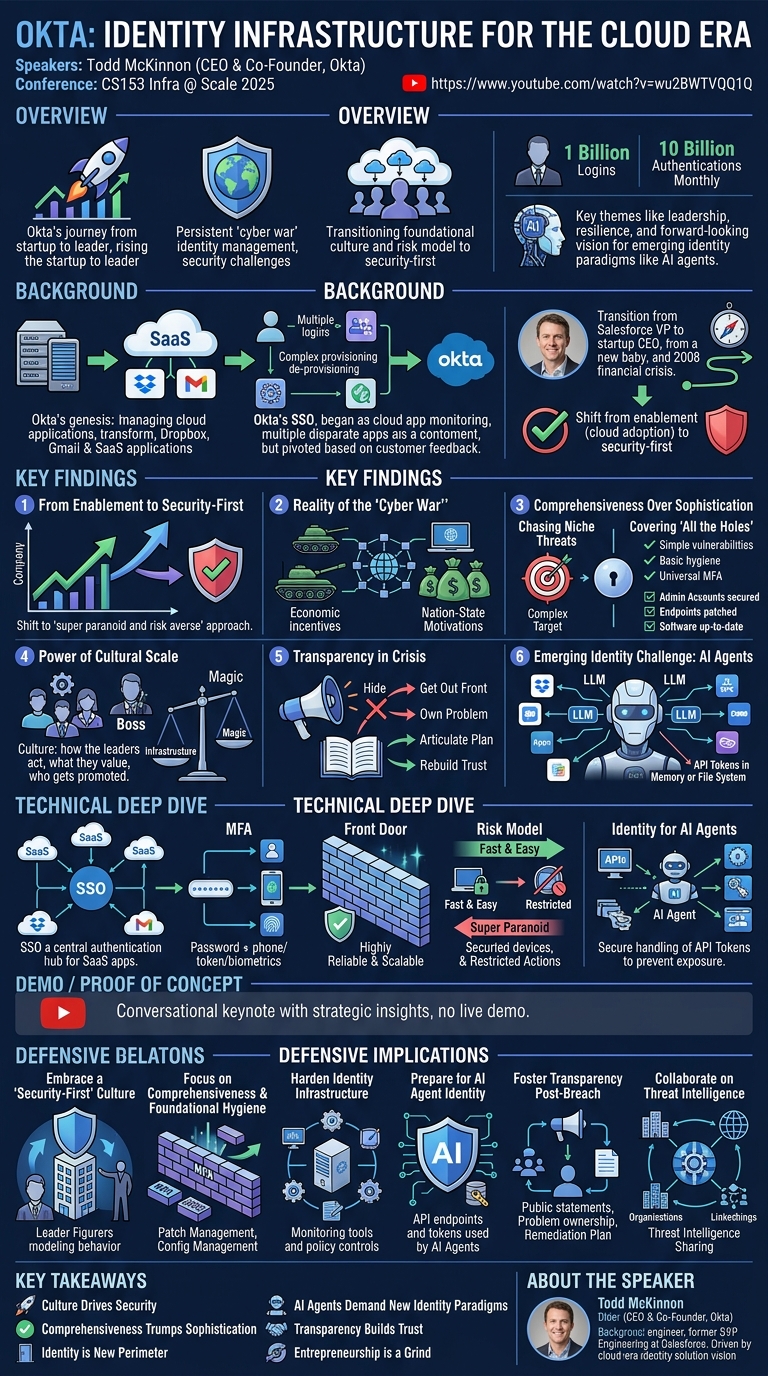
Okta: Identity Infrastructure for the Cloud Era
Speakers: Todd McKinnon (CEO & Co-Founder, Okta)
Conference: CS153 Infra @ Scale 2025
YouTube: https://www.youtube.com/watch?v=wu2BWTVQQ1Q
Overview
In this insightful talk at CS153 Infra @ Scale 2025, Todd McKinnon, CEO and Co-Founder of Okta, delves into the origins of his company, the evolving landscape of identity management, and the critical security challenges faced by modern enterprises. McKinnon offers a candid look at Okta's journey from a startup focused on cloud enablement to a leading identity provider grappling with the realities of a persistent "cyber war." His discussion highlights the profound shift required for a company to transition its foundational culture and risk model to prioritize security above all else, especially when operating at a massive scale.
The discussion with McKinnon is particularly relevant for anyone navigating the complexities of cloud adoption, cybersecurity, and the future of digital identity. Okta, as a company facilitating over a billion logins and ten billion authentications monthly, stands at the nexus of user access and enterprise security. McKinnon's reflections on leadership, overcoming entrepreneurial challenges, and adapting to a threat-laden environment provide invaluable lessons for both aspiring founders and seasoned technical leaders. He not only recounts past struggles, including significant security breaches, but also articulates a forward-looking vision for how organizations, and indeed Okta itself, must harden their defenses and prepare for emerging identity paradigms, such as those involving AI agents.
This talk is not merely a historical account; it's a strategic blueprint for understanding the demands of building and securing critical infrastructure in an era defined by cloud computing and sophisticated cyber threats. McKinnon's emphasis on cultural transformation, comprehensive security, and the often-underestimated challenge of "simple" attacks underscores a fundamental truth in cybersecurity: foundational strength and unwavering vigilance are paramount. His insights into the future of identity, particularly concerning non-human entities like AI agents, position the conversation firmly at the cutting edge of technological evolution and its inherent security implications.
Background
▶ Watch: Introduction of Todd McKinnon, Okta CEO (0:00)
Okta's genesis in 2009 was deeply rooted in a pivotal technological transformation: the widespread adoption of cloud computing and Software-as-a-Service (SaaS) applications. Todd McKinnon, having spent 15 years in engineering roles, including a significant tenure at Salesforce, recognized a burgeoning opportunity. As companies began migrating away from on-premise software to cloud-based solutions like Dropbox and Gmail, a new pain point emerged: managing user access across a disparate ecosystem of applications. Users faced the inconvenience of multiple logins and differing credentials, while IT departments struggled with the complexity of provisioning and de-provisioning access.
McKinnon and his co-founder, Freddy Carris, initially explored ideas like cloud application monitoring but quickly pivoted to identity management based on direct customer feedback. The simple, yet critical, problem of making it easier for employees to log into their work accounts resonated strongly. What appeared on the surface as a tactical Single Sign-On (SSO) solution, McKinnon realized, required building a highly reliable, scalable, and robust infrastructure. This strategic insight allowed Okta to bootstrap a business around a clear customer need, while laying the groundwork for a much larger, impactful company in the long term.
McKinnon also shared personal challenges of transitioning from a comfortable executive role at Salesforce to a startup CEO. At 36, with a new baby and in the wake of the 2008 financial crisis, leaving a secure job was a significant risk. He highlighted the psychological toll of entrepreneurship, especially the need to "believe even when you don't believe" – maintaining optimism and inspiring a team despite the high probability of failure. This personal journey underscored the non-linear path of innovation and the resilience required to build a company that would eventually become a leader in its field.
Over the years, as Okta grew to manage a billion logins and ten billion authentications per month, its role evolved. Initially focused on "enablement" – helping organizations adopt cloud technologies – the company increasingly found itself at the forefront of the "cyber war." McKinnon candidly admitted that Okta's internal culture and risk model, initially geared towards "fast and easy" deployment, did not adapt quickly enough to the heightened threat landscape. This led to painful experiences with security breaches, forcing a fundamental re-evaluation and a profound shift towards a "security-first" mindset, not just in their products but across their entire corporate culture and operations.
Key Findings
▶ Watch: Early product idea (monitoring) failed, leading to pivot (2:20)
McKinnon's talk revealed several critical findings about the current state and future trajectory of identity management and cybersecurity:
- The Shift from Enablement to Security-First: Okta's journey illustrates a vital lesson for any technology company. While initial success may come from enabling new paradigms (like cloud adoption), sustained leadership in critical infrastructure demands an unyielding focus on security. McKinnon acknowledged that Okta initially grew with a culture of "enablement" and "fast and easy" deployment. However, due to its success and the increasing scale of its operations (a billion logins, ten billion authentications monthly), it became a prime target for adversaries. This necessitated a cultural transformation to a "super paranoid and risk averse" approach, where security is the non-negotiable first priority, influencing product development and internal operations alike.
- The Reality of the "Cyber War": McKinnon emphasized that the cyber threat landscape is a very real "war," driven by significant economic incentives (data theft, ransomware, crypto theft) and nation-state motivations (controlling information assets, reputational damage). This war is persistent and requires constant vigilance, not just reactive measures.
- Comprehensiveness Over Sophistication: A surprising but crucial insight from McKinnon was that the majority of successful cyberattacks are not technologically sophisticated. Instead, they exploit basic vulnerabilities and a lack of comprehensiveness in security defenses. The true challenge for large organizations is to cover "all of the holes" – ensuring every identity, account (especially admin accounts), computer, and system is patched, managed, and securely configured. This implies that foundational security hygiene, like universal Multi-Factor Authentication (MFA), is often more impactful than chasing advanced, niche threats.
- The Power of Cultural Scale: McKinnon highlighted that while infrastructure at scale is important, "culture at scale" is "magic." He defined culture simply as "how the leaders act, what they value, what they reward, who gets promoted." A genuine, consistent tone from the top, where leaders walk the walk on security priorities, is essential for driving company-wide change and hardening an organization against threats.
- Transparency in Crisis: In the wake of security breaches, McKinnon learned the importance of transparency and accountability. While the instinct might be to hide, he stressed the necessity of getting "out there in front of it," owning the problem, articulating a clear plan, and reassuring customers and investors. This approach helps rebuild trust, even if the company's reputation "changes" rather than fully "recovers."
- The Emerging Identity Challenge of AI Agents: Looking to the future, McKinnon identified AI agents (building on concepts like daemons and bots) as a significant new frontier for identity. With Large Language Models (LLMs) catalyzing conversational interfaces and trainable work capabilities, these agents will require robust identity management. He pointed out the current security shortcomings in many agent frameworks (e.g., storing API tokens in memory or on file systems), signifying a critical area for future innovation in identity security.
Technical Deep Dive
▶ Watch: Discovering the core identity/login problem for cloud apps (2:55)
Okta's core offering, Single Sign-On (SSO), was born out of the necessity to simplify access to the burgeoning number of SaaS applications in the early cloud era. Instead of users managing separate credentials for each cloud service, Okta provides a centralized authentication mechanism. This allows users to log in once to Okta, and then gain seamless access to all their authorized applications without re-entering credentials. This architecture not only enhances user experience but also provides IT departments with a single control plane for managing access policies and user lifecycles.
Beyond SSO, Okta’s infrastructure is built to support Multi-Factor Authentication (MFA), a critical layer of security that requires users to provide two or more verification factors to gain access to a resource. This could include something they know (password), something they have (a phone, a hardware token), or something they are (biometrics). McKinnon emphasized the importance of making MFA ubiquitous, even for basic access, as a fundamental defense against credential theft.
A key technical challenge for Okta has always been scalability and reliability. As McKinnon reiterated, identity infrastructure must be "very reliable and very very very very scalable" because it serves as the "front door" for an organization's digital resources. This requires a distributed, resilient architecture capable of handling billions of authentications monthly without downtime. The underlying systems must be designed for high availability and fault tolerance, often leveraging cloud-native principles and robust database technologies to ensure continuous operation.
The talk highlighted a profound shift in Okta's risk model. Initially, the focus was on enabling rapid cloud adoption, which sometimes prioritized ease of deployment. However, after experiencing security incidents, Okta underwent a transformation to a "super paranoid and risk averse" stance. This means scrutinizing every aspect of their operations, from infrastructure configuration to employee device policies. For example, the seemingly innocuous practice of allowing sales personnel to use personal cell phones was identified as a significant risk due to potential phishing or malware exposure, leading to a policy change. This level of granular risk assessment and control extends to ensuring all admin accounts are highly secured, endpoints are properly patched, and software versions are up-to-date across the entire enterprise.
Looking ahead, McKinnon delved into the emerging technical frontier of identity for AI agents. He clarified that agents are not entirely new, drawing parallels to traditional daemons in Linux and bots in communication platforms like Slack. The revolutionary aspect, driven by Large Language Models (LLMs), is the conversational interface and trainable capabilities that make these agents immensely powerful and accessible. These agents will increasingly perform tasks by interacting with various services (e.g., calendar, CRM, project management tools).
The critical security challenge identified is the current handling of API tokens by these agent frameworks. McKinnon noted that many frameworks might store these sensitive tokens "in memory or put it on the file system," making them vulnerable if the host machine is compromised. This "simple" vulnerability – akin to finding passwords – underscores the urgent need for new identity and access management solutions specifically designed for non-human entities. These solutions will need to provide secure storage, lifecycle management, and granular authorization for agent identities, preventing token exposure and limiting the blast radius of a compromised agent. This represents a significant area of future development for identity providers like Okta, extending their expertise beyond human-centric identity to the burgeoning world of machine and agent identities.
Demo / Proof of Concept
▶ Watch: The personal challenge of leaving a comfortable executive role (5:00)
Todd McKinnon's talk was a conversational keynote, focusing on strategic insights, entrepreneurial journey, and high-level technical and cultural shifts within Okta and the broader industry. As such, it did not include a live demonstration, code examples, or a specific proof of concept of Okta's products or emerging technologies. The content was primarily analytical and reflective, drawing on real-world experiences and future-oriented predictions.
Defensive Implications
▶ Watch: Todd's personal motivation: 'I just wanted to be the boss' (6:07)
McKinnon's insights offer several critical defensive implications for organizations striving to secure their digital identities and infrastructure:
- Embrace a "Security-First" Culture: The most profound implication is the necessity of embedding security as a non-negotiable, top-tier priority across the entire organization. This isn't just about implementing tools; it's about a cultural shift where every decision, from product development to IT operations and even sales practices, is viewed through a security lens. Leaders must actively model and reward this behavior, making it clear that security is paramount, even if it introduces friction or slows down other initiatives.
- Focus on Comprehensiveness and Foundational Hygiene: Defenders should prioritize covering "all of the holes" rather than solely chasing sophisticated, theoretical threats. This means rigorously implementing and enforcing basic security controls, such as universal Multi-Factor Authentication (MFA) for all users and accounts, including administrative ones. It also entails meticulous patch management across all devices and applications, secure configuration management for all infrastructure components, and robust vulnerability management programs. The "simple" attacks often succeed due to gaps in these fundamental areas.
- Harden Identity Infrastructure: Given that identity is the "front door," organizations must invest in highly reliable and scalable identity management solutions like Single Sign-On (SSO). Beyond deployment, continuous monitoring and hardening of these systems are crucial. Policies should be implemented to restrict risky behaviors, such as the use of personal devices for work-related sensitive tasks, if they cannot be adequately secured and managed.
- Prepare for AI Agent Identity: As organizations increasingly adopt AI agents and automation, defenders must proactively develop strategies for managing their identities. This includes secure provisioning, authentication, and authorization mechanisms for non-human entities. It's imperative to address the current vulnerabilities of API token storage and management in agent frameworks, exploring solutions that prevent tokens from being stored insecurely on file systems or in memory, thereby limiting the impact of a compromised agent.
- Foster Transparency and Accountability Post-Breach: In the inevitable event of a security incident, organizations must adopt a strategy of transparency and accountability. Hiding or downplaying an incident erodes trust. Instead, prepare to communicate clearly, own the problem, articulate a concrete plan for remediation and improvement, and reassure stakeholders. This approach, while difficult, is essential for rebuilding confidence and demonstrating commitment to security.
- Collaborate on Threat Intelligence: Despite legal and liability concerns that often lead to information siloing, McKinnon stressed the importance of industry collaboration for threat intelligence sharing. Defenders should actively seek partnerships with peer organizations and cybersecurity vendors (like CrowdStrike and Palo Alto Networks) to share insights, emerging threat patterns, and best practices. This collective defense strengthens the overall security posture against a common adversary.
Key Takeaways
- Culture Drives Security: A company's culture and risk model must evolve to prioritize security, moving from "enablement" to a "super paranoid and risk averse" stance, especially for critical infrastructure providers. This shift must be driven and consistently reinforced by leadership.
- Comprehensiveness Trumps Sophistication: Most cyberattacks exploit basic vulnerabilities rather than advanced ones. The primary defensive challenge is ensuring comprehensive coverage – securing every account, device, and configuration – rather than over-focusing on highly sophisticated, rare attack vectors.
- Identity is the New Perimeter: With a billion logins and ten billion authentications monthly, robust, scalable, and reliable identity management (SSO, MFA) is paramount. It serves as the critical "front door" to an organization's digital assets.
- AI Agents Demand New Identity Paradigms: The rise of AI agents, powered by LLMs, introduces a significant new challenge for identity management. Organizations must develop secure identity, authentication, and authorization frameworks for non-human entities, particularly addressing the secure handling of API tokens.
- Transparency Builds Trust: In the face of security breaches, open communication, owning the problem, and clearly articulating a remediation plan are crucial for maintaining customer and investor confidence, even if it means acknowledging a changed reputation.
- Entrepreneurship is a Grind: Building a successful company is a long-term commitment that requires immense adaptability, resilience, and the ability to inspire belief despite long odds. It's a continuous investment, much like a relationship, that requires constant effort and a tolerance for monotony.
About the Speaker(s)
Todd McKinnon is the CEO and Co-Founder of Okta, a leading independent provider of identity for the enterprise. He started Okta in 2009, driven by the vision of solving the complex problem of identity management in the rapidly expanding cloud computing and SaaS era. Before founding Okta, McKinnon had a distinguished career in engineering, spending approximately 15 years in the field. Notably, he served as the Senior Vice President of Engineering at Salesforce, where he managed a team of 500 people and contributed to building large-scale infrastructure.
McKinnon's background as an engineer heavily influenced Okta's technical foundation, emphasizing the need for highly reliable and scalable identity solutions. At 36, he embarked on his entrepreneurial journey, navigating the psychological and practical challenges of leaving a comfortable executive position to build a company from scratch. His leadership style, as highlighted in the talk, emphasizes adaptability, the ability to inspire a team through uncertainty, and a deep commitment to cultural transformation, especially in prioritizing security.
Reviews
Simon Wisk (Open Source Developer & AI Tooling Expert) — WEAK
A CEO keynote dressed up as a technical talk. McKinnon is thoughtful and the topics — identity infrastructure, security culture, AI agent identity — are genuinely important. But there's no engineering here to review. This is a founder reflecting on lessons learned, not a builder showing you how anything works. The AI agent identity point is the most interesting thing in the talk, and it's dispatched in three sentences.
Jensen Hitch (AI Compute Platform CEO) — WEAK
Todd McKinnon is a credible operator with hard-won lessons from running identity infrastructure at scale, and the AI agent identity observation is genuinely interesting. But this talk is a founder narrative and cultural reflection, not an infrastructure engineering session. It stays almost entirely at the business and leadership layer — there is no systems reasoning, no constraint analysis, no deployment architecture, and no engineering depth that would help someone building at scale understand anything they couldn't read in a press release. The framing as an infrastructure talk makes the gap worse.
→ Top-rated talks at Stanford CS153: Technology Entrepreneurship — Infra @ Scale (Winter 2025)
All talks from Stanford CS153: Technology Entrepreneurship — Infra @ Scale (Winter 2025)