Skip the Mac, Hit the iPhone: Evasive iMessage Attacks
Swantje Lange (PhD Student at HPI working on 5G Security · Hasso Plattner Institute (HPI))
Objective for the We v4.0 (#OFTW) 2026 · Day 2 · Main Stage
Overview
Swantje Lange, a PhD student at the Hasso Plattner Institute (HPI), presented groundbreaking research into the evasive capabilities of iMessage attacks, specifically demonstrating how attackers can bypass traditional detection methods and target iPhones while "skipping the Mac." Her talk, "Skip the Mac, Hit the iPhone: Evasive iMessage Attacks," unveiled a critical vulnerability in Apple's iMessage protocol that allows for precise device fingerprinting and targeted exploit delivery. This research is particularly pertinent given the pervasive use of spyware like Pegasus, which often leverages zero-click vulnerabilities in messaging services to compromise high-value targets.
Key moments
- 5:30 iMessage's deep iOS integration expands attack surface
- 14:40 Kaspersky's mystery: iMessage attacks only hit iPhones
- 17:00 Apple Identity Service and device 'capabilities' explained
- 19:00 Fingerprinting target devices using iMessage capabilities
- 22:30 Targeted exploit delivery: 'Skip the Mac, hit the iPhone'
- 24:00 Apple's response to device inference and targeting
- 28:00 Q&A: Authenticating iMessage capability requests
Skip the Mac, Hit the iPhone: Evasive iMessage Attacks
Speakers: Swantje Lange, PhD Student at HPI working on 5G Security, Hasso Plattner Institute (HPI)
Conference: Objective for the We
YouTube: https://www.youtube.com/watch?v=pNR8M7wBHz4
Overview
Swantje Lange, a PhD student at the Hasso Plattner Institute (HPI), presented groundbreaking research into the evasive capabilities of iMessage attacks, specifically demonstrating how attackers can bypass traditional detection methods and target iPhones while "skipping the Mac." Her talk, "Skip the Mac, Hit the iPhone: Evasive iMessage Attacks," unveiled a critical vulnerability in Apple's iMessage protocol that allows for precise device fingerprinting and targeted exploit delivery. This research is particularly pertinent given the pervasive use of spyware like Pegasus, which often leverages zero-click vulnerabilities in messaging services to compromise high-value targets.
The talk highlights the unique attack surface presented by iMessage due to its deep integration into the iOS system, contrasting it with sandboxed third-party messaging applications. Lange's team discovered that the Apple Identity Service, a core component of iMessage's end-to-end encryption architecture, inadvertently exposes sensitive information about a target's devices. This allows adversaries to determine specific hardware models and operating system versions, enabling them to deploy highly tailored and stealthy exploits that avoid detection on secondary devices like macOS systems, which are often used for security monitoring and debugging. The findings underscore a significant challenge in securing highly integrated platforms and call for a re-evaluation of data minimization principles within complex communication protocols.
Background
▶ Watch: iMessage's deep iOS integration expands attack surface (5:30)
Smartphones have become indispensable repositories of personal data, making them prime targets for sophisticated adversaries, including state-sponsored actors employing spyware. Such tools, often marketed for legitimate purposes, have been widely documented as being used against journalists, human rights activists, and politicians, enabling comprehensive surveillance and posing significant threats to privacy and even life. Attackers favor remote attack surfaces, with messaging services emerging as a critical vector. Historically, we've seen various remote exploits delivered via SMS phishing, malicious PDFs in WhatsApp groups, and other messaging platforms.
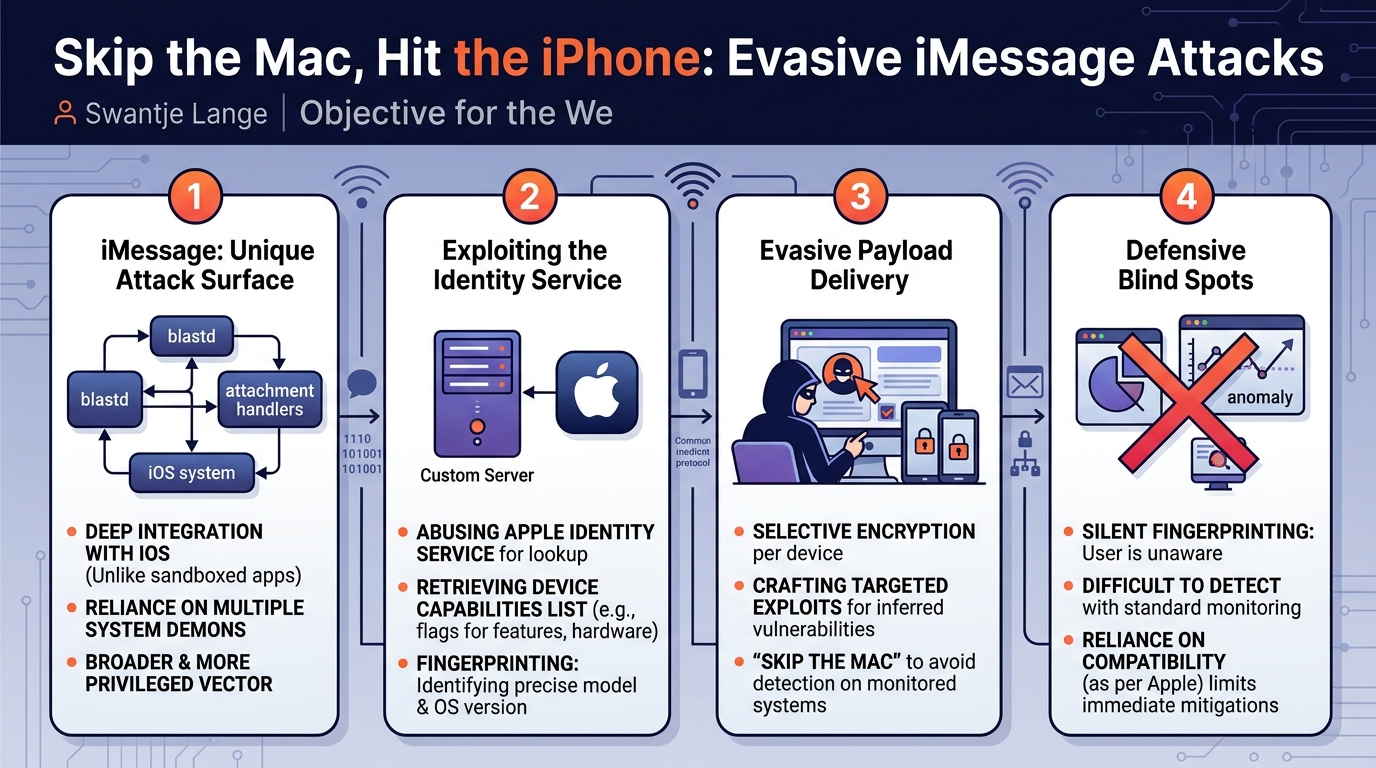
iMessage, however, presents a distinct and more complex attack surface compared to typical sandboxed applications like Signal or WhatsApp. Unlike these apps, iMessage is deeply integrated into the iOS operating system, relying on multiple system demons or processes to function. Key examples include blastd for unpacking messages, a service for identity lookup to retrieve key material for end-to-end encryption, and separate demons for attachment encoding/decoding and message transfer. This intricate architecture means that an exploit targeting one of these system-level components can potentially bypass the usual app sandbox protections, offering a wider and more privileged attack surface.
Previous high-profile iMessage attacks illustrate this vulnerability:
- Forced Entry (2021): A zero-click attack discovered by Citizen Lab, this exploit chain leveraged malicious GIF image files (actually disguised PDFs) to achieve code execution. Researchers observed crashes in the attachment encoding demon, indicating the attack's target. Crucially, Forced Entry involved a BlastDoor bypass, circumventing Apple's security mechanism designed to unpack and sanitize messages. This allowed the malicious payload, often spyware, to be installed without user interaction.
- BlastPass (2023): Another zero-click attack, BlastPass delivered malicious images embedded within PassKit attachments (used for Apple Wallet tickets). This attack exploited a WebP image parser within a chain involving iMessage, Apple Wallet code, and Image I/O components. While BlastDoor did register crashes, indicating it engaged with the malicious input, the exploit still managed to achieve code execution.
- Operation Triangulation (2023): Discovered by Kaspersky targeting its own employees, this zero-click attack used malicious watch face attachments. Initially, Kaspersky detected anomalous network traffic – iPhones connecting to suspicious domains. Deep analysis revealed the exploitation of a font parsing library, leading to a full exploit chain and code execution. A key observation from Operation Triangulation, and a primary motivation for Lange's research, was that the malicious messages only hit the iPhone and were not received on associated Macs, despite the same Apple ID being used. This suggested a mechanism for evasive, device-specific targeting.
Exploits usually leverage unpatched vulnerabilities, most often unknown to vendors (zero-days). These vulnerabilities are highly device-specific, and exploits are not always 100% reliable, sometimes causing crashes. Attackers strive for stealth, aiming to minimize crashes to avoid detection by users or automated reporting mechanisms (like BlastDoor's crash reporting to Apple). To ensure exploits run successfully, attackers must fingerprint target devices, identifying the specific hardware model and operating system version to match the correct exploit. Amnesty International's recent report on Pegasus spyware confirmed that its customers receive a management interface capable of device fingerprinting, emphasizing its importance in modern attacks. For iMessage, such fingerprinting happens silently, invisible to the end-user.
Key Findings
▶ Watch: Apple Identity Service and device 'capabilities' explained (17:00)
The central discovery presented in this talk is the abuse of the iMessage protocol's Apple Identity Service for sophisticated device fingerprinting and targeted exploit delivery. This mechanism allows attackers to precisely identify the hardware model and operating system version of a target's Apple devices and then selectively deliver malicious payloads to specific devices, such as an iPhone, while intentionally bypassing others, like an associated Mac. This capability provides a significant advantage for attackers seeking stealth and evasion, as observed in Operation Triangulation.
The researchers identified that when an iMessage sender (or a custom iMessage client) queries the Apple Identity Service with a receiver's Apple ID (e.g., phone number or email), the service responds not only with the receiver's public key material but also with a list of capabilities. These capabilities are flags indicating various features supported by each of the receiver's devices. By systematically analyzing these capability lists, attackers can reconstruct a detailed profile of the target's hardware and software environment.
Crucially, this fingerprinting allows attackers to craft messages that are specifically formatted to be parsable and exploitable only by a particular device type or OS version. For instance, if an exploit targets a vulnerability unique to a specific iOS version on an iPhone, the attacker can use the inferred capabilities to ensure the malicious message is only delivered to that vulnerable iPhone, avoiding other devices associated with the same Apple ID. This explains the anomaly observed in Operation Triangulation, where malicious messages reached iPhones but not Macs, effectively "skipping the Mac" to avoid detection on a potentially monitored debugging system.
Technical Deep Dive
▶ Watch: Fingerprinting target devices using iMessage capabilities (19:00)
The iMessage protocol, at its core, relies on end-to-end encryption. When a sender initiates a message, their device transparently queries the Apple Identity Service to retrieve the public key material for all of the receiver's registered devices. This ensures that the message can be encrypted individually for each device, allowing for decryption on multiple platforms (iPhone, iPad, Mac, Apple Watch) and maintaining consistent chat history across the sender's own devices.
The critical component enabling evasive attacks is the capabilities list returned by the Apple Identity Service. Alongside public keys, this list enumerates various features supported by each receiving device. These capabilities can encompass a wide range of attributes, including:
- Cryptographic features: Indicating supported encryption algorithms or protocols.
- Parental control features: Signifying the presence of restrictions.
- Hardware-specific features: Such as satellite communication support.
- iMessage application features: Like support for polls, animated emojis, or specific attachment types.
The purpose of these capabilities, as stated by Apple, is to ensure compatibility. By knowing a device's capabilities, the sending device can format the message appropriately, guaranteeing that the receiving device can successfully decode and render it, even if the receiving device is offline at the time of sending. This design, while convenient for user experience, inadvertently creates a powerful fingerprinting vector.
Attackers can leverage this by using custom iMessage clients. Projects available on GitHub, such as Rust Push or Blue Bubbles, provide open-source implementations of the iMessage protocol. These clients can be modified to query the Apple Identity Service directly with a target's Apple ID (e.g., phone number or email address). The service then returns a JSON-like structure containing various capabilities, some with version numbers, boolean flags (true/false), or "N/A" values.
To build a comprehensive fingerprinting database, researchers (and by extension, sophisticated attackers) can perform several steps:
- Self-Querying: An attacker can query the Apple Identity Service using their own Apple ID, which is linked to their own devices (e.g., a MacBook and an iPhone). By observing the returned capabilities, they can establish a baseline for known devices. For example, a capability like
prefersSDR=1.0might indicate an Apple Watch, whileshowPeerErrors=N/Amight be characteristic of a MacBook. - Firmware Analysis: To gather more extensive data, attackers can download publicly available Apple firmware images for various devices (iPhones, iPads, Macs, Apple Watches, Apple Vision Pro) and different operating system versions (e.g., iOS 18, iOS 26, watchOS, visionOS, macOS, iPadOS). By extracting and analyzing the capabilities embedded within these firmware images, a comprehensive database can be constructed, mapping specific capability sets to precise hardware models and software versions.
- Capability Evolution: The number of capabilities returned by the Apple Identity Service tends to increase with newer iOS versions, reflecting the introduction of new iMessage features. This trend allows attackers to infer the general age and, therefore, the approximate operating system version of a target device based on the size and content of its capability list. A smaller set of capabilities often points to an older iOS version.
Once this database is established, an attacker can:
- Fingerprint a Target: Query the Apple Identity Service with the target's Apple ID.
- Match Capabilities: Compare the returned capabilities against their database to identify the target's specific hardware (e.g., iPhone 15, Apple Watch Series 9) and OS version (e.g., iOS 17.3).
- Targeted Exploit Delivery: Using a custom iMessage client, the attacker can then craft an exploit payload and use the inferred capabilities to instruct the Apple Identity Service to deliver this payload only to the specific vulnerable device (e.g., an iPhone running a particular iOS version known to have an unpatched vulnerability), while explicitly excluding other devices associated with the same Apple ID (e.g., a Mac that might be used for debugging or is not vulnerable to that specific exploit). This leverages the per-device encrypted channels, effectively ensuring the exploit "ends up at the right device" and remains undetected on other linked systems.
Demo / Proof of Concept
▶ Watch: Apple's response to device inference and targeting (24:00)
While the talk did not feature a live demonstration of an exploit, the speaker, Swantje Lange, meticulously detailed the methodology and evidence gathered during her team's research to prove the feasibility of these evasive iMessage attacks. The "proof of concept" lies in their systematic approach to understanding and exploiting the Apple Identity Service's behavior.
The research began by analyzing the anomalous observations from Operation Triangulation, where malicious iMessages only reached iPhones and not associated Macs. This anomaly spurred their investigation into how such selective delivery could occur.
Their methodology involved:
- Protocol Analysis: Deep diving into the iMessage protocol, particularly the interactions with the Apple Identity Service, to understand how device information is exchanged.
- Custom Client Development/Utilization: Employing or developing custom iMessage clients (similar to open-source projects like Rust Push or Blue Bubbles) to programmatically query the Apple Identity Service. This allowed them to act as an attacker, sending identity requests with target Apple IDs and observing the raw responses.
- Capability Mapping: Systematically collecting and analyzing the capabilities lists returned by the service for various known Apple devices (their own iPhones, Macs, Apple Watches) running different operating system versions.
- Firmware Extraction: Expanding this dataset by extracting capability information directly from publicly available Apple firmware images across a wide range of devices and OS versions. This step allowed them to build a comprehensive database correlating specific capability sets with precise hardware models and software versions.
- Inference Validation: By comparing the capabilities returned from live queries against their compiled database, they could reliably infer the hardware and software versions of target devices. They demonstrated, for example, how specific capability flags (e.g.,
prefersSDR=1.0for Apple Watch,showPeerErrors=N/Afor MacBooks) could be used for precise device type identification. - Targeted Delivery Simulation (Conceptual): While not executing a live exploit, their findings conceptually proved how an attacker, armed with this fingerprinting data, could then configure their custom iMessage client to specifically target only those devices matching a particular vulnerability profile, thereby "skipping" other devices. This validation confirmed the mechanism behind the evasive behavior seen in real-world attacks.
This rigorous analytical and data-driven approach served as the robust proof of concept for their key findings, demonstrating the practical exploitability of the Apple Identity Service for device fingerprinting and selective payload delivery.
Defensive Implications
▶ Watch: Q&A: Authenticating iMessage capability requests (28:00)
The findings presented by Swantje Lange highlight a significant blind spot for defenders and users within the Apple ecosystem. The ability to silently fingerprint devices and deliver targeted exploits to iPhones while bypassing other devices makes detection extremely challenging.
Apple's Stance:
Upon disclosure of these findings, Apple acknowledged the existence of the capability lists, stating they are necessary for compatibility and ensuring messages are correctly formatted and decodable across diverse devices and OS versions. They argued that removing this feature would break compatibility with new iMessage features or necessitate complex fallback logic. Apple indicated that they continuously assess data minimization in their systems and "might consider this later," which Lange humorously noted did "not really sound like a fix."
Regarding the ability to target single devices, Apple confirmed that they use "encrypted channels per device" and that capabilities are essential for correct message handling. They viewed this selective delivery as a "natural consequence of those channels," suggesting a lack of immediate intent to alter this fundamental behavior.
Challenges for Defenders:
- Stealth: The primary implication is the enhanced stealth of attacks. If an attacker knows a Mac is being used for monitoring (as Kaspersky did with tools like Frida), they can simply avoid sending the malicious payload to that device, making it harder to capture and analyze.
- User Blindness: Users have no visibility into the capability queries being made against their Apple IDs. There is no notification or consent mechanism, making them entirely unaware of the fingerprinting process.
- Difficulty in Detection: Traditional security measures that rely on observing anomalies across all devices linked to an account may fail if the malicious activity is confined to a single, specific device. Kaspersky's initial detection of Operation Triangulation relied on network traffic analysis, which proved effective but is not a common capability for average users.
Proposed Mitigations (from the speaker):
Swantje Lange proposed two main mitigation strategies for Apple:
- Initial Contact Acceptance: Restrict capability lookups to only occur after an initial contact request from the sender has been accepted by the target. This would prevent arbitrary querying of any Apple ID by malicious clients.
- Local Capability Caching: Allow devices to cache the capabilities of their contacts locally and only update them periodically from a central server. This would reduce the frequency and utility of direct queries to the Apple Identity Service.
- Centralized Anomaly Detection: Apple's servers handle iMessage traffic. They could potentially implement checks to detect messages that are intentionally sent to only a subset of a user's devices when typically all devices would receive the message. Such an anomaly could flag potential targeted attacks.
Given Apple's current response, these mitigations do not appear to be on their immediate roadmap, leaving users vulnerable to this specific type of evasive attack. Defenders, particularly in high-risk environments, must remain vigilant about network-level anomalies and consider specialized monitoring solutions that can inspect traffic from individual iOS devices, rather than relying solely on cross-device synchronization for attack visibility. The research also highlighted that other privacy issues related to iMessage, detailed in their upcoming paper, remain under review by Apple, indicating further areas of concern.
Key Takeaways
- iMessage's Deep Integration Creates Unique Attack Surface: Unlike sandboxed apps, iMessage's reliance on multiple system demons (e.g.,
blastd, attachment handlers) provides a broader and more privileged attack surface within iOS. - Apple Identity Service Enables Device Fingerprinting: The core finding is that the Apple Identity Service, used for end-to-end encryption key exchange, inadvertently exposes a capabilities list that can be abused to precisely determine a target's hardware model and operating system version.
- Targeted Exploit Delivery is Possible and Evasive: Attackers can use custom iMessage clients and the inferred capabilities to deliver malicious payloads exclusively to a vulnerable device (e.g., an iPhone) while intentionally bypassing others (e.g., a Mac used for monitoring), enhancing attack stealth and evasion.
- Real-World Precedent: Operation Triangulation: The observation that Operation Triangulation attacks only hit iPhones and not Macs was a key motivator for this research, confirming the real-world impact of this evasive technique.
- Apple's Response Highlights Compatibility Challenges: Apple acknowledges the technical necessity of capability lists for system compatibility but has not committed to immediate mitigations, citing potential breakage of features or increased complexity.
- Defenders Face Increased Challenges: The silent nature of fingerprinting and the ability to selectively target devices make these attacks extremely difficult for users to detect and for traditional security monitoring tools to intercept, necessitating advanced network-level vigilance.
About the Speaker(s)
Swantje Lange is a PhD student at the Hasso Plattner Institute (HPI), where her research focuses on security and cellular networks, particularly 5G security. Her work often involves in-depth analysis of mobile phone technologies and their underlying network infrastructures. Beyond her research, Lange is actively involved in organizational aspects of conferences, demonstrating her commitment to the academic and security communities. Her current research into iMessage security underscores her expertise in identifying and analyzing vulnerabilities within complex communication systems.
Reviews
Dr. Zero (Offensive Security Researcher) — STRONG ACCEPT
Solid protocol-level research that explains something we saw in the wild (Operation Triangulation's Mac-skipping behavior) and turns it into a reproducible fingerprinting technique. Not a full exploit chain, but the capability-list abuse is concrete, novel, and has clear offensive implications. Would've been a 5 if they'd shown the fingerprinting database in action against blind targets or pushed harder on the privacy implications Apple is sitting on.
Heather Calloway (CISO) — STRONG ACCEPT
This is material every CISO with an executive protection program needs to understand. The Apple Identity Service leaks enough device metadata to let attackers fingerprint hardware and OS versions, then deliver exploits only to vulnerable iPhones while bypassing Macs used for monitoring. Apple's response—'it's for compatibility'—means this isn't getting fixed soon.