A closer look at Quick Start - Emulating a new iPhone
Sebastian Schnorbus (Mobile Security Research)
Objective for the We v4.0 (#OFTW) 2026 · Day 2 · Main Stage
Overview
In this insightful talk at Objective for the We, Sebastian Schnorbus, a mobile security researcher, delved into the intricacies of Apple's Quick Start feature. Quick Start is a core utility designed to facilitate the seamless migration of user data from an existing iOS device to a new iPhone or iPad. Schnorbus’s research, which formed the basis of his master's thesis, aimed to demystify the underlying proprietary wireless protocol stack, assess its security posture, and ultimately explore the feasibility of reimplementing this functionality on non-Apple hardware.
Key moments
- 0:00 Introduction: Why reverse engineer iOS Quick Start?
- 1:56 Reverse engineering methodology: binaries, decompilers, Frida hooks
- 3:47 BLE pairing: visual code and Secure Remote Password protocol
- 8:09 Quick Start transfers full iOS backup, including keychain
- 10:01 Demo: Python reimplementation extracting sensitive iPhone data
- 12:15 Security analysis and iOS 17 reauthentication changes
- 14:06 EU DMA impact: new interoperable migration protocol
- 16:15 Q&A: Brute-forcing the 6-digit pairing code
A closer look at Quick Start - Emulating a new iPhone
Speakers: Sebastian Schnorbus, Mobile Security Research
Conference: Objective for the We
YouTube: https://www.youtube.com/watch?v=suqDaOC68O4
Overview
In this insightful talk at Objective for the We, Sebastian Schnorbus, a mobile security researcher, delved into the intricacies of Apple's Quick Start feature. Quick Start is a core utility designed to facilitate the seamless migration of user data from an existing iOS device to a new iPhone or iPad. Schnorbus’s research, which formed the basis of his master's thesis, aimed to demystify the underlying proprietary wireless protocol stack, assess its security posture, and ultimately explore the feasibility of reimplementing this functionality on non-Apple hardware.
The motivation behind this deep dive is compelling: Quick Start handles an extensive array of highly sensitive personal data. This includes Wi-Fi credentials, device passcodes, Apple ID tokens, eSIM profiles, and a user's entire collection of photos and videos. Such a treasure trove of information naturally presents an attractive target for attackers. Schnorbus's work provides a critical understanding of how this sensitive data transfer operates, revealing both its robust security mechanisms and potential vulnerabilities discovered prior to iOS 17. The implications of this research extend from enhancing defensive strategies for iOS users to broader discussions around data ownership and interoperability.
Background
▶ Watch: Introduction: Why reverse engineer iOS Quick Start? (0:00)
Apple's Quick Start feature streamlines the initial setup of a new iOS device by allowing users to wirelessly transfer their entire digital life from an old device. This convenience, however, necessitates the secure handling of a vast amount of personal and sensitive data. The data transferred encompasses not only user-generated content like photos, videos, and documents but also critical system-level information such as saved Wi-Fi credentials, the device passcode, Apple ID details for passwordless login, and even the iOS keychain, which stores website passwords and other secrets. The sheer volume and sensitivity of this data make Quick Start a prime candidate for security scrutiny.
Schnorbus's research methodology involved a multi-pronged approach to reverse engineer Apple's proprietary protocols. The initial step leveraged syslogs, system-level logs that provide external observations of device functionality. By employing debug profiles, more verbose logging was enabled, allowing for the generation of packet captures of both Bluetooth Low Energy (BLE) and Wi-Fi (specifically AWDL, Apple Wireless Direct Link) communications. These packet captures were then loaded into Wireshark, where standard protocols could be analyzed, and custom extensions were developed to parse Apple's proprietary data formats.
To gain internal visibility, Schnorbus extracted binaries from either a jailbroken iPhone or directly from iOS firmware archives. These binaries were then subjected to static analysis using decompilers such as Ghidra and IDA Pro, providing a high-level view of the underlying code. Recognizing the limitations of static analysis, dynamic reversing techniques were also employed. Frida, a dynamic instrumentation toolkit, proved invaluable for hooking into critical function calls, allowing the researcher to dump data directly from memory. This dynamic approach was particularly effective for extracting encryption keys, enabling the decryption and subsequent analysis of the intercepted data streams. This comprehensive methodology allowed Schnorbus to meticulously reconstruct the Quick Start protocol stack.
Key Findings
▶ Watch: BLE pairing: visual code and Secure Remote Password protocol (3:47)
Sebastian Schnorbus's reverse engineering efforts revealed a sophisticated, multi-stage protocol for Apple's Quick Start, designed to ensure both efficiency and security during sensitive data migration. The process begins with the new iPhone broadcasting a specific payload via Bluetooth Low Energy (BLE). Nearby existing iPhones detect this advertisement and display a "Set up your new iPhone" popup. Upon user interaction (clicking "Continue"), the old iPhone initiates a BLE connection to the new device.
The initial BLE phase involves several critical steps:
- Proprietary Protocol Negotiation: Apple employs a custom protocol to establish and negotiate the BLE communication channel.
- Pairing (Pair Setup): An authentication step known as "pair setup" is performed. This involves a visual pairing code displayed on the new iPhone, which the old iPhone scans. Alternatively, a six-digit numeric code can be manually entered. This pairing mechanism is an implementation of the Secure Remote Password (SRP) protocol, a password-authenticated key exchange (PAKE) protocol. SRP ensures that both devices possess the correct pairing code before a shared secret can be successfully established. This shared secret is then used to derive encryption keys.
- Encrypted Communication: All subsequent BLE communication is encrypted using ChaCha20-Poly1305, an authenticated encryption cipher, providing both confidentiality and integrity.
- Data Serialization: Application payloads within the encrypted channel are encoded using OPEC, a custom Apple data serialization format akin to JSON but with a more efficient binary encoding. Messages are structured as requests and responses. Early BLE exchanges involve the new iPhone requesting data such as Wi-Fi credentials, device information, passcode validation, and Apple ID tokens (including NSET data for passwordless Apple ID login) from the old iPhone.
Once the initial BLE communication is complete, the process transitions to AWDL (Apple Wireless Direct Link). AWDL is Apple's proprietary peer-to-peer wireless technology, also utilized in features like AirDrop, and is based on 802.11 frames, offering Wi-Fi-comparable data rates.
- AWDL Service Discovery: AWDL uses a standard MDNS-based service discovery mechanism to advertise an IPv6 address and a TCP port for the new iPhone. The old iPhone then connects to this endpoint.
- Second Pairing (Pair Verify): To ensure continuity and prevent man-in-the-middle attacks during the transition, a non-interactive "pair verify" mechanism is executed. This protocol leverages a pair of elliptic curve keys that were negotiated during the initial BLE connection. It uses an elliptic curve Diffie-Hellman (ECDH) exchange to create a secure channel and employs digital signatures to cryptographically verify that the devices are still communicating with the same trusted counterpart. This again results in a shared secret for deriving encryption keys for the TCP channel.
- Main Data Transfer: The core of Quick Start involves the transfer of an entire iOS backup over this encrypted AWDL TCP channel. This backup is largely equivalent to an encrypted backup performed via a physical cable, containing photos, videos, documents, app data, and crucially, the iOS keychain. The keychain export includes a keybag and a password, providing the necessary means to at least partially decrypt its contents, granting access to sensitive items like saved Safari website passwords, Wi-Fi credentials, and even Find My keys. File messages during this stage are further encoded in multiple Apple-specific ways and compressed for efficiency.
Technical Deep Dive
▶ Watch: Demo: Python reimplementation extracting sensitive iPhone data (10:01)
The technical architecture of Quick Start is a testament to Apple's layered approach to wireless communication and security. The initial phase, leveraging Bluetooth Low Energy (BLE), serves as the discovery and initial secure channel establishment mechanism. The new iPhone advertises its presence with a specific BLE payload, which is picked up by nearby iOS devices. Upon user consent, a BLE connection is formed, and a proprietary protocol is used to negotiate the specifics of this communication channel.
The first critical security component is the Pair Setup protocol. This is Apple's implementation of the Secure Remote Password (SRP) protocol, a robust password-authenticated key exchange (PAKE). Unlike a simple Diffie-Hellman exchange, SRP ensures that a shared secret can only be derived if both parties know a pre-shared password – in this case, the 6-digit numeric pairing code visually displayed on the new iPhone. This design makes SRP resistant to offline dictionary attacks, as each pairing attempt requires interactive communication, which can be rate-limited by the device. The result of a successful SRP exchange is a cryptographically strong shared secret, from which symmetric encryption keys are derived. All subsequent BLE traffic is then secured using ChaCha20-Poly1305, an authenticated encryption algorithm renowned for its speed and security, providing both confidentiality and protection against tampering.
Within this encrypted BLE tunnel, application-level messages are serialized using OPEC. While the talk didn't delve into the precise specification of OPEC, it was described as a binary data serialization format similar to JSON but optimized for efficiency. These OPEC-encoded messages facilitate the exchange of initial setup data. The new iPhone sends specific requests to the old iPhone to retrieve critical information such as Wi-Fi credentials, device identification data, and, significantly, validation for the user's passcode. Furthermore, the protocol allows for the transfer of Apple ID tokens and NSET data, which are essential for enabling passwordless login to the user's Apple ID on the new device. This early data exchange is crucial for the new device to establish network connectivity and authenticate the user's identity seamlessly.
Following the initial BLE-based setup, the Quick Start process transitions to AWDL (Apple Wireless Direct Link) for the bulk data transfer. AWDL is a proprietary Wi-Fi-based, peer-to-peer networking technology that bypasses traditional Wi-Fi access points, allowing devices to communicate directly at high speeds. It operates on the 802.11 standard, making it suitable for transferring large volumes of data like an entire iOS backup. The transition is managed through MDNS (Multicast DNS), a standard protocol used for service discovery on local networks. The new iPhone advertises an IPv6 address and a TCP port via MDNS, to which the old iPhone then connects, establishing a high-bandwidth TCP channel.
A second crucial security mechanism, Pair Verify, is executed over this new AWDL TCP channel. This non-interactive protocol serves to re-authenticate the connection and prevent an attacker from hijacking the data transfer midway. It leverages elliptic curve keys that were established and exchanged during the preceding BLE phase. An elliptic curve Diffie-Hellman (ECDH) exchange is performed to establish a new shared secret, and cryptographic signatures, also derived from the previously established keys, are used to verify the identity of the communicating devices. This ensures that the old iPhone is indeed still talking to the same new iPhone it initially paired with over BLE. The resulting shared secret then secures all subsequent TCP communication with encryption keys.
The primary function of the AWDL phase is the transfer of a complete iOS backup. This is not merely a subset of user data but an extensive snapshot of the old device's contents. It includes all user-generated content (photos, videos, documents), application data, and critically, the iOS keychain. The keychain is a secure database storing sensitive credentials, including saved website passwords from Safari, various Wi-Fi network passwords, and even Find My keys, which could potentially be used to track other devices associated with the Apple ID. Schnorbus highlighted that this wirelessly transferred backup is functionally equivalent to an encrypted backup performed via a physical cable, including the presence of a keybag and a password that allows for the partial decryption of the keychain's contents. The files within this backup are further optimized for transfer through Apple-specific encodings and compression algorithms.
Demo / Proof of Concept
▶ Watch: Security analysis and iOS 17 reauthentication changes (12:15)
Sebastian Schnorbus's research culminated in a practical demonstration: a reimplementation of the Quick Start protocol on a standard laptop using Python. This Command Line Interface (CLI) tool successfully emulated the behavior of a new iPhone, allowing it to initiate and receive data from a genuine iOS device. The choice to emulate the new iPhone was strategic, as it is the "receiving" end, thus obtaining a wealth of sensitive data with minimal outbound transmission.
The recorded demo showcased the following sequence:
- BLE Advertisement: The Python tool, running on the laptop, broadcast the specific BLE advertisement payload.
- User Prompt: A nearby iPhone detected this advertisement and displayed the "Set up your new iPhone" popup, visually confirming the successful emulation of the initial discovery phase.
- BLE Communication: Upon the user clicking "Connect" on the physical iPhone, the BLE communication commenced. The Python tool then initiated the Pair Setup exchange. For demonstration purposes, a pairing code of 123456 was hardcoded into the tool, which the user would then manually enter or visually confirm on the iPhone.
- Data Requests: During the encrypted BLE phase, the Python tool requested critical information from the old iPhone, including device information, Wi-Fi credentials, and Apple ID tokens.
- AWDL Transition: After the BLE phase, the system seamlessly transitioned to AWDL communication. The Python tool then performed the Pair Verify exchange to re-authenticate the connection over the new TCP channel.
- File Reception: Immediately following the AWDL pairing, the Python tool began receiving files from the iPhone. The demo clearly showed the keychain export being among the first files received, followed by a rapid scroll of other data, demonstrating the successful transfer of the entire iOS backup.
- Completion: For the demo, an iPhone with limited data was used, resulting in a fast transfer. Upon completion, the physical iPhone displayed the prompt to erase the old device, signifying the successful conclusion of the Quick Start process from the perspective of the emulated new device.
This proof of concept unequivocally demonstrated the feasibility of intercepting sensitive Quick Start data without requiring a physical Apple device, highlighting the importance of understanding the underlying protocols for security analysis.
Defensive Implications
▶ Watch: Q&A: Brute-forcing the 6-digit pairing code (16:15)
The detailed reverse engineering of Quick Start by Sebastian Schnorbus provides crucial insights for defenders. Prior to iOS 17, the security posture of Quick Start presented a significant vulnerability: if an attacker gained temporary, unsupervised physical access to an iPhone, they could initiate a Quick Start transfer to a malicious, emulated "new iPhone" (like the Python tool) and exfiltrate a vast amount of sensitive data, potentially without the legitimate user immediately noticing due to the wireless nature of the transfer. This scenario was particularly concerning given the breadth of data transferred, including the iOS keychain.
However, Apple addressed this critical attack vector in iOS 17. As Schnorbus noted, a vital reauthentication measure was implemented. Now, before any Bluetooth connection can even be initiated for Quick Start, the user must reauthenticate with their passcode, Face ID, or Touch ID. This fundamental change significantly elevates the security requirements, making unauthorized wireless data exfiltration much more difficult, as it mandates explicit user consent and authentication for each transfer. This is a robust defense against opportunistic attackers.
The talk also highlighted the strength of Apple's pairing mechanisms. Both Pair Setup (using SRP) and Pair Verify (using ECDH and signatures) are highly effective at mitigating Man-in-the-Middle (MITM) attacks. The SRP protocol, in particular, relies on the user visually confirming or manually entering a 6-digit numeric code. While six digits might seem to offer limited entropy, the interactive nature of SRP means that an attacker cannot simply brute-force the code offline. Each attempt requires a full, interactive exchange, which can be rate-limited by the device, making brute-forcing impractical and easily detectable. Therefore, for an MITM attack to succeed, the attacker would need to know the pairing code, which in a typical setup scenario would involve the legitimate user actively providing it, or the attacker having physical proximity to observe it.
A key enabler for Schnorbus's reimplementation was the apparent lack of hardware platform verification or MFI (Made For iPhone/iPad) countermeasures. Had Apple implemented cryptographic checks to verify that the "new iPhone" was indeed genuine Apple hardware, the Python-based emulation would have been significantly more challenging, if not impossible. This finding suggests that while the cryptographic protocols themselves are strong, the system relied on the assumption that only trusted Apple devices would engage in the Quick Start process.
Finally, Schnorbus briefly touched upon the implications of the EU's Digital Markets Act (DMA), which mandates interoperable device migration features between platforms like iOS and Android. Apple and Google have since implemented such a feature, which uses a completely different protocol stack (SixLoWPAN, HTTP, TLS, custom TLS extension, and PAKE). Interestingly, Schnorbus discovered that Apple initially repeated its "mistake" by omitting reauthentication in an early iOS beta of this new interoperable feature. However, this oversight was corrected before he could report it, preventing a potential bug bounty but demonstrating Apple's responsiveness to security considerations, even in new protocol implementations. While this new interoperable feature makes Schnorbus's original Quick Start reimplementation less relevant for cross-platform data migration, his work remains invaluable for understanding Apple's proprietary protocols and their evolution.
Key Takeaways
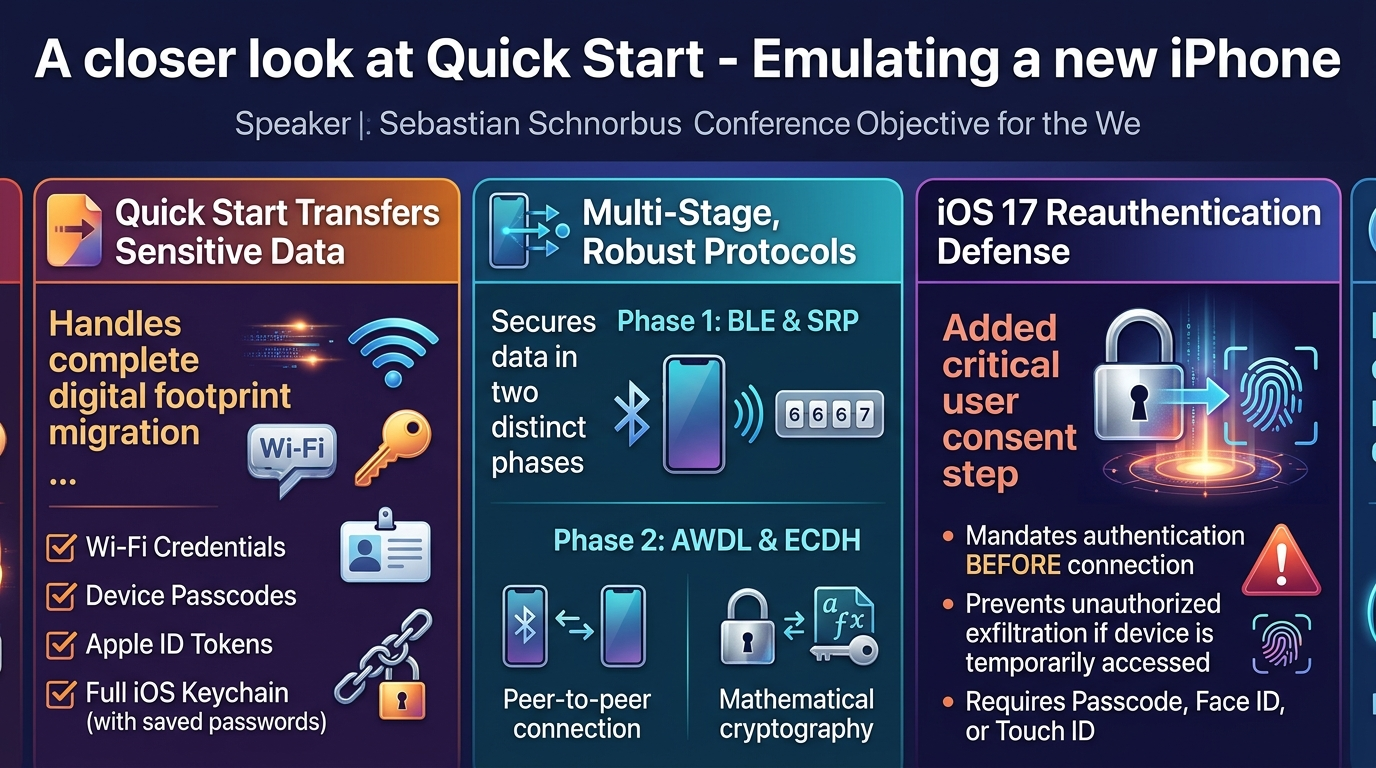
- Quick Start transfers highly sensitive data: Apple's Quick Start feature facilitates the migration of a user's entire digital footprint, including Wi-Fi credentials, passcodes, Apple ID tokens, and critically, the iOS keychain containing saved passwords and other secrets.
- Multi-stage, robust cryptographic protocols: The process involves a complex two-stage secure channel establishment using BLE and AWDL. Secure Remote Password (SRP) and Elliptic Curve Diffie-Hellman (ECDH), along with ChaCha20-Poly1305 encryption, secure the data transfer against eavesdropping and tampering.
- iOS 17 introduced critical reauthentication: A significant security enhancement in iOS 17 requires passcode, Face ID, or Touch ID reauthentication before the Quick Start process can even initiate, effectively mitigating the pre-iOS 17 vulnerability of unauthorized data exfiltration with temporary device access.
- Strong pairing mechanisms resist brute-forcing: The interactive nature of the SRP pairing protocol, requiring a 6-digit code and real-time communication, makes brute-forcing attempts impractical and subject to rate limiting, thus protecting against offline dictionary attacks.
- Lack of hardware verification enabled reimplementation: The absence of specific hardware platform verification or MFI countermeasures was a key factor allowing the successful reimplementation of the "new iPhone" role on a standard laptop, highlighting a potential area for future hardening by Apple.
- Interoperability features use different, yet familiar, security patterns: The new EU-mandated interoperable migration feature, while using a distinct protocol stack, still relies on Password Authenticated Key Exchange (PAKE) protocols, demonstrating Apple's consistent approach to securing key exchanges.
About the Speaker(s)
Sebastian Schnorbus is a mobile security researcher whose work focuses on understanding and analyzing the security of mobile device protocols. His presentation at Objective for the We was based on his master's thesis, where he undertook the challenging task of reverse engineering Apple's proprietary Quick Start feature. His expertise lies in dissecting complex wireless communication stacks, utilizing tools like syslogs, packet captures, decompilers (Ghidra, IDA Pro), and dynamic analysis frameworks such as Frida to uncover internal mechanisms and security implications.
Reviews
Dr. Zero (Offensive Security Researcher) — STRONG ACCEPT
Solid reverse engineering work on a proprietary Apple protocol stack that actually handles real secrets. The pre-iOS 17 attack surface finding was meaningful, the methodology was sound, and the Python reimplementation proves the research was thorough. Not a novel exploit class, but genuine technical depth on an under-documented target.
Heather Calloway (CISO) — SOLID
Solid reverse-engineering work that matters for anyone running mobile device management at scale. The iOS 17 reauthentication fix is the headline — if your fleet hasn't upgraded, you have a data exfiltration risk from temporary physical access. Competent research, narrow audience.