Venturing beyond iOS: Exploring Co-Processor Firmware
Lukas Arnold (Mobile Security Research)
Objective for the We v4.0 (#OFTW) 2026 · Day 2 · Main Stage
Overview
In this insightful talk from Objective for the We, Lukas Arnold, a PhD student at TU Darmstadt, takes attendees on an "adventure beyond the realms of the iPhone's operating system" to explore the often-overlooked firmware running on co-processors. While the iOS application processor (AP) receives significant security scrutiny and mitigation efforts, Arnold highlights that co-processors are critical components enabling essential features like AirDrop, always-on displays, and satellite connectivity, yet they often harbor complex, decades-old protocol stacks that are difficult to implement securely. The talk emphasizes that vulnerabilities in these co-processors can have profound security implications for the entire device, citing the Operation Triangulation exploit chain where attackers leveraged GPU registers to bypass advanced memory mitigations on the CPU.
Key moments
- 0:00 Introduction: Why co-processor firmware security matters
- 2:00 Past exploits highlight co-processor vulnerabilities
- 3:55 The critical role of the iPhone's baseband processor
- 4:50 Why baseband exploitation is a significant, stealthy threat
- 7:40 Analyzing Apple's new C1 baseband: hardware, iOS, firmware
- 12:00 Extracting and reverse engineering the unencrypted baseband firmware
- 14:30 Detailed security architecture: chain of trust and compartments
- 16:45 Apple's baseband security now on par with application processors
Venturing beyond iOS: Exploring Co-Processor Firmware
Speakers: Lukas Arnold, Mobile Security Research
Conference: Objective for the We
YouTube: https://www.youtube.com/watch?v=rk5rnsuFroQ
Overview
In this insightful talk from Objective for the We, Lukas Arnold, a PhD student at TU Darmstadt, takes attendees on an "adventure beyond the realms of the iPhone's operating system" to explore the often-overlooked firmware running on co-processors. While the iOS application processor (AP) receives significant security scrutiny and mitigation efforts, Arnold highlights that co-processors are critical components enabling essential features like AirDrop, always-on displays, and satellite connectivity, yet they often harbor complex, decades-old protocol stacks that are difficult to implement securely. The talk emphasizes that vulnerabilities in these co-processors can have profound security implications for the entire device, citing the Operation Triangulation exploit chain where attackers leveraged GPU registers to bypass advanced memory mitigations on the CPU.
Arnold's research specifically targets wireless co-processors, which present a unique attack surface due to their ability to receive signals over the air via a Software Defined Radio (SDR). The primary focus is on the baseband processor, a crucial wireless co-processor responsible for cellular connectivity, GNSS (GPS, Galileo), and emergency satellite features. The security of basebands has historically been considered weaker than that of the main application processor. However, with Apple's recent introduction of its homegrown C1 baseband, Arnold investigates whether this perception still holds true, offering a comprehensive analysis of its hardware, iOS integration, and, most importantly, its firmware and security model.
This presentation is particularly relevant for security researchers, mobile device developers, and anyone interested in the deeper layers of iPhone security. It challenges the conventional wisdom regarding co-processor security, revealing Apple's significant strides in securing its latest baseband iteration. By dissecting Apple's vertical integration approach and the architectural design of the C1 baseband, Arnold provides critical insights into the evolving landscape of mobile device security, especially concerning components that operate beneath the main operating system.
Background
▶ Watch: Introduction: Why co-processor firmware security matters (0:00)
The security landscape of modern smartphones is incredibly complex, with multiple specialized processors working in concert to deliver functionality. While the application processor (AP) running iOS is the most visible and frequently targeted component, co-processors play an equally vital, albeit often hidden, role. These include Wi-Fi, NFC, Bluetooth, always-on display processors, GPUs, and critically, the baseband modem. These components are not merely peripheral; they handle sensitive data, manage critical system tasks, and can possess significant access to system resources. The speaker highlights that Apple itself acknowledges their importance in its platform security guide, noting that many implement security features like signed and verified firmware.
Historically, wireless co-processors like the baseband have been considered attractive targets for attackers for several reasons. They often implement protocol stacks that are decades old, inherently complex, and continuously evolving with new features, making secure implementation a formidable challenge. Unlike exploits targeting the AP, which increasingly face sophisticated memory mitigations and integrity enforcement, baseband exploits have traditionally been perceived as "cheap" to develop, albeit requiring skilled operators in proximity to send malicious over-the-air packets. Past research, including work by Project Zero, has demonstrated the feasibility of remote code execution vulnerabilities in basebands, underscoring their critical attack surface. Furthermore, gaining persistence on a baseband is particularly insidious due to the limited logging and visibility from the application processor, making detection exceptionally difficult. An exploited baseband could potentially even serve as a launchpad for escalating privileges to the application processor.
Apple's approach to co-processors involves vertical integration, tightly coupling them with each other and the main CPU to enable new features and optimize battery life. This tight integration, while beneficial for functionality, also means co-processors have access to numerous interfaces, making them interesting points of compromise. In recent years, Apple has transitioned from using third-party basebands (Qualcomm, MediaTek, Intel) to developing its own, the C1 baseband. This shift presents a unique opportunity for security researchers to analyze a first-generation homegrown modem, especially given the differing opinions on baseband security mitigations—some suggesting general unprotectedness, others hinting at undocumented vendor improvements. Arnold's motivation stems from this uncertainty, aiming to provide a definitive analysis of the security posture of Apple's C1 baseband.
Key Findings
▶ Watch: The critical role of the iPhone's baseband processor (3:55)
Lukas Arnold's exploration of Apple's C1 baseband yielded several significant findings that fundamentally reshape the understanding of iPhone co-processor security. The most crucial discovery is that the C1 baseband firmware is unencrypted, allowing researchers to extract and analyze its internal workings without needing a full iOS jailbreak. This accessibility enabled a deep dive into the baseband's architecture, revealing Apple's deliberate efforts to enhance its security posture.
The analysis unveiled a sophisticated security model built upon a chain of trust, starting from a hardware-baked boot ROM that verifies the bootloader's certificate, signed by Apple. This bootloader, in turn, loads various firmware files, including the main operating system and cellular protocol stack. The C1 baseband employs a microkernel architecture, designed to minimize functionality within the kernel, thereby simplifying formal verification and reducing the attack surface. A dedicated root task is responsible for setting up additional security mitigations.
Perhaps the most impactful finding is the implementation of security compartments. The baseband firmware divides its operations into distinct user-space tasks: the platform compartment (managing OS and hardware subsystems), the over-the-air compartment (processing received packets with limited hardware access), and the middleware compartment (communicating with iOS and handling calls). These compartments communicate exclusively via Remote Procedure Calls (RPCs), which are mediated by system calls. This design ensures that if a vulnerability is triggered in, for example, the over-the-air compartment by a malicious packet, the attacker's control is confined to that single user-space process, preventing direct manipulation of kernel memory or other compartments.
Arnold's research also established a clear lineage between the Apple C1 baseband and older Intel basebands (following Apple's acquisition of Intel's modem division). While sharing a common history, the Apple baseband and its various cores demonstrate a progressive introduction of more security features tailored to their specific purpose. This evolution suggests that the C1 baseband's security is now "on par with an application processor," a significant departure from the historical perception of basebands being inherently less secure. These findings collectively highlight Apple's commitment to extending its robust security model to traditionally vulnerable co-processors.
Technical Deep Dive
▶ Watch: Analyzing Apple's new C1 baseband: hardware, iOS, firmware (7:40)
The technical analysis presented by Lukas Arnold is structured around three key perspectives: the hardware, the iOS integration, and the firmware itself. This multi-faceted approach allowed for a comprehensive understanding of Apple's C1 baseband.
Hardware Analysis
Despite the scarcity of official specifications, Arnold pieced together a hardware model of the C1 baseband. At its core is the baseband processor, equipped with its own Dynamic Random Access Memory (DRAM) and Static Random Access Memory (SRAM). It interfaces with a Power Management Unit (PMU), a radio chain for over-the-air signal transmission, a GNSS stack for GPS/Galileo signal processing, and dedicated storage. Through shipping documents and third-party component data sheets, specific details emerged, such as the PMU being produced by TSMC. Crucially, the baseband connects to the main application processor via PCI Express (PCIe), over which IP packets are transmitted. Although hardware specifications sometimes hint at debug features, these are confirmed to be inactive on production devices, limiting direct hardware-level introspection.
iOS Integration
Analyzing the C1 baseband's integration into iOS presented challenges, primarily because the baseband is found only in newer iPhones (e.g., iPhone 16), for which no public exploits or full jailbreaks exist. This restricts advanced debugging capabilities like Frida or LLDB. However, Arnold leveraged several accessible methods:
- Reading system logs and creating system diagnosis files, which include valuable internal data.
- Installing Apple-provided debug profiles to obtain additional diagnostic information.
- Sniffing packets exchanged between iOS and the baseband.
- Using a Software Defined Radio (SDR) to send custom over-the-air packets to the baseband and observe its behavior, including potential crashes.
Through these methods, particularly by analyzing device tree files from system diagnostics, Arnold confirmed the hardware analysis and verified that critical data, such as IP packets, indeed traverses the PCI Express interface between the application processor and the baseband.
Firmware Analysis
The most profound insights came from the firmware analysis. Arnold discovered that the C1 baseband firmware is unencrypted and readily extractable from an iOS firmware image as fab.bin, a custom Apple format file. Open-source tools like IPSW were then used to further unpack this into numerous files, of which several contain executable code. Key firmware components identified include:
- The ILB file: This is the bootloader that initiates the entire baseband startup process.
- The AOS file: The largest code file, running on an ARM V8 core. It contains the baseband's operating system and the core cellular protocol stack.
- Additional files: These manage uplink/downlink data, implement lower layers of the cellular protocol stack, and handle satellite communication (both receiving and potentially transmitting signals).
To analyze these files, Arnold imported them into a reversing environment such as Binary Ninja. This required significant effort, including developing custom plugins and tweaks to correctly resolve pointers, extract function symbols (often including file and function names), and identify repeating memory patterns to reconstruct data structures. This meticulous process allowed for the extraction of a wealth of information regarding:
- Hardware interfacing mechanisms.
- Internal operating system workings and continuously running tasks.
- Diagnostic output methods.
- Implementations of cellular protocols and finite state machines.
A notable finding from the firmware analysis was the significant code similarity to older Intel basebands, confirming the heritage from Apple's acquisition of Intel's modem division five years prior.
Security Model
The detailed firmware analysis allowed Arnold to reconstruct the C1 baseband's security model. It starts with a robust chain of trust: a hardware-baked boot ROM verifies the digital signature of the bootloader (ILB), which must be signed by Apple. This bootloader then loads and verifies the integrity of other firmware components, including the AOS file.
The baseband operating system itself is based on a microkernel design, aiming for minimal functionality within the kernel to enhance security and verifiability. Upon startup, a root task is initialized, which is responsible for setting up and enforcing further security mitigations.
A cornerstone of the C1 baseband's security is its compartmentalization. The operating system runs multiple user-space tasks, or "compartments," each with restricted privileges:
- Platform compartment: Manages the operating system and hardware subsystems, thus having significant hardware access.
- Over-the-air compartment: Processes incoming cellular packets. Crucially, it has very limited or no direct hardware access. This design is critical, as it attempts to isolate the most exposed attack surface (radio signals) from direct hardware control.
- Middleware compartment: Handles communication with iOS and manages functions like phone calls. It has some hardware access, for example, to audio components.
These compartments communicate with each other and the microkernel exclusively via Remote Procedure Calls (RPCs), which are mediated by system calls. This strict inter-process communication mechanism means that an exploit in one compartment (e.g., the over-the-air compartment due to a malformed packet) cannot directly manipulate kernel memory or arbitrarily access resources of other compartments. The attacker's control is confined to the compromised user-space process, significantly raising the bar for privilege escalation and lateral movement within the baseband. This system, dubbed the operating system compartment kit, represents a central security feature.
By comparing these features to older Intel basebands, Arnold concluded that while a common history exists, Apple's C1 baseband has progressively integrated more and more advanced security features, bringing its overall security posture much closer to that of the iPhone's application processor, a significant achievement in mobile security.
Demo / Proof of Concept
▶ Watch: Extracting and reverse engineering the unencrypted baseband firmware (12:00)
This talk was a detailed technical analysis and reverse engineering effort focused on understanding the architecture and security model of Apple's C1 baseband. It did not include a live demonstration or a proof of concept exploit. The speaker's methodology involved static firmware analysis, hardware inference, and observation of system behavior rather than active exploitation.
Defensive Implications
▶ Watch: Apple's baseband security now on par with application processors (16:45)
Lukas Arnold's research into Apple's C1 baseband offers crucial insights for defenders concerned with mobile device security. The primary implication is that the long-held assumption of basebands being inherently less secure than application processors is increasingly outdated, at least for Apple's latest homegrown modem. Defenders should recognize that Apple has significantly invested in strengthening baseband security, bringing its posture closer to that of the iOS application processor.
Key defensive takeaways include:
- Acknowledge Enhanced Security: Defenders should update their threat models to reflect the C1 baseband's advanced security features, including the chain of trust, microkernel architecture, and robust compartmentalization. This means that achieving a baseband compromise is likely more challenging and expensive than in previous generations.
- Focus on Compartment Boundaries: The compartmentalized design, with strict RPCs for inter-process communication, is a critical mitigation. Defenders should understand that even if an over-the-air vulnerability is found, its impact is likely confined to a specific user-space compartment, making escalation significantly harder. This doesn't eliminate the threat, but it narrows the scope of potential damage.
- Persistence Remains a Challenge: While initial exploitation might be harder, the difficulty of detecting persistence on the baseband due to limited logging and visibility from the application processor remains a significant concern. Defenders should advocate for or explore methods to enhance baseband diagnostics and logging, if technically feasible and exposed by Apple, to improve post-compromise detection capabilities.
- Continuous Monitoring for Over-the-Air Threats: Despite the internal mitigations, the baseband's exposure to over-the-air signals means it will always present a unique attack surface. Organizations with high-value targets should continue to monitor for novel over-the-air attack techniques and ensure their mobile threat intelligence includes baseband-specific vulnerabilities, even if they become rarer.
- Supply Chain Scrutiny: The mention of third-party components (e.g., TSMC for PMU) highlights the importance of supply chain security. While Apple integrates these, vulnerabilities in underlying hardware or firmware from suppliers could still pose a risk, warranting continued vigilance in this area.
In essence, while Apple's C1 baseband raises the bar for attackers, the baseband remains a critical component that warrants continued, albeit more nuanced, security attention from defenders.
Key Takeaways
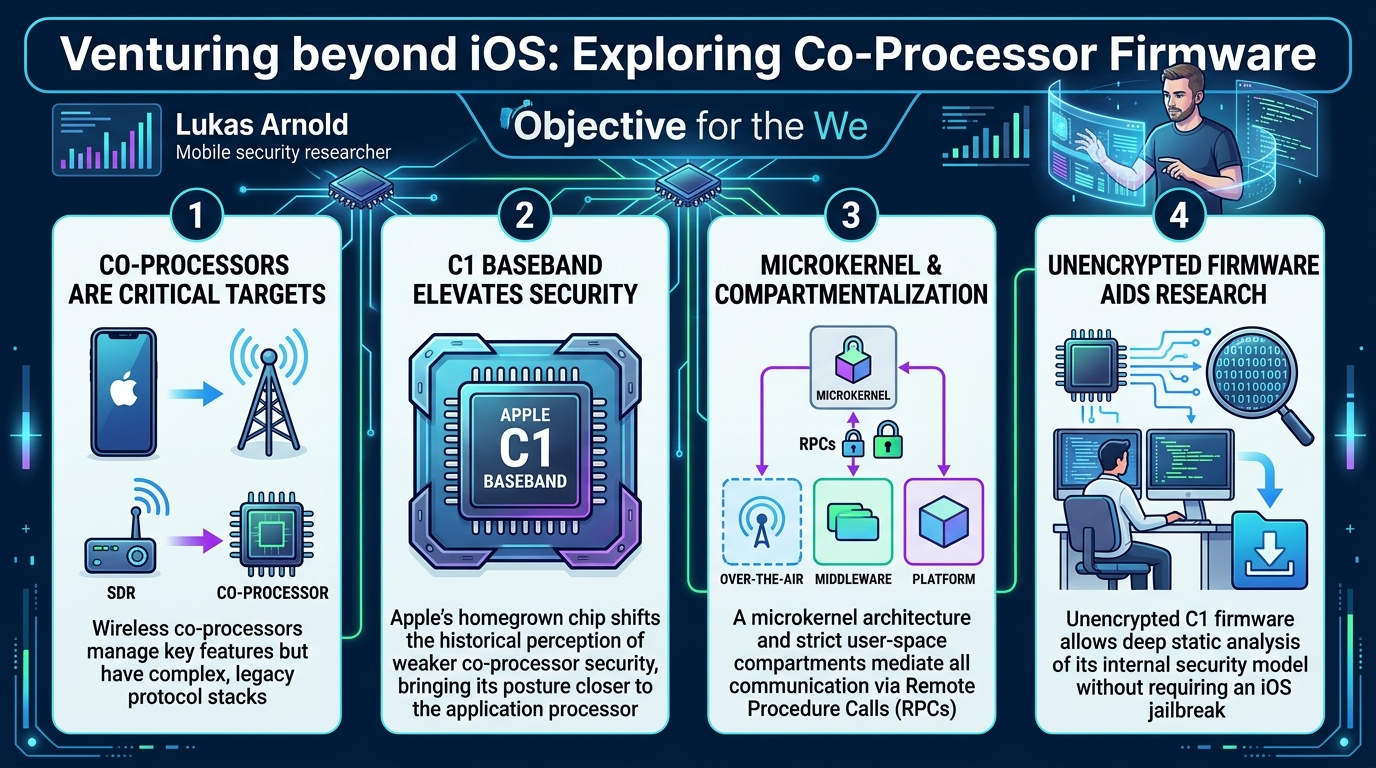
- Co-processors are Critical Security Targets: Wireless co-processors, especially the baseband, are essential to device functionality and present a significant, often overlooked, attack surface due to complex, legacy protocol stacks and over-the-air exposure.
- Apple's C1 Baseband Elevates Security: Apple's homegrown C1 baseband represents a substantial leap in security, moving its posture closer to that of the application processor, challenging the historical perception of basebands being inherently less secure.
- Microkernel and Compartmentalization are Key Mitigations: The C1 baseband employs a microkernel architecture and strict security compartments (platform, over-the-air, middleware) that communicate via Remote Procedure Calls (RPCs), effectively limiting the scope of potential exploits.
- Unencrypted Firmware Aids Research: The discovery of unencrypted C1 baseband firmware allows deep static analysis of its internal workings, security model, and heritage from Intel baseband designs, even without a full iOS jailbreak.
- Over-the-Air Attack Surface Remains: Despite internal mitigations, the baseband's continuous exposure to over-the-air signals means it will always be a potential target, necessitating ongoing vigilance from defenders.
About the Speaker(s)
Lukas Arnold is a PhD student at TU Darmstadt, specializing in mobile security research. His work focuses on exploring the security of critical components within mobile devices, particularly those often overlooked, such as co-processors. His research aims to uncover vulnerabilities and understand the evolving security architectures of modern smartphone hardware and firmware.
Reviews
Dr. Zero (Offensive Security Researcher) — STRONG ACCEPT
Solid reverse engineering work on Apple's C1 baseband that actually delivers on its premise. Arnold shows the firmware is unencrypted, reconstructs the security model, and demonstrates Apple built real compartmentalization into this thing. Not a vuln drop, but genuine first-look research on hardware most people can't touch.
Heather Calloway (CISO) — SOLID
Solid reverse engineering work on Apple's new C1 baseband that updates the threat picture for mobile fleet decisions. The finding that Apple has meaningfully hardened baseband security—compartmentalization, microkernel, chain of trust—is worth knowing, though the operational takeaway for most CISOs is 'Apple is doing the right things; keep patching.'