Trust me, I'm an Apple Watch — Fun & Games with the Apple Watch Protocol Stack
Nils Rollshausen (Mobile Security Research)
Objective for the We v4.0 (#OFTW) 2026 · Day 2 · Main Stage
Overview
In this insightful talk from Objective for the We (#OFTW) v4.0, Nils Rollshausen, a mobile security researcher, unveils the intricate and often overlooked protocol stack that underpins the communication between Apple iPhones and Apple Watches. Titled "Trust me, I'm an Apple Watch — Fun & Games with the Apple Watch Protocol Stack," Rollshausen's presentation dives deep into the mechanisms that allow these devices to share a vast array of sensitive user data, from health metrics and iMessages to calendar events and device settings. The core premise of his research challenges Apple's reputation for robust security by asking a provocative question: can an attacker impersonate an Apple Watch and trick an iPhone into divulging its secrets?
Key moments
- 1:30 Finding an ecosystem entry point through Apple Watch
- 4:30 Unpacking the Apple Watch protocol stack layers
- 5:30 Discovering the IPsec VPN and custom Alloy protocol
- 7:45 Lack of robust device attestation during pairing
- 9:00 Building a fake Apple Watch to steal Wi-Fi password
- 11:40 Remotely operating iPhone camera after fake watch pairing
- 13:30 Introducing Byte Witch for Apple data format decoding
- 14:40 Clarifying user interaction for the fake watch attack
Trust me, I'm an Apple Watch — Fun & Games with the Apple Watch Protocol Stack
Speakers: Nils Rollshausen, Mobile Security Research
Conference: Objective for the We
YouTube: https://www.youtube.com/watch?v=7gx7by-Qnzs
Overview
In this insightful talk from Objective for the We (#OFTW) v4.0, Nils Rollshausen, a mobile security researcher, unveils the intricate and often overlooked protocol stack that underpins the communication between Apple iPhones and Apple Watches. Titled "Trust me, I'm an Apple Watch — Fun & Games with the Apple Watch Protocol Stack," Rollshausen's presentation dives deep into the mechanisms that allow these devices to share a vast array of sensitive user data, from health metrics and iMessages to calendar events and device settings. The core premise of his research challenges Apple's reputation for robust security by asking a provocative question: can an attacker impersonate an Apple Watch and trick an iPhone into divulging its secrets?
The talk meticulously details the process of reverse engineering Apple's custom, layered communication protocols, revealing a complex system built upon Bluetooth, IPsec, and proprietary message-passing frameworks like Alloy and Shoes. Rollshausen demonstrates that despite Apple's advanced security mitigations on the iPhone itself, the Apple Watch's implicit trust relationship presents a unique and exploitable avenue for data exfiltration. His work culminates in a proof-of-concept (PoC) that successfully mimics an Apple Watch, enabling the extraction of sensitive information, including Wi-Fi passwords and even remote control over the iPhone's camera.
This research is significant because it highlights a crucial often-overlooked attack surface within tightly integrated ecosystems. While direct exploitation of modern iOS devices becomes increasingly difficult, peripheral devices that share deep trust relationships can become attractive targets. Rollshausen's findings serve as a potent reminder that security is only as strong as its weakest link, emphasizing the need for comprehensive security architectures that extend beyond the primary device to all trusted peripherals.
Background
▶ Watch: Finding an ecosystem entry point through Apple Watch (1:30)
Apple has cultivated a strong public image around the privacy and security of its ecosystem, frequently touting advanced mitigations that make direct exploitation of iOS devices exceptionally challenging. Indeed, the landscape of iOS exploitation has evolved to a point where "hardcore exploits" are often the exclusive domain of highly specialized companies or nation-states, requiring significant resources and expertise. This reality, while bolstering user security against common threats, presents a challenge for independent researchers seeking novel ways to explore the security boundaries of Apple's platforms.
Against this backdrop, Nils Rollshausen sought an alternative entry point into the Apple ecosystem, one that sidestepped the formidable defenses of the iPhone itself. His gaze turned to the Apple Watch, a device that accompanies iPhone users everywhere, maintaining a continuous and highly trusted connection. The Apple Watch and iPhone automatically and "magically" exchange a voluminous amount of sensitive data, including health information, instant messages (iMessages, SMS), calendar events, device settings, emails, and pictures. This extensive data sharing, facilitated by an implicit trust, positioned the Apple Watch as a potential "treasure trove" for an attacker who could bypass the iPhone's direct defenses.
The fundamental problem Rollshausen aimed to address was the nature of this implicit trust. If an iPhone automatically shares such a wealth of personal data with its paired Apple Watch, what prevents an adversary from impersonating a legitimate watch? The underlying assumption was that Apple would have implemented sophisticated device attestation mechanisms to ensure only genuine, trusted Apple Watches could establish this privileged connection. However, as the research unfolded, it became apparent that the trust establishment process leaned heavily on standard Bluetooth pairing practices, lacking the "Apple-specific magic" or robust attestation that might be expected for such a sensitive relationship. This discovery laid the groundwork for Rollshausen's investigation into whether a meticulously reverse-engineered, fake Apple Watch could indeed trick an iPhone into granting it full access to its data.
Key Findings
▶ Watch: Discovering the IPsec VPN and custom Alloy protocol (5:30)
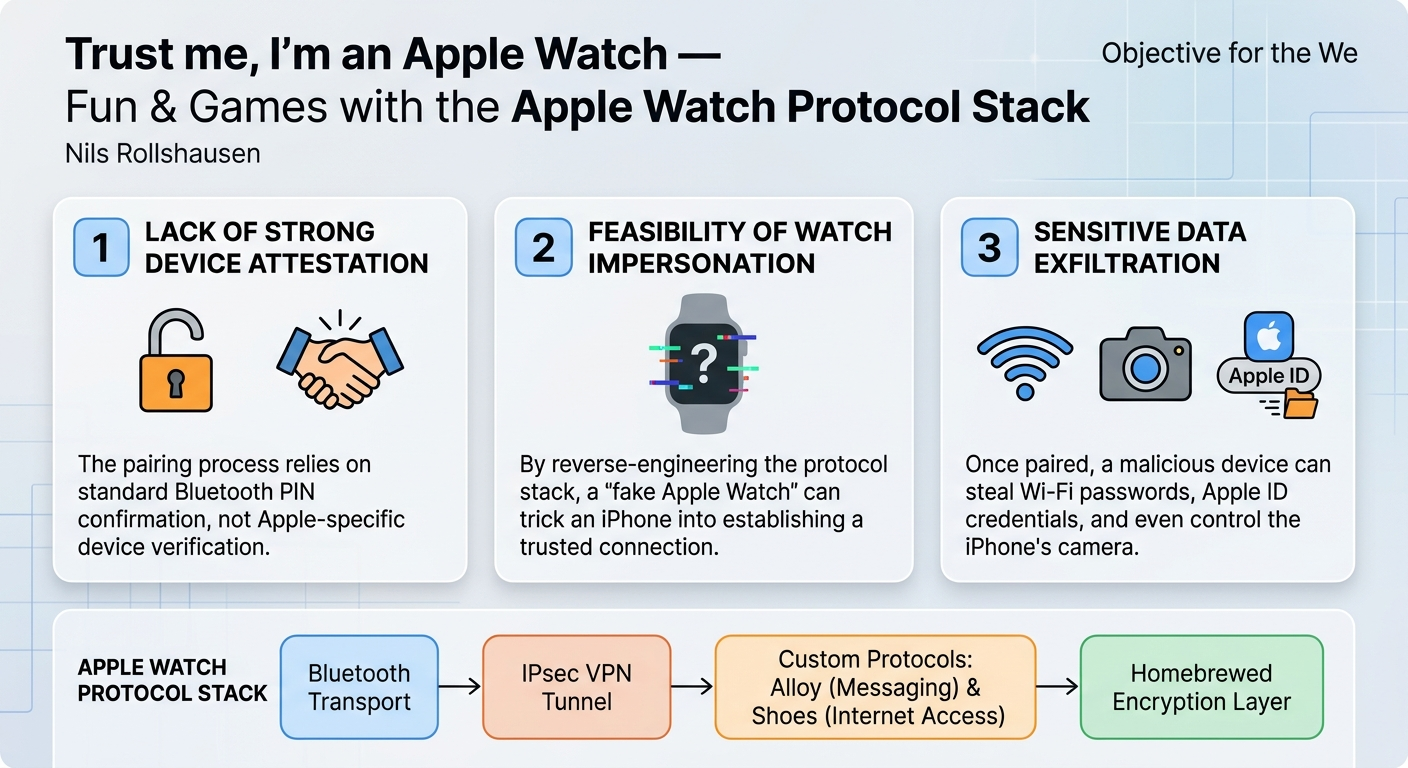
The central and most critical finding of Nils Rollshausen's research is the apparent absence of robust, Apple-specific device attestation during the Apple Watch pairing process. While he initially anticipated encountering a "brick wall" of proprietary security mechanisms designed to authenticate genuine Apple Watches, this sophisticated validation never materialized. Instead, the trust establishment largely mirrors standard Bluetooth peripheral pairing, which typically involves a simple PIN confirmation. This revelation directly enables the core attack: if an iPhone cannot definitively distinguish a real Apple Watch from a meticulously crafted imitation, then impersonation becomes feasible.
Building on this foundational discovery, Rollshausen demonstrated that by thoroughly reverse engineering and re-implementing the complex Apple Watch protocol stack, a malicious actor could create a "fake Apple Watch" capable of establishing a trusted connection with a legitimate iPhone. Once paired, this imposter device gains access to a wide range of sensitive data that would ordinarily be shared with a genuine watch. Specific data types successfully exfiltrated in the proof-of-concept include:
- Wi-Fi Passwords: Crucially, the iPhone transmits its Wi-Fi credentials to the paired watch, enabling the fake device to capture this highly sensitive network access information.
- Apple ID Credentials: The talk indicates that Apple ID credentials, among other sensitive identifiers, are part of the data that can be leaked.
- Unique Device Identifiers: Information that could be used for tracking or further targeting.
- Health Data: Given the Apple Watch's role as a health monitor, its access to personal health measurements like calorie burn rates becomes a significant privacy concern.
- Remote Camera Control: Perhaps one of the most visually impactful findings, the fake watch was able to remotely open the iPhone's camera, take pictures, and have those images sent back to the attacker.
These findings collectively highlight a significant vulnerability in the Apple ecosystem's trust model, demonstrating that even with strong device-level security, the implicit trust extended to peripherals can create exploitable pathways to sensitive user data. The research underscores that the difficulty of exploiting iOS directly has shifted the attack surface, making trusted companion devices an increasingly attractive target for adversaries.
Technical Deep Dive
▶ Watch: Building a fake Apple Watch to steal Wi-Fi password (9:00)
The journey to understanding and ultimately exploiting the Apple Watch protocol stack began with meticulous reverse engineering. Nils Rollshausen started with a known entry point: Bluetooth communication. Utilizing a Frida hook, specifically a tool provided by Yiska, he instrumented the Bluetooth daemon on iOS to log all sent and received packets. This raw packet capture served as the foundational dataset for dissecting the communication.
Initial analysis of the Bluetooth captures revealed patterns, such as early-stage messages on a specific "3A channel" exhibiting a Type-Length-Value (TLV) encoding structure. By correlating these patterns with decompiled iOS source code, Rollshausen identified the functions responsible for processing these packets. This iterative process of identifying structures, locating handling functions, and interpreting log strings allowed him to gradually build an understanding of the underlying protocols. As new protocols were identified, support for them was added to the analysis tools, making subsequent captures progressively more readable and comprehensible.
This systematic unpeeling of the protocol "onion" eventually revealed a sophisticated, multi-layered communication architecture:
- Bluetooth Transport: The lowest layer, handling the physical wireless connection. Apple, however, does not fully rely on standard Bluetooth transport encryption.
- IPsec VPN Tunnel: For enhanced security, Apple establishes an IPsec tunnel between the iPhone and the Apple Watch. All subsequent communication occurs within this encrypted tunnel, indicating Apple's distrust of the inherent Bluetooth encryption alone.
- Custom Apple Protocols (Alloy & Shoes): Within the IPsec tunnel, two primary custom protocols operate:
- Alloy: This is the core message-passing protocol responsible for most of the interesting data exchange. When the watch has new data (e.g., health measurements), it serializes it into an Alloy message with a specific topic identifier. On the iPhone, the identity service daemon receives this message, interprets the topic string, and forwards it to the appropriate local application daemon (e.g., the health daemon for health data) for application-specific processing. This modular design allows various services to interact securely.
- Shoes: This protocol is primarily used to provide internet access to the Apple Watch. While part of the stack, it was less central to Rollshausen's data exfiltration goals.
- Homebrewed Encryption Layer: For particularly sensitive data, such as health information, Apple introduced an additional, custom encryption layer on top of Alloy. While its specifics were not detailed in the talk beyond being "a bit sketchy in parts," its existence underscores Apple's layered approach to data protection for highly private information.
Crucially, the trust establishment mechanism during initial pairing proved to be the Achilles' heel. When an Apple Watch is first paired with an iPhone, there's no pre-existing relationship. The process involves a user entering a six-digit PIN, similar to pairing any generic Bluetooth peripheral. Rollshausen's extensive analysis revealed no proprietary device attestation mechanisms or "Apple-specific magic" to verify the authenticity of the watch. The iPhone simply trusts the device that successfully completes this PIN-based pairing process. This lack of strong attestation makes the entire stack vulnerable to impersonation.
To exploit this, Rollshausen embarked on an ambitious re-implementation project, resulting in a "cursed setup" designed to mimic a legitimate Apple Watch:
- A Bluetooth-capable microcontroller handled the low-level Bluetooth communication.
- Packets were then passed to a computer.
- From the computer, packets were forwarded to an Android emulator.
- The Android emulator hosted a significant amount of custom code that re-implemented Apple's proprietary protocols (IPsec, Alloy, etc.) precisely to the degree needed to interact successfully with an iPhone.
This complex setup allowed the fake watch to engage in the pairing game, which involves exchanging approximately 350 messages. Once this intricate dance was successfully completed, the iPhone implicitly trusted the imposter, opening the door to data exfiltration and remote control capabilities. The specific technique for the visual pairing animation (a "funny-looking animation" often seen with Apple products) was also investigated. It was found to involve an invisible overlay that acts like two alternating QR codes, designed to be imperceptible to the human eye but detectable by the iPhone camera. While the exact encoding was not fully reverse-engineered, Apple's implementation could be hooked into for encoding/decoding, with existing open-source work building on this.
Demo / Proof of Concept
▶ Watch: Remotely operating iPhone camera after fake watch pairing (11:40)
Nils Rollshausen's talk included a compelling demonstration of his "cursed setup" effectively impersonating an Apple Watch and interacting with a legitimate iPhone. The proof-of-concept (PoC) highlighted the tangible security implications of the discovered vulnerabilities.
The setup, as described in the technical deep dive, involved a chain of components: a Bluetooth-capable microcontroller, a host computer, and an Android emulator running custom code. This intricate arrangement allowed the research team to precisely re-implement the Apple Watch's complex protocol stack. During the demonstration, the fake watch successfully navigated the approximately 350 messages required for the Apple Watch pairing process.
Upon successful pairing, the PoC immediately showcased its ability to exfiltrate sensitive data. One of the most striking revelations was the iPhone's transmission of its Wi-Fi password to the fake watch. Beyond Wi-Fi credentials, the demonstration also indicated the leakage of other private information, including Apple ID credentials, unique device identifiers, and health data. To underscore the ethical nature of his research, Rollshausen humorously demonstrated how he could modify the terms and conditions displayed during the pairing process to explicitly state, "we will be stealing all of your data including but not limited to Apple ID credentials, Wi-Fi credentials, unique device identifiers, and health data." This served as a tongue-in-cheek nod to proper disclosure, even in a simulated attack scenario.
Perhaps the most visually impactful part of the demonstration was the remote camera control. After the fake watch was successfully paired, it gained the ability to remotely trigger the iPhone's camera, take a picture, and have that image sent back to the attacker's system. A "very condensed speedrun video" was presented, showing the re-implementation in action, the information being extracted, and then the critical moment where the PoC opened the iPhone's camera and remotely captured a photo. This capability vividly illustrated the depth of access an impersonating device could achieve.
Rollshausen also mentioned the development of Byte Witch, a web application designed to help reverse engineers parse and understand custom data formats. Born out of the parsing challenges encountered during this research, Byte Witch supports live, in-browser decoding of various "custom and weird Apple formats" like BP lists and opaque blobs. While not directly part of the PoC for the watch attack, it was a valuable byproduct of the extensive protocol analysis.
Defensive Implications
▶ Watch: Clarifying user interaction for the fake watch attack (14:40)
Nils Rollshausen's research into the Apple Watch protocol stack uncovers a significant vulnerability rooted in the trust model between iPhones and their companion devices. While Apple is reportedly working on a fix, the fundamental implications extend beyond a simple patch.
The primary defensive implication is the urgent need for stronger device attestation during the pairing process. The current reliance on a PIN-based Bluetooth pairing, without robust cryptographic proof of device authenticity, creates an exploitable trust gap. Apple should consider implementing hardware-backed attestation mechanisms that cryptographically verify the identity and integrity of an Apple Watch before granting it deep access to an iPhone's data. This would ideally involve secure enclave technologies or similar hardware roots of trust to prevent impersonation.
For users, the findings highlight the critical importance of vigilance during device pairing. While the attack is "not anything close to zero-click" and requires user interaction—specifically, tricking the user into scanning a fake pairing code and then completing the pairing process—it is still a reasonable threat model. The existence of convincing "fake Apple Watches" available cheaply (e.g., from AliExpress) means that a sophisticated social engineering attack could leverage this vulnerability. Users should:
- Be highly suspicious of unusual or unexpected pairing requests for their Apple Watch.
- Only initiate pairing with physical Apple Watches that they own and trust, and ideally, directly from Apple or authorized resellers.
- Exercise caution with any "terms and conditions" presented during a pairing process, as demonstrated by the PoC's ability to modify them.
- Understand that granting pairing permission to a device can have profound security implications, including access to sensitive data and device control.
From a broader security architecture perspective, this research underscores that security in an ecosystem is only as strong as its weakest link. Even if the primary device (iPhone) is highly secured against direct exploits, a trusted peripheral (Apple Watch) with a less stringent trust establishment process can become a gateway. Defenders and security architects must apply a holistic view, ensuring that all devices within an ecosystem, especially those with deep trust relationships, are subject to equally rigorous security controls, including strong authentication and attestation. The layered security of the Apple Watch protocol stack (Bluetooth, IPsec, Alloy, custom encryption) is commendable, but the initial trust anchor (the pairing process) needs strengthening.
Finally, the work encourages continued research into peripheral device security. As our lives become increasingly intertwined with smart devices, understanding the communication protocols and trust models of these companion devices will be paramount for identifying and mitigating emerging threats.
Key Takeaways
- Apple Watch as a Gateway: The Apple Watch, due to its implicit trust relationship and continuous data exchange with the iPhone, serves as a significant attack surface for exfiltrating sensitive user data.
- Lack of Robust Device Attestation: The core vulnerability lies in the Apple Watch pairing process, which relies on standard Bluetooth PIN-based authentication and lacks strong, Apple-specific device attestation mechanisms to verify the authenticity of the watch.
- Complex, Layered Protocol Stack: Apple employs a sophisticated, multi-layered protocol stack involving Bluetooth, an IPsec VPN tunnel, and custom protocols like Alloy (for message passing) and Shoes (for internet access), along with an additional homebrewed encryption layer for sensitive data.
- Feasibility of Impersonation: By meticulously reverse engineering and re-implementing this complex protocol stack, an attacker can successfully impersonate an Apple Watch, tricking an iPhone into establishing a trusted connection.
- Significant Data Exfiltration: Once paired, a fake Apple Watch can exfiltrate highly sensitive data, including Wi-Fi passwords, Apple ID credentials, unique device identifiers, health data, and even gain remote control over the iPhone's camera to take pictures.
- User Interaction Required: While impactful, the attack is not zero-click; it requires user interaction, specifically scanning a fake pairing code and completing the pairing process, which can be facilitated by social engineering or using convincing fake Apple Watch hardware.
About the Speaker(s)
Nils Rollshausen is a mobile security researcher with a focus on uncovering vulnerabilities and understanding complex systems within the Apple ecosystem. His work, as demonstrated in this talk, involves deep dives into proprietary protocols and reverse engineering to analyze the security posture of Apple devices and their interactions. Rollshausen's research aims to identify novel attack vectors, particularly those that bypass traditional, heavily mitigated surfaces. He is known for his commitment to sharing knowledge, having published a paper on Apple Watch protocols and making portions of his research openly available on GitHub. Furthermore, his practical approach to tooling led to the creation of Byte Witch, a web-based tool designed to assist other researchers in parsing and decoding custom and obscure data formats, reflecting his broader dedication to the security research community.
Reviews
Dr. Zero (Offensive Security Researcher) — STRONG ACCEPT
Solid offensive research that asked the right question — what happens when you impersonate a Watch? — and actually did the work to answer it. The lack of device attestation in pairing is a real finding. Not a 5 because the attack model still requires social engineering the user through pairing, and the protocol RE, while extensive, isn't novel technique so much as novel target.
Heather Calloway (CISO) — STRONG ACCEPT
Solid offensive research that exposes a meaningful gap in Apple's device trust model. The attack surface—companion devices with implicit trust relationships—is exactly the kind of thing CISOs should be thinking about as direct iOS exploitation gets harder. Worth your time if you have any executive protection concerns or high-risk users carrying Apple Watches.