Clickfix&Crypto: Making Victims Do the Work
Kseniia Yamburh (macOS Malware Researcher)
Objective for the We v4.0 (#OFTW) 2026 · Day 2 · Main Stage
Overview
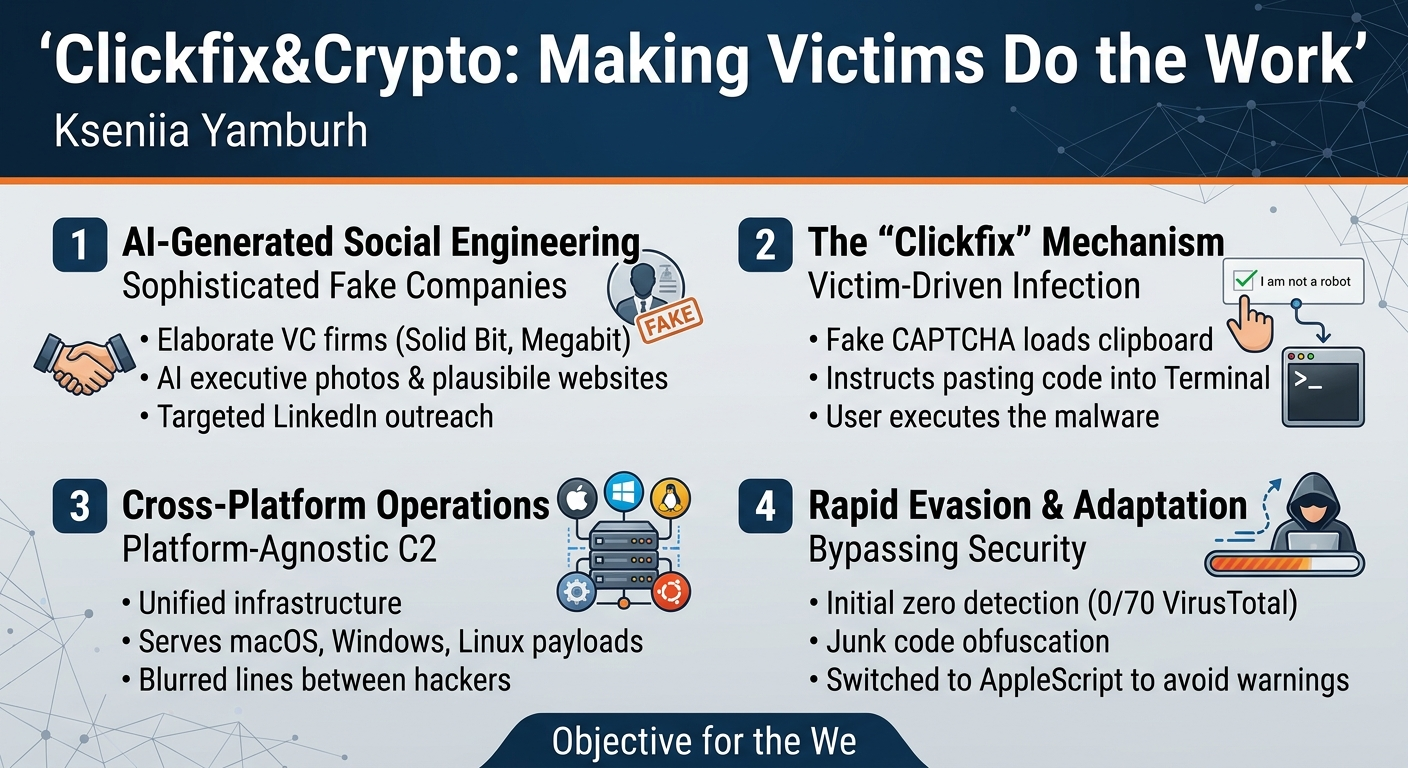
In "Clickfix&Crypto: Making Victims Do the Work," Kseniia Yamburh, a macOS Malware Researcher at Moonlock by MacPaw, dissects a sophisticated, yet deceptively simple, social engineering campaign targeting macOS users. The talk challenges conventional notions of cyberattacks, demonstrating that even advanced threat actors often forgo zero-day exploits in favor of well-crafted psychological manipulation. Yamburh vividly illustrates how attackers are leveraging AI-generated personas, fake venture capital firms, and a cunning technique dubbed "Clickfix" to coerce victims into executing malware themselves.
Key moments
- 3:45 Nation state hackers: polite LinkedIn messages, not zero-days
- 11:30 Clickfix: Victim pastes malicious command from CAPTCHA
- 12:50 Falling walls: macOS/Windows and nation-state/cybercriminal convergence
- 14:40 Attackers bypass terminal warnings using script editor
- 22:00 OSINT: professional stalking to unmask threat actors
- 24:00 Attackers reuse infrastructure despite elaborate fake teams
- 32:15 Q&A: Practical OSINT tools and challenges
Clickfix&Crypto: Making Victims Do the Work
Speakers: Kseniia Yamburh, macOS Malware Researcher, Moonlock by MacPaw
Conference: Objective for the We
YouTube: https://www.youtube.com/watch?v=LyekFP_t7hI
Overview
In "Clickfix&Crypto: Making Victims Do the Work," Kseniia Yamburh, a macOS Malware Researcher at Moonlock by MacPaw, dissects a sophisticated, yet deceptively simple, social engineering campaign targeting macOS users. The talk challenges conventional notions of cyberattacks, demonstrating that even advanced threat actors often forgo zero-day exploits in favor of well-crafted psychological manipulation. Yamburh vividly illustrates how attackers are leveraging AI-generated personas, fake venture capital firms, and a cunning technique dubbed "Clickfix" to coerce victims into executing malware themselves.
This presentation is highly relevant for anyone in cybersecurity, especially those focused on endpoint protection, threat intelligence, and social engineering defenses. It highlights a critical shift in the threat landscape where the lines between nation-state actors and cybercriminals are blurring, and cross-platform attacks are becoming the norm. Yamburh's work underscores the persistent vulnerability of even "secure" platforms like macOS to human-centric attacks, emphasizing the need for both robust technical defenses and heightened user awareness.
Background
▶ Watch: Nation state hackers: polite LinkedIn messages, not zero-days (3:45)
For years, the cybersecurity community often comforted itself with two prevailing "walls" of separation. The first was the perceived divide between Windows and macOS, suggesting that malware targeting one platform rarely affected the other. macOS users, in particular, often harbored a false sense of security, believing their systems were inherently immune to the same threats plaguing Windows. The second wall was the distinct toolkit and modus operandi attributed to nation-state hackers versus cybercriminals. Nation-state groups were typically associated with highly sophisticated, resource-intensive operations, often involving zero-day exploits, while cybercriminals were seen as relying on more commodity malware and broad-stroke phishing.
Kseniia Yamburh's research, however, unequivocally demonstrates that both of these walls have fallen. The campaigns she investigates reveal cross-platform command and control (C2) servers serving payloads for macOS, Windows, and Linux from the same infrastructure. Furthermore, the tactics once considered hallmarks of advanced persistent threat (APT) groups – such as highly personalized social engineering and elaborate fake personas – are now standard practice for various cybercriminal crews. This convergence means that the same techniques, from LinkedIn messages to sophisticated malware obfuscation, are being deployed across the board, making attribution more challenging and defense more complex. The underlying problem these attackers exploit is human trust and the inherent difficulty in distinguishing legitimate professional outreach from malicious lures, especially when presented with a veneer of legitimacy and professionalism.
Key Findings
▶ Watch: Falling walls: macOS/Windows and nation-state/cybercriminal convergence (12:50)
The central discovery of Yamburh's research is the Clickfix technique, a novel method where victims are socially engineered into running malware on their own machines without the need for exploits. This technique capitalizes on user trust in familiar interfaces and prompts, turning a seemingly innocuous CAPTCHA verification into a self-infection mechanism.
Key findings include:
- Sophisticated Social Engineering: Attackers create elaborate fake venture capital (VC) firms (e.g., Solid Bit Capital, Megabit, Lumax Capital) with AI-generated executive team photos and plausible-looking websites. They initiate contact via personalized LinkedIn messages, often complimenting the target's work, to establish rapport and lower defenses.
- Victim-Driven Infection (Clickfix): The core innovation is a five-step kill chain:
- LinkedIn direct message.
- Calendly link for meeting scheduling.
- Spoofed conference page (impersonating Zoom or real events like Hedgebrook).
- A fake CAPTCHA that quietly poisons the user's clipboard with a malicious command.
- Instructions for the user to paste this command into their terminal and execute it.
This process bypasses native Apple protections because the user, not an exploit, initiates the malicious activity.
- Cross-Platform Operations: The campaign's infrastructure demonstrated the ability to serve payloads for macOS, Windows, and Linux from the same command and control servers, indicating a platform-agnostic approach by the threat actors.
- Evasion of Detection and Protections:
- The initial malware samples scored 0/70 on VirusTotal, highlighting their ability to bypass static antivirus detection.
- Attackers quickly adapted to new Apple protections. When Apple introduced a warning for pasting commands into the terminal, the threat actors swiftly shifted to using AppleScript URL schemes to open the malicious script directly in the Script Editor, bypassing the terminal warning entirely.
- Malware binaries employed significant junk code obfuscation to frustrate reverse engineering and automated analysis tools.
- Attribution Challenges: While the tactics bore striking resemblance to known nation-state groups (e.g., those described by Mandiant), the increasing overlap between state-sponsored and cybercriminal methodologies makes definitive attribution difficult, with many tactics being shared or copied.
- OSINT as a Primary Defense: Yamburh demonstrated the effectiveness of open-source intelligence (OSINT) in unmasking the threat actors. Simple Whois lookups, combined with social media searches, revealed recurring names (e.g., Anatoly Bigdash for domain registration, Mykhailo Horev for LinkedIn outreach) and inconsistencies (e.g., domains registered two weeks ago claiming years of operation).
Technical Deep Dive
▶ Watch: Attackers bypass terminal warnings using script editor (14:40)
The attack chain begins with a highly targeted social engineering phase. Attackers craft convincing LinkedIn messages, often citing the recipient's specific work or achievements, to build immediate trust. These messages direct targets to schedule meetings via Calendly links, a common and legitimate professional tool, further normalizing the interaction.
The fake companies established for these campaigns are remarkably detailed yet flawed upon closer inspection. Yamburh highlighted examples like Solid Bit Capital, Megabit, and Lumax Capital. These entities boasted professional-looking websites, complete with AI-generated executive team photos. While visually appealing and sufficient to pass a cursory "5-second search," these AI-generated faces often exhibited an uncanny perfection that contrasted sharply with the "tired" look of real executives. Crucially, OSINT investigations revealed glaring inconsistencies, such as the Lumax Capital domain being registered just two weeks prior, despite its website claiming operations since 2018. A simple Whois lookup quickly exposed this fundamental lie.
The kill chain then progresses through five stages, each designed to lower the victim's guard:
- Direct Message on LinkedIn: Initial contact, building rapport.
- Booking on Calendly: Legitimizing the meeting process.
- Spoofed Conference Page: The victim is directed to a fake conference platform, often impersonating legitimate services like Zoom or even real financial conferences such as Hedgebrook. These pages are pixel-perfect clones, reinforcing the illusion of legitimacy.
- CAPTCHA Poisoning (Clickfix): This is the heart of the attack. The spoofed conference page presents a seemingly benign "Cloudflare I'm not a robot" CAPTCHA. However, the underlying HTML code for this CAPTCHA is malicious. When the user interacts with it (e.g., clicks a checkbox), a carefully crafted malicious command is silently loaded onto their clipboard.
- User-Executed Command: The CAPTCHA then instructs the user to paste the content of their clipboard into the macOS Terminal and press Enter to "verify" their humanity or complete a "driver update." From the perspective of native Apple security, no external attack has occurred; the user themselves initiated the command.
The payload analysis revealed a multi-stage infection process. The command pasted into the terminal typically involves a curl command to download a remote Python script from a suspicious domain. This script ensures Python is available on the system, even installing Homebrew if missing, then using it to install Python. Subsequently, the remote Python script is executed, often configured to run in the background.
Detection evasion was a significant aspect of these attacks. Initial samples of the binary scored 0/70 on VirusTotal, indicating a high degree of stealth against static analysis from major antivirus engines. This was partly achieved through junk code obfuscation. Yamburh showed disassemblies where almost every line of code was meaningless mathematical instructions that canceled each other out, designed to drown analysis tools in garbage and hide the few critical instructions responsible for pulling the next stage or resigning the binary.
The attackers also demonstrated remarkable adaptability. When Apple introduced a new warning for users pasting commands into the Terminal, the threat actors quickly pivoted. Instead of the Terminal, they now direct users to Script Editor via an AppleScript URL scheme. A lure page impersonating Apple itself links to an AppleScript which, when clicked, opens Script Editor with the malicious script already loaded. The user is then prompted to "play" the script, entirely bypassing Apple's new Terminal warning.
Beyond the initial script, the campaign also deployed more sophisticated macOS applications. One notable example was a fake Zoom app written in Swift. This application exhibited an impressive attention to detail, featuring a native-looking UI and a genuine Swift UI password prompt. It even replicated the subtle "frustration animation" of a real macOS prompt, where the window shakes if an incorrect password is typed. Once the victim enters their macOS credentials, the application exfiltrates them via a Telegram bot. The underlying infrastructure for this fake Zoom app was also observed to host payloads for Windows and Linux, confirming the cross-platform nature of the operation.
The OSINT methodology employed to unmask the actors involved pivoting from initial indicators. Malicious domains were traced via Whois records to a consistent registrant: Anatoly Bigdash, using the same name, Boston address, phone number, and Gmail account across multiple domains. Further investigation via Google and social media revealed Bigdash as a founder of Solidbit Capital, the very company Mykhailo Horev claimed to co-found when messaging victims on LinkedIn. This reuse of names, emails, and infrastructure, despite the elaborate upfront social engineering, ultimately provided the critical links for attribution.
Demo / Proof of Concept
▶ Watch: Attackers reuse infrastructure despite elaborate fake teams (24:00)
While Kseniia Yamburh's presentation did not include a live, interactive demonstration of the attack, she provided a comprehensive walkthrough of the attacker's "demo" from the victim's perspective. This conceptual demonstration highlighted the key stages and visual elements designed to trick users.
The "demo" began by showcasing the pixel-perfect clone of the Hedgebrook financial conference website. This replica was indistinguishable from the legitimate site, complete with accurate branding and layout, establishing a high degree of credibility. The critical component of this demonstration was the fake Cloudflare CAPTCHA embedded within this spoofed page. Yamburh illustrated how this CAPTCHA, which appeared as a standard "I'm not a robot" checkbox, was actually a local HTML element with no genuine connection to Cloudflare.
The core of the "Clickfix" mechanism was then explained: when the victim interacted with this fake CAPTCHA, the page silently loaded a malicious command onto their clipboard. The "demo" then walked through the final, crucial step: the CAPTCHA's instructions to the user to paste the clipboard content into their macOS Terminal and execute it. This sequence effectively demonstrated how the attacker "made victims do the work," turning a seemingly benign verification step into a self-infection vector. The subsequent analysis of the payload and the fake Zoom app further elaborated on what the victim would unknowingly execute, providing a full conceptual proof-of-concept of the entire attack chain.
Defensive Implications
▶ Watch: Q&A: Practical OSINT tools and challenges (32:15)
Defending against sophisticated social engineering campaigns like Clickfix requires a multi-layered approach, combining user education with robust technical controls and proactive threat intelligence.
- Educate Users on Terminal/Script Editor Risks: The most critical defensive measure is to instill a zero-tolerance policy for pasting unknown commands into the Terminal or executing scripts from the Script Editor. Users must be educated that these are powerful tools that can compromise their system, and commands should only be run if fully understood and sourced from trusted, verified channels.
- Verify Domain Names Rigorously: Users should be trained to scrutinize domain names, not just what's displayed on a web page. A quick Whois lookup can expose discrepancies, such as a domain claiming years of operation but registered only weeks prior. Tools like Patrick Wardle's BlockBlock are invaluable, as they specifically monitor and warn users when content is pasted from a browser directly into the Terminal, even before Apple implemented its own similar protection.
- Recognize Social Engineering Red Flags:
- Urgency: Any request that pressures immediate action should be treated with suspicion.
- Unsolicited Contact: Be wary of unexpected messages, especially those from unfamiliar sources on platforms like LinkedIn, even if they seem highly personalized or complimentary.
- AI-Generated Content: While increasingly sophisticated, AI-generated images (especially "perfect" executive photos) and generic placeholder text can be subtle indicators of a fake entity.
- Look-Alike Domains: Check for subtle misspellings or unusual subdomains in URLs.
- Implement Legitimate Security Software: While Clickfix bypasses many native protections, a legitimate antivirus solution (like Moonlock or others) provides an essential layer of defense by detecting and blocking the downloaded payloads. The speaker emphasized choosing a reputable solution that actively performs its job.
- Leverage Community and Threat Intelligence: The success of uncovering these campaigns often relies on community efforts. Security researchers sharing suspicious files and intelligence on platforms like Twitter (e.g., Malware Hunter Team, Chris/Lopsak, Objective-C) is crucial. Organizations should consider contributing to or subscribing to threat intelligence feeds and actively following researchers specializing in their platform.
- Proactive OSINT: Security teams can proactively use OSINT techniques (as demonstrated by Yamburh) to investigate suspicious domains, email addresses, and personas that might be targeting their organization. Tools like VirusTotal, Shodan, and even advanced LLMs like Claude can aid in these investigations.
- Regular Security Awareness Training: Ongoing training that includes real-world examples of social engineering and technical evasion techniques keeps users informed and vigilant against evolving threats.
Key Takeaways
- Social Engineering is the New Zero-Day: Threat actors, including those with advanced capabilities, increasingly rely on sophisticated social engineering to bypass technical defenses, making human trust the primary vulnerability.
- "Clickfix" Empowers Attackers: The Clickfix technique makes victims inadvertently execute malware, sidestepping native operating system protections by having the user initiate the malicious action themselves.
- Cross-Platform Attacks are the Norm: The lines between Windows, macOS, and Linux malware campaigns are blurring, with shared C2 infrastructure and payloads targeting multiple operating systems.
- Defenses Must Adapt Rapidly: Attackers are highly agile, quickly developing workarounds for new security features (e.g., bypassing Apple's Terminal warning with Script Editor). Continuous monitoring and adaptive defenses are crucial.
- OSINT is a Powerful Defensive Tool: Simple open-source intelligence techniques, such as Whois lookups and social media analysis, can effectively unmask threat actors and their infrastructure, despite their attempts at elaborate deception.
- Community Collaboration is Essential: The cybersecurity community plays a vital role in sharing intelligence, analyzing samples, and developing tools to counter emerging threats, as demonstrated by the contributions of researchers like Patrick Wardle.
About the Speaker(s)
Kseniia Yamburh is a dedicated macOS Malware Researcher at Moonlock by MacPaw, a company focused on developing user-friendly antivirus solutions for Macs. Hailing from Ukraine, Kseniia is a prominent figure in the macOS security community, known for her active presence on Twitter under the handle @OsintBarbie. Her professional endeavors include relentlessly hunting new macOS malware, diving deep into cybercrime ecosystems, and conducting extensive OSINT operations. A core part of her mission is to dispel the popular misconception that Macs are immune to malware, a message she passionately conveys through her research and presentations. Her work underscores the critical need for vigilance and robust security practices among macOS users.
Reviews
Dr. Zero (Offensive Security Researcher) — SOLID
Competent walkthrough of a real-world social engineering campaign with useful IOCs and OSINT pivot examples. Nothing technically novel — Clickfix has been documented for over a year — but it's well-structured, accessible, and the speaker clearly did the hands-on analysis herself.
Heather Calloway (CISO) — SOLID
Clear, well-documented breakdown of a social engineering technique that's actively targeting macOS users in crypto and VC circles. Useful for awareness training and endpoint teams, but the strategic implications are narrower than the presentation suggests—this is a targeted threat to a specific population, not a paradigm shift.