Panel: Finding Your Footing in Apple Security
Patrick Wardle (Founder of The Objective-See Foundation · Objective-See Foundation), Jiska Classen (Mobile Security Research, Reverse Engineering & Education), Kseniia Yamburh (macOS Malware Researcher), Gergely Kalman (Independent Security Researcher)
Objective for the We v4.0 (#OFTW) 2026 · Day 2 · Main Stage
Overview
This article delves into the insights shared during the "Finding Your Footing in Apple Security" panel at the Objective for the We conference. Moderated by Patrick Wardle, founder of The Objective-See Foundation, the panel featured an esteemed lineup of experts: Jiska Classen, a mobile security researcher and professor; Kseniia Yamburh, a macOS malware researcher; and Gergely Kalman, an independent security researcher renowned for his Apple bug bounty work. The discussion offered a candid look into the diverse, often unexpected, paths that led these professionals into the specialized field of Apple security, highlighting both their commonalities and unique experiences.
Key moments
- 0:00 Panel introduction and diverse paths into Apple security
- 10:40 Gergely on connecting with people and community support
- 15:50 Jiska on the reality of research and persistence
- 28:40 Gergely describes a self-driven bug hunter's daily life
- 40:30 Gergely's advice on passion projects for students
- 47:50 Gergely on AI as a 'pathological liar' mentor
- 52:20 Patrick on Objective-See's interactions with Apple
- 73:00 Patrick's vision for Objective-See's future growth
Panel: Finding Your Footing in Apple Security
Speakers: Patrick Wardle (Founder of The Objective-See Foundation, Objective-See Foundation); Jiska Classen (Mobile Security Research, Reverse Engineering & Education); Kseniia Yamburh (macOS Malware Researcher); Gergely Kalman (Independent Security Researcher)
Conference: Objective for the We
YouTube: https://www.youtube.com/watch?v=ExZ_g9t6w6E
Overview
This article delves into the insights shared during the "Finding Your Footing in Apple Security" panel at the Objective for the We conference. Moderated by Patrick Wardle, founder of The Objective-See Foundation, the panel featured an esteemed lineup of experts: Jiska Classen, a mobile security researcher and professor; Kseniia Yamburh, a macOS malware researcher; and Gergely Kalman, an independent security researcher renowned for his Apple bug bounty work. The discussion offered a candid look into the diverse, often unexpected, paths that led these professionals into the specialized field of Apple security, highlighting both their commonalities and unique experiences.
The core objective of the panel was to demystify careers in Apple security, providing invaluable advice and a "reality check" for students and aspiring professionals. From the academic rigor of university research to the high-stakes world of bug bounty hunting and the daily grind of malware analysis, the panelists explored the motivations, challenges, and rewards inherent in this dynamic domain. Their shared wisdom covered everything from initial entry points and foundational skill development to navigating the complexities of legal boundaries, managing imposter syndrome, and adapting to emerging technologies like artificial intelligence.
The talk is particularly relevant in today's cybersecurity landscape, where Apple's ecosystem continues to expand its market share and attract increasing attention from both legitimate researchers and malicious actors. As the demand for skilled Apple security professionals grows, understanding the practical realities, necessary skill sets, and ethical considerations becomes paramount. This panel served as a crucial guide, not only for those looking to embark on this career path but also for seasoned practitioners seeking to refine their approach and contribute more effectively to the community.
Background
▶ Watch: Panel introduction and diverse paths into Apple security (0:00)
The journey into Apple security, as illuminated by the panelists, is rarely linear and often marked by serendipitous encounters and evolving technological landscapes. Historically, the cybersecurity focus has predominantly been on Windows, as highlighted by Patrick Wardle's early career at the National Security Agency (NSA), where offensive cyber operations were almost exclusively targeting Microsoft's operating system. This left the nascent macOS (then OS X) platform relatively "untapped" from a security research perspective, presenting a unique opportunity for early adopters.
The panelists' diverse backgrounds underscore the varied entry points into this niche field. Jiska Classen's path began with Bluetooth security research during her PhD, which naturally led her to firmware reverse engineering on mobile platforms like iOS and Android to interact with proprietary wireless protocols and latest chip features. Kseniia Yamburh, on the other hand, transitioned from broader threat intelligence focused on Google and Windows products, joining Macpaw where she was explicitly tasked with becoming an Apple security expert, learning from resources like Patrick Wardle's book. Gergely Kalman's entry was driven by the rise of Apple Silicon and the observed "tremendous code smell" in Apple's software, coupled with a curiosity about the efficacy of the Apple Security Bounty program.
A recurring theme was the scarcity of accessible resources for aspiring Apple security researchers. Kseniia specifically mentioned the lack of dedicated courses or affordable training materials, pointing to the critical role of mentorship and practical experience. Patrick Wardle's experience of creating his own tools, akin to Sysinternals for Windows, to "disinfect" Macs for friends, exemplifies the early void in the ecosystem that researchers had to fill. This historical context of a less-explored platform, coupled with a growing user base and increasing sophistication of threats, created the fertile ground for the Apple security community to emerge and thrive, driven by individuals willing to forge their own paths and share their knowledge.
Key Findings
▶ Watch: Jiska on the reality of research and persistence (15:50)
The panel discussion yielded several key insights and findings regarding a career in Apple security:
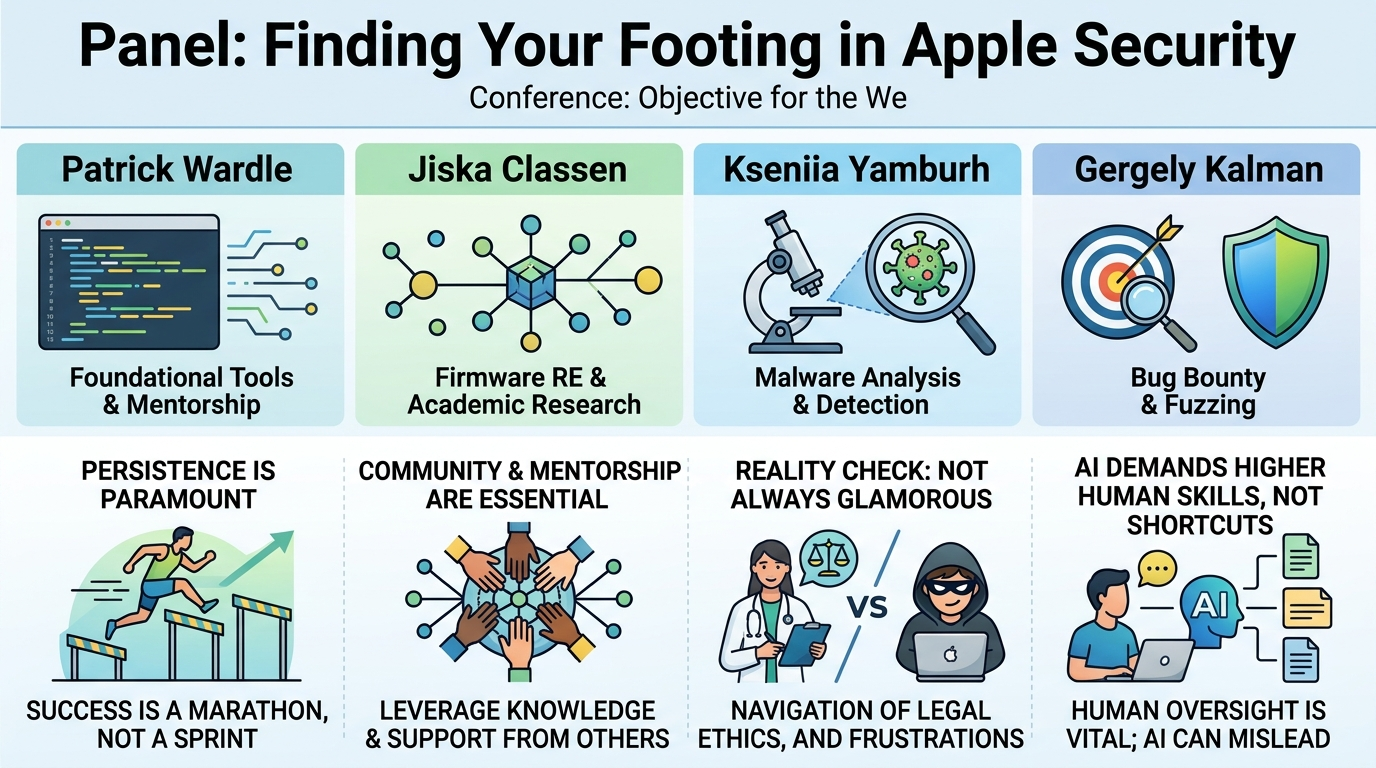
- Persistence is Paramount: All panelists emphasized that success in security research, especially in a complex field like Apple's, is a marathon, not a sprint. Kseniia openly shared her initial struggles, describing "crying a lot" during her first three months of intensive learning. Greg noted that while successes are showcased, the months of "bashing his head against the wall" (failure) are not, reinforcing that persistence through frustration is critical. Patrick echoed this, comparing it to writing a book where consistent daily effort (e.g., 500 words a day) ultimately leads to completion, even when motivation wanes. The act of doing can trigger motivation.
- Community and Mentorship are Invaluable: Jiska highlighted the transformative experience of joining a local Linux user group at 13, where older members fostered her interest. Greg passionately spoke about the "people" — other researchers who share knowledge freely and genuinely want others to succeed. His anecdote about reaching out to Chaba for support during a 14-month bug fix cycle underscored the emotional and practical support derived from a strong community.
- Reality Check: The Un-glamorous Truths: The perception of cybersecurity as "flashy and sexy" was debunked. Jiska pointed out that unlike CTFs with guaranteed solutions, real research offers no such certainty, with projects potentially yielding no findings despite months of hard work. Kseniia stressed the often-frustrating legal and ethical constraints, where researchers must navigate laws (e.g., PII protection) that limit what they can publish or even investigate, preventing potential "troubles with legal." Greg spoke about pervasive imposter syndrome and the self-admitted "idiocy" of working so intensely that basic needs like eating are forgotten.
- AI as a Double-Edged Sword: While acknowledging AI's potential to accelerate learning and overcome "rabbit holes," panelists warned against over-reliance. Jiska articulated that AI demands a higher skill level, requiring experts to evaluate and steer its output, rather than merely relying on basic programming. She expressed concern about the current "drop in hiring entry-level positions" due to AI, stressing the future need for senior people. Greg called AI a "pathological liar" and warned that excessive dependence leads to "getting dumber at an absolutely astounding speed." He cited the recent 700 bug fixes and 20-way collisions in Apple's bug bounty program as evidence of AI raising the "floor" but not replacing "true expertise."
- Navigating the Relationship with Apple: The panelists discussed the complex, often one-sided, interaction with Apple. Patrick praised Apple for hiring talented speakers from his conferences (like Julia Udlak from Ukraine) but lamented their lack of information sharing (e.g., XProtect Yara rules). Jiska highlighted the "feature" of independent research not being sponsored by Apple, allowing researchers to explore sensitive areas (like the Apple Watch interface APIs) without conflict of interest, while also acknowledging the frustration of bug reports going into a "void." Greg, a frequent bug bounty participant, described Apple's communication as "lawyerish" but conceded that Apple's program is more extensive than many other big tech companies, and internal justification for security spending often comes from external bug reports.
Technical Deep Dive
▶ Watch: Gergely's advice on passion projects for students (40:30)
While a panel discussion doesn't typically feature a single, unified technical deep dive, the speakers collectively touched upon various technical domains and concepts relevant to Apple security. Their experiences highlight the diverse skill sets and knowledge required in this field.
Firmware Reverse Engineering and Wireless Protocols:
Jiska Classen's journey into Apple security began with her PhD research, which involved Bluetooth security and firmware reverse engineering. This highly specialized area requires deep understanding of low-level hardware interactions, embedded systems, and proprietary communication protocols. Her work involved modifying chip firmware to analyze and manipulate wireless protocol behavior, a critical skill for uncovering vulnerabilities in the underlying layers of mobile devices. This demonstrates the necessity of delving into the intricacies of both software and hardware to achieve meaningful security research.
Malware Analysis and Tool Development:
Patrick Wardle's transition from the NSA's Windows-centric malware analysis and exploit analysis to macOS security highlighted a significant gap in the ecosystem. His early work involved developing macOS security tools to fill the void left by the absence of equivalents to Windows' Sysinternals utilities. These tools focused on identifying persistence mechanisms and autoruns—common indicators of compromise. Kseniia Yamburh's role as a macOS malware researcher at Macpaw further underscores the ongoing need for expertise in analyzing and detecting threats specific to Apple platforms. Her work involves researching new solutions for better detection, implementing new features in security products, and collaborating with developers and data scientists, indicating a blend of offensive knowledge for defensive application.
Bug Bounty Hunting and Fuzzing:
Gergely Kalman's primary focus on the Apple Security Bounty program involves extensive fuzzing and vulnerability discovery. Fuzzing is an automated software testing technique that involves feeding invalid, unexpected, or random data inputs to a computer program to expose bugs and security flaws. Greg's experience with "tremendous code smell" in Apple software and his focus on finding "good primitives" or "interesting behavior" points to a methodical, often frustrating, process of identifying subtle edge cases that can be chained into exploitable vulnerabilities. The panel's discussion on AI and fuzzing also drew parallels, with Jiska noting that both can lead to "bug collisions" and that the effectiveness of fuzzing often depends on the "fuzzing harness" – the specific setup and methodology used.
Apple-Specific Technologies and Challenges:
The discussion implicitly and explicitly referenced several Apple technologies and security mechanisms:
- Apple Silicon: Greg mentioned the release of Apple Silicon as a catalyst for his interest, highlighting the ongoing shift in Apple's hardware architecture and the new security considerations it introduces.
- Transparency, Consent, and Control (TCC): Greg specifically brought up Apple's changes to the TCC framework, which manages user privacy and access to sensitive resources. He expressed frustration with how Apple altered these rules without adequately considering the impact on the researcher community, underscoring the challenges of working within a tightly controlled ecosystem.
- XProtect and Yara Rules: Patrick Wardle discussed Apple's built-in anti-malware, XProtect, and its use of Yara rules for signature-based detection. He noted the conservative nature of Apple's rules (to avoid false positives) and the community's desire for Apple to share more information about new signatures to enhance collective defense.
- Apple Watch Interface APIs: Jiska highlighted research involving opening up the Apple Watch interface APIs, a sensitive area where Apple has resisted opening access. This exemplifies how independent research can push boundaries and address areas of public or regulatory interest that a vendor might be reluctant to explore.
The technical discussions, though dispersed across individual experiences, painted a picture of a field demanding adaptability, low-level technical prowess, and a deep understanding of Apple's proprietary systems and security models.
Demo / Proof of Concept
▶ Watch: Gergely on AI as a 'pathological liar' mentor (47:50)
As this was a panel discussion focused on career advice and insights, there was no specific technical demonstration or proof of concept presented by the panelists. The discussion revolved around their experiences, methodologies, and observations within the Apple security domain rather than showcasing a particular exploit or tool.
Defensive Implications
▶ Watch: Patrick's vision for Objective-See's future growth (73:00)
The insights shared by the panelists offer several critical defensive implications for individuals, organizations, and even Apple itself, regarding how to approach and strengthen Apple security.
For Individuals and Aspiring Professionals:
- Cultivate Foundational Skills and Persistence: The consensus is clear: strong technical foundations (reverse engineering, programming, system internals) are non-negotiable. However, these must be paired with immense persistence and resilience. The "reality check" underscores that failures are common, and the ability to stay motivated through long periods without breakthroughs is a key defensive trait for a researcher.
- Engage with the Community Ethically: Leveraging communities (like Linux user groups or security conferences) for mentorship and knowledge sharing is vital. However, understanding and adhering to legal and ethical boundaries is paramount. Kseniia's warning about the dangers of mishandling PII or violating laws during research highlights the responsibility researchers bear. This ethical grounding is a defense against potential legal repercussions and reputational damage.
- Strategic Use of AI: While AI tools (like LLMs) can accelerate learning and assist in tasks, they should be used as an aid, not a crutch. The advice to "be the human in the loop" and verify AI outputs critically is a defense against "getting dumber" or being misled by "pathological liar" AIs. Developing the higher-level skills to evaluate and steer AI is crucial for future relevance, especially in entry-level positions.
For Organizations and Security Product Vendors:
- Invest in Talent Development: Macpaw's strategy of "raising their own professionals" due to the scarcity of Apple security experts is a direct defensive measure against the talent gap. Organizations should consider internal training programs, mentorship, and supporting junior researchers to build specialized expertise.
- Prioritize Problem-Solving and Automation: Kseniia's advice to students—"poke around to find any pain points" and offer solutions—translates directly to product development. Security vendors should focus on automating solutions for common struggles and integrating features that address real-world, often tedious, tasks for users and security teams.
- Cross-Team Collaboration: Kseniia's description of her workday involving extensive collaboration with developers, designers, data scientists, and even marketing, highlights the importance of a holistic approach to security. Breaking down silos ensures that security considerations are embedded throughout the product lifecycle.
- Adaptive Threat Detection: The discussion around Apple's XProtect Yara rules points to a broader defensive challenge. While Apple's conservative approach minimizes false positives, it can be slow to adapt to new threats. Third-party security products have an opportunity to offer an "additional layer" of defense by being more agile in signature deployment and threat intelligence sharing.
For Apple (and other large vendors):
- Improved Transparency and Collaboration: The recurring call for greater transparency and two-way information sharing from Apple is a significant defensive implication. While understandable concerns about "out-of-context sentences" exist, sharing more threat intelligence (e.g., Yara rules for new malware) with the broader security community could enhance collective defense against adversaries who are constantly adapting.
- Researcher Engagement: Greg's observation that bug reports "costing Apple money is a good thing" because it internally justifies security investment suggests that actively engaging with the researcher community (beyond just bug bounties) can strengthen internal security postures. Considering researcher feedback on policy changes (like TCC) could prevent unintended negative impacts on the very community trying to make their products more secure.
- Addressing AI's Impact on the Talent Pipeline: Jiska's concern about AI hindering entry-level hiring is a long-term defensive issue for the industry. Apple, as a major employer, has a role in fostering the next generation of security talent, potentially through partnerships, educational initiatives, or rethinking junior roles to ensure a sustainable pipeline of expertise.
Key Takeaways
- Persistence is the Most Critical Skill: Success in Apple security research, bug bounty hunting, or malware analysis requires unwavering dedication and the ability to endure long periods of failure or unglamorous work. The act of doing often precedes motivation.
- Community and Mentorship are Essential: Connecting with other researchers, engaging in open-source projects, and seeking mentorship provides crucial support, knowledge, and motivation that is often unavailable through formal education or lone efforts.
- Cybersecurity is Not Always Glamorous: Aspiring professionals must be prepared for the realities of the field, including legal constraints, ethical dilemmas, imposter syndrome, and the high likelihood of projects not yielding immediate or flashy results.
- AI Demands Higher-Order Skills, Not Shortcuts: While AI can be a powerful tool for accelerating research and learning, it's a "pathological liar" that requires critical evaluation and human oversight. True expertise in the AI era will involve the ability to steer and validate AI outputs, not merely rely on them.
- Navigating Apple's Ecosystem is Unique: Interacting with Apple involves a complex, often one-sided, relationship characterized by a robust bug bounty program but limited transparency and information sharing. Independent research, however, offers a valuable counterpoint, allowing exploration of sensitive areas without vendor influence.
- The Industry Needs a Talent Pipeline Strategy: The rise of AI and the scarcity of specialized Apple security talent highlight the need for organizations to invest in developing junior professionals and for educational institutions and conferences to connect students with real-world problems and hiring companies.
About the Speaker(s)
- Patrick Wardle: Founder of the Objective-See Foundation. Patrick began his cybersecurity career at the National Security Agency (NSA), focusing on Windows malware and exploit analysis. Upon leaving the NSA, he transitioned to macOS security, becoming a pioneer in the field by developing essential tools to address the lack of security utilities for Macs. He is the author of books on macOS security and a passionate advocate for the community, organizing conferences like Objective for the We and Objective by the Sea.
- Jiska Classen: A professor at HPI, leading the mobile and wireless security research group. Jiska specializes in iOS and Android security research, with a background in Bluetooth security and firmware reverse engineering during her PhD. She is actively involved in teaching mobile and IoT security courses, guiding students through technical research projects, and fostering their growth in the field.
- Kseniia Yamburh: A macOS malware researcher at Macpaw. Kseniia started her cybersecurity career in threat intelligence, initially focusing on Google and Windows. She pivoted to Apple security at Macpaw, where she received dedicated training and mentorship. Her work involves researching new detection solutions, implementing security features, and collaborating across various teams within a product-focused environment.
- Gergely Kalman: An independent security researcher primarily focused on the Apple Security Bounty program. Gergely's journey into Apple security was inspired by the advent of Apple Silicon and a keen eye for software vulnerabilities. He is known for his work in fuzzing and uncovering bugs, often sharing his experiences and insights at conferences and through his participation in the bug bounty ecosystem.
Reviews
Dr. Zero (Offensive Security Researcher) — SOLID
Decent career-advice panel that delivers exactly what it promises — war stories and reality checks for aspiring Apple security folks. Nothing technically novel, but honest signal from credible people. Fine for the target audience; forgettable for anyone already in the field.
Heather Calloway (CISO) — SOLID
Honest, grounded career advice for aspiring Apple security researchers. Useful for anyone building or advising a security team with Apple exposure, but the strategic implications for enterprise security programs are limited.