Apple bug bounty: Why should you learn about the filesystem in 2026?
Gergely Kalman (Independent Security Researcher)
Objective for the We v4.0 (#OFTW) 2026 · Day 2 · Main Stage
Overview
In his talk at Objective for the We, Gergely Kalman, an independent security researcher affectionately known as "the Apple security researcher file system guy," delves into the enduring relevance of understanding file systems for effective bug bounty hunting, particularly within the Apple ecosystem. Kalman challenges the common misconception that file system vulnerabilities are a relic of the past, arguing that despite being based on decades-old POSIX standards, these logic bugs remain "ridiculously effective" and often overlooked attack vectors. His presentation serves not only as a technical deep dive into specific vulnerability classes but also as a compelling narrative on career trajectory for aspiring security professionals in a rapidly evolving industry.
Key moments
- 0:20 Introduction and personal journey into bug bounty
- 4:40 Objective skills, self-optimization, and finding mentors
- 9:45 Defining vulnerabilities, zero-days, and high-impact targets
- 12:50 Why Apple's bug bounty program is approachable
- 20:00 Filesystem logic bugs: the future of secure systems
- 24:00 Specific 2026 targets: LPE, SIP bypasses, sandbox escapes
- 27:30 Learning resources and how to get started in research
- 28:50 Q&A: Leveraging published research for new bugs
Apple bug bounty: Why should you learn about the filesystem in 2026?
Speakers: Gergely Kalman, Independent Security Researcher
Conference: Objective for the We
YouTube: https://www.youtube.com/watch?v=9i0GUuMvEvc
Overview
In his talk at Objective for the We, Gergely Kalman, an independent security researcher affectionately known as "the Apple security researcher file system guy," delves into the enduring relevance of understanding file systems for effective bug bounty hunting, particularly within the Apple ecosystem. Kalman challenges the common misconception that file system vulnerabilities are a relic of the past, arguing that despite being based on decades-old POSIX standards, these logic bugs remain "ridiculously effective" and often overlooked attack vectors. His presentation serves not only as a technical deep dive into specific vulnerability classes but also as a compelling narrative on career trajectory for aspiring security professionals in a rapidly evolving industry.
Kalman underscores the critical importance of mastering fundamental concepts, especially in an era where memory corruption bugs are increasingly mitigated. He positions file system vulnerabilities as a foundational yet continually exploited aspect of modern operating systems, presenting a unique opportunity for both novice and experienced researchers. The talk highlights how Apple's efforts to retrofit security onto an existing architecture often introduce new avenues for bypasses, making a deep understanding of file system interactions an invaluable skill for discovering high-impact zero-days.
Beyond the technical insights, Kalman offers pragmatic career advice, encouraging attendees to cultivate "objectively valuable skills" and pursue bug bounties as a means of self-employment and continuous learning. He emphasizes that despite the perceived complexity, file system research is "beginner-friendly" due to identifiable patterns and attack vectors. The presentation ultimately makes a strong case for why file system knowledge will not just remain relevant but become even more crucial for identifying impactful vulnerabilities on platforms like macOS and iOS well into 2026 and beyond.
Background
▶ Watch: Introduction and personal journey into bug bounty (0:20)
Gergely Kalman's journey into Apple security research began as a "burned out programmer" who, almost five years prior to this talk, stumbled upon a zero-day vulnerability. This initial success propelled him into full-time Apple bug bounty hunting, leading to numerous CVEs and his current reputation as a leading expert in file system security. His personal experience forms the bedrock of his advice, particularly for students or those seeking a career change into security research.
Kalman acknowledges the "tumultuous environment" of the current tech industry, characterized by layoffs and uncertainty, exacerbated by the rise of Large Language Models (LLMs). He notes that traditional career advice often feels "outdated" and that securing a good job, especially without experience, is a "daunting task." In this context, he advocates for a self-directed path, focusing on acquiring "objectively valuable skills" that are resilient to industry shifts. For him, hacking is one such skill, and bug bounties offer a legitimate and rewarding avenue for applying it, a stark contrast to the legal threats faced by early researchers.
The core of Kalman's technical background argument revolves around the nature of vulnerabilities. He defines a bug as exploitable if it becomes a vulnerability, and an exploit as code that leverages a vulnerability to achieve an attacker's goal. Zero-days are particularly valuable as they are unknown to the vendor and users, making them unpatched and potent. The impact of a vulnerability, he stresses, is a product of its severity and user count—the more people it can hurt, the more attention and resources will be dedicated to fixing it. He specifically recommends the Apple Security Bounty Program (ASB) as an "approachable" platform, despite occasional difficulties in dealing with Apple, due to its broad scope and consistent payouts.
From a technical perspective, Kalman champions the focus on logic bugs and file system operations because memory corruption vulnerabilities are increasingly mitigated across modern operating systems. He posits that file systems, despite being "40-year-old tech," are fundamental building blocks whose APIs and underlying understanding are being lost, especially among younger researchers who assume these areas are "figured out." This neglect, combined with the inherent difficulty of broadly mitigating file system vulnerabilities without breaking decades of API compatibility, makes them a fertile ground for discovery. He highlights that these vulnerabilities are "everywhere" and offer "very set patterns and vectors" making them accessible even to beginners, before progressing to finding "new vectors and new bug classes."
Key Findings
▶ Watch: Defining vulnerabilities, zero-days, and high-impact targets (9:45)
Gergely Kalman's talk reveals several critical findings regarding the state of file system security and its implications for bug bounty hunting in the Apple ecosystem:
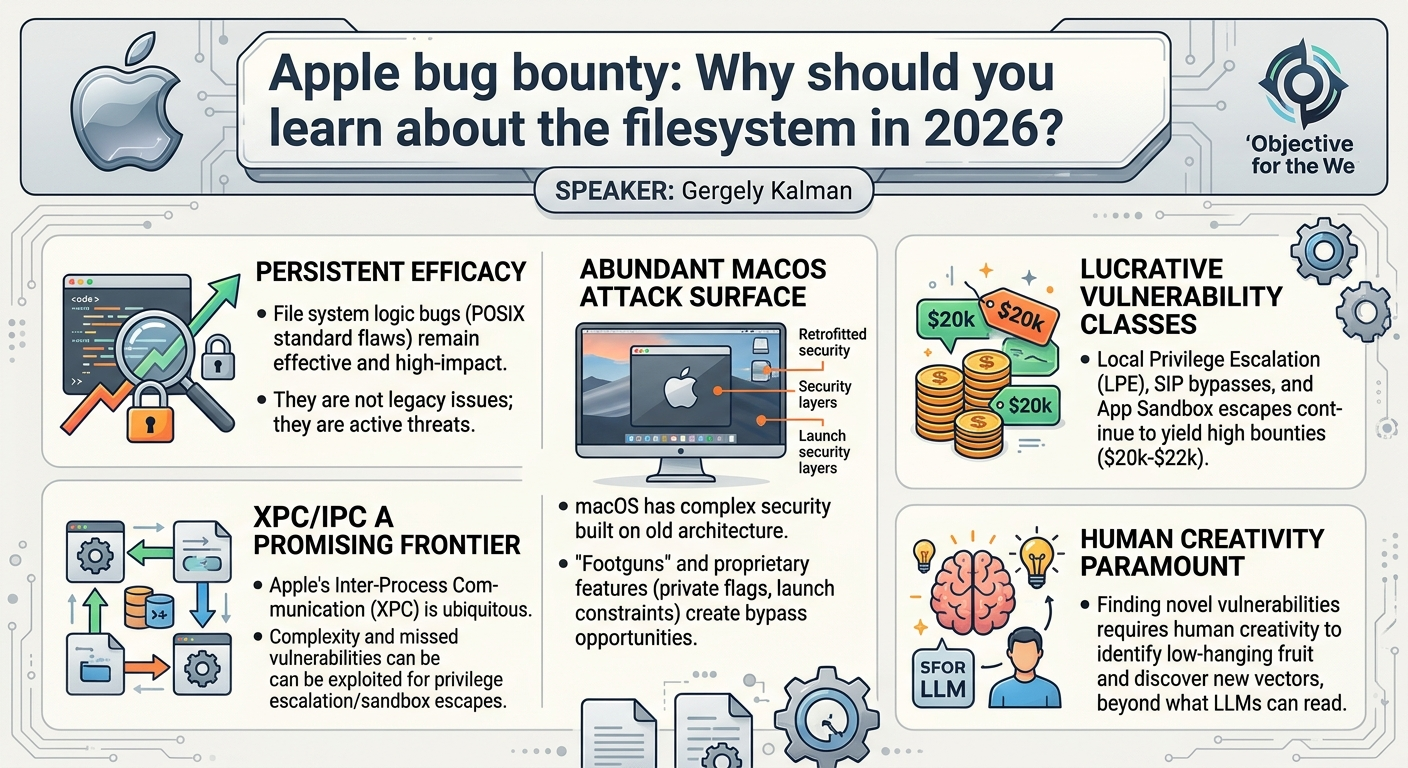
- Persistent Efficacy of File System Logic Bugs: Despite common perception, file system vulnerabilities, particularly logic bugs rooted in POSIX design flaws, remain highly effective and impactful. They are not legacy issues but active threats, largely due to the fundamental nature of file operations and the difficulty of broad mitigation.
- Abundant Attack Surface in macOS: Apple's macOS, being a system where security has often been "retrofitted" onto an existing architecture, presents a vast and complex attack surface. The combination of POSIX "footguns" (e.g., race conditions, unintuitive access control, complex path resolution) and Apple's proprietary additions (like private flags and launch constraints) creates numerous opportunities for exploitation.
- Mitigation Challenges and Bypasses: Broad, systemic mitigation of file system vulnerabilities is "impossible" without breaking API compatibility and user-space software that relies on 40 years of expectations. Apple's attempts at mitigation, while commendable, often lead to specific bypasses, as demonstrated by Kalman's own experience bypassing one of Apple's fixes based on a private flag.
- Lucrative Vulnerability Classes: Specific categories of file system vulnerabilities continue to yield significant bounties. These include Classic POSIX Local Privilege Escalation (LPE), SIP (System Integrity Protection) bypasses, and App Sandbox escapes, with reported bounty values reaching $20,000 to $22,000.
- XPC/IPC as a Promising Frontier: Apple's inter-process communication (IPC) mechanisms, particularly XPC, are identified as "incredibly promising" attack surfaces. The ubiquity and complexity of XPC endpoints often lead to missed vulnerabilities that can be leveraged for privilege escalation or sandbox escapes.
- Impact of Financial Disincentivization: Apple's reduction in payouts for TCC (Transparency, Consent, and Control) vulnerabilities is noted as a "financial disincentivization," potentially diverting researchers from this area despite its security relevance. This highlights the practical realities and incentives driving bug bounty research.
- Creativity Over Raw Computing Power: While LLMs are good at reading code, Kalman stresses that finding novel file system vulnerabilities still requires "a little bit creative" thinking to identify low-hanging fruit and discover new vectors, suggesting human ingenuity remains paramount.
Technical Deep Dive
▶ Watch: Filesystem logic bugs: the future of secure systems (20:00)
Gergely Kalman emphasizes that the foundational elements of file system security, particularly the POSIX standard, contain inherent "footguns" that create a rich attack surface. These include the fact that "all operations are racy," "access control is very, very complex and unintuitive," and "path resolution is more unintuitive." Additionally, "users can mount" file systems, and Apple's custom "adance protections are basically regaxes" which attackers can exploit with various "tricks." Broad mitigation of these issues is challenging because any drastic change would "break the API, therefore break 40 years of expectations and all users space software."
A common primitive in many file system vulnerabilities is the ability to control one path component. Kalman illustrates this with a simple yet powerful example: if an attacker can control a directory, say /hello, by replacing it with a symlink, they can manipulate subsequent operations. This allows them to "make a root demon write a file into [a] protected directory that you yourself couldn't" directly. This leverages the principle that "the parents control the descendants," enabling privilege escalation by redirecting privileged writes. He notes that such bugs have been found in production Apple software "not too long ago."
macOS specifically presents vulnerabilities because "most of this protection is retrofitted." Apple introduces mitigations like launch constraints, but these are often not entirely useful in preventing file system issues. Kalman expresses strong concern over Apple's decision to reduce TCC payouts, calling it a "financial disincentivization" rather than a true mitigation. He also points out Apple's introduction of "private flags" for certain files, which are not pushed upstream due to compatibility issues, creating maintenance burdens for Apple and potential bypass opportunities for attackers. He humorously recounts bypassing one of Apple's fixes related to these flags, leading to a payout.
Kalman then details specific, high-value bug classes that are still relevant for 2026:
- Classic POSIX Local Privilege Escalation (LPE):
- Goal: Gain control over a file typically owned by
rootthat a regular user cannot normally manipulate. - Examples:
/etc/sudoers(which controlssudoprivileges), or files within thecups(Common Unix Printing System) directory. - Targets: Processes running with
rootprivileges. - System Calls: Researchers should scrutinize calls like
chmod,rename,chown, andopenfor vulnerabilities, as these are frequently involved in file system manipulation.
- SIP Bypass Exploits:
- Mechanism: These vulnerabilities exploit the installation process of Apple-signed installer packages (
.pkg). When installed, thesystem_installddaemon (which runs as root) spawns scripts for post- and pre-installation. - Vulnerability: If these scripts are susceptible to command injection or other manipulation, an attacker can induce
system_installd's subprocesses to perform arbitrary actions. - Impact: Crucially, any process or subprocess spawned by
system_installdinherits the privilege to bypass SIP (System Integrity Protection). This allows an attacker to "place malware or delete files that even root can't." - Value: Kalman estimates such an exploit to be worth approximately $20,000.
- App Sandbox Escapes:
- Goal: Create a directory or file that does not possess the quarantine flag. The quarantine flag is a security attribute that macOS applies to files downloaded from the internet, instructing the system to perform additional security checks.
- Attack Surface: These often involve XPC endpoints, which are part of Apple's inter-process communication (IPC) mechanism. An attacker seeks to induce a more privileged process (via an XPC endpoint) to perform actions outside its intended scope.
- Example: An XPC endpoint with an arbitrary directory create bug can be leveraged.
- Method: An attacker creates a directory without the quarantine flag, then fills it with symlinks. Symlinks themselves cannot carry the quarantine flag. The final binary within this structure is then made to point to something like
/bin/bash. The operating system only checks the top-level directory and the final binary for the quarantine flag, ignoring intermediate symlinks. This allows an application to execute code as if it were not quarantined, effectively escaping its sandbox. - Value: This type of bug is valued around $22,000.
Kalman also mentions branching into iOS research, making "partial progress" with an "arbitrary file writer as root," indicating similar file system logic issues persist across Apple's platforms. He concludes that XPC/IPC remains an "incredibly promising" attack surface due to its pervasive use in macOS system design and the frequent oversight of security implications in its implementation.
Demo / Proof of Concept
▶ Watch: Specific 2026 targets: LPE, SIP bypasses, sandbox escapes (24:00)
While Gergely Kalman's talk did not feature a live demonstration or a dedicated proof-of-concept section, his presentation is replete with theoretical examples and references to his past work and blog posts that serve as conceptual proofs. He explicitly describes how vulnerabilities like Classic POSIX LPE, SIP bypasses, and App Sandbox escapes operate, providing concrete attack methodologies. For instance, the detailed explanation of using a symlink to redirect a root daemon's write operation into a protected directory, or the step-by-step process of creating an unquarantined directory with symlinks to execute bin/bash from within a sandboxed application, function as robust conceptual proofs of concept. These examples, drawn from his extensive experience and numerous CVEs, underscore the practical applicability of his research findings.
Defensive Implications
▶ Watch: Q&A: Leveraging published research for new bugs (28:50)
Gergely Kalman's insights into file system vulnerabilities carry significant implications for developers, security architects, and defenders operating within the Apple ecosystem and beyond.
- Rethink File System Assumptions: Developers must shed the assumption that POSIX file system operations are inherently secure or fully understood. The talk highlights that "all operations are racy," and that "access control is very, very complex and unintuitive." This necessitates a deeper, more critical examination of every file creation, modification, and access, especially in privileged processes.
- Robust Input Validation for Paths: The prevalence of issues stemming from controlling "one path component" underscores the critical need for meticulous input validation and canonicalization of all file paths. Developers should never trust user-supplied or external data when constructing file paths, and should be wary of common pitfalls like symlink following and race conditions in file operations.
- Secure IPC Design: The identification of XPC endpoints as an "incredibly promising" attack surface means that developers designing inter-process communication mechanisms must prioritize security. Every XPC endpoint should be thoroughly audited for potential arbitrary file operations, especially directory creation or modification, which can lead to sandbox escapes or privilege escalation.
- Awareness of Retrofitted Security Limitations: Apple's approach of "retrofitting" security onto existing APIs, while necessary, creates a continuous cycle of bypasses. Defenders should not solely rely on high-level mitigations like launch constraints or SIP but understand their underlying limitations and the specific ways they can be circumvented, particularly through chained vulnerabilities.
- Incentivize Vulnerability Research: Apple, and other vendors, should reconsider policies that financially disincentivize research in critical areas like TCC. Adequate bounties encourage researchers to report vulnerabilities responsibly, preventing them from being exploited by malicious actors. A healthy bug bounty ecosystem is a crucial defensive layer.
- Continuous Auditing of System Components: Security teams should conduct regular and thorough audits of system daemons, installer packages, and any process that runs with elevated privileges (e.g.,
system_installd). Particular attention should be paid to pre- and post-installation scripts for potential command injection flaws. - Beyond Memory Safety: While memory safety mitigations are vital, this talk serves as a stark reminder that they do not address the vast landscape of logic bugs. Security strategies must evolve to equally prioritize and address these architectural and design-level flaws, which are often harder to detect automatically.
- Education and Training: The "entire understanding of this system is something that I think is being lost." This highlights a need for better education and training for developers and security professionals on the intricacies and potential dangers of file system interactions and POSIX semantics.
Key Takeaways
- Filesystem vulnerabilities are a neglected but highly effective attack surface: Despite being considered "old tech," logic bugs and race conditions within file system operations remain a potent source of high-impact vulnerabilities, especially on macOS.
- POSIX "footguns" and retrofitted security create ample attack opportunities: The inherent complexities and historical design choices of POSIX, combined with Apple's efforts to layer security onto an existing architecture, generate a constant stream of new bypasses and exploitable flaws.
- Specific bug classes offer high rewards: Classic POSIX Local Privilege Escalation (LPE), SIP bypasses via installer packages, and App Sandbox escapes through unquarantined file creation are consistently lucrative areas for bug bounty hunters, with bounties reaching $20,000-$22,000.
- XPC/IPC is a critical and promising attack surface: Apple's inter-process communication mechanisms, particularly XPC, are ubiquitous in macOS and frequently contain logic flaws that can be leveraged for significant security impact.
- Bug bounty hunting is a viable and impactful career path: For individuals seeking self-employment or a career change, focusing on "objectively valuable skills" like security research and leveraging platforms like the Apple Security Bounty Program (ASB) offers a rewarding path to financial independence and global impact.
- Continuous learning, mentorship, and creative thinking are paramount: Success in security research, especially in uncovering novel file system vulnerabilities, relies on constant skill acquisition, understanding market incentives, seeking guidance from mentors, and applying creativity to find new attack vectors.
About the Speaker(s)
Gergely Kalman is an independent security researcher and a full-time Apple bug bounty hunter. He has earned a reputation as "the Apple security researcher file system guy" due to his extensive work and numerous CVEs related to file system vulnerabilities. Kalman's background includes a prior career as a "burned out programmer" before he transitioned into security research after discovering a significant zero-day. He specializes in identifying logic bugs and file system operation flaws, which he believes are increasingly important as memory corruption vulnerabilities become more mitigated. Gergely is passionate about giving back to the community, sharing his knowledge to help aspiring security professionals navigate the industry and find their path in bug bounty hunting.
Reviews
Dr. Zero (Offensive Security Researcher) — STRONG ACCEPT
Kalman delivers exactly what the title promises: a working researcher's argument for why filesystem bugs still pay, with concrete attack patterns and dollar figures attached. It's practitioner knowledge from someone actively cashing checks, not a literature review. Loses half a star for staying surface-level on the technical chains—this is a 'why and where' talk, not a 'here's the exploit' talk.
Heather Calloway (CISO) — SOLID
Useful primer on why file system logic bugs remain exploitable on macOS, with concrete bounty-eligible bug classes. Solid for practitioners building Apple security skills, but the strategic implications for most enterprise security programs are limited—this is researcher career advice more than threat intelligence.