Evaluating connection migration based QUIC censorship circumvention
Seungju Lee (Paper author · Princeton University), Mona Wang (Paper author · Princeton University), Watson Jia (Paper author · Princeton University), Qiang Wu (Paper author · GFW Report), Henry Birge-Lee (Paper author · Princeton University), Liang Wang (Paper author · Princeton University), Prateek Mittal (Paper author · Princeton University)
Privacy Enhancing Technologies Symposium (PETS) 2026 · Day 1 · Moose
Overview
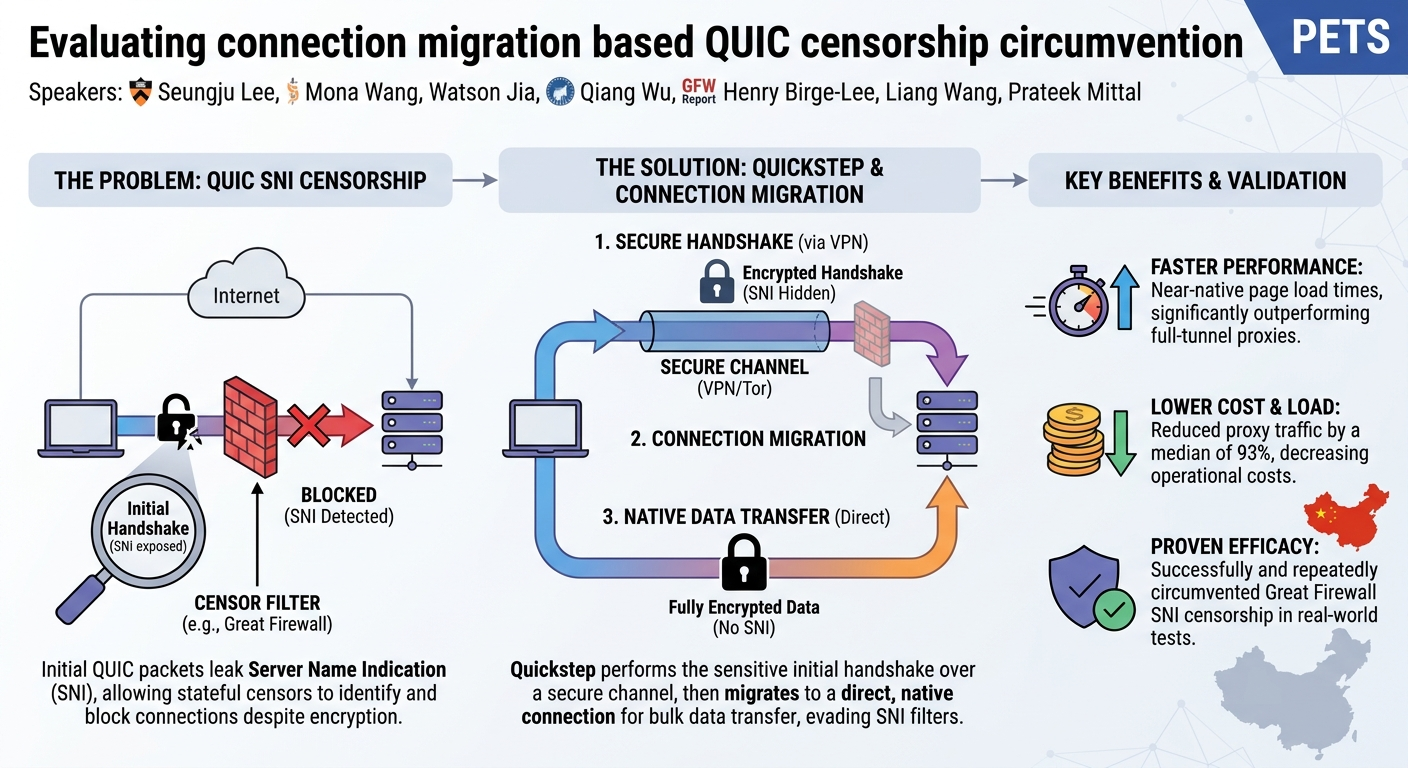
In a compelling presentation at PETS, researchers from Princeton University and the Great Firewall Report unveiled Quickstep, an innovative framework designed to circumvent QUIC censorship. Presented by Enjolie, the talk, titled "Evaluating connection migration based QUIC censorship circumvention," addressed the growing challenge of state-sponsored internet censorship targeting modern transport protocols. With QUIC, the foundation of HTTP/3, rapidly becoming ubiquitous—accounting for over 30% of global HTTP traffic according to Cloudflare—its susceptibility to censorship poses a significant threat to global information access. This research highlights a critical vulnerability in how QUIC's initial handshake packets, despite being encrypted, can still reveal sensitive information like the Server Name Indication (SNI), allowing sophisticated stateful censors like the Chinese Great Firewall to block connections.
Key moments
- 0:45 QUIC's widespread adoption and features
- 1:20 How QUIC initial packets are censored
- 4:00 QUIC's connection migration feature explained
- 5:00 Quickstep protocol: handshake via VPN, then migrate
- 5:30 Quickstep successfully circumvents Chinese Great Firewall
- 6:45 Quickstep reduces page load time significantly
- 9:10 Need standardized discovery for connection migration support
Evaluating connection migration based QUIC censorship circumvention
Speakers: Seungju Lee (Paper author, Princeton University); Mona Wang (Paper author, Princeton University); Watson Jia (Paper author, Princeton University); Qiang Wu (Paper author, GFW Report); Henry Birge-Lee (Paper author, Princeton University); Liang Wang (Paper author, Princeton University); Prateek Mittal (Paper author, Princeton University)
Conference: PETS
YouTube: https://www.youtube.com/watch?v=T4pzBfNu16o
Overview
In a compelling presentation at PETS, researchers from Princeton University and the Great Firewall Report unveiled Quickstep, an innovative framework designed to circumvent QUIC censorship. Presented by Enjolie, the talk, titled "Evaluating connection migration based QUIC censorship circumvention," addressed the growing challenge of state-sponsored internet censorship targeting modern transport protocols. With QUIC, the foundation of HTTP/3, rapidly becoming ubiquitous—accounting for over 30% of global HTTP traffic according to Cloudflare—its susceptibility to censorship poses a significant threat to global information access. This research highlights a critical vulnerability in how QUIC's initial handshake packets, despite being encrypted, can still reveal sensitive information like the Server Name Indication (SNI), allowing sophisticated stateful censors like the Chinese Great Firewall to block connections.
The Quickstep framework leverages a unique feature of QUIC: connection migration. By strategically splitting the initial, information-rich handshake phase over a secure channel (such as a VPN) and then migrating the bulk of the data transfer to a direct, native connection, Quickstep effectively bypasses SNI-based filtering. This approach not only successfully circumvents censorship but also significantly reduces the performance overhead and operational costs associated with fully proxied connections. The work is particularly timely given the recent escalation of QUIC SNI censorship by nations like Russia (2022-2023) and China (2024), making robust circumvention techniques more vital than ever for maintaining open internet access.
This article delves into the technical underpinnings of Quickstep, examining how it exploits QUIC's architectural advantages to evade detection. It explores the practical implications for both users seeking to bypass censorship and service providers facing increased blocking efforts. The research provides a comprehensive evaluation of Quickstep's effectiveness, its performance benefits, and the current landscape of QUIC and connection migration support in the wild, offering crucial insights for the ongoing battle against internet censorship.
Background
▶ Watch: QUIC's widespread adoption and features (0:45)
The evolution of internet transport protocols has consistently aimed for improved performance and security. QUIC (Quick UDP Internet Connections), initially proposed by Google in 2012 and standardized by the IETF in 2021, represents a significant leap forward from TCP. Unlike TCP, QUIC is a UDP-based, multiplexed transport layer protocol that inherently bundles TLS encryption by default, aiming to mitigate issues like head-of-line blocking and providing enhanced security and performance features. Its adoption has been rapid, forming the backbone of HTTP/3, the newest HTTP standard, also standardized in 2021. Major browsers like Chrome, Edge, Opera, Safari, and Firefox now support QUIC, contributing to its substantial footprint in global internet traffic.
Despite its strong security posture, QUIC is not entirely immune to censorship. Traditional censorship often targets the SNI field within the Client Hello message of TCP/TLS traffic, which, being unencrypted, reveals the target domain name. While QUIC encrypts most of its traffic, including the Client Hello, the initial packets that carry this crucial handshake information do not offer full confidentiality. The encryption keys for these initial packets are derived from publicly available information, such as a public salt and the connection ID—a non-encrypted part of QUIC packets. This design choice, while facilitating connection establishment, inadvertently creates a window for sophisticated stateful censors to identify and block connections based on the SNI. This vulnerability has been actively exploited, with Russia initiating QUIC SNI censorship between 2022 and 2023, and China following suit in 2024, indicating a growing trend in state-level efforts to control internet access by targeting this modern protocol.
The threat model assumed by the Quickstep researchers involves a stateful censor actively monitoring network traffic to block access to specific websites based on their server name. If a client attempts to reach a blocked domain, even if the IP address itself is not blocked, the censor can first interfere with DNS requests. More critically, even if the client obtains the IP address via alternative means, the censor can still inspect the initial QUIC packets, extract the SNI from the "not very securely encrypted" Client Hello, and subsequently block the entire QUIC connection. This scenario underscores the need for a circumvention strategy that specifically addresses the exposure of SNI during the initial handshake phase, while minimizing the performance and cost penalties associated with traditional full-tunnel VPNs. The Quickstep project was thus conceived to address these specific challenges, aiming to not only circumvent QUIC SNI censorship but also to reduce operational costs for both clients and secure channel providers, all while inducing minimal performance overhead.
Key Findings
▶ Watch: QUIC's connection migration feature explained (4:00)
The Quickstep research yielded several significant findings, demonstrating the framework's effectiveness in both circumvention and performance optimization. The core contribution is the successful design and validation of a protocol that directly addresses QUIC SNI censorship by leveraging QUIC's connection migration feature.
First and foremost, Quickstep was empirically verified to successfully circumvent the Chinese Great Firewall's QUIC SNI censorship. The researchers targeted several tiktokcdn.com domains, which were known to be blocked via QUIC SNI but not via IP address. Prior work had established that the Great Firewall's QUIC SNI censorship is probabilistic, meaning it doesn't trigger on every attempt, but once triggered, the connection to that endpoint remains blocked for a period. Quickstep clients consistently and repeatedly succeeded in establishing connections to these blocked domains, whereas non-Quickstep clients would fail after a few attempts, confirming its efficacy against a sophisticated state-level censor.
Beyond circumvention, Quickstep demonstrated substantial improvements in performance and cost efficiency compared to traditional full-tunnel proxy solutions. The evaluation focused on two key metrics: the amount of traffic sent through the secure handshake channel (e.g., a VPN proxy) and the overall page load time. When connecting to 100 different QUIC-supporting domains, Quickstep remarkably reduced the load on the proxy by a median of 93%. This significant reduction in traffic through the often bandwidth-constrained handshake channel directly translates to lower operational costs for providers and reduced data consumption for clients using pay-as-you-go services.
Furthermore, Quickstep substantially improved page load time for the majority of websites. Comparative analysis showed that Quickstep connections closely mirrored the performance of native, unproxied connections, far outperforming fully proxied connections. This is because the bulk of the data transfer, which contributes most to page load time after the initial connection establishment, occurs over the high-speed native channel in Quickstep. This finding underscores Quickstep's ability to deliver a near-native browsing experience while simultaneously bypassing censorship, addressing a critical limitation of many existing circumvention tools that introduce significant latency.
Finally, the study also provided valuable insights into the real-world adoption of QUIC and connection migration. Between November 2024 and April 2026, the researchers observed a significant increase in QUIC support across 2.8 million domains. More critically for Quickstep's viability, support for connection migration—a standard QUIC feature—increased almost sevenfold, from approximately 31,000 domains in November 2024 to a much larger number by April 2026. This growing adoption signals a positive trend for the large-scale deployability of Quickstep, though the researchers noted that identifying connection migration support remains non-trivial, highlighting an area for future standardization.
Technical Deep Dive
▶ Watch: Quickstep protocol: handshake via VPN, then migrate (5:00)
Quickstep's technical innovation exploits two fundamental observations: the nature of sensor filtering and QUIC's connection migration capability.
Stateful censors, like the Great Firewall, typically focus filtering on "information-rich handshake packets." These packets, exemplified by the Client Hello in both TCP/TLS and QUIC, contain critical fields like Server Name Indication (SNI) and cipher suites. While QUIC aims for pervasive encryption, the initial packets carrying the Client Hello are not fully confidential. Their encryption keys are derived from publicly available data, including a public salt and the unencrypted connection ID. This allows sophisticated censors to inspect these initial packets, identify the target domain via the SNI, and subsequently block the connection, even if the IP address itself is not blacklisted.
The second crucial observation is QUIC's distinct connection identification and inherent support for connection migration. Unlike TCP's 5-tuple connection identifier, a QUIC connection is primarily defined by its connection ID. This unique identifier allows a QUIC connection to persist even if one or both endpoints' IP addresses or ports change mid-connection. This benefits mobile clients, avoiding re-establishment when moving between networks (e.g., Wi-Fi to cellular), thus improving performance.
Quickstep leverages these observations by proposing a "split-path" framework that segregates the vulnerable handshake phase from the secure data transfer phase. The process unfolds in three main steps:
- Initial Handshake via Secure Channel: A Quickstep client first initiates a DNS request and the crucial QUIC handshake through a secure handshake channel. This channel (e.g., VPN, Tor) encrypts and tunnels the initial establishment, hiding the sensitive SNI from the censor. During this phase, client and server establish a full QUIC connection, negotiating encryption keys and assigning a unique connection ID.
- Connection Migration: Once the QUIC connection is fully established and secured via TLS encryption over the handshake channel, the Quickstep client performs a connection migration. It switches the network path for the established QUIC connection from the secure proxy to a direct, native connection between the client's actual IP address and the server's IP address. Because QUIC connections are identified by their connection ID, not IP/port pairs, migration is seamless and transparent to the QUIC protocol.
- Secure Native Data Transfer: Following migration, all subsequent QUIC traffic flows directly over the native connection. At this point, the traffic is fully encrypted using the TLS keys negotiated during the initial handshake, which occurred securely over the proxy. Consequently, the censor, which previously only had visibility into the initial, semi-encrypted handshake packets, now sees only opaque, encrypted QUIC packets on the native path. Without SNI or other identifying information, the censor cannot block the ongoing connection.
This architecture ensures that the information-rich handshake, susceptible to SNI-based filtering, is protected by a secure channel, while the bulk of the data transfer, fully encrypted and performance-sensitive, benefits from the speed and efficiency of a direct connection. The core enabler of Quickstep is the QUIC connection ID, which decouples the logical connection from the underlying network addresses, making this migration-based circumvention strategy viable and highly effective.
Demo / Proof of Concept
▶ Watch: Quickstep reduces page load time significantly (6:45)
The efficacy of Quickstep was rigorously demonstrated through a practical proof-of-concept against one of the world's most sophisticated censorship systems: the Chinese Great Firewall. This evaluation was crucial for validating Quickstep's ability to overcome real-world, dynamic censorship mechanisms.
For the demonstration, the researchers specifically targeted several domains associated with tiktokcdn.com. These domains were chosen because prior research and observation had confirmed that they were subject to active QUIC SNI censorship by the Great Firewall. Crucially, their IP addresses themselves were not universally blocked, making them ideal candidates to test SNI-specific filtering. The censorship applied to these domains was noted to be "probabilistic," meaning that the blocking mechanism doesn't activate on every single connection attempt. However, once triggered, the connection to that specific endpoint would be blocked for a certain duration, indicative of a stateful filtering approach.
The experimental setup involved two types of clients: a Quickstep client and a standard, non-Quickstep client. Both attempted to establish connections to the pre-selected tiktokcdn.com domains. The results were stark and conclusive:
- The Quickstep client consistently and repeatedly succeeded in establishing and maintaining connections to these domains. This demonstrated that by routing the initial handshake through a secure channel and then migrating to a native connection, Quickstep effectively bypassed the Great Firewall's SNI-based filters. The censor, unable to inspect the SNI on the subsequent native data path, allowed the connection to proceed unimpeded.
- In contrast, the non-Quickstep client would reliably fail after several connection attempts. This confirmed that without Quickstep's circumvention mechanism, the Great Firewall's filters would eventually detect the blocked SNI in the initial QUIC packets and terminate the connection, preventing access to the target content.
This proof-of-concept provided strong empirical evidence that Quickstep successfully evades real-world QUIC SNI censorship. The ability to repeatedly connect to domains actively blocked by the Great Firewall underscores the framework's robustness and practical utility. It validated the core hypothesis that splitting the handshake and data paths, leveraging QUIC's connection migration, is an effective strategy against state-level internet censorship targeting modern transport protocols. This successful demonstration is a critical step towards advocating for wider adoption of such circumvention techniques.
Defensive Implications
▶ Watch: Need standardized discovery for connection migration support (9:10)
The research on Quickstep and QUIC SNI censorship carries significant implications for network defenders, service providers, and even end-users. Understanding these dynamics is crucial for both mitigating censorship and promoting a more open internet.
For website operators and content providers, the primary implication is the urgent need to ensure full support for QUIC and, critically, connection migration. As censorship increasingly targets QUIC, services that fully embrace its features, particularly connection migration, will be more resilient to blocking. The research noted that while QUIC support is growing rapidly (an increase across 2.8 million domains between November 2024 and April 2026), the explicit support for connection migration, though a standard QUIC feature, was initially much lower (around 31,000 domains in November 2024). Although it showed a sevenfold increase by April 2026, widespread adoption is still key. Providers should actively configure their QUIC servers to enable and correctly signal connection migration support. This proactive stance would allow circumvention tools like Quickstep to function effectively, thereby maintaining accessibility for users in censored regions.
Secondly, the researchers highlighted a challenge in identifying whether a server supports connection migration, noting it is "often non-trivial in the wild." This points to a need for standardized mechanisms for clients to discover connection migration capabilities. Defenders, especially those developing or deploying QUIC services, should advocate for and implement clearer signaling. The talk specifically mentioned "more active use of the disabled_active_migration flag in QUIC" as a potential mechanism to enable clients to reliably determine origin server support. Better signaling would reduce the overhead for circumvention tools and improve their reliability by allowing them to intelligently choose servers that support Quickstep's operation.
For network administrators and security professionals operating within censored environments, Quickstep illustrates the arms race dynamic inherent in internet censorship. As censors adapt to new protocols like QUIC, circumvention tools must innovate. Defenders should recognize that solely relying on basic encryption is insufficient against advanced stateful censors that exploit protocol nuances. The detailed analysis of how QUIC's initial packets leak SNI, despite encryption, serves as a vital lesson in understanding protocol-level vulnerabilities. This knowledge can inform the design of more robust applications and network configurations that minimize metadata leakage.
Finally, for users in censored regions, Quickstep offers a promising avenue for maintaining access to information. It demonstrates that combining secure channels for initial handshakes with the performance benefits of native connections is a viable and efficient strategy. While Quickstep itself is a framework, its underlying principles can guide the development of user-facing VPNs or proxy services that implement similar split-tunneling approaches for QUIC traffic. The reduced cost and improved performance observed with Quickstep mean that such tools could offer a more sustainable and user-friendly experience compared to traditional fully proxied connections. The takeaway is clear: understanding how modern protocols are designed and how their features can be leveraged is critical in the ongoing fight for internet freedom.
Key Takeaways
- QUIC SNI Censorship is a Growing Threat: Despite QUIC's inherent encryption, its initial handshake packets can expose the Server Name Indication (SNI), making it vulnerable to state-level censorship, as demonstrated by Russia (2022-2023) and China (2024) actively blocking QUIC traffic based on SNI.
- Connection Migration is Key to Circumvention: Quickstep leverages QUIC's unique connection migration feature, which allows a connection to persist across IP/port changes, to split the sensitive handshake phase from the bulk data transfer, effectively bypassing SNI filters.
- Split-Path Approach Evades Censors: By performing the initial QUIC handshake over a secure channel (e.g., VPN) and then migrating the connection to a direct, native path, Quickstep hides the SNI from censors during the critical initial phase, allowing subsequent fully encrypted data to flow unimpeded.
- Significant Performance and Cost Benefits: Quickstep dramatically reduces reliance on bandwidth-constrained proxies, cutting proxy load by a median of 93% and significantly improving page load times to near-native levels compared to fully proxied connections.
- Growing, But Inconsistent, Server Support: While QUIC adoption is increasing (2.8 million domains saw increased support), widespread and easily discoverable support for connection migration (which increased sevenfold from 31,000 domains in November 2024) is essential for Quickstep's broad deployment and requires better standardization, such as clearer use of the
disabled_active_migrationflag. - Proactive Defense for Open Internet: Website operators and service providers should prioritize enabling and clearly signaling QUIC and connection migration support to enhance resilience against censorship and empower users in restricted environments.
About the Speaker(s)
The research presented in "Evaluating connection migration based QUIC censorship circumvention" was a collaborative effort by a team of distinguished researchers primarily from Princeton University and the Great Firewall Report. The talk was presented by Enjolie (likely Seungju Lee, a paper author from Princeton University).
The team includes Seungju Lee, Mona Wang, Watson Jia, Henry Birge-Lee, Liang Wang, and Prateek Mittal, all affiliated with Princeton University, a renowned institution known for its cutting-edge research in computer science and cybersecurity. Their work often focuses on internet measurement, censorship circumvention, and network security. Qiang Wu contributed from the Great Firewall Report, an organization dedicated to monitoring and analyzing internet censorship, particularly by the Chinese Great Firewall. This collaboration combines deep academic insight into network protocols with practical, real-world experience in observing and combating censorship, lending significant credibility and practical relevance to the Quickstep project. Their collective expertise highlights a commitment to advancing internet freedom and resilience against state-sponsored blocking efforts.
Reviews
Dr. Zero (Offensive Security Researcher) — MUST SEE
The Princeton and GFW Report crew took QUIC's connection migration feature and turned it into a weapon against DPI. Splitting the handshake over a VPN and migrating the bulk data to a direct pipe is an elegant, high-impact bypass. It drops proxy overhead by 93% and actually works against live Chinese censorship, making this one of the most practical PETS talks of the year.
Heather Calloway (CISO) — STRONG ACCEPT
This is censorship circumvention research with direct availability implications for global enterprises. If you operate in regions with state-level firewalls, this talk dictates how you need to configure your CDNs and edge load balancers to ensure users and remote employees can still reach you.
→ Top-rated talks at Privacy Enhancing Technologies Symposium (PETS) 2026
All talks from Privacy Enhancing Technologies Symposium (PETS) 2026