SoK: Offline Finding Protocols for Lightweight Location Tracking
Akshaya Kumar (Paper author · Georgia Institute of Technology), Carolina Ortega Pérez (Paper author · Cornell University), Joseph Jaeger (Paper author · Georgia Institute of Technology), Thomas Ristenpart (Paper author · University of Toronto), Michael Specter (Paper author · Georgia Institute of Technology)
Privacy Enhancing Technologies Symposium (PETS) 2026 · Day 1 · Moose
Overview
Crowdsourced location tracking, epitomized by devices like Apple AirTags and Tile trackers, has revolutionized how millions keep tabs on personal belongings. However, the pervasive, always-on nature of these systems has also ignited significant security, privacy, and safety concerns, notably their potential for aiding in criminal activities such as stalking and physical assault. The talk, based on a Systematization of Knowledge (SoK) paper presented at PETS, delves into the cryptographic underpinnings of these "offline finding protocols," aiming to provide a comprehensive and critical analysis of their design, deployed techniques, and inherent vulnerabilities.
Key moments
- 0:00 Introduction to offline finding protocols and privacy concerns
- 2:00 How offline finding protocols work: basic mechanism
- 3:00 Key security goals: unlinkability vs. anti-stalking detection
- 5:30 Apple's unlinkability vulnerability via Bluetooth MiTM attack
- 7:00 Google's anti-stalking bypass by malicious owner
- 8:40 Takeaways: No protocol achieves all security goals
- 9:20 Beyond cryptography: resource, physical, societal concerns
SoK: Offline Finding Protocols for Lightweight Location Tracking
Speakers: Akshaya Kumar (Paper author, Georgia Institute of Technology); Carolina Ortega Pérez (Paper author, Cornell University); Joseph Jaeger (Paper author, Georgia Institute of Technology); Thomas Ristenpart (Paper author, University of Toronto); Michael Specter (Paper author, Georgia Institute of Technology)
Conference: PETS
YouTube: https://www.youtube.com/watch?v=TtM2m9hUluc
Overview
Crowdsourced location tracking, epitomized by devices like Apple AirTags and Tile trackers, has revolutionized how millions keep tabs on personal belongings. However, the pervasive, always-on nature of these systems has also ignited significant security, privacy, and safety concerns, notably their potential for aiding in criminal activities such as stalking and physical assault. The talk, based on a Systematization of Knowledge (SoK) paper presented at PETS, delves into the cryptographic underpinnings of these "offline finding protocols," aiming to provide a comprehensive and critical analysis of their design, deployed techniques, and inherent vulnerabilities.
Presented by Carolina Ortega Pérez, this SoK bridges a critical gap in the understanding of these largely proprietary and undocumented protocols. By synthesizing findings from 40 academic papers and nine industry documents spanning from 2014 to 2025, the researchers illuminate the competing threat models, the efficacy of deployed techniques, and the overall status of security and privacy in this rapidly evolving domain. The paper not only consolidates scattered knowledge but also introduces novel security definitions, offering a much-needed framework for evaluating and improving the resilience of these ubiquitous tracking systems against both benign and malicious actors.
The core message of the research is sobering: despite their widespread adoption, current offline finding protocols fall significantly short of achieving robust cryptographic security. The analysis exposes fundamental design flaws, cryptographic vulnerabilities, and a critical lack of attention to anti-abuse mechanisms, particularly those protecting potential stalking targets. The findings underscore the urgent need for a paradigm shift in the design of these systems, advocating for a holistic approach that balances functionality with stringent security, privacy, and user safety considerations.
Background
▶ Watch: Introduction to offline finding protocols and privacy concerns (0:00)
The foundational mechanism behind lightweight location tracking relies on offline finding protocols. These protocols operate on a simple yet powerful premise: a small, battery-powered tag (e.g., an AirTag or Tile) is initially paired via Bluetooth with an owner device. When the tag moves out of Bluetooth range of its owner, it enters "lost mode." In this mode, the tag continuously broadcasts a public key over Bluetooth. Any nearby finder device (typically a smartphone running a vendor-specific app or integrated OS functionality) detects this public key, uses it to encrypt its current location, and then transmits the encrypted location data along with the tag's public key back to a central server. Later, the owner device can query this server to retrieve the aggregated location reports, thereby pinpointing the last known location of their lost item.
Crucial to the privacy and security of these systems are two primary cryptographic goals. First, key rotation is employed to achieve unlinkability. The goal is to prevent the finder devices, the central servers, or any Bluetooth sniffers from linking a specific tag back to its owner or tracking the owner's movements through their tags over time. Second, the location data itself is encrypted to ensure location confidentiality from the server, meaning the server should not be able to directly ascertain the precise location of a tag.
However, the proliferation of these devices has brought to light a significant and often overlooked threat model: stalking. A malicious owner could surreptitiously place a tag into someone else's bag, effectively turning it into an unwanted tracking device. To counter this, vendors like Apple and Google have introduced anti-stalking mitigations. A common approach involves altering the key rotation frequency: when a tag is in lost mode and separated from its owner, its keys rotate less often (e.g., once every 24 hours), compared to faster rotation when connected. This slower rotation allows a potential stalking target to detect if a consistent, unknown tag has been following them over a 24-hour period, triggering an alert on their device. This introduces a fundamental trade-off between unlinkability and stalking detection, where a slightly weaker form of unlinkability (over larger time windows) is accepted to enhance user safety.
Beyond these core concerns, the paper also explores other vital security goals. Forward secrecy ensures that even if a server is compromised and gains access to a tag's current cryptographic secrets, it cannot decrypt previously collected location reports. Advertisement unforgeability aims to prevent malicious software or custom-built tags from participating in the network, ensuring the integrity of the tracking ecosystem. Furthermore, the researchers contribute new security definitions, such as stalker identity integrity, which proposes mechanisms to identify the perpetrator of a stalking incident. The comprehensive SoK classifies these goals based on whether they protect the owner or the finder and delineates various adversarial models, highlighting the complexity and multifaceted nature of securing these pervasive tracking technologies.
Key Findings
▶ Watch: Key security goals: unlinkability vs. anti-stalking detection (3:00)
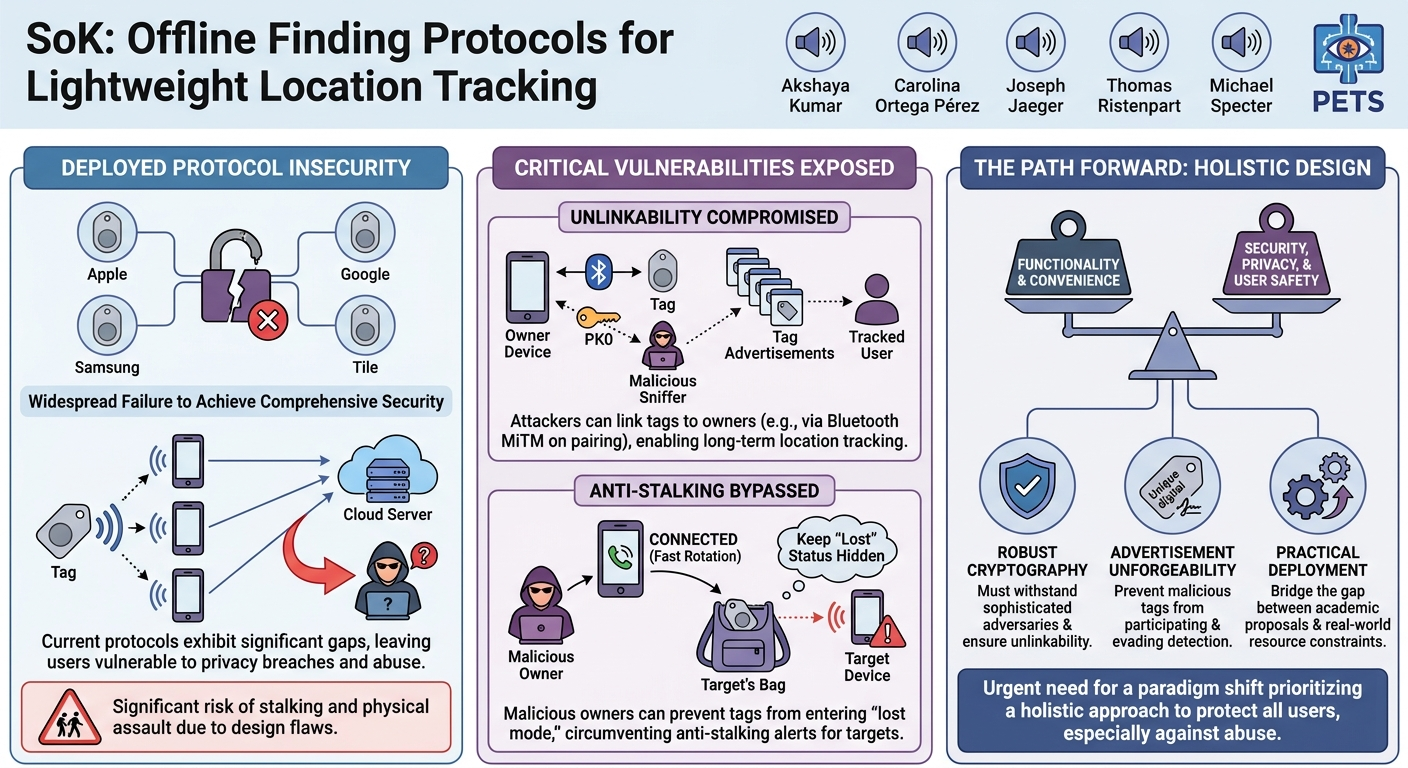
The systematization of knowledge reveals a stark reality: none of the currently deployed offline finding protocols achieve all cryptographically possible security goals. This critical gap stems from a combination of fundamental design choices, inherent cryptographic vulnerabilities, and a tendency for vendors to define threat models that exclude certain attack vectors or prioritize functionality over comprehensive security.
A primary finding concerns unlinkability. The research highlights that Samsung and Tile protocols exhibit a complete lack of unlinkability due to their reuse of a fixed set of advertisements, making continuous tracking trivial for any observer. While Apple and Google offer some degree of unlinkability, the paper demonstrates that even their implementations are susceptible to specific adversaries, rendering strong privacy elusive. This means that, under certain conditions, an attacker can still link a tag to its owner or track its movements.
Another significant deficiency is the universal failure of existing protocols to achieve detectability against malicious tags. This implies that anyone with off-the-shelf hardware can construct a custom tag and integrate it into the network. Such a malicious tag might not adhere to the protocol's rules—for instance, by maintaining rapid key rotation even when in lost mode, making it significantly harder for a stalking target to detect. This vulnerability opens the door to highly surreptitious and undetectable tracking.
Furthermore, the SoK underscores a pervasive lack of attention to anti-stalking protections and, more broadly, to the safety of finder devices. While some mitigations exist (like Apple and Google's slower key rotation in lost mode), they are shown to be insufficient against determined or malicious owners. The focus has historically been on protecting the owner's privacy and the confidentiality of their lost items, rather than safeguarding individuals who might become unwitting targets of abuse facilitated by these very systems.
Finally, while academic research has proposed various improvements addressing specific security properties, these proposals often face significant hurdles in terms of practical deployability and performance. Many academic solutions introduce computational overhead or resource requirements that are incompatible with the lightweight, low-power constraints of mass-market tracking tags, creating a persistent gap between theoretical security and real-world implementation. The paper argues that a more integrated approach, considering cryptographic security alongside practical constraints, is essential for future advancements.
Technical Deep Dive
▶ Watch: Apple's unlinkability vulnerability via Bluetooth MiTM attack (5:30)
The paper's technical deep dive meticulously dissects the cryptographic mechanisms and vulnerabilities within deployed offline finding protocols, illustrating how specific design choices lead to critical security failures. Two prominent examples are presented to highlight the shortcomings in owner security (unlinkability) and finder safety (detectability).
For owner security, the talk elaborates on an unlinkability attack against Apple's AirTag protocol, originally detailed by Lin et al. The vulnerability lies in the key derivation process during the initial pairing phase. When an owner device pairs with an AirTag, it generates a public/private key pair. Crucially, the owner device then forwards PK0 (the initial public key) to the tag. The tag subsequently uses this PK0 to deterministically derive all future public keys that it will advertise to finder devices. The critical flaw is that this transmission of PK0 occurs before a secure channel is established between the owner device and the tag. Consequently, a Bluetooth meddler-in-the-middle attacker present during the pairing process can intercept PK0. Once PK0 is compromised, the attacker can independently compute and predict all subsequent public keys that the tag will ever advertise. This capability directly breaks the unlinkability goal, as the attacker can now link all observed advertisements back to the original pairing event and, by extension, to the owner. The researchers note that this design choice was likely made to achieve forward secrecy, but alternative cryptographic constructions could achieve forward secrecy without sacrificing unlinkability.
Regarding finder safety, the paper scrutinizes a detectability attack against Google's offline finding protocol, attributed to Bodega et al. This attack targets the mechanism by which tags transition between "connected" and "lost" modes, and how this impacts key rotation frequency. Google's protocol dictates that keys rotate rapidly when connected to the owner device, but much slower (e.g., once a day) when in lost mode. The transition process is initiated by the owner device: when it detects that the tag has been out of range for a certain period, it informs the central server that the tag is "disconnected." If a finder device later reports a location associated with the tag's key, the server then instructs the finder device that the tag is "lost." The finder device, in turn, relays this information to the tag, prompting it to enter lost mode and slow its key rotation. The critical vulnerability arises because a malicious owner can simply choose to never inform the server that their tag is out of range. By withholding this information, the tag is effectively prevented from entering lost mode from the perspective of the server and other devices. Consequently, the tag's keys continue to rotate rapidly, mimicking a connected state. This rapid rotation prevents finder devices (specifically potential stalking targets) from receiving an unwanted tracking alert, as these alerts are typically triggered by the detection of a consistently slow-rotating, unknown tag over an extended period (e.g., 24 hours). This attack directly undermines the detectability against malicious owners, rendering anti-stalking mitigations ineffective in this scenario.
These technical examples underscore that the security failures are not merely theoretical but stem from specific, exploitable design decisions in widely deployed systems. They highlight the need for a more rigorous application of cryptographic principles and a broader consideration of adversarial models, especially those involving malicious owners and sophisticated network interlopers.
Demo / Proof of Concept
▶ Watch: Takeaways: No protocol achieves all security goals (8:40)
As a Systematization of Knowledge (SoK) paper, the talk did not present a novel demonstration or proof-of-concept developed by the authors. Instead, its primary contribution is a comprehensive analytical framework and a critical review of existing protocols, vulnerabilities, and academic proposals. The "Technical Deep Dive" section, for instance, meticulously describes attack vectors and methodologies discovered and published by other researchers (such as Lin et al. and Bodega et al.), rather than showcasing new exploits. The purpose of this SoK is to consolidate, classify, and analyze the scattered literature, providing a holistic understanding of the security landscape of offline finding protocols. Therefore, the talk focuses on illustrating how existing attacks work and why deployed systems are vulnerable, using detailed explanations rather than live demonstrations.
Defensive Implications
▶ Watch: Beyond cryptography: resource, physical, societal concerns (9:20)
The findings of this SoK carry significant implications for various stakeholders involved in the development, deployment, and use of offline finding protocols. Implementing robust defenses requires a multi-pronged approach addressing both technical vulnerabilities and broader policy considerations.
For vendors (e.g., Apple, Google, Samsung, Tile), the immediate imperative is to re-evaluate and re-engineer critical components of their protocols:
- Secure Pairing: The vulnerability demonstrated in Apple's protocol (Lin et al.) highlights the absolute necessity of establishing a secure channel before transmitting sensitive cryptographic parameters like PK0 during the pairing phase. This could involve secure key exchange protocols or leveraging existing secure channels if available. This would prevent Bluetooth meddler-in-the-middle attacks from compromising unlinkability.
- Robust Mode Transition: Google's protocol flaw (Bodega et al.) reveals that relying solely on the owner to report a tag's disconnected status is insufficient. Protocols must incorporate independent, verifiable mechanisms for tags to transition into lost mode and slow key rotation, even if the owner is malicious or unresponsive. This could involve cryptographically signed attestations from the tag itself or decentralized consensus mechanisms among finder devices. This would enhance detectability against malicious owners.
- Advertisement Unforgeability: The lack of this property across all deployed protocols is a critical security gap. Vendors must implement mechanisms to cryptographically authenticate legitimate tags and prevent arbitrary, malicious devices from participating in the network. This could involve digital signatures on advertisement packets using keys provisioned during manufacturing or a secure enrollment process.
- Enhanced Anti-Stalking Features: Current anti-stalking measures are demonstrably inadequate. Future designs should move beyond mere detection (e.g., "an unknown tag is following you") towards mechanisms that aid in stalker identity integrity. This could involve secure logging of keys used for advertising, allowing authorities to trace back to the original owner device if a stalking incident is confirmed. Furthermore, anti-stalking should not solely rely on the target having a compatible device or being within notification range.
- Achieving Forward Secrecy without Compromising Unlinkability: As highlighted, some design choices for forward secrecy inadvertently weaken unlinkability. Vendors must explore alternative cryptographic constructions that achieve both goals concurrently, ensuring that past location data remains confidential even if future secrets are compromised, without enabling long-term tracking.
For users, the defensive implications are primarily about awareness and vigilance:
- Understand Limitations: Users must be aware that current anti-stalking features are not foolproof and can be circumvented by determined or malicious actors.
- Regular Checks: Users who suspect unwanted tracking should regularly check their belongings and surroundings for unknown tracking devices.
- Device Compatibility: Ensure personal devices (smartphones) are updated and configured to receive anti-stalking notifications from all relevant tracking networks (e.g., Apple's Find My, Google's Find My Device).
For researchers, the SoK provides a clear roadmap for future work:
- Practically Deployable Solutions: Focus on designing academic proposals that meet the stringent resource constraints (battery life, computational power, memory) of lightweight tracking tags, ensuring theoretical improvements can be translated into real-world deployments.
- Holistic Security: Integrate cryptographic security with considerations for the physical layer security, usability, and societal impacts of these systems.
- Anti-Abuse and Finder Protections: Prioritize research into novel mechanisms for protecting finders and preventing abuse, moving beyond traditional owner-centric security models.
Ultimately, defending against the vulnerabilities exposed by this SoK requires a concerted effort from the entire ecosystem, prioritizing user safety and privacy alongside the convenience offered by these powerful tracking technologies.
Key Takeaways
- Current protocols lack comprehensive security: None of the existing, widely deployed offline finding protocols (e.g., Apple, Google, Samsung, Tile) achieve all cryptographically possible security goals, exhibiting significant gaps due to design choices, cryptographic weaknesses, and limited threat models.
- Unlinkability is often compromised: Many deployed systems, particularly Samsung and Tile, completely lack unlinkability. Even Apple and Google's implementations suffer from vulnerabilities (e.g., Bluetooth meddler-in-the-middle attacks on Apple's PK0 transmission) that allow adversaries to link tags to owners or track movements.
- Anti-stalking features are insufficient: Protections against unwanted tracking are weak, especially against malicious owners who can circumvent existing mitigations (e.g., Google's mode transition flaw). There's a critical need for mechanisms that not only detect unwanted tags but also facilitate stalker identity integrity.
- Malicious tags can easily participate: A universal failing is the lack of advertisement unforgeability, enabling anyone to construct a custom, malicious tag that can join the network and potentially evade anti-stalking detection by not adhering to protocol rules.
- Academic solutions face deployment challenges: While academic research offers promising improvements to specific security properties, these proposals often struggle with practical deployability, performance requirements, and resource constraints inherent to lightweight tracking devices.
- Holistic design is essential: Future development of offline finding protocols must integrate robust cryptographic security with real-world resource limitations, physical layer security considerations, usability, and a strong focus on societal concerns like anti-abuse to build truly safe and private systems.
About the Speaker(s)
The talk "SoK: Offline Finding Protocols for Lightweight Location Tracking" was presented by Carolina Ortega Pérez, who is listed as a paper author from Cornell University. She is part of a collaborative research team that includes Akshaya Kumar, Joseph Jaeger, and Michael Specter from the Georgia Institute of Technology, and Thomas Ristenpart from the University of Toronto. This team collectively authored the Systematization of Knowledge paper that formed the basis of this presentation, bringing together diverse expertise to analyze the cryptographic layer of crowdsourced location tracking protocols. Their work represents a significant contribution to understanding the security and privacy landscape of these ubiquitous technologies.
Reviews
Dr. Zero (Offensive Security Researcher) — SOLID
It's an SoK. That means no new zero-days, just a very neat taxonomy of how everyone else already broke AirTags and Tiles. Solid baseline if you need to understand the systemic design failures in offline finding protocols, but offensively, it's just a map of known graves.
Heather Calloway (CISO) — STRONG ACCEPT
This presentation systematizes the cryptographic failures of mass-market tracking protocols like Apple AirTags and Google Find My. For the enterprise, this is required reading for executive protection and physical security teams. It proves that consumer anti-stalking mitigations are fundamentally broken and cannot be relied upon to protect high-profile personnel or sensitive assets from targeted tracking.
→ Top-rated talks at Privacy Enhancing Technologies Symposium (PETS) 2026
All talks from Privacy Enhancing Technologies Symposium (PETS) 2026