Practical Semi-Open Chat Groups for Secure Messaging Applications
Alex Davidson (Paper author · LASIGE, Universidade de Lisboa), Luiza Soezima (Paper author · Aarhus University), Fernando Virdia (Paper author · University of Surrey)
Privacy Enhancing Technologies Symposium (PETS) 2026 · Day 1 · Alpaca
Overview
This talk, presented by Alex Davidson at PETS, introduces a novel approach to managing membership in secure messaging applications through the concept of semi-open chat groups. The work, a collaboration with Luiza Soezima and Fernando Virdia, addresses a critical gap in current secure group communication models. Existing solutions typically offer only two extremes: open groups, which allow immediate joining via a link but are inherently insecure due to lack of vetting, and closed groups, which require manual administrator approval for each join request. While closed groups offer security, their administrative overhead becomes unmanageable for even moderately sized groups, leading to usability degradation and, ultimately, the admission of potentially undesirable members.
Key moments
- 0:00 Introduction to secure messaging group challenges
- 1:05 Introducing semi-open groups via continuous e-voting
- 2:15 Key design constraints for secure messaging applications
- 4:00 Summary of contributions and new cryptographic primitive
- 5:00 Technical explanation of the e-voting protocol
- 6:50 Verifiable exponentiation and permutation commute protocol (VEPCP)
- 8:30 Performance results and future research directions
Practical Semi-Open Chat Groups for Secure Messaging Applications
Speakers: Alex Davidson (Paper author, LASIGE, Universidade de Lisboa); Luiza Soezima (Paper author, Aarhus University); Fernando Virdia (Paper author, University of Surrey)
Conference: PETS
YouTube: https://www.youtube.com/watch?v=03ef-FLeIoA
Overview
This talk, presented by Alex Davidson at PETS, introduces a novel approach to managing membership in secure messaging applications through the concept of semi-open chat groups. The work, a collaboration with Luiza Soezima and Fernando Virdia, addresses a critical gap in current secure group communication models. Existing solutions typically offer only two extremes: open groups, which allow immediate joining via a link but are inherently insecure due to lack of vetting, and closed groups, which require manual administrator approval for each join request. While closed groups offer security, their administrative overhead becomes unmanageable for even moderately sized groups, leading to usability degradation and, ultimately, the admission of potentially undesirable members.
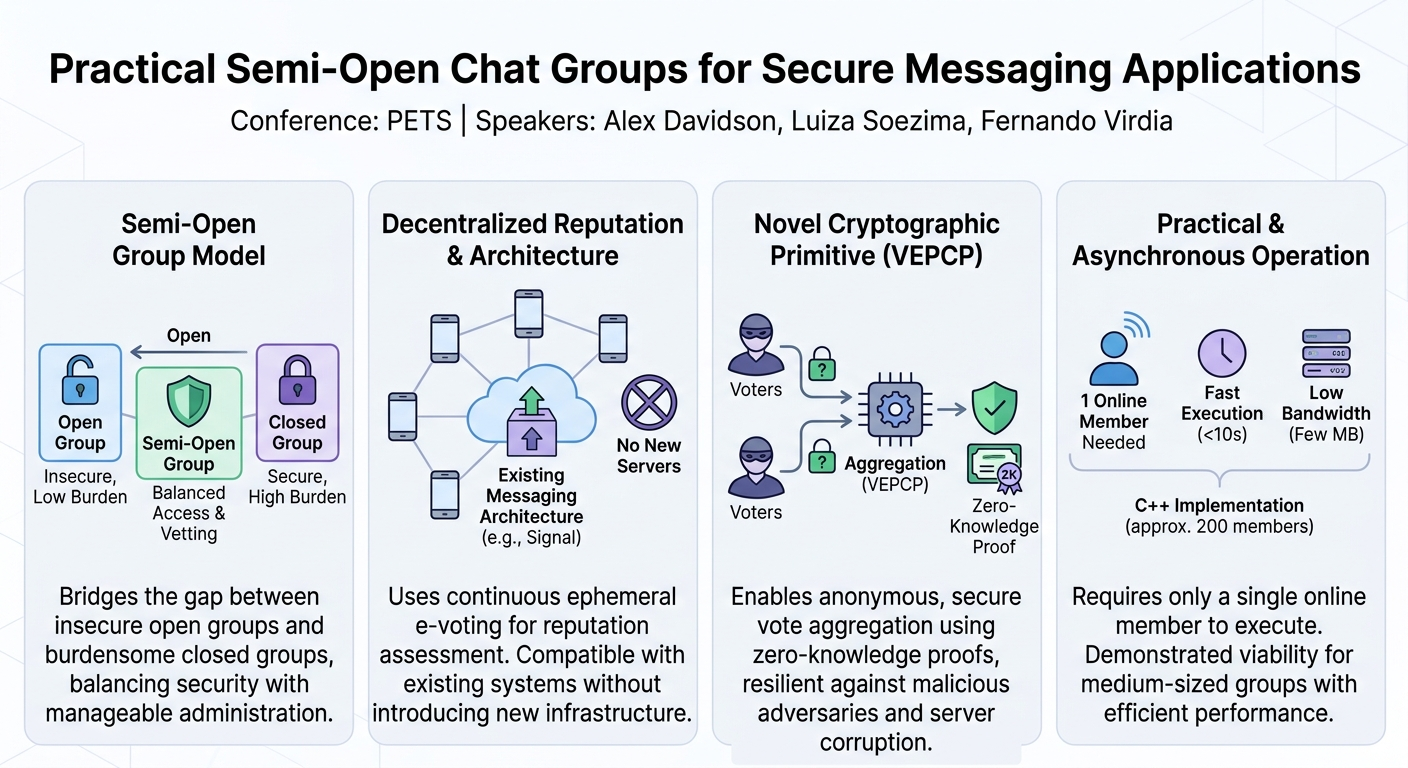
The core contribution is a robust, automated procedure for semi-open groups that streamlines the decision-making process for admitting new members. This system is designed to assess a user's reputation based on continuous, ephemeral e-voting within the group, providing a secure and scalable alternative to the manual burdens of closed groups. The research is particularly relevant for sensitive group communications, such as those used by activists, where the integrity and trustworthiness of group members are paramount, and the need for both security and operational efficiency is acute.
The proposed solution is meticulously engineered to align with the stringent requirements of modern secure messaging protocols. It operates asynchronously, requiring only a single online group member for execution, and crucially, does not necessitate the introduction of new servers or non-standard cryptographic libraries. This design makes it compatible with existing architectures like Signal, ensuring practical deployability. By offering a middle ground that balances ease of access with robust security vetting, this work significantly enhances the viability and scalability of secure group communications for a wide array of applications.
Background
▶ Watch: Introduction to secure messaging group challenges (0:00)
The landscape of online group communications, particularly within secure messaging applications, has long grappled with a fundamental dilemma regarding group access control. On one end of the spectrum are open groups, characterized by their frictionless entry. Users can join instantly, often by simply clicking a shared link. While this model promotes rapid expansion and accessibility, it comes at a severe security cost: anyone with the link can join, making these groups highly susceptible to infiltration by malicious actors or antagonistic entities whose objectives may conflict with the group's. For sensitive discussions, such as those among activists or within private communities, open groups are entirely unsuitable.
At the other end are closed groups, which prioritize security by mandating a manual approval process for every join request. An administrator reviews each applicant, theoretically ensuring that only trusted individuals gain entry. While this offers a higher degree of security, it introduces a significant administrative overhead. Usability research cited by the speakers indicates that for groups with even a few hundred members, the manual vetting process quickly becomes unsustainable. Administrators are overwhelmed, leading to delays, burnout, and ultimately, a breakdown in the vetting process where individuals who "shouldn't be in the group" are admitted simply to alleviate the workload. This effectively compromises the very security closed groups are designed to provide.
The challenge, therefore, lies in devising a mechanism that can offer the security of closed groups without the crippling administrative burden, while also avoiding the open vulnerabilities of open groups. Prior research into reputation systems has attempted to address similar problems, but existing solutions often fall short when applied to the specific constraints of secure messaging applications. Many require all voters to be online simultaneously, rendering them incompatible with the asynchronous nature of real-world secure messaging. Others rely on globally scoped reputations, rather than group-specific assessments, or depend on complex infrastructure like mix nets or multi-server non-colluding pipelines, which introduce new trust assumptions and architectural complexities incompatible with minimalist secure messaging designs. Furthermore, issues like non-anonymous security or unacceptable vote leakage plague many conventional reputation systems, making them unsuitable for environments where privacy and strong security against malicious adversaries are paramount. The absence of a "semi-open" group model that seamlessly integrates into existing secure messaging architectures, while upholding strong privacy and security guarantees, is the problem this work directly addresses.
Key Findings
▶ Watch: Key design constraints for secure messaging applications (2:15)
The research presented in "Practical Semi-Open Chat Groups for Secure Messaging Applications" introduces several significant contributions that collectively address the challenges of secure and scalable group management.
Firstly, the talk formalizes and proposes the concept of semi-open groups. This novel group type sits between the insecure "open" and administratively burdensome "closed" models, offering a pragmatic balance. In a semi-open group, a join request triggers an automated, reputation-based decision-making process, which can either inform a final manual approval or lead to fully automated acceptance or rejection.
Secondly, the core of this automated process is a continuous ephemeral e-voting protocol. Unlike traditional elections, this system allows group members to cast votes at any time, with an election being triggered specifically upon a new join request. The reputation of the prospective member is then assessed based on all historical votes cast on that user within the group, providing a dynamic and evolving trust metric.
Thirdly, the protocol is designed for seamless integration into existing secure messaging architectures, specifically highlighting compatibility with the Signal architecture. A crucial finding is that this reputation system can operate without introducing any new entities, such as dedicated servers or external services, minimizing architectural changes and maintaining the decentralized ethos of many secure messaging platforms.
A significant operational breakthrough is the protocol's asynchronous nature, requiring only a single online group member to execute the election process. This dramatically improves usability and resilience, as it does not depend on the simultaneous online presence of multiple members, a common bottleneck in many distributed protocols.
From a security standpoint, the work provides strong guarantees. The system offers security against a malicious adversary capable of corrupting a subset of users or even the server itself. This robust security model is underpinned by the hardness of the Decision Diffie-Hellman (DDH) problem, a well-established cryptographic assumption.
Furthermore, the authors define a new cryptographic primitive: the verifiable exponentiation and permutation commute protocol. This primitive is fundamental to achieving the necessary privacy and security properties, enabling secure aggregation of votes without revealing individual voter identities or vote contents.
Finally, the practicality of the solution is demonstrated through a C++ implementation. This implementation showcases efficient performance, executing the reputation assessment for groups of approximately 200 members in under 10 seconds and consuming only a few megabytes of bandwidth. This performance profile indicates that the proposed semi-open group model is not only theoretically sound but also practically viable for real-world secure messaging applications.
Technical Deep Dive
▶ Watch: Summary of contributions and new cryptographic primitive (4:00)
The technical foundation of semi-open chat groups rests on a sophisticated continuous ephemeral e-voting protocol designed to operate within the constraints of secure messaging applications. The protocol's design adheres to several crucial stipulations: it must be asynchronous, executing even if only a single user is online; it must run on existing app architectures without introducing new servers or non-standard cryptography; and it must ensure privacy, where only the final result is learned, votes are anonymized, and no vote can be linked back to individual users. Critically, it must maintain security even in a malicious setting, where an adversary can corrupt multiple users or the server itself.
At the heart of the voting mechanism are the users' cryptographic credentials. Each user U_i possesses two secret exponents: a user exponent U_i and a voter exponent V_i. Users publish a user public key derived from their user exponent. When user U_2 wishes to vote on user U_1, they take U_1's public key, raise it to the power of their secret voter exponent V_2, and then add their plaintext vote X (which is typically from a small, discrete domain like binary yes/no, or a short list of preferences) to the exponent. This constructed value forms a ballot, which is an encrypted representation of the vote.
The central challenge lies in counting these votes securely and privately. The protocol aims to compute a discrete logarithm on an aggregated value to reveal the total vote count for a candidate. For this discrete log computation to be efficient, the votes X must originate from a small domain, which is a reasonable assumption for reputation systems (e.g., +1 for support, -1 for oppose).
A key component in the aggregation process is the voter tag. Each voter U_i generates a voter tag by taking a group-specific public key (often from the server) and raising it to the power of their secret voter exponent V_i. This tag is then provided to the group. The overall goal is to combine these voter tags with secret material from both the user and the server in a way that allows the vote X to be revealed only in aggregate, without exposing individual votes or the secret exponents themselves. Directly combining these secrets would be insecure.
This is where the novel cryptographic primitive, the verifiable exponentiation and permutation commute protocol (VEPCP), becomes indispensable. The VEPCP enables the secure aggregation of votes through a multi-party computation involving the group, the server, and the user whose reputation is being assessed. The process unfolds as follows:
- The group collects all the voter tags.
- The group blinds these tags (a cryptographic technique to obscure the original values) and sends the blinded list to the server.
- The server then performs two critical operations: it exponentiates each item in the list and permutes (randomly shuffles) the entire list.
- Crucially, the server provides a zero-knowledge proof alongside the processed list. This proof cryptographically assures the group that the server has correctly performed both the exponentiation and the random shuffling, without revealing any information about the original blinded tags or the permutation order. This zero-knowledge proof is vital for ensuring malicious security against a server attempting to subvert or manipulate the votes.
- This process is then repeated with the user being voted on, who also performs an exponentiation and permutation, again providing a zero-knowledge proof.
Once these steps are completed, the group possesses the necessary cryptographically transformed values to perform the final discrete logarithm calculation. This calculation reveals the aggregated vote for the candidate user, effectively determining their reputation score, while preserving the anonymity of individual voters and the privacy of their specific votes.
The security of this intricate protocol is formally proven under specific assumptions:
- At least one member of the group must be online, in addition to the server and the user wishing to join.
- The group must contain a small, constant set of trusted users who are assumed to be honest and form a committee.
- The transcript of the group's communications must be robust and unmodifiable, observable by all group members.
Under these assumptions, the protocol is proven secure against a malicious adversary, relying on the computational hardness of the Decision Diffie-Hellman problem and the integrity of the trusted discrete log proofs employed within the VEPCP. Performance-wise, the C++ implementation demonstrates practicality, handling groups of hundreds of members with runtimes of tens of seconds or less and bandwidth consumption of tens of megabytes or less. This makes it a viable solution for real-world secure messaging applications that require robust, private, and scalable group access control.
Demo / Proof of Concept
▶ Watch: Verifiable exponentiation and permutation commute protocol (VEPCP) (6:50)
While the talk did not detail a live, interactive demonstration of the protocol in action, the speakers provided strong evidence of its practical feasibility through the development of a C++ implementation. This implementation serves as a concrete proof of concept, validating the theoretical underpinnings of the continuous ephemeral e-voting protocol and the verifiable exponentiation and permutation commute protocol.
The performance characteristics reported from this C++ implementation are key indicators of its real-world applicability. For groups comprising approximately 200 members, the system is capable of executing the entire reputation assessment process, including ballot generation, aggregation via the VEPCP, and final vote counting, in roughly 10 seconds. This efficiency is crucial for maintaining a responsive user experience in a messaging application, where delays in joining a group could be disruptive. Furthermore, the bandwidth consumption for such operations is reported to be in the range of a few megabytes. This modest data footprint is important for mobile-first secure messaging applications, where network conditions can vary, and data usage is often a concern for users.
These performance metrics underscore the practicality of integrating such a sophisticated cryptographic protocol into existing secure messaging environments without unduly burdening system resources or user experience. The C++ implementation effectively demonstrates that the proposed semi-open group model is not merely an academic exercise but a viable, performant solution ready for further exploration and potential deployment within applications like Signal.
Defensive Implications
▶ Watch: Performance results and future research directions (8:30)
The introduction of practical semi-open chat groups carries significant defensive implications for developers of secure messaging applications, group administrators, and users operating in sensitive environments.
For secure messaging application developers, this research offers a blueprint for enhancing the utility and scalability of their platforms. By integrating the continuous ephemeral e-voting protocol, developers can provide a "third option" beyond the current open/closed dichotomy. This allows them to support larger, more dynamic groups without compromising on security or privacy. The protocol's compatibility with existing architectures, such as Signal's, and its avoidance of new server infrastructure, lowers the barrier to adoption. Developers can now design for secure group growth, offering features that cater to communities like activists, journalists, or human rights defenders who require robust vetting without the overhead that often cripples such operations.
For administrators of large secure groups, the benefits are immediate and substantial. The automated reputation assessment significantly reduces the manual burden associated with vetting join requests in closed groups. This automation mitigates the "usability degradation" problem, where administrators, overwhelmed by requests, resort to less stringent vetting or simply admit unverified members. By offloading initial screening to the automated system, administrators can focus their attention on edge cases or appeals, ensuring that the group maintains its integrity and security posture more effectively and sustainably. This is particularly valuable for groups where trust and shared objectives are critical.
From a broader defensive perspective, the protocol's design inherently strengthens the resilience of online communities against infiltration. The use of a verifiable exponentiation and permutation commute protocol (VEPCP) with zero-knowledge proofs ensures that even if an adversary corrupts the server or a subset of group members, the integrity of the vote aggregation process remains intact, and individual votes remain anonymous. This robust security model, based on the Decision Diffie-Hellman (DDH) problem, provides a high level of assurance against malicious manipulation of group membership. The asynchronous nature of the protocol, requiring only a single online group member, also means that group security is not contingent on the constant online presence of multiple administrators or a quorum of voters, making it more robust against network disruptions or targeted denial-of-service attacks that might attempt to prevent elections.
Ultimately, by enabling more secure and scalable group formation, this work empowers users to build and maintain more resilient and trustworthy online communities. It shifts the defensive paradigm from a reactive, manual vetting process to a proactive, cryptographically enforced system that can better withstand sophisticated attacks and the inherent challenges of managing large, sensitive groups in a decentralized manner.
Key Takeaways
- Semi-Open Groups Bridge a Critical Gap: The research introduces the concept of semi-open chat groups, providing a crucial middle ground between insecure open groups and administratively burdensome closed groups for secure messaging applications.
- Decentralized Reputation via E-Voting: A continuous ephemeral e-voting protocol allows group members to continuously assess the reputation of potential new members, triggering elections on join requests and leveraging historical votes for secure, decentralized decision-making.
- Signal-Compatible and Asynchronous Design: The protocol is engineered for practical deployment, compatible with existing architectures like Signal, requiring no new servers or non-standard cryptography, and operates asynchronously, needing only a single online group member for execution.
- Novel Cryptographic Primitive for Privacy and Security: The verifiable exponentiation and permutation commute protocol (VEPCP) is introduced, utilizing zero-knowledge proofs to enable secure, anonymous vote aggregation even in the presence of a malicious server or corrupted users.
- Robust Malicious Security: The system provides strong security guarantees against malicious adversaries capable of corrupting users or the server, with its security proofs rooted in the hardness of the Decision Diffie-Hellman problem.
- Practical Performance for Medium-Sized Groups: A C++ implementation demonstrates the protocol's viability, processing reputation assessments for groups of 200 members in under 10 seconds with minimal bandwidth, indicating readiness for real-world application.
About the Speaker(s)
The talk was presented by Alex Davidson, who is listed as a paper author affiliated with LASIGE, Universidade de Lisboa. He is a key contributor to the research on practical semi-open chat groups. The work is also a joint effort with Luiza Soezima, another paper author from Aarhus University, and Fernando Virdia, also a paper author associated with the University of Surrey. Together, their collective expertise in cryptography and secure messaging systems underpins the innovative solutions presented in this research.
Reviews
Dr. Zero (Offensive Security Researcher) — SOLID
Davidson and team dropped a highly rigorous cryptographic solution to the open/closed group dilemma in E2EE apps like Signal. The math is elegant—introducing a new VEPCP primitive to aggregate asynchronous votes without leaking identity—even if the underlying assumption about human voting behavior is entirely disconnected from reality.
Heather Calloway (CISO) — SOLID
This is a dense applied cryptography paper that solves a very real operational nightmare: securely scaling out-of-band incident response chats. While your board doesn't care about zero-knowledge proofs, your head of IR should view this as the future blueprint for crisis communications.
→ Top-rated talks at Privacy Enhancing Technologies Symposium (PETS) 2026
All talks from Privacy Enhancing Technologies Symposium (PETS) 2026