Overcoming Language Barriers: Multilingual Analysis of the 2023 Swiss Privacy Law's Impact
Luka Nenadic (Paper author · ETH Zurich), David Rodriguez (Paper author · Information Processing and Telecommunications Center, Universidad Politécnica de Madrid, ETSI Telecomunicación), Joseph A. Calandrino (Paper author · Carnegie Mellon University)
Privacy Enhancing Technologies Symposium (PETS) 2026 · Day 1 · Alpaca
Overview
This insightful talk, presented at PETS, delves into the critical question of how the 2023 revision of Swiss privacy law, largely mirroring the European Union's General Data Protection Regulation (GDPR), has impacted disclosures within the privacy policies of Swiss websites. The research addresses a significant gap in current literature, which predominantly focuses on the effects of privacy legislation within the US and EU. By examining Switzerland, a country with four official languages (German, French, Italian, Romansh) and widespread English usage, the study offers a unique multilingual perspective on regulatory compliance outside major economic blocs.
Key moments
- 0:00 Introduction: Swiss privacy law impact question
- 2:00 Three key findings summarized
- 3:00 Website segmentation for analysis
- 5:00 Using GPT-5 for multilingual policy analysis
- 7:00 Swiss privacy law significantly increased disclosures
- 8:00 Privacy policy generators: prevalence and impact
- 10:00 Conclusion, implications, and future research
Overcoming Language Barriers: Multilingual Analysis of the 2023 Swiss Privacy Law's Impact
Speakers: Luka Nenadic (Paper author, ETH Zurich), David Rodriguez (Paper author, Information Processing and Telecommunications Center, Universidad Politécnica de Madrid, ETSI Telecomunicación), Joseph A. Calandrino (Paper author, Carnegie Mellon University)
Conference: PETS
YouTube: https://www.youtube.com/watch?v=0TtwIOCZggw
Overview
This insightful talk, presented at PETS, delves into the critical question of how the 2023 revision of Swiss privacy law, largely mirroring the European Union's General Data Protection Regulation (GDPR), has impacted disclosures within the privacy policies of Swiss websites. The research addresses a significant gap in current literature, which predominantly focuses on the effects of privacy legislation within the US and EU. By examining Switzerland, a country with four official languages (German, French, Italian, Romansh) and widespread English usage, the study offers a unique multilingual perspective on regulatory compliance outside major economic blocs.
The importance of this research extends beyond Switzerland's borders. It explores the phenomenon known as the "Brussels effect," where EU regulations exert influence over non-EU jurisdictions, even prior to local legislative changes. Furthermore, the study investigates the role of privacy policy generators, automated tools widely used by Swiss websites to craft their legal disclosures. The findings provide crucial insights for regulators, website operators, and researchers globally, highlighting the effectiveness of large language models (LLMs) like GPT-5 in analyzing complex legal texts at scale and the varied impact of regulatory changes in a diverse linguistic and legal landscape.
Background
▶ Watch: Introduction: Swiss privacy law impact question (0:00)
The landscape of global data privacy has been dramatically reshaped by landmark legislation such as the European Union’s General Data Protection Regulation (GDPR) and the California Consumer Privacy Act (CCPA) in the United States. These regulations have set high standards for data protection and transparency, compelling organizations to explicitly detail their data processing practices in easily accessible privacy policies. While extensive research has analyzed the impact of GDPR and CCPA on privacy practices within their respective jurisdictions, there has been a notable scarcity of studies examining similar effects in other regions, particularly outside the US and EU. This creates a blind spot regarding how users in diverse linguistic and legal environments are affected by evolving privacy norms.
Switzerland presents a particularly compelling case study for this research. Situated at the heart of Europe but not a member of the EU, Switzerland has long navigated its own path while remaining deeply interconnected with its European neighbors. The 2023 revision of the Swiss privacy law, which notably adopted many provisions akin to the GDPR, provided a unique opportunity to observe the direct consequences of such a legislative overhaul. This context is further complicated by Switzerland's rich linguistic diversity, with German, French, Italian, and English all playing significant roles in online communication. Analyzing privacy policies across these languages poses a considerable challenge for traditional computational methods, which often struggle with the nuances, vagueness, and sheer volume of legal text.
Moreover, the research acknowledges the potential influence of the "Brussels effect," a phenomenon where the EU's regulatory power extends beyond its borders, leading non-EU entities to voluntarily adopt EU standards to facilitate trade or avoid compliance complexities. It was hypothesized that some Swiss websites, especially those with EU users, might have already aligned their privacy practices with GDPR prior to the Swiss law revision. The prevalence of privacy policy generators in the Swiss market also forms a crucial part of the background, as these tools can significantly influence the content and standardization of disclosures. Understanding their usage patterns and their effect on compliance is vital for assessing the overall impact of new legislation and for informing future regulatory guidance.
Key Findings
▶ Watch: Website segmentation for analysis (3:00)
The research yielded three pivotal findings that shed light on the evolving landscape of digital privacy compliance, particularly in a multilingual and globally interconnected context:
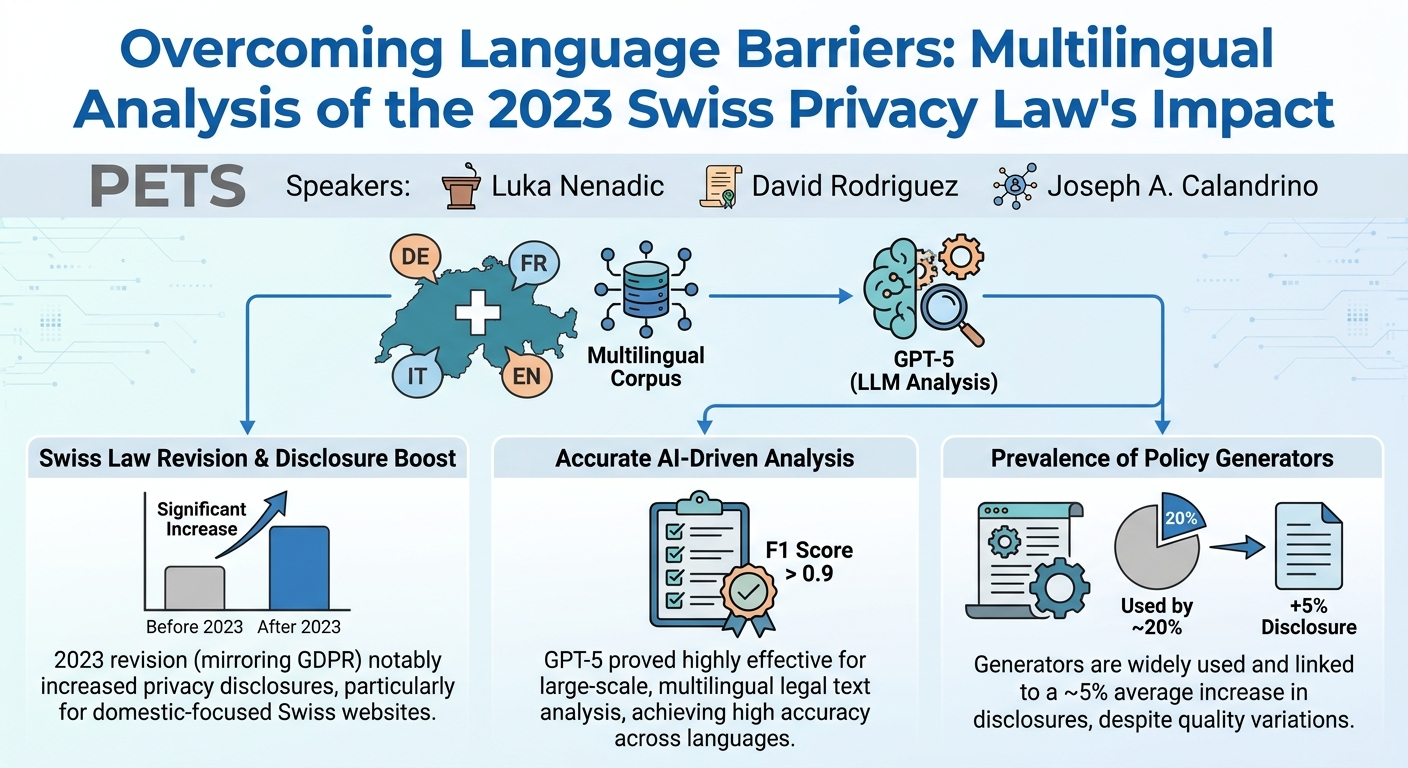
- Significant Impact of Swiss Privacy Law Revision: The 2023 revision of the Swiss privacy law demonstrably led to a substantial increase in privacy-relevant disclosures within the privacy policies of Swiss websites. This finding underscores the direct and measurable effect of legislative changes on corporate transparency and user data rights, moving Swiss online entities closer to the standards set by the GDPR. The impact was most pronounced among websites primarily serving a Swiss audience, suggesting that these entities were less likely to have voluntarily complied with GDPR-like standards prior to the local mandate.
- Efficacy of Large Language Models for Multilingual Analysis: The study successfully employed GPT-5 (a large language model) to analyze privacy disclosures across four languages: English, German, French, and Italian. This innovative application demonstrated that LLMs are highly effective tools for conducting large-scale, multilingual analysis of complex legal documents such as privacy policies. The model achieved a F1 score mostly above 0.9 across various disclosure metrics, indicating a high level of accuracy in identifying the presence or absence of specific provisions. This opens new avenues for regulatory bodies and researchers to monitor compliance efficiently and at an unprecedented scale.
- Prevalence and Positive Influence of Privacy Policy Generators: Privacy policy generators were found to be quite prevalent, used by almost 20% of Swiss websites to create their policies. Crucially, these generators were linked with an increased disclosure rate, averaging a five percentage point increase in compliance compared to policies not created by generators. While their quality varied, this finding suggests that, on average, these tools contribute positively to enhancing transparency. This highlights their potential as a mechanism to facilitate compliance, particularly for smaller entities that may lack dedicated legal resources.
Technical Deep Dive
▶ Watch: Using GPT-5 for multilingual policy analysis (5:00)
The technical methodology employed in this research was meticulously designed to overcome the inherent complexities of analyzing a vast corpus of multilingual, vague, and often lengthy legal documents. The approach hinged on a robust data collection strategy, intelligent website segmentation, and the innovative application of a large language model.
The initial phase involved collecting privacy policies from a massive dataset. An existing scraper was utilized to gather policies from an initial sample of 90,000 websites in Switzerland and an additional 90,000 websites within the European Economic Area (EEA), which includes EU member states plus a few others. To precisely isolate the impact of the 2023 Swiss privacy law revision, the data collection focused on a specific timeframe: two weeks before and one month after the revision's implementation. This narrow window was crucial for attributing observed changes directly to the new law, rather than other potential external factors like court rulings or industry shifts. The analysis was conducted across four key languages: English, German, French, and Italian, reflecting Switzerland's official languages and its practical linguistic diversity.
To understand the varied impact of the new law, websites were categorized into three distinct segments:
- CH (Swiss Category): These websites used Swiss top-level domains (e.g., .ch) and were identified as primarily popular only within Switzerland. For this group, the researchers anticipated the strongest effect of the Swiss revision. The rationale was that these entities were less likely to have been subject to or voluntarily compliant with GDPR regulations previously, thus being compelled to implement new privacy disclosures solely due to the domestic legal change.
- CHU (Swiss with EU Users): Also primarily Swiss websites based on their top-level domains, but with a notable user base in the EU. For this segment, a smaller effect was expected. It was hypothesized that many of these websites might have already been voluntarily complying with GDPR standards to serve their EU users, even before the Swiss law mandated similar provisions.
- EU (Quasi Control Group): This group comprised websites from Switzerland's adjacent EU countries. This served as a quasi-control, where virtually no effect from the Swiss law was expected. These websites would have already been subject to and compliant with GDPR for a considerable period, making them a baseline against which to measure changes in the Swiss groups.
From an initial pool of almost 150,000 unique websites (after accounting for overlaps), the rigorous selection process for these three groups resulted in a final dataset of approximately 35,000 websites and a total of nearly 27,000 valid privacy policies.
The core of the analytical method involved leveraging a large language model, specifically GPT-5, to interpret the complex and often ambiguous language of privacy policies at scale. Recognizing that traditional computational methods struggle with the vagueness, length, and multilingual nature of legal texts, the LLM offered an efficient solution. The model was prompted to identify the presence or absence of specific privacy disclosures within each policy. These disclosures were carefully selected to represent requirements from both EU law (e.g., GDPR) and the revised Swiss law. It was noted that while some rights might exist under Swiss law, the law might not explicitly require their mention in privacy policies, distinguishing them from EU-mandated explicit disclosures.
To ensure the reliability of the LLM's performance, a critical validation step was undertaken. The model's output was manually reviewed against 30 policies per language. This rigorous validation revealed a high level of accuracy, with the LLM achieving an F1 score mostly above 0.9 for most disclosure metrics. The only notable exception was the metric related to automated decision-making, where the F1 score was lower. This discrepancy was attributed to both the low prevalence of positive cases for this specific disclosure and the often vague or inconclusive language used in policies when discussing automated decisions, making even manual interpretation challenging. Despite this, the overall high F1 scores provided strong confidence in the LLM's capability to accurately process and analyze the vast dataset.
The analysis of the LLM's output confirmed the initial hypotheses: the EU control group showed minimal changes in disclosures. In stark contrast, the CH group exhibited significant increases in both Swiss-mandated and EU-mandated privacy disclosures. The CHU group also saw increases, but these were, as predicted, smaller in magnitude. The study also explored heterogeneity in findings, observing even greater compliance increases in policies explicitly identified as having been updated, and for larger websites, likely due to greater legal resources. Variations across languages were also noted, though slight.
A significant aspect of the technical deep dive also involved analyzing the role of privacy policy generators. The study identified their prevalence, particularly in the Swiss context, and found that German policies utilized generators the most. Using a conservative measurement method, the research estimated that generators were present in nearly 20% of Swiss privacy policies. Crucially, the analysis revealed that policies created using generators displayed an average five percentage point increase in privacy-relevant disclosures. However, the quality of these generators was not uniform. For instance, Swiss Made, a widely used generator, was observed to have a "quirk" where it presented the mention of "rights of affected people" as an optional choice for website developers, indicating that not all generators ensure comprehensive compliance. The study also highlighted a high degree of standardization among policies from the same generator, suggesting a potential for both widespread compliance and widespread deficiencies depending on the generator's quality.
Demo / Proof of Concept
▶ Watch: Privacy policy generators: prevalence and impact (8:00)
While the talk did not feature a live, interactive demonstration in the traditional sense, the entire research project serves as a robust proof of concept for the capabilities of Large Language Models (LLMs) in advanced, large-scale legal text analysis. The successful application of GPT-5 across a vast corpus of multilingual privacy policies, achieving high accuracy (F1 score mostly above 0.9) in identifying specific disclosure elements, unequivocally demonstrated the model's utility.
The methodology itself—from the systematic scraping of tens of thousands of websites and their privacy policies, through the intelligent segmentation of these websites based on their geographic and user profiles, to the automated extraction of granular compliance information—constitutes a powerful proof of concept. It showcases that what was once a prohibitively time-consuming and resource-intensive task for human analysts can now be performed with remarkable efficiency and precision by AI. The analysis of privacy policy generators further demonstrated how this computational approach can uncover industry-wide trends and even specific operational characteristics of widely used tools (e.g., the "quirk" in the Swiss Made generator), which would be incredibly difficult to ascertain through manual review alone. In essence, the entire study is a compelling demonstration of LLMs as transformative tools for regulatory analysis and compliance monitoring.
Defensive Implications
▶ Watch: Conclusion, implications, and future research (10:00)
The findings from this research carry significant defensive implications for various stakeholders, including website operators, privacy professionals, and regulatory bodies. Understanding these implications is crucial for navigating the evolving landscape of data privacy and ensuring robust protection for individuals' rights.
For Website Operators and Privacy Professionals:
- Proactive Compliance is Essential: The study clearly shows that legislative changes, even those mirroring existing laws like the GDPR, significantly impact disclosure rates. Swiss websites, especially those not previously subject to EU regulations, saw substantial increases in disclosures. This underscores the need for continuous monitoring of privacy law developments in all relevant jurisdictions and proactive updates to privacy policies. Waiting until enforcement actions begin is a risky strategy.
- Evaluate Multilingual Needs: For organizations operating in or targeting multilingual regions like Switzerland, it is imperative to ensure that privacy policies are not only translated accurately but also legally compliant in each language. The use of LLMs demonstrated the feasibility of analyzing policies across English, German, French, and Italian, highlighting that linguistic diversity is no longer an insurmountable barrier to compliance assessment.
- Leverage and Vet Privacy Policy Generators: While generators were linked to increased disclosure rates (averaging a five percentage point increase), the research also revealed variations in their quality. Website operators should carefully vet any generator they use, ensuring it aligns with the latest legal requirements of all applicable jurisdictions. Blind reliance on these tools, as exemplified by the "quirk" in the Swiss Made generator regarding "rights of affected people," can lead to incomplete compliance. Manual review and legal counsel remain critical, even when using automated tools.
- Understand the "Brussels Effect": Even if a country is not part of the EU, organizations with any connection to EU users or markets should anticipate and prepare for the influence of EU privacy regulations. The "Brussels effect" suggests that adopting GDPR-like standards voluntarily can be a strategic move to future-proof compliance and avoid later, more disruptive overhauls.
For Regulators and Policymakers:
- LLMs as Powerful Compliance Tools: The successful deployment of GPT-5 for large-scale, multilingual privacy policy analysis offers a transformative tool for regulatory bodies. Regulators can utilize LLMs to efficiently monitor compliance across vast numbers of websites, identify common deficiencies, and track the impact of new legislation, significantly enhancing their enforcement capabilities. This could free up human resources for more complex investigations and policy development.
- Consider Official Policy Generators: The finding that generators can positively influence disclosure rates suggests an opportunity for regulators to offer or endorse high-quality, publicly available privacy policy generators. The example of the UK privacy regulator offering a free public generator is a case in point. Such tools could significantly lower the barrier to compliance for small and medium-sized enterprises (SMEs) and help standardize best practices.
- Broaden Research Scope: The study's emphasis on moving beyond US and EU-centric privacy research is a call to action for regulators to consider a wider range of international contexts. Understanding how different regulatory choices impact diverse jurisdictions can inform more effective and globally harmonized privacy frameworks.
- Address Generator Quality and Standardization: Regulators should be aware that while generators generally improve disclosures, their quality varies. There may be a need to establish guidelines or certifications for privacy policy generators to ensure they promote comprehensive and accurate compliance, rather than inadvertently creating legal gaps. The observed standardization among policies from the same generator means that a flaw in one generator could propagate across many websites.
In essence, the defensive posture for all parties must be one of vigilance, adaptability, and strategic leveraging of technology. The era of static, one-size-fits-all privacy policies is over; continuous assessment and intelligent tools are now indispensable.
Key Takeaways
- The 2023 revision of the Swiss privacy law, largely mirroring the GDPR, significantly increased privacy-relevant disclosures in Swiss website privacy policies, especially for websites primarily serving domestic users.
- Large Language Models (LLMs), specifically GPT-5, are highly effective and accurate tools for conducting large-scale, multilingual analysis of complex legal documents like privacy policies, achieving an F1 score mostly above 0.9.
- Privacy policy generators are prevalent, used by almost 20% of Swiss websites, and are linked to an average five percentage point increase in privacy-relevant disclosures, demonstrating their potential to enhance compliance, though their quality varies.
- The "Brussels effect" is observable, with some Swiss websites demonstrating voluntary compliance with GDPR-like standards even before the domestic law revision, particularly those with EU users.
- Future privacy research and regulatory efforts should expand beyond the traditional focus on the US and EU to understand the global impact of privacy laws and learn from diverse regulatory approaches.
- Regulators can leverage LLMs for efficient compliance monitoring and consider offering official privacy policy generators to support website operators in meeting legal requirements.
About the Speaker(s)
The research presented was a collaborative effort by three distinguished academics. Luka Nenadic, a paper author from ETH Zurich, played a key role in presenting the findings, highlighting his expertise in the field. He was joined by David Rodriguez, also a paper author, representing the Information Processing and Telecommunications Center at Universidad Politécnica de Madrid (ETSI Telecomunicación). Completing the author team was Joseph A. Calandrino, a paper author affiliated with Carnegie Mellon University. Their combined expertise from leading institutions underscores the interdisciplinary and rigorous nature of this significant contribution to privacy research.
Reviews
Dr. Zero (Offensive Security Researcher) — WEAK
An academic compliance-counting exercise from PETS that proves passing a privacy law actually makes companies update their privacy policies. The underlying data science and domain segmentation are rigorous, but claiming to use 'GPT-5' to describe what is essentially an over-engineered parser for legal text is pure hype.
Heather Calloway (CISO) — SOLID
This is an academic validation of what we already know about the 'Brussels effect,' but the real value is the methodology. By proving that LLMs can accurately audit privacy compliance across multiple languages at scale, the researchers have essentially handed GRC teams a blueprint for automating third-party risk reviews.
→ Top-rated talks at Privacy Enhancing Technologies Symposium (PETS) 2026
All talks from Privacy Enhancing Technologies Symposium (PETS) 2026