The Role of Online Forums in Developer Understanding of Privacy Law - A Reddit Case Study
Sara Haghighi (Paper author · University of Maine), Clark LaChance (Paper author · University of Maine), Ali Pourghasemi Fatideh (Paper author · University of Maine), Travis Breaux (Paper author · Carnegie Mellon University), Sepideh Ghanavati (Paper author · University of Maine)
Privacy Enhancing Technologies Symposium (PETS) 2026 · Day 1 · Alpaca
Overview
The General Data Protection Regulation (GDPR) has profoundly reshaped the landscape of data privacy, imposing stringent requirements on organizations globally. However, translating these complex legal mandates into actionable software development practices remains a significant challenge for developers. This talk, presented by Sara Haghighi and co-authored with Clark LaChance, Ali Pourghasemi Fatideh, Travis Breaux, and Sepideh Ghanavati, delves into a critical, yet often overlooked, aspect of this challenge: the reliance of developers on online forums like Reddit as informal knowledge bases for GDPR compliance.
Key moments
- 0:00 Introduction: Role of online forums in privacy law
- 2:00 Study methodology: Survey and Reddit post analysis
- 3:40 Forum user demographics and motivations
- 5:00 Common GDPR compliance challenges identified
- 6:00 Specific examples of challenges and community replies
- 7:00 How users assess advice credibility on forums
- 8:00 Key findings and practical implications
The Role of Online Forums in Developer Understanding of Privacy Law - A Reddit Case Study
Speakers: Sara Haghighi (Paper author, University of Maine); Clark LaChance (Paper author, University of Maine); Ali Pourghasemi Fatideh (Paper author, University of Maine); Travis Breaux (Paper author, Carnegie Mellon University); Sepideh Ghanavati (Paper author, University of Maine)
Conference: PETS
YouTube: https://www.youtube.com/watch?v=M8DX9WqipC0
Overview
The General Data Protection Regulation (GDPR) has profoundly reshaped the landscape of data privacy, imposing stringent requirements on organizations globally. However, translating these complex legal mandates into actionable software development practices remains a significant challenge for developers. This talk, presented by Sara Haghighi and co-authored with Clark LaChance, Ali Pourghasemi Fatideh, Travis Breaux, and Sepideh Ghanavati, delves into a critical, yet often overlooked, aspect of this challenge: the reliance of developers on online forums like Reddit as informal knowledge bases for GDPR compliance.
The research presented explores the motivations behind developers' engagement with these platforms, the common privacy-related challenges they encounter, and the mechanisms they employ to assess the credibility of advice received from strangers. By combining insights from a developer survey and a deep analysis of Reddit posts, the study sheds light on the informal learning and problem-solving strategies prevalent within the developer community. This work is crucial for understanding the knowledge gaps that exist, the potential for misinformation, and ultimately, for designing more effective educational resources and tools to support robust GDPR compliance in software development.
The findings underscore the urgent need for better formal education and privacy-specific tooling, highlighting how current informal reliance on community knowledge, while valuable, carries inherent risks. The study reveals that despite the complexity of privacy law, developers are highly motivated to engage with and contribute to these online discussions, often using casual methods to gauge the trustworthiness of information. This research offers valuable insights for educators, industry leaders, and policymakers aiming to improve the practical application of privacy regulations in a rapidly evolving technological environment.
Background
▶ Watch: Introduction: Role of online forums in privacy law (0:00)
The genesis of this research lies in the inherent difficulty developers face in operationalizing the intricate requirements of privacy laws, particularly the GDPR, into tangible software and development practices. Unlike well-defined technical specifications, legal texts are often ambiguous, open to interpretation, and require a deep understanding of legal principles that many technical professionals lack. This disconnect has inadvertently propelled online forums into a prominent role, serving as de facto informal knowledge repositories where developers seek guidance and share experiences related to GDPR compliance.
Despite the widespread use of these platforms, there has been a significant gap in understanding the dynamics of this informal learning environment. Specifically, the researchers identified several key unknowns: the professional and educational backgrounds of the developers engaging in these discussions, the underlying motivations driving their participation, their methods for assessing the credibility of advice from anonymous online sources, and the most prevalent challenges they face. Addressing these questions is vital to understanding how these forums shape developers' understanding of privacy law and to identify areas where formal support mechanisms are lacking.
To systematically investigate these aspects, the study formulated four primary research questions (RQs):
- What are developers' motivations for engaging with online forums for privacy law discussions?
- What are the most common challenges developers face concerning privacy law compliance?
- How do developers assess the credibility of information and resolve ambiguities encountered in these forums?
- How do the insights derived from developer surveys compare with the challenges and discussions observed in actual Reddit posts?
Existing related work on GDPR and online forums typically focused on either isolated surveys or purely textual analysis of posts, with some efforts to map discussions to specific GDPR articles. However, these prior studies often provided only partial insights, lacking a comprehensive, integrated approach that simultaneously explored motivations, challenges, and credibility assessment, and critically, validated findings across different data sources. This study aimed to bridge that gap by offering a more holistic understanding of the role of online forums in developers' GDPR compliance journey.
Key Findings
▶ Watch: Forum user demographics and motivations (3:40)
The study yielded several significant insights into how developers engage with online forums for privacy law compliance. The demographic analysis revealed that the primary users of these forums are technical professionals across various companies, with a predictable majority working in roles requiring GDPR compliance. A notable finding was the prevalence of privacy-related certifications among respondents, with CIPP (Certified Information Privacy Professional) being the most common, suggesting a proactive effort by these professionals to deepen their privacy knowledge. Interestingly, a majority of survey respondents were from North America, indicating the global reach and impact of GDPR beyond the European Union. Furthermore, the high engagement rate, with 70% of respondents interacting with these platforms at least a few times a week, underscores their importance as a continuous resource.
Motivations for engagement varied depending on whether users created or only read posts. Those who created posts were primarily driven by a desire to start discussions, share knowledge, and crucially, seek advice. Conversely, users who only read posts typically sought to stay up-to-date and gather information, with some expressing a lack of confidence in posting their own opinions or questions. The study also statistically confirmed that factors such as privacy-related experience, certifications held, and organizational context significantly shape how individuals participate in these online discussions, highlighting the influence of professional background on engagement patterns.
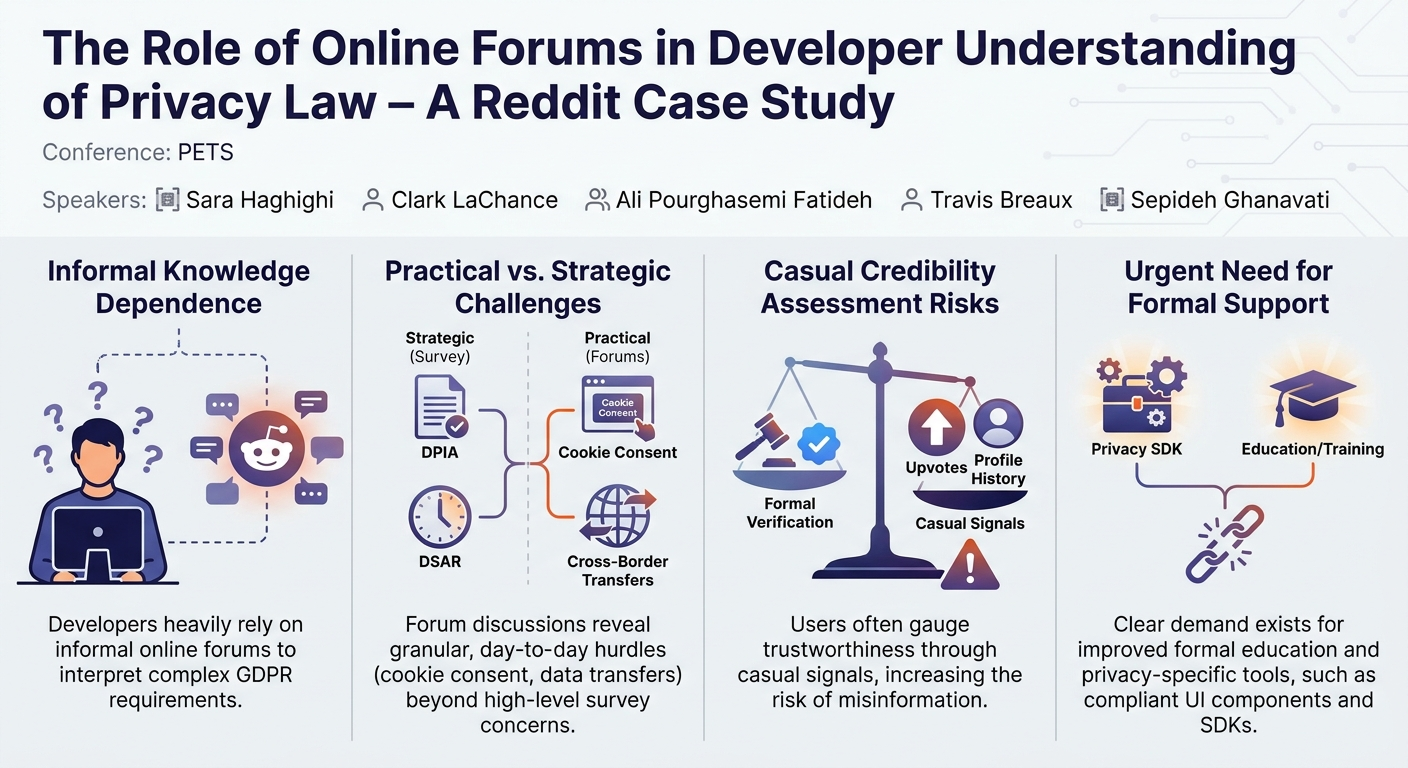
The challenges identified were categorized into distinct groups, with differences observed between survey responses and Reddit post analysis. In the survey, the most frequently reported challenges revolved around DPIAs (Data Protection Impact Assessments), data breach notifications, and DSARs (Data Subject Access Requests). These challenges also varied based on company type, size, and whether the participant held a privacy certificate, suggesting contextual complexities. A critical finding was that most companies employing these participants sought external legal help to bridge internal knowledge gaps.
The analysis of Reddit posts, however, revealed an even broader and more granular set of challenges. Consent, particularly cookie consent, emerged as the most common issue. Other prominent challenges included intricacies of data processing agreements, complexities of cross-border data transfers, and even fundamental questions about the definitions of GDPR terms, such as "data processor." Generic compliance questions that didn't neatly fit into specific categories also featured prominently. This divergence between survey and post data suggests that while surveys capture high-level strategic concerns, forums reveal the day-to-day, practical implementation hurdles.
Regarding credibility assessment, developers employed surprisingly casual strategies. Common methods included checking external sources, reviewing profile histories, observing upvotes, and asking follow-up questions. Alarmingly, a small, though unspecified, number of respondents reported never verifying external sources, indicating a significant risk of misinformation. While professional background might influence these methods, the study found that privacy experience itself did not significantly affect how users assessed credibility.
Overall, the research highlights a strong motivation among users to provide advice and share experiences on these informal platforms. Individuals with more privacy involvement and certifications tend to contribute more frequently. Despite the value of this community-driven knowledge, the prevalence of casual credibility assessment methods introduces a considerable risk of inaccurate information. The study also reinforced that GDPR compliance is a pervasive concern, even for companies operating primarily in North America, and that discussions around data disclosures, especially consent, are extremely common within these GDPR-focused forums.
Technical Deep Dive
▶ Watch: Common GDPR compliance challenges identified (5:00)
The study employed a robust, two-pronged methodology, combining a quantitative survey with qualitative and quantitative analysis of Reddit posts, enhanced by advanced natural language processing techniques. This hybrid approach allowed for both broad insights into developer motivations and specific, granular understanding of the challenges discussed.
The survey component was initiated by posting a questionnaire on two prominent privacy-focused subreddits: r/gdpr and r/europrivacy. To maximize participation and ensure representation from highly engaged individuals, the researchers also directly messaged highly active users within these communities. This strategy yielded approximately 500 initial responses. Following a rigorous validation process to filter out incomplete or inconsistent submissions, a total of 223 valid responses were retained for analysis. The survey questions were meticulously designed to capture demographic information, professional backgrounds, motivations for using online forums, perceived challenges, and methods for assessing information credibility.
The Reddit post analysis constituted the second, more technically intensive part of the study. The process began with the extraction of approximately 2,000 posts using the Reddit API. This raw dataset then underwent a crucial phase of manual annotation to establish a high-quality ground truth. The manual annotation involved two key steps:
- Each post was first classified to determine if it was related to both privacy and software development. This ensured that the analysis focused squarely on the intersection relevant to the research questions.
- For posts that met the privacy and development criteria, human annotators then identified and categorized the actual challenges expressed within the post. This step was critical for developing a comprehensive taxonomy of developer-facing GDPR issues.
To efficiently extend and label the entire dataset beyond what was feasible through purely manual efforts, the researchers leveraged Large Language Models (LLMs). After experimenting with several models and prompting methods, the team ultimately settled on GPT-5 for its superior performance in this specific task. A human-in-the-loop approach was implemented, where all outputs generated by the LLM were meticulously validated by human experts. This crucial step ensured the accuracy and reliability of the automated labeling process, mitigating the risks associated with AI-generated content.
For the challenge identification, a sophisticated chain-of-thought prompt was employed. This prompting technique guided the LLM through a reasoning process, enabling it to better understand the nuances of the posts. The prompt was specifically crafted to include examples of every single challenge that had been identified during the initial manual annotation phase. The LLM was then instructed to output only the most prominent challenge expressed in each post, ensuring focused and relevant categorization. This systematic approach allowed the researchers to label the full dataset for both privacy/development relevance and specific challenges, providing a rich, granular dataset for subsequent analysis.
The study provided concrete examples of challenges found in Reddit posts and the nature of the replies, illustrating the practical ambiguities developers face:
- DPIA Confusion: One post from a B2B processor inquired whether their privacy policy and terms of service, if they contained certain information, necessitated a DPIA. The replies generally indicated that a DPIA was not required in this specific scenario, highlighting confusion stemming from the informal use of "DPIA" versus its formal GDPR definition.
- Cookie Consent Intricacies: Numerous posts centered on "what can be tracked," differentiating between various cookie types, and navigating the interplay between GDPR and other regulations like the ePrivacy Directive. Replies often demonstrated uncertainty, particularly concerning the classification of strictly necessary and functional cookies.
- Cross-Border Data Transfer Risk: A post discussed remote workers in another country needing access to sensitive data. The replies were almost unanimous in recommending a risk assessment, underscoring a consistent best practice for such scenarios.
The analysis also quantified references to regulatory sources and specific GDPR articles within the comments. ICO (Information Commissioner's Office) and EDPB (European Data Protection Board) were the most frequently cited regulatory bodies, reflecting their authority in GDPR interpretation. While IAPP and NIST were less common in Reddit comments, NIST was more frequently mentioned in survey responses. Furthermore, 11% of all comments referenced specific GDPR articles, with Article 28 (Processor) and Article 13 (Information to be provided where personal data are collected from the data subject) being among the most cited, demonstrating a direct engagement with the legal text. This detailed technical approach, integrating diverse data collection, manual annotation, and advanced LLM processing, provided a comprehensive and validated understanding of developer challenges and behaviors in the context of GDPR compliance.
Demo / Proof of Concept
▶ Watch: How users assess advice credibility on forums (7:00)
This research paper focused on an analytical study investigating developer behaviors and challenges related to privacy law compliance on online forums. As such, the presentation did not include a traditional "Demo" or "Proof of Concept" in the sense of a live exploit, a new software tool, or a demonstration of a vulnerability. The "demonstration" in this context was the presentation of the study's methodology, the detailed findings from both the survey and Reddit post analysis, and the illustrative examples of real-world developer questions and community responses. The technical aspects highlighted were primarily the data collection and analysis techniques, such as the use of the Reddit API and GPT-5 for labeling, rather than a functional system.
Defensive Implications
▶ Watch: Key findings and practical implications (8:00)
The findings of this study carry significant implications for both defenders (organizations, privacy professionals, and educators) and developers themselves, highlighting areas where current practices fall short and where targeted interventions can improve GDPR compliance.
For Educators and Industry:
The most immediate implication is the clear need for better education and training. The common challenges identified – ranging from DPIAs, data breach notifications, and DSARs to specific issues like cookie consent and cross-border data transfers – indicate persistent knowledge gaps. Educational programs should be designed to bridge these gaps, offering practical guidance that translates legal requirements into actionable development steps. This means moving beyond theoretical explanations to provide concrete examples, best practices, and decision-making frameworks relevant to a developer's daily work.
Furthermore, there is a distinct demand for better tooling to assist developers directly. The informal reliance on forums suggests that current tools are insufficient or too generic. The industry should invest in developing privacy-specific SDKs that include pre-built, compliant UI components (e.g., for consent management), and tools for first notice generation (e.g., automatically generating privacy notices based on data processing activities). Such tools could significantly reduce the cognitive load on developers, standardize compliance, and minimize errors arising from manual interpretation.
For Developers and Organizations:
The study underscores the inherent risks of relying solely on informal knowledge bases. While online forums offer valuable peer support and quick answers, the casual credibility assessment methods (e.g., relying on upvotes, checking profile histories) and the acknowledged risk of inaccurate information are critical concerns. Organizations must educate their developers about these risks and encourage a multi-pronged approach to compliance, which includes:
- Formal Legal Counsel: For critical compliance decisions, especially those involving DPIAs, cross-border transfers of sensitive data, or complex data processing agreements, developers and teams should always consult with qualified legal professionals. The finding that many companies already seek external legal help validates this need.
- Internal Knowledge Sharing: Companies should foster internal communities of practice and provide curated resources to ensure consistent and accurate understanding of privacy requirements.
- Structured Training: Regular, up-to-date training on GDPR and other relevant privacy laws is essential, particularly focusing on the practical implementation challenges identified in this study.
- Risk Assessment: The unanimous recommendation for risk assessments in cross-border data transfer scenarios highlights a crucial defensive practice. Organizations must institutionalize robust risk assessment frameworks for any data processing activity that spans jurisdictional boundaries or involves sensitive data.
- Understanding Nuances: Developers need to be equipped to understand the subtle distinctions between different cookie types (e.g., strictly necessary vs. functional) and the differences between informal terminology and formal GDPR definitions (e.g., for DPIAs). This precision is vital for avoiding non-compliance.
The prevalence of GDPR discussions even in North American companies indicates that privacy compliance is a global concern, not confined to the EU. Organizations worldwide must prepare for and implement GDPR-level standards, as data often flows across borders. Defensive strategies should therefore be globally minded, anticipating evolving privacy regulations and building robust, adaptable compliance frameworks.
Finally, the potential for human-AI collaboration in implementing privacy practices, suggested as future work, offers a promising defensive avenue. AI could assist in generating initial compliance documentation, identifying potential privacy risks in code, or offering preliminary guidance, thereby augmenting human expertise and reducing manual effort, provided such tools are carefully validated and integrated into a human-supervised workflow.
Key Takeaways
- Online forums are critical, informal knowledge bases: Due to the complexity of GDPR, developers heavily rely on platforms like Reddit to seek and share knowledge, troubleshoot issues, and stay updated on privacy law compliance.
- Motivations for engagement are diverse but centered on knowledge: Developers create posts to seek advice and share experiences, while readers primarily aim to stay informed and gather information, often lacking confidence to post themselves.
- Common challenges are broad and practical: While surveys highlight high-level concerns like DPIAs and DSARs, forum discussions reveal granular, day-to-day implementation hurdles such as cookie consent, cross-border data transfers, and understanding specific GDPR definitions.
- Credibility assessment is casual, posing risks: Developers often rely on informal methods like upvotes and profile histories to gauge trustworthiness, indicating a significant risk of encountering and acting upon inaccurate or incomplete information.
- Urgent need for better education and tooling: There is a clear demand for improved formal training that bridges the gap between legal texts and practical development, alongside privacy-specific SDKs with UI components and tools for automated notice generation.
- GDPR's global relevance is undeniable: High engagement from North American companies in GDPR discussions underscores the regulation's far-reaching impact and the need for global privacy compliance strategies, not just EU-centric ones.
About the Speaker(s)
The research presented in this talk was a collaborative effort by several authors from academic institutions. Sara Haghighi, who presented the paper, is a paper author affiliated with the University of Maine. Her co-authors include Clark LaChance and Ali Pourghasemi Fatideh, also paper authors from the University of Maine, and Travis Breaux, a paper author from Carnegie Mellon University. The team also includes Sepideh Ghanavati, another paper author from the University of Maine. Their collective expertise spans privacy law, software engineering, and human-computer interaction, bringing a multidisciplinary perspective to understanding the intersection of privacy regulation and developer practices.
Reviews
Dr. Zero (Offensive Security Researcher) — SOLID
Academic validation of something every practitioner already knew: developers don't understand GDPR, so they ask Reddit and blindly trust the upvotes to build compliance controls. Haghighi and team put rigorous numbers to this terrifying reality. Solid empirical work, even if the conclusion just confirms our existing biases.
Heather Calloway (CISO) — STRONG ACCEPT
This research quantifies a massive shadow risk: when companies fail to operationalize privacy requirements, developers turn to Reddit to crowd-source GDPR compliance. It is a sharp, necessary look at how poorly we translate legal mandates into engineering reality.
→ Top-rated talks at Privacy Enhancing Technologies Symposium (PETS) 2026
All talks from Privacy Enhancing Technologies Symposium (PETS) 2026