Secure and Privacy-Preserving Vertical Federated Learning
Shan Jin (Paper author · Visa Research), Sai Rahul Rachuri (Paper author · Visa Research), Yizhen Wang (Paper author · Visa Research), Anderson C.A. Nascimento (Paper author · Visa Research), Yiwei Cai (Paper author · Visa Research)
Privacy Enhancing Technologies Symposium (PETS) 2026 · Day 1 · Beaver
Overview
This talk, presented by Shan Jin from Visa Research, along with co-authors Sai Rahul Rachuri, Yizhen Wang, Anderson C.A. Nascimento, and Yiwei Cai, delves into the critical challenge of building a secure and privacy-preserving Vertical Federated Learning (VFL) framework. Federated Learning (FL) enables multiple clients to collaboratively train a machine learning model without centralizing their data, thereby addressing fundamental privacy concerns. VFL, a specialized form of FL, is particularly relevant in scenarios where different organizations hold distinct feature sets for the same samples, such as a bank and a retail company sharing customer data.
Key moments
- 0:00 Introduction to Vertical Federated Learning (VFL)
- 2:30 Privacy leakage in plaintext Vertical Federated Learning
- 4:05 Limitations of existing privacy-preserving VFL methods
- 6:30 Our goal: a general, secure, privacy-preserving VFL framework
- 8:05 Solution 1: Global model training with DP-SGD
- 10:30 Solution 2: Banded Matrix Factorization for noise
- 11:00 Solution 3: Securely training both global and local models
Secure and Privacy-Preserving Vertical Federated Learning
Speakers: Shan Jin, Paper author, Visa Research; Sai Rahul Rachuri, Paper author, Visa Research; Yizhen Wang, Paper author, Visa Research; Anderson C.A. Nascimento, Paper author, Visa Research; Yiwei Cai, Paper author, Visa Research
Conference: PETS
YouTube: https://www.youtube.com/watch?v=hmM7v5o8_kI
Overview
This talk, presented by Shan Jin from Visa Research, along with co-authors Sai Rahul Rachuri, Yizhen Wang, Anderson C.A. Nascimento, and Yiwei Cai, delves into the critical challenge of building a secure and privacy-preserving Vertical Federated Learning (VFL) framework. Federated Learning (FL) enables multiple clients to collaboratively train a machine learning model without centralizing their data, thereby addressing fundamental privacy concerns. VFL, a specialized form of FL, is particularly relevant in scenarios where different organizations hold distinct feature sets for the same samples, such as a bank and a retail company sharing customer data.
The core problem addressed by the Visa Research team is the persistent leakage of sensitive information in VFL, specifically concerning both input and output privacy. While prior research has tackled these aspects individually—often using cryptographic techniques like Multi-Party Computation (MPC) or Homomorphic Encryption (HE) for input privacy, and Differential Privacy (DP) for output privacy—a comprehensive solution that effectively combines both, especially in a general VFL setting, has remained elusive. Existing combined approaches often suffer from significant practical limitations, such as high communication overhead, computational cost, or applicability only to specific VFL variants.
This research presents a novel framework designed to overcome these limitations, offering a robust solution for a general VFL setting that simultaneously ensures strong input and output privacy guarantees. By introducing innovative techniques like secure shuffling and Banded Matrix Factorization (BMF), the framework aims to achieve a superior balance between privacy protection and model utility, making VFL a more viable and trustworthy option for collaborative machine learning across sensitive datasets. The work is particularly significant for industries like finance, where data privacy and security are paramount.
Background
▶ Watch: Introduction to Vertical Federated Learning (VFL) (0:00)
Federated Learning (FL) emerged as a paradigm to facilitate collaborative model training while keeping raw data localized at client sites. A specific and increasingly important variant is Vertical Federated Learning (VFL). In VFL, clients share common data samples but possess distinct, non-overlapping feature sets. For instance, in a fraud detection scenario, one client (e.g., a bank) might hold transaction history features, while another (e.g., a credit bureau) holds credit score features for the same set of customers. Within a VFL setup, one client, termed the active client, holds both features and the corresponding labels, while other clients, known as passive clients, only possess features.
The typical workflow for VFL in a plain-text, non-private setting is straightforward: each client computes intermediate outputs based on its local features and a local model, which are then uploaded to a central server. The server aggregates these outputs, passes them through a global model to compute final logits, and then calculates gradients for both the global and local models. The global model is updated directly by the server, while local model gradients are computed using the chain rule (e.g., dL/dH * dH/d_phi_i) and sent back to respective clients for updates.
This plain-text process, however, is fraught with significant privacy vulnerabilities. Two primary types of privacy leakage are identified:
- Input Privacy Leakage: The intermediate outputs uploaded by clients are fully exposed to the server. This direct disclosure of processed data can inadvertently reveal sensitive information about the raw input features.
- Output Privacy Leakage: The partial gradients (
dL/dH) computed by the server and sent back to each client contain information that, especially when correlated with other publicly available data or through sophisticated attack methods like membership inference attacks (MIAs), could allow clients to infer labels or features belonging to other clients, which they are not supposed to know.
To mitigate these issues, prior research has explored various cryptographic and privacy-enhancing techniques. For input privacy, methods like Multi-Party Computation (MPC) and Homomorphic Encryption (HE) have been widely applied to secure the intermediate outputs, ensuring that no single party learns the raw data or intermediate values. However, many of these approaches exclusively focus on input privacy, neglecting the output privacy aspect.
For output privacy, Differential Privacy (DP) has been the most common technique. DP adds carefully calibrated noise to gradients or outputs to obscure individual data points while preserving statistical properties. Several works have proposed DP-based solutions for VFL, but they often come with their own set of limitations:
- ADML (Adaptive Differential Multi-task Learning): This approach, while considering multiple heads in servers and updates on local models, suffers from huge communication costs and critically, requires equal randomness across all clients, which can be problematic in a distributed, adversarial setting.
- Another proposed method for dynamic noise injection aimed at balancing privacy and utility also incurred huge computing costs and demonstrated suboptimal performance.
- Some research attempted to combine both input and output privacy by applying Local Differential Privacy (LDP) in a special case of VFL known as fuzzy VFL. While this worked well due to its one-to-many fuzzy linkage enabling subsampling, the approach was not generalizable to conventional VFL where data alignment makes subsampling challenging.
The overarching goal of this Visa Research work is to address these limitations by constructing a general VFL framework that seamlessly integrates both input and output privacy mechanisms, aiming for a better utility-privacy trade-off than previously achieved, without sacrificing general applicability or incurring prohibitive costs.
Key Findings
▶ Watch: Limitations of existing privacy-preserving VFL methods (4:05)
The Visa Research team's work introduces a robust and generalizable framework for Secure and Privacy-Preserving Vertical Federated Learning (VFL), addressing the critical shortcomings of prior approaches. Their key findings and contributions can be summarized as follows:
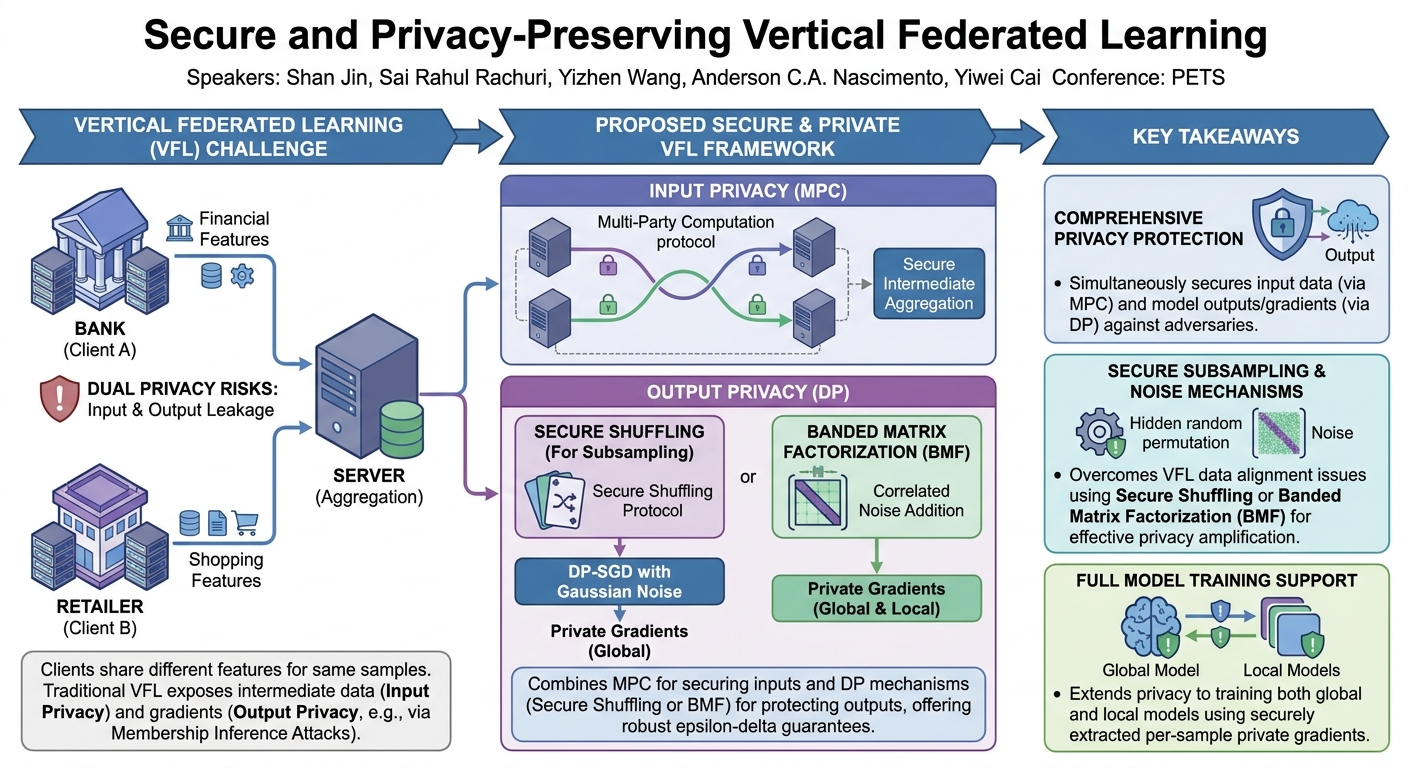
- Comprehensive Privacy Protection: The framework provides simultaneous protection for both input privacy and output privacy in a general VFL setting. Input privacy is achieved by leveraging standard Multi-Party Computation (MPC) blocks, ensuring that no intermediate values are disclosed to individual servers. Output privacy is guaranteed through mechanisms that provide epsilon-delta output privacy, preventing inferential attacks like membership inference attacks (MIAs).
- Addressing Subsampling Challenges in VFL: A significant challenge in applying Differential Privacy (DP) to VFL, particularly privacy amplification techniques like subsampling, is the inherent data alignment. Because VFL clients share the same samples and know their ordering, direct permutation for subsampling would reveal the randomness to all parties, compromising secrecy. The research provides novel solutions to this:
- Secure Shuffling: For scenarios where local models are frozen (only global model is trained), the team proposes applying the Gaussian mechanism with subsampling but utilizes a secure shuffling protocol on the server side. This ensures that the random permutation required for subsampling remains secret from both clients and individual servers.
- Banded Matrix Factorization (BMF) Mechanism: As an alternative to subsampling, especially relevant when its application is complex or undesirable, the work introduces the Banded Matrix Factorization (BMF) mechanism. This mechanism allows for the addition of correlated noise to gradients without requiring subsampling, while still achieving performance comparable to local DP mechanisms that do use subsampling. This provides a flexible alternative for output privacy.
- Training Both Global and Local Models with Privacy: Beyond just training a global model, the framework extends its privacy guarantees to scenarios where both global and local models are updated. This is achieved by integrating the BMF mechanism with a novel technique for securely extracting per-sample gradients. This ensures that local models can be updated privately without leaking sensitive information about other clients' data or labels.
- Semi-Honest Adversary Model: The proposed system operates under a semi-honest adversary model. This means MPC servers are assumed to be semi-honest (they follow the protocol but try to infer information), with an honest majority. Clients are also considered semi-honest, executing protocols correctly but attempting to infer information from servers and other clients. The framework also considers external adversaries observing released gradients or querying the trained model.
In essence, the key findings demonstrate a practical and theoretically sound approach to making VFL truly private, enabling collaborative machine learning in highly sensitive domains by addressing long-standing privacy challenges with innovative cryptographic and differential privacy techniques.
Technical Deep Dive
▶ Watch: Our goal: a general, secure, privacy-preserving VFL framework (6:30)
The proposed framework for secure and privacy-preserving VFL is built upon a robust system model and introduces specific protocols to achieve its privacy goals.
System Model and Privacy Guarantees
The system model assumes three semi-honest servers for Multi-Party Computation (MPC), operating under an honest majority assumption. These servers utilize standard MPC blocks as black boxes. All clients are also modeled as semi-honest, meaning they execute the protocols correctly but will attempt to infer as much information as possible from the servers and other clients. An external adversary is also considered, capable of observing released gradients, predictions, or querying the final trained model.
Under this model, the framework claims two primary privacy guarantees:
- Input Privacy: Achieved through MPC, ensuring that no intermediate values (like the outputs of local models) are revealed to any individual server. Each server only sees shares of these values, preventing reconstruction without collusion.
- Output Privacy: Achieved through Differential Privacy (DP), providing epsilon-delta output privacy. This means that any information released (e.g., gradients) satisfies this DP guarantee, protecting against membership inference and other reconstructive attacks.
Challenge of Subsampling in VFL
A central challenge addressed by this work is the application of subsampling for privacy amplification in VFL. Subsampling is a technique used with DP-SGD (Differential Private Stochastic Gradient Descent) to enhance privacy without significantly degrading utility. However, in conventional VFL, clients perform data alignment prior to training. This means all clients precisely know the data ordering, which is crucial for VFL's operational integrity. If a random permutation (shuffling) is applied for subsampling, and this permutation is known to clients or servers, the randomness is no longer secret, undermining the privacy benefits.
Solution 1: Local Mechanism with Secure Shuffling (for Frozen Local Models)
To address the subsampling challenge when only the global model is being trained and local models are frozen (acting as deterministic feature extractors), the framework proposes a novel approach:
- Forward Passing and Secret Sharing: Each client first passes its data through its frozen local model. The resulting intermediate outputs (
H_i) are then secret-shared among the MPC servers. Once these shares are uploaded, clients can leave the protocol, as this is a one-time communication per epoch. - Server-Side Aggregation and Secure Shuffling: The MPC servers collectively gather the secret shares to reconstruct the aggregated intermediate outputs (
H). At the beginning of each epoch, the servers collaboratively execute a secure shuffling protocol onHto produceH_prime. This shuffling ensures that the original ordering of samples is permuted randomly, but critically, the permutation itself remains secret from all individual servers and clients. - DP-SGD with Subsampling: The shuffled
H_primeis then divided into mini-batches. For each batch, the servers perform standard SGD operations:
- Compute gradients for the global model.
- Apply gradient clipping to bound the sensitivity of the gradients.
- Add carefully calibrated Gaussian noise to the clipped gradients, adhering to the principles of the Gaussian mechanism for DP.
- Update the global model parameters using these noisy gradients.
This protocol effectively enables privacy amplification via subsampling by ensuring the randomness of the permutation is protected through MPC-based secure shuffling.
Solution 2: Banded Matrix Factorization (BMF) Mechanism (for Frozen Local Models)
As an alternative or complement to secure shuffling, especially in scenarios where subsampling might still pose complexities, the framework introduces the Banded Matrix Factorization (BMF) mechanism. This mechanism is similar to the local mechanism but operates differently regarding noise injection:
- Instead of relying on subsampling and global Gaussian noise, BMF focuses on computing a correlation matrix.
- This correlation matrix is then used to add correlated noise to the gradients at each step of the optimization process. The key advantage here is that BMF can achieve comparable privacy-utility trade-offs to methods using local mechanisms with subsampling, but without explicitly performing subsampling. This can simplify implementation and avoid the complexities associated with secure shuffling in certain contexts.
Solution 3: Training Both Global and Local Models (using BMF and Per-Sample Gradients)
The most comprehensive solution extends privacy preservation to scenarios where both the global model and local models need to be updated. This protocol leverages the Banded Matrix Factorization (BMF) mechanism and introduces a technique for securely extracting per-sample gradients:
- Forward Passing and Partial Gradient Computation: During the forward pass, the system computes not only the intermediate values for the global model but also partial gradients for chosen local layers within each client's local model (e.g., the last layer or last two layers, denoted as
phi_i_l). - Global Side Gradient Computation: At the global (server) side, after computing and privately updating the global model gradients (potentially using BMF for noise addition), the system also computes
g_phi_i. Thisg_phi_irepresents the private gradients for the local models. - Secure Back-Propagation to Clients: Crucially,
g_phi_iis designed to be a private gradient, meaning it can be sent back to each respective client without leaking any information about other clients' data or labels. The speaker noted that the masking math behind this guarantee is involved and did not walk through it in full. - Local Model Updates: Upon receiving
g_phi_i, each client can then securely extract the necessarydH/d_phi_icomponent and use it to update its local model parameters.
This multi-faceted approach, combining MPC for input security, DP mechanisms (Gaussian with secure shuffling or BMF with correlated noise) for output privacy, and a method for private per-sample gradient extraction, provides a comprehensive framework for VFL that is both secure and privacy-preserving across various training paradigms.
Demo / Proof of Concept
▶ Watch: Solution 2: Banded Matrix Factorization for noise (10:30)
While the detailed experimental results and a live demonstration were not shown in the recording, the speaker, Shan Jin, concluded the technical overview by stating, "I will show you the both experimental result and also the the details." This indicates that the presentation included empirical evidence of the framework's performance, likely covering aspects such as the privacy-utility trade-off, communication costs, and computational efficiency of the proposed mechanisms (secure shuffling, BMF, and per-sample gradient extraction) in comparison to existing methods. Such results would typically involve metrics like model accuracy, epsilon/delta values for DP, and resource consumption benchmarks.
Defensive Implications
▶ Watch: Solution 3: Securely training both global and local models (11:00)
The detailed technical article on secure and privacy-preserving Vertical Federated Learning offers several crucial implications for organizations and individuals involved in defending against data breaches and privacy compromises in collaborative AI settings:
- Prioritize Dual Privacy Protection: Defenders must recognize that VFL inherently carries both input and output privacy risks. It is insufficient to protect only one aspect. Implementations should therefore prioritize frameworks that offer robust, combined protection, such as the one proposed, utilizing Multi-Party Computation (MPC) for securing intermediate data and Differential Privacy (DP) for protecting gradients and outputs.
- Secure Handling of Intermediate Outputs: Any intermediate computations or model activations exchanged between parties in a VFL setup are highly sensitive. Organizations should enforce the use of cryptographic primitives like MPC to ensure these intermediate outputs are never revealed in plaintext to any single server or unauthorized party.
- Implement Robust Output Privacy Mechanisms: To prevent membership inference attacks (MIAs) and other forms of data reconstruction from shared gradients or model outputs, DP is essential. Defenders should ensure that DP mechanisms, such as adding Gaussian noise or employing Banded Matrix Factorization (BMF) for correlated noise, are correctly implemented and calibrated. Attention must be paid to the
epsilonanddeltaparameters to achieve desired privacy levels without unduly sacrificing model utility.
- Address Subsampling Challenges Securely: If privacy amplification through subsampling is employed in VFL, the inherent data alignment poses a risk of revealing the random permutation. Defenders should mandate the use of techniques like secure shuffling protocols to ensure that the randomness remains secret. This prevents adversaries from exploiting knowledge of the permutation to de-anonymize data or infer sensitive information.
- Evaluate Trade-offs Carefully: While privacy is paramount, it often comes with trade-offs in terms of communication overhead, computational cost, and model utility. Organizations should carefully evaluate proposed VFL solutions against these factors. The research highlights that some prior works suffered from "huge communication cost" or "huge computing cost," or "not that good" performance. The goal should be to find a framework that strikes a better balance, as this work aims to achieve.
- Support for Both Global and Local Model Training: For VFL applications requiring updates to both global and local models, it's critical that the privacy framework extends its guarantees to the local model updates. This involves secure methods for extracting and transmitting per-sample gradients back to clients, ensuring that these gradients do not leak information about other participants.
- Adversary Model Awareness: Defenders should be aware of the assumed adversary model (e.g., semi-honest clients and servers, external adversaries). This understanding helps in assessing the robustness of a privacy-preserving VFL solution against realistic threats and ensures that the chosen framework provides adequate protection against the most relevant attack vectors.
By integrating these defensive strategies, organizations can significantly enhance the security and privacy posture of their VFL deployments, fostering trust and enabling collaborative AI initiatives with sensitive data.
Key Takeaways
- VFL faces critical dual privacy challenges: Both input data (intermediate outputs) and output information (gradients) are susceptible to leakage, requiring comprehensive protection.
- Prior solutions were often incomplete or inefficient: Existing methods typically addressed input or output privacy in isolation, or suffered from high communication/computation costs and limited generalizability when attempting to combine them.
- MPC and DP are synergistically combined: The proposed framework effectively uses Multi-Party Computation (MPC) for input privacy and Differential Privacy (DP) for output privacy, offering strong
epsilon-deltaguarantees in a general VFL setting. - Novel mechanisms overcome VFL-specific challenges: Techniques like secure shuffling (for subsampling) and Banded Matrix Factorization (BMF) (for correlated noise without subsampling) address the unique challenges of applying privacy amplification in VFL due to data alignment.
- Framework supports full model training: The solution extends to securely training both global and local models by introducing private per-sample gradient extraction, ensuring end-to-end privacy.
- Achieves a better utility-privacy trade-off: By strategically integrating these techniques, the framework aims to provide superior privacy protection without significantly compromising model performance, making VFL more practical for sensitive applications.
About the Speaker(s)
The primary speaker for this talk was Shan Jin, who is affiliated with Visa Research. Shan Jin presented this work as a collaborative effort with several colleagues, all listed as paper authors: Sai Rahul Rachuri, Yizhen Wang, Anderson C.A. Nascimento, and Yiwei Cai. The co-authors' affiliation with Visa Research suggests their expertise in secure systems, privacy-preserving technologies, and machine learning, particularly within the context of financial applications. Their collective research focuses on advancing the state-of-the-art in privacy-preserving machine learning frameworks like Vertical Federated Learning.
Reviews
Dr. Zero (Offensive Security Researcher) — SOLID
Visa Research actually did the math. They tackled the dirty secret of Vertical Federated Learning—that intermediate outputs and partial gradients leak everything—by welding Multi-Party Computation and Differential Privacy together. It's heavy, academic crypto research that solves the data alignment subsampling problem in VFL, making it legitimately useful for anyone trying to build this without lying to their compliance team.
Heather Calloway (CISO) — STRONG ACCEPT
Visa Research has proposed a cryptographic framework that allows companies to train joint machine learning models on shared customers without exposing their underlying data to each other. It solves a massive privacy and compliance blocker for B2B data partnerships. If your business wants to build joint AI models with third parties, your data science and architecture teams need to be tracking this.
→ Top-rated talks at Privacy Enhancing Technologies Symposium (PETS) 2026
All talks from Privacy Enhancing Technologies Symposium (PETS) 2026