Ephemeral Network-Layer Fingerprinting Defenses
Tobias Pulls (Paper author · Karlstad University), Topi Korhonen (Paper author · Independent), Ethan Witwer (Paper author · Linköping University), Niklas Carlsson (Paper author · Linköping University)
Privacy Enhancing Technologies Symposium (PETS) 2026 · Day 1 · Beaver
Overview
In the realm of privacy-preserving networks like Tor and VPNs, traffic analysis attacks, particularly fingerprinting, pose a persistent and evolving threat. These attacks aim to infer sensitive user activities, such as visited websites, watched videos, or chosen network configurations, by analyzing the patterns of encrypted traffic. Traditional defenses against these attacks often involve custom-built, static mechanisms tailored to specific attack vectors and network conditions, which can be brittle and resource-intensive to maintain.
Key moments
- 1:50 Core question: What if every connection has a unique defense?
- 2:00 Introducing the ephemeral defense search algorithm (4 steps)
- 4:00 Algorithm step 3: Combining defense components for polynomial growth
- 6:00 Website fingerprinting results: ephemeral defenses are competitive
- 6:40 Video fingerprinting results: untuned defenses perform well
- 7:30 Circuit fingerprinting results: general-purpose defense effectiveness
- 8:40 Attacks trained on diverse ephemeral defenses learn to generalize
- 9:30 Real-world deployment with Mullvad VPN and Arti framework
Ephemeral Network-Layer Fingerprinting Defenses
Speakers: Tobias Pulls (Paper author, Karlstad University), Topi Korhonen (Paper author, Independent), Ethan Witwer (Paper author, Linköping University), Niklas Carlsson (Paper author, Linköping University)
Conference: PETS
YouTube: https://www.youtube.com/watch?v=yx3_kVBEwSc
Overview
In the realm of privacy-preserving networks like Tor and VPNs, traffic analysis attacks, particularly fingerprinting, pose a persistent and evolving threat. These attacks aim to infer sensitive user activities, such as visited websites, watched videos, or chosen network configurations, by analyzing the patterns of encrypted traffic. Traditional defenses against these attacks often involve custom-built, static mechanisms tailored to specific attack vectors and network conditions, which can be brittle and resource-intensive to maintain.
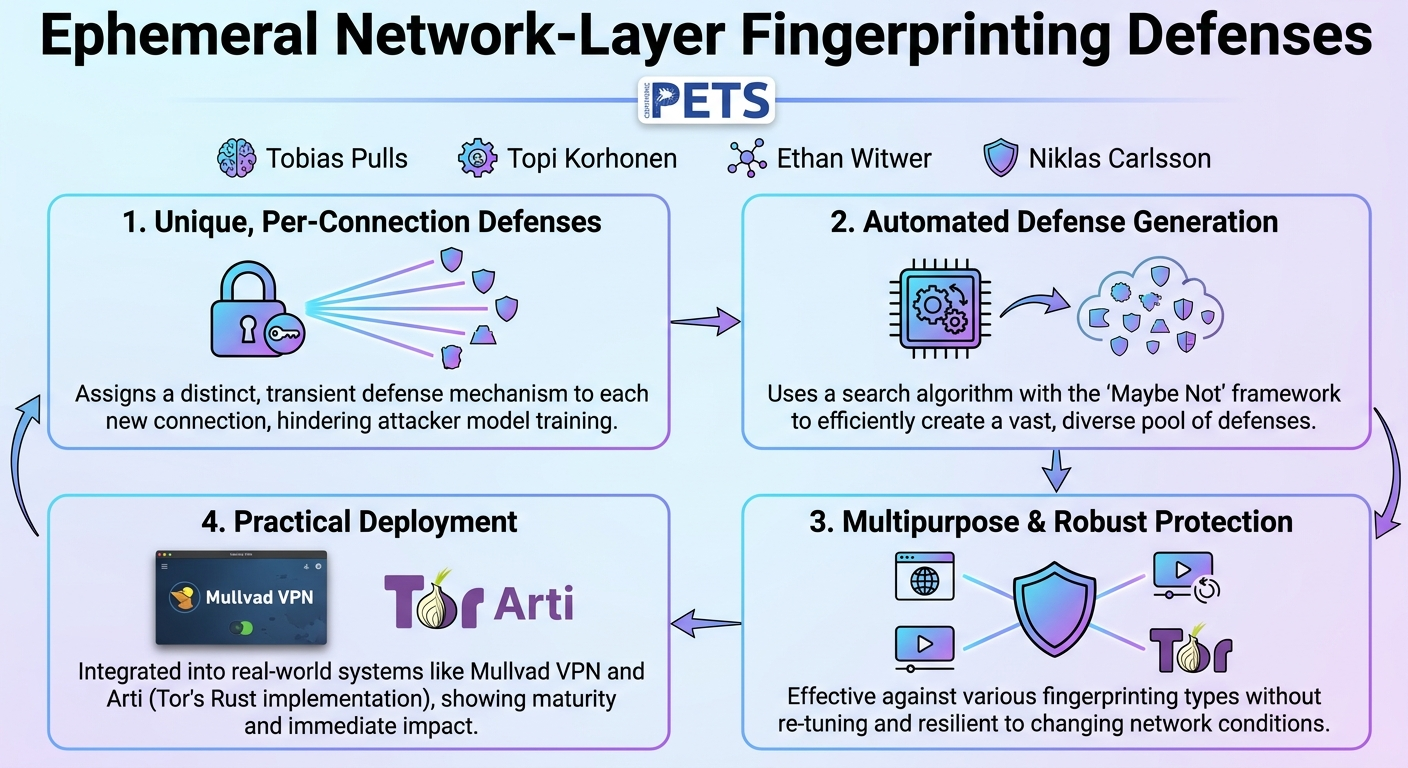
This talk, delivered by Tobias Pulls at PETS, introduces a novel paradigm: ephemeral network-layer fingerprinting defenses. The core idea is to equip each network connection with a unique, transient defense mechanism, akin to the concept of ephemeral keys in TLS. This approach seeks to enhance privacy by diversifying defensive strategies on a per-connection basis, making it significantly harder for adversaries to train generalizable attack models. The research presents a systematic method for discovering a vast array of such ephemeral defenses and evaluates their efficacy across a spectrum of fingerprinting attack types, from quick circuit analyses to long-duration video streaming.
The significance of this work lies in its ambitious goal to move beyond static, one-size-fits-all defenses towards a dynamic, adaptive, and scalable defensive posture. By proposing an algorithm to generate a polynomial number of unique defenses and demonstrating their multipurpose nature and resilience to varying network conditions, the speakers offer a promising direction for strengthening privacy in anonymity networks. The practical integration of these concepts into real-world systems like Mullvad VPN and Arti (Tor's Rust implementation) underscores the immediate relevance and potential impact of this research on user privacy.
Background
▶ Watch: Core question: What if every connection has a unique defense? (1:50)
Traffic analysis attacks have long been a significant concern for users of anonymity networks. These attacks exploit statistical patterns in encrypted traffic flows to infer user activities, even when the content itself is obfuscated. The talk contextualizes this problem by categorizing fingerprinting attacks along dimensions of data volume and duration:
- Website Fingerprinting Attacks: These are perhaps the most widely studied. A local, passive adversary observes traffic between a user and a privacy-preserving service (e.g., Tor, Nim, VPN) to determine which website the user is visiting. These attacks typically involve analyzing a few thousand packets over a few seconds, capturing the unique "fingerprint" of a website's loading sequence, including packet counts, sizes, and timings.
- Circuit Fingerprinting Attacks: Operating at a finer granularity, these attacks aim to identify the type of Tor circuit a user is establishing, for instance, distinguishing between a connection to an onion service versus a regular website. This often involves analyzing the first 30 or so Tor cells (fixed-size packets) during the handshake phase, which occurs over a mere couple of hundred milliseconds. The limited data volume makes these attacks distinctively challenging to defend against.
- Video Fingerprinting Attacks: At the other end of the spectrum, these attacks seek to identify the specific video a user is watching on a streaming platform like YouTube. Video traffic generates a massive volume of data, potentially spanning minutes to hours, and exhibits highly characteristic patterns due to adaptive bitrate streaming and buffering behaviors.
The common thread across these attack types is the adversary's ability to learn and generalize patterns from observed traffic. Existing defenses often involve padding (adding fake traffic) or blocking (introducing delays) to obscure these patterns. However, these defenses are typically custom-made, requiring significant effort to design, tune, and validate for specific scenarios, datasets, and attack models. This bespoke approach leads to a fragmented defensive landscape, where a defense effective against one attack or under one set of network conditions might fail against another.
The fundamental question that motivated this research was: "What if every connection has a unique defense?" This query led to the concept of ephemeral defenses, where defensive mechanisms are generated and applied dynamically, existing only for the duration of a single connection. Such a paradigm shift necessitates a method for generating a vast number of diverse defenses quickly and efficiently, moving away from the laborious manual tuning of individual countermeasures. The underlying framework for expressing and simulating these defenses is Maybe Not, which allows defenses to be defined as probabilistic state machines, providing a structured and domain-specific language for their creation.
Key Findings
▶ Watch: Algorithm step 3: Combining defense components for polynomial growth (4:00)
The research yielded several significant findings that challenge conventional approaches to traffic analysis defense and pave the way for more robust privacy protections:
- Feasibility of Ephemeral Defense Generation: The developed ephemeral defense search algorithm successfully demonstrated the ability to generate a large, polynomially growing number of unique defense mechanisms. This addresses the core requirement for ephemeral defenses, where a diverse pool of options is crucial for per-connection uniqueness. The algorithm's ability to combine components of previously validated defenses while largely preserving their efficacy is a key enabler for this scalability.
- Competitiveness with State-of-the-Art Defenses: When evaluated against website fingerprinting attacks, the ephemeral defenses proved to be competitive with existing custom-tuned, state-of-the-art defenses. While not always "stellar" or "beating by far" related work, they consistently achieved results on the Pareto front, demonstrating comparable protection levels with various trade-offs in bandwidth and latency overheads. This indicates that automatically generated, diverse defenses can perform on par with meticulously handcrafted ones.
- Multipurpose and General Purpose Nature: A crucial finding is the multipurpose nature of the ephemeral defenses. Defenses initially tuned for website fingerprinting proved remarkably effective when applied as-is to other attack types, specifically video fingerprinting and circuit fingerprinting. This suggests that these ephemeral defenses are not overly specialized but possess a generalizability that allows them to provide decent protection across different attack scenarios, data scales, and network conditions without requiring re-tuning.
- Robustness to Network Conditions: The ephemeral defenses exhibited a notable insensitivity to varying network environments. Particularly in video fingerprinting, where custom defenses like Scrambler are highly tuned, the ephemeral defenses, while not achieving optimal protection, performed "pretty good" and, critically, were "not very sensitive" to network conditions. This robustness is a significant advantage, as real-world networks are inherently dynamic and unpredictable.
- Attacker Generalization via Diverse Defenses: Perhaps the "most fun result of the paper," as highlighted by Tobias Pulls, was the observation from a comprehensive heatmap experiment involving the Laser Beak attack. When Laser Beak was trained on a diverse set of ephemeral defenses, the attack model learned to generalize, meaning it became effective at attacking a wide range of other ephemeral defenses it had not specifically been trained on. This counter-intuitive finding suggests that the very diversity of ephemeral defenses, while beneficial for users, can also, paradoxically, improve an attacker's ability to generalize if they gain access to a sufficiently varied training set of defended traffic. This underscores the continuous arms race in privacy and the need for ever-evolving defensive strategies.
- Real-World Applicability: The practical integration of these concepts into Mullvad VPN (as an opt-in feature for nearly two years) and into Arti (Tor's Rust implementation) provides strong evidence of the research's real-world applicability and maturity. This deployment demonstrates that the framework and its generated defenses are robust enough for production environments.
Technical Deep Dive
▶ Watch: Video fingerprinting results: untuned defenses perform well (6:40)
The cornerstone of this research is the ephemeral defense search algorithm, a four-step process designed to systematically discover and validate a vast number of unique, dynamic traffic analysis defenses. This algorithm leverages the Maybe Not framework, which allows defenses to be expressed as probabilistic state machines. Maybe Not acts as a domain-specific language (DSL) for traffic analysis defenses, ensuring that randomly generated state machines have a higher probability of being "good defenses" compared to arbitrary code.
- Step 1: Random Defense Generation: The process begins by creating a large quantity of random state machines. These machines are designed to run concurrently on both the client side and the relay/server side of a connection. Each pair of client-side and server-side state machines constitutes a candidate defense. The use of Maybe Not's DSL is critical here, as it constrains the random generation to meaningful defensive actions (e.g., sending padding packets, introducing delays) rather than arbitrary operations. This step aims to rapidly populate a pool of initial, potentially viable defensive components.
- Step 2: Simulation and Constraint Assessment: Each candidate defense generated in Step 1 undergoes rigorous simulation. The researchers use the Maybe Not simulator, a fast network simulator, to apply these defenses to a diverse set of network traces. These traces represent the specific task at hand, primarily website fingerprinting in the initial phase, but also extended to other types. Critically, the simulations incorporate diverse network conditions, including scenarios with simulated network bottlenecks (e.g., limited bandwidth), mirroring real-world network variability. After simulation, the resulting traces are assessed against predefined constraints, primarily focusing on acceptable bandwidth overheads and latency overheads. Only defenses that meet these performance criteria are accepted and passed to the next stage, filtering out overly inefficient or impractical mechanisms.
- Step 3: Component Recombination and Growth: This is the most innovative step, enabling the polynomial growth in the number of available defenses. The accepted defenses from Step 2 are "ripped apart" into their constituent client-side and server-side state machine components. These components are then collected into two separate piles: one for client machines and one for server machines. The algorithm then randomly combines these components to form new candidate defenses. This recombination isn't limited to one-to-one pairings; a new defense can be composed of multiple client-side machines (e.g., three) and multiple server-side machines (e.g., two), all operating in concert. A surprising but crucial finding is that if individual components (or simple combinations) fulfill the performance constraints from Step 2, most arbitrary recombinations of these components will also continue to satisfy those constraints. This property allows for a rapid, polynomial growth in the number of unique, valid defenses, which is essential for the "ephemeral" nature requiring a vast pool of options. This step essentially exploits the modularity and composability of the Maybe Not state machines.
- Step 4: Deployment: The final step involves deploying these validated and numerous defenses. The Maybe Not framework facilitates this deployment, offering integrations that inherently provide tunable bandwidth and latency overheads. This means that operators can select defenses based on their specific performance requirements and privacy goals. The talk mentions that while there's "some tuning involved with machine and environment parameters" for the search process itself, the overall framework streamlines the deployment of these diverse defenses.
The evaluation of these defenses involved several key comparisons:
- Website Fingerprinting: The researchers used the big enough dataset and compared their ephemeral defenses (both padding only and those incorporating blocking actions) against related work implemented within Maybe Not. They meticulously hyperparameter-tuned each defense for two scenarios: infinite network bandwidth (typical in research) and a simulated network bottleneck. They assessed overheads and accuracy against five different attacks, representing three generations of deep learning-based attacks, including the state-of-the-art Laser Beak. The results showed the ephemeral defenses to be competitive.
- Video Fingerprinting: For this, the Long Enough dataset was used, including its default and four bandwidth-constrained versions. Crucially, the same ephemeral defenses tuned for website fingerprinting were used as-is, without re-tuning. These were compared against Scrambler, a custom-tuned defense for video fingerprinting. While Scrambler offered better accuracy, the ephemeral defenses performed "pretty good," especially highlighting their robustness to different network environments.
- Circuit Fingerprinting: This involved targeting the first 30 cells of a Tor handshake. With no comparable related work, the researchers compared their website fingerprinting defenses (non-tuned for circuit fingerprinting) against a version specifically tuned for this task. Overheads were minimal (e.g., 10x bandwidth meaning 300 cells), and the baseline for binary classification was 50%. Again, the website fingerprinting defenses performed "pretty decent" even without specific tuning.
The heatmap experiment for Laser Beak, though only briefly described due to a technical glitch, was a pivotal validation. It involved training a Laser Beak model for every defense and then testing it against every possible defense. The diagonal of the resulting matrix showed performance when training and testing on the same defense. However, the key insight was that when trained on the diverse set of ephemeral defenses, the attack model showed improved generalization capabilities, effectively learning to attack a broader range of defenses. This highlights the double-edged sword of diversity: while it makes individual attacks harder, a sufficiently diverse training set can empower more generalized attack models.
Demo / Proof of Concept
▶ Watch: Circuit fingerprinting results: general-purpose defense effectiveness (7:30)
While no live demonstration of the ephemeral defense system was presented during the talk, the research provides compelling evidence of its functionality and real-world applicability through several validation mechanisms and existing deployments. The most significant validation comes from the comprehensive experimental evaluations and the practical integration into established privacy-preserving technologies.
A key conceptual "proof" highlighted by Tobias Pulls was the heatmap experiment involving the Laser Beak attack. Although the visual aid itself was unavailable during the presentation due to a technical error, the speaker vividly described its implications. This experiment involved an extensive and computationally expensive process: training a Laser Beak model for each ephemeral defense generated by the algorithm, and then testing each of those trained models against every other ephemeral defense. The resulting heatmap visually represented the cross-effectiveness of attack models against diverse defenses. The critical finding was that when Laser Beak was trained on the diverse population of ephemeral defenses, the attack model gained a remarkable ability to generalize. This means it could successfully attack a wide range of other ephemeral defenses, even those it had not specifically encountered during its training phase. This finding, while potentially alarming for defenders, serves as a powerful validation of the ephemeral defenses' diversity and the algorithm's ability to produce truly distinct defensive patterns. It demonstrates that the generated defenses are not merely trivial variations but possess sufficient structural differences to influence the generalization capabilities of state-of-the-art deep learning attacks.
Beyond this experimental validation, the practical viability of ephemeral network-layer fingerprinting defenses is further underscored by their integration into real-world, production systems:
- Mullvad VPN Integration: A version of this system has been deployed in Mullvad VPN, a prominent commercial VPN service, for nearly two years. It exists as an opt-in feature, allowing users to leverage these dynamic defenses to enhance their privacy. This deployment signifies that the system is stable, robust, and performs acceptably under real-world network conditions and user loads. The fact that a commercial entity has adopted this technology speaks volumes about its practical value and maturity.
- Arti (Tor's Rust Implementation) Integration: The underlying Maybe Not framework has also been integrated into Arti, which is the Rust implementation of the Tor anonymity network. This integration is particularly significant as Tor is at the forefront of privacy research and deployment. It indicates that the Maybe Not framework, which is foundational to generating these ephemeral defenses, is considered a robust and valuable tool for building next-generation privacy defenses within critical anonymity infrastructures.
These deployments, combined with the extensive experimental results across website, video, and circuit fingerprinting, serve as the primary "proof of concept" for the research. They demonstrate that the ephemeral defense paradigm is not merely a theoretical construct but a practical, deployable solution capable of enhancing user privacy in real-world scenarios.
Defensive Implications
▶ Watch: Real-world deployment with Mullvad VPN and Arti framework (9:30)
The research on ephemeral network-layer fingerprinting defenses carries profound implications for network defenders, shifting the paradigm from static, reactive countermeasures to dynamic, proactive protection.
- Embrace Dynamic, Per-Connection Defenses: The most direct implication is the call for defenders to move away from static, fixed defenses towards ephemeral, per-connection defense mechanisms. Instead of deploying a single, universally applied padding or blocking strategy, defenders should aim to diversify. By assigning a unique defense to each new connection, the cost for an adversary to build effective fingerprinting models increases dramatically, as they cannot rely on consistent patterns across multiple observations. This makes it harder for attackers to collect sufficient training data for any single defense, forcing them to either collect vast amounts of data for every possible defense or develop highly generalized, and thus potentially less accurate, attacks.
- Leverage Automated Defense Generation: The ephemeral defense search algorithm provides a blueprint for generating a vast number of diverse defenses efficiently. Defenders should explore tools and frameworks that enable automated generation and selection of defensive strategies. This reduces the manual effort and expertise required to keep pace with evolving attack techniques, allowing for a more agile defensive posture. The Maybe Not framework serves as a concrete example of such a tool, offering a domain-specific language for expressing and simulating defenses.
- Prioritize Multipurpose Defenses and Robustness: The finding that defenses tuned for one type of fingerprinting (e.g., website) can provide "pretty decent" protection against others (e.g., video, circuit) without re-tuning is a significant advantage. Defenders should seek out or develop defenses that exhibit this multipurpose nature and robustness to varying network conditions. This simplifies deployment and maintenance, as a single pool of defenses can effectively protect against a broader range of threats in diverse real-world network environments, minimizing the need for highly specialized, scenario-dependent solutions.
- Understand Attacker Generalization: The "spicy" finding regarding attacker generalization is a critical insight for defenders. While deploying diverse ephemeral defenses makes individual attacks harder, if an adversary manages to collect traffic samples from a sufficiently diverse set of these defenses, their attack models (especially deep learning-based ones like Laser Beak) can learn to generalize and become effective against other unseen defenses. This implies a continuous arms race:
- Defense Diversity is Key, but Not a Panacea: Defenders must continue to evolve their defense generation algorithms to produce ever more diverse and unpredictable patterns, preventing attackers from easily building comprehensive training sets.
- Limit Adversary Training Data: Strategies to limit the adversary's ability to collect diverse training data become even more crucial. This could involve techniques like dynamic defense rotation, making it harder for an attacker to correlate observations across connections, or increasing the cost of data collection.
- Monitor for Generalizing Attacks: Defenders should be aware that even with diverse defenses, sophisticated attackers might eventually develop generalized models. Continuous monitoring and evaluation of defensive efficacy against new attack paradigms are essential.
- Integration into Core Network Infrastructure: The deployment of these concepts in Mullvad VPN and Arti demonstrates that dynamic defenses are mature enough for production environments. Network operators, VPN providers, and developers of anonymity systems should consider integrating such frameworks into their core infrastructure to offer enhanced, opt-in privacy features. This moves advanced privacy defenses from academic research into practical, user-facing solutions.
In essence, this research empowers defenders with a strategy to fight fingerprinting by embracing unpredictability and diversity. It highlights that the future of traffic analysis defense lies in dynamic, automatically generated, and context-aware mechanisms that continuously evolve, making the attacker's task of building persistent, accurate models significantly more challenging.
Key Takeaways
- Ephemeral Defenses for Enhanced Privacy: The core concept is to assign a unique, transient defense to each network connection, making it significantly harder for adversaries to consistently fingerprint user activities across multiple sessions.
- Automated Generation of Diverse Defenses: The research presents a novel four-step algorithm that leverages the Maybe Not framework to efficiently generate a polynomial number of diverse and unique ephemeral defenses, addressing the need for a vast pool of defensive options.
- Multipurpose Protection Across Attack Types: Ephemeral defenses, even when tuned for one type of attack (e.g., website fingerprinting), demonstrate surprising effectiveness as "general purpose" protections against various other fingerprinting attacks, including video and circuit fingerprinting, without requiring specific re-tuning.
- Robustness to Network Variability: These defenses exhibit a notable insensitivity to diverse network conditions, performing consistently well even in scenarios with simulated network bottlenecks, making them suitable for real-world, unpredictable network environments.
- Attacker Generalization is a Double-Edged Sword: While defense diversity is beneficial, training state-of-the-art deep learning attacks (like Laser Beak) on a wide range of ephemeral defenses can, paradoxically, enable attackers to develop more generalized models capable of attacking unseen defenses.
- Real-World Applicability and Deployment: The practical integration of these ephemeral defenses into production systems like Mullvad VPN (as an opt-in feature) and the underlying Maybe Not framework into Arti (Tor's Rust implementation) underscores the maturity and immediate relevance of this research.
About the Speaker(s)
The talk was presented by Tobias Pulls, who is identified as a paper author from Karlstad University. He explicitly mentioned his collaborators on this work: Toppi Korhonen (Paper author, Independent), Ethan Witwer (Paper author, Linköping University), and Niklas Carlsson (Paper author, Linköping University), who was present in the audience. The presentation focused on their collaborative research into dynamic, ephemeral defenses against network-layer fingerprinting attacks.
Reviews
Dr. Zero (Offensive Security Researcher) — MUST SEE
Pulls and his team just dropped a foundational shift in how we handle traffic analysis, moving from static padding to per-connection ephemeral state machines. It's rare to see academic privacy research that actually survives contact with real networks, but they already shipped this in Mullvad and Tor's Arti. This is exactly what a research track is supposed to be.
Heather Calloway (CISO) — SOLID
This research proves that dynamically altering network traffic patterns can disrupt standard traffic analysis, but also shows that advanced adversaries using deep learning can generalize and track users anyway. If your threat model includes state surveillance of executive travel or high-risk employee communications, this fundamentally changes how you must evaluate commercial VPN and privacy vendors.
→ Top-rated talks at Privacy Enhancing Technologies Symposium (PETS) 2026
All talks from Privacy Enhancing Technologies Symposium (PETS) 2026