What-App? App usage detection using encrypted LTE/5G traffic
Jinjin Wang (Paper author · University of Birmingham), Zishuai Cheng (Paper author · Beijing University of Posts and Telecommunications), Mihai Ordean (Paper author · University of Birmingham), Baojiang Cui (Paper author · Beijing University of Posts and Telecommunications)
Privacy Enhancing Technologies Symposium (PETS) 2026 · Day 1 · Beaver
Overview
In an era where cellular networks are foundational to daily life, carrying an unprecedented volume of personal data, the security and privacy of this communication are paramount. This talk, presented by Jinjin Wang, a PhD student from the University of Birmingham, delves into a critical, often overlooked, privacy vulnerability: the leakage of application usage information through encrypted LTE/5G traffic. Despite multiple layers of cryptographic protection, including TLS at the application layer and PDCP ciphering at the cellular network layer, metadata transmitted over the radio link between a user's device and the base station remains exposed.
Key moments
- 0:00 Introduction: Cellular network security and radio link vulnerability
- 2:00 Three research questions and contributions
- 3:00 How metadata leakage reveals distinct traffic patterns
- 4:30 Two-stage traffic fingerprinting attack methodology
- 6:00 High accuracy and robustness of the attack
- 8:00 Existing defense challenges and categories
- 9:00 Proposed cluster-based traffic shaping defense
- 10:00 Summary of findings and future defense improvements
What-App? App usage detection using encrypted LTE/5G traffic
Speakers: Jinjin WANG (Paper author, University of Birmingham); Zishuai Cheng (Paper author, Beijing University of Posts and Telecommunications); Mihai Ordean (Paper author, University of Birmingham); Baojiang Cui (Paper author, Beijing University of Posts and Telecommunications)
Conference: PETS
YouTube: https://www.youtube.com/watch?v=A6K2DG1Njao
Overview
In an era where cellular networks are foundational to daily life, carrying an unprecedented volume of personal data, the security and privacy of this communication are paramount. This talk, presented by Jinjin Wang, a PhD student from the University of Birmingham, delves into a critical, often overlooked, privacy vulnerability: the leakage of application usage information through encrypted LTE/5G traffic. Despite multiple layers of cryptographic protection, including TLS at the application layer and PDCP ciphering at the cellular network layer, metadata transmitted over the radio link between a user's device and the base station remains exposed.
The research investigates what an adversary can learn from this ostensibly protected traffic, even without decrypting the payload. It introduces an end-to-end traffic fingerprinting attack capable of identifying not only the specific application a victim is using but also distinct activities within those applications. Crucially, the talk addresses the robustness of this attack across varying device models, application versions, network types (4G/5G), and in the presence of background traffic. Finally, it explores novel defense mechanisms, proposing a cellular-specific defense that intelligently balances privacy protection with the demanding latency and bandwidth efficiency requirements of modern mobile networks. This work highlights a significant privacy gap in current cellular communication paradigms and offers a path forward for more robust user protection.
Background
▶ Watch: Introduction: Cellular network security and radio link vulnerability (0:00)
Cellular network communication is a complex multi-layered process designed with several security mechanisms. When a user's device, such as a smartphone, sends data, it first travels wirelessly from the device to a base station. From there, it's forwarded through the operator's core network and finally reaches the application server. To safeguard this journey, operators physically protect their infrastructure, implement mutual authentication between the user equipment (UE) and the core network, and derive cryptographic keys. These keys are then used to encrypt the over-the-air traffic at the PDCP layer, ensuring data confidentiality between the phone and the base station. Additionally, most applications employ higher-layer protocols like TLS (Transport Layer Security) to establish secure channels directly between the application and its server, further encrypting the communication content.
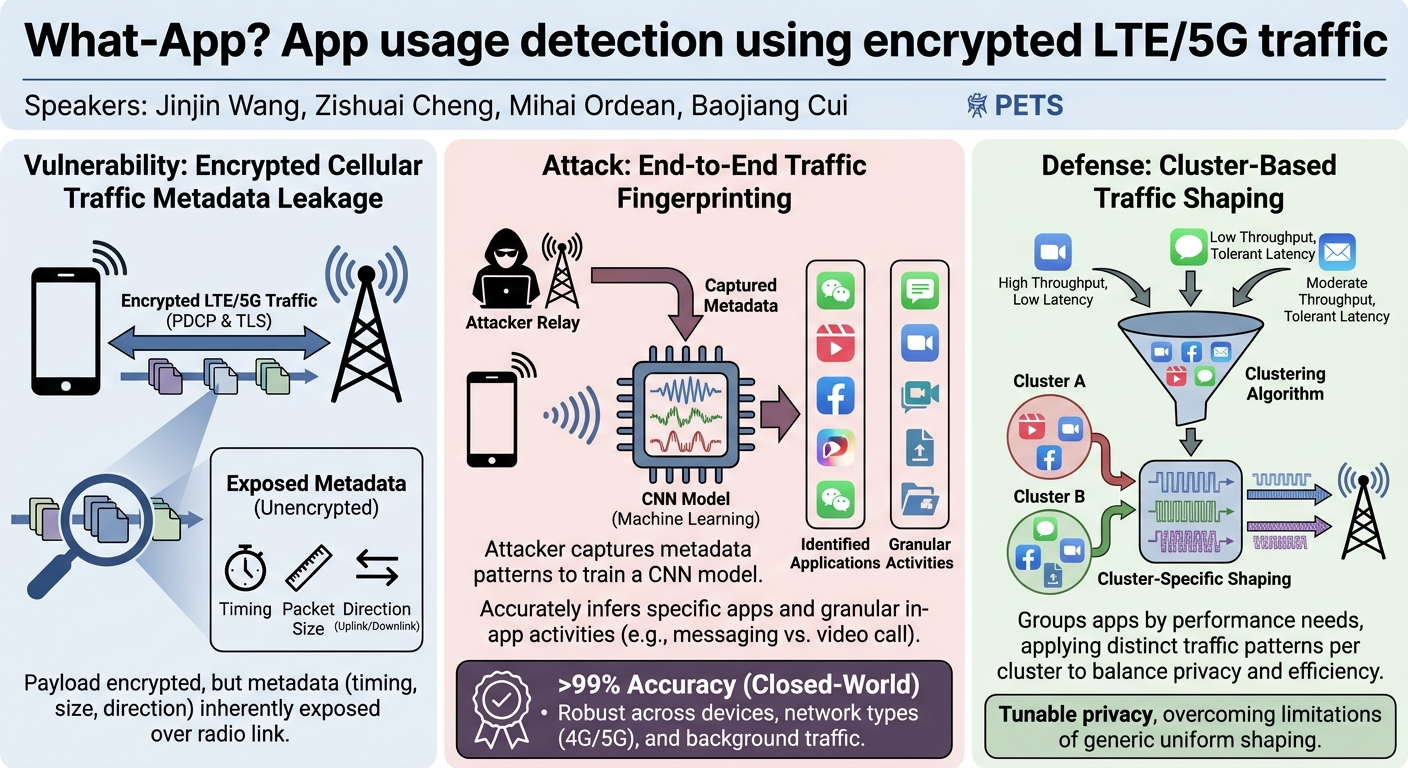
These robust security mechanisms effectively prevent an attacker from recovering the actual content of the communication. However, a critical exposure point persists: the radio link between the user's phone and the base station. Because communication over this link relies on radio signals, a nearby attacker can passively capture these over-the-air transmissions without needing physical access to the phone or the base station. While the payload remains encrypted, fundamental metadata such as timing, packet size, and packet direction (uplink or downlink) are inherently exposed and cannot be hidden by current encryption schemes. This metadata, often overlooked, forms distinct "fingerprints" for different applications and even different activities within the same application, as they follow unique program logic and data transmission patterns. Analyzing how these features evolve over time allows an attacker to infer user activities, thereby compromising privacy despite strong cryptographic protections.
Key Findings
▶ Watch: How metadata leakage reveals distinct traffic patterns (3:00)
The research presented in this talk addresses three fundamental questions regarding privacy leakage in encrypted cellular traffic, leading to several significant findings:
First, the study definitively answers what an attacker can learn from encrypted over-the-air cellular traffic. The authors developed an end-to-end traffic fingerprinting attack capable of identifying both the specific application being used and discrete activities within those applications. This demonstrates that even with robust encryption at multiple layers (TLS and PDCP), the metadata (timing, packet size, direction) provides sufficient information for highly accurate inference of user behavior.
Second, the research rigorously tested the effectiveness and robustness of this attack across various real-world conditions. The findings confirm that the attack remains highly effective despite significant variations:
- High Accuracy in Closed-World Setting: In a scenario where all observed activities were known to the attacker, the developed Convolutional Neural Network (CNN) model achieved over 99% accuracy using both uplink and downlink traffic. Even with only downlink traffic, the CNN still managed an impressive 97% accuracy. Other tested classifiers also yielded at least 95% accuracy, underscoring the highly distinguishable nature of user activity fingerprints embedded in cellular traffic. The dataset for this evaluation comprised 49 application activities from 40 popular applications, with at least 5 minutes of traffic collected per activity (e.g., distinguishing WhatsApp messaging from video calling).
- Effectiveness in Open-World Setting: Recognizing that an attacker may not have full knowledge of all possible activities, the study evaluated an open-world scenario. Even when the attacker's model was trained on a mere 15 out of 49 total activities, it still achieved over 95% accuracy with a high true positive rate for the known target activities. This suggests that even partial knowledge can enable significant privacy breaches.
- Robustness to Real-World Variables: The attack proved robust against common real-world variations, including application updates, different device models, and different network types (4G and 5G). While these variations could slightly reduce accuracy, the authors note that such reductions could be mitigated by refining the model or incorporating more diverse training data.
Third, the talk explores potential solutions to prevent this information leakage. Acknowledging the limitations of existing website fingerprinting defenses when applied to cellular networks, the authors designed and implemented a novel cellular-specific defense mechanism. This defense aims to balance strong privacy protection with the critical requirements of low latency and high bandwidth efficiency inherent in cellular communication, moving beyond generic traffic randomization or uniform shaping.
Technical Deep Dive
▶ Watch: High accuracy and robustness of the attack (6:00)
The core of this research lies in its traffic fingerprinting attack and its proposed cellular-specific defense. The attack leverages the fact that even encrypted cellular traffic exposes metadata that forms unique patterns.
Attack Mechanism: Traffic Fingerprinting
The attack exploits observable features at the cellular PDCP layer: packet arrival time (timing), packet size, and packet direction (uplink from device to base station, or downlink from base station to device). Different applications, and indeed different activities within the same application, generate distinct sequences of packet sizes and timings due to their underlying program logic and data exchange protocols. For instance, a video call will produce a continuous stream of relatively large packets in both directions, while a text message might involve a burst of smaller packets. The talk illustrates this visually, representing each traffic trace as a two-dimensional plot where the X-axis is packet arrival time, the Y-axis is packet size, and color indicates packet direction. These visualizations clearly show distinguishable patterns for different activities.
The attack proceeds in two distinct stages:
- Training Stage:
- An attacker first sets up a control device (an "over-the-air relay") positioned between a controlled mobile phone and a base station. This relay is crucial for passively capturing encrypted traffic.
- The attacker then systematically runs various target applications and specific activities (e.g., browsing, messaging, video calls, file uploads) on the controlled phone.
- For each activity, the corresponding over-the-air traffic is captured by the relay and meticulously labeled with the activity performed.
- This collected, labeled traffic data is then used to train a classification model. The research specifically highlights the effectiveness of a Convolutional Neural Network (CNN), which excelled in pattern recognition for this type of time-series data. Other classifiers were also tested, demonstrating the general feasibility of the approach.
- Deployment Stage:
- Once the model is trained, the attacker deploys the relay in a real-world scenario, strategically placing it to intercept traffic between a victim device and its base station.
- The relay continuously captures the victim's encrypted cellular traffic.
- This captured, unlabeled traffic is then fed into the pre-trained classification model.
- The model analyzes the metadata patterns (timing, packet size, direction) and predicts which application or specific activity the victim is currently engaged in, effectively de-anonymizing their usage.
The data collection for the experiments was substantial, involving 40 popular applications and a total of 49 distinct application activities. For each activity, at least 5 minutes of traffic was collected. This comprehensive dataset allowed for robust training and evaluation of the classification models, demonstrating high accuracy even in challenging open-world scenarios where the attacker had limited prior knowledge of all possible activities.
Defense Strategy: Cluster-Based Traffic Shaping
The talk also addresses the critical need for effective defenses. Existing defenses, primarily designed for website fingerprinting, often fall into two categories:
- Randomization: Adding random padding or dummy packets. This can be effective but heavily depends on the algorithm and parameters, and insufficient randomization can still leak information.
- Uniform Shaping: Forcing all traffic into a single, uniform pattern. While offering strong, even provable, security guarantees, this approach introduces significant and often unacceptable bandwidth and latency overhead, making it impractical for the diverse demands of cellular applications.
To overcome these limitations, the authors propose a novel cellular-specific defense based on a simple yet powerful observation: different applications have vastly different performance requirements (e.g., a real-time video call needs low latency and high throughput, while an email client has more relaxed requirements). Forcing all applications into one pattern is unnecessary and inefficient.
The proposed defense works as follows:
- Feature Extraction: For each application, key performance features are extracted, specifically its throughput and latency requirements.
- Clustering: Applications with similar throughput and latency requirements are grouped into clusters. This is a crucial step, as it allows for differentiated treatment.
- Cluster-Specific Shaping: Instead of a single global pattern, applications within each cluster are shaped into a common traffic pattern specific to that cluster. This makes applications within the same cluster indistinguishable to an attacker, while allowing different clusters to use different shaping configurations tailored to their performance needs.
- Tunable Privacy: The number of clusters is controlled by a privacy parameter, epsilon. A stronger privacy setting (smaller epsilon) leads to fewer clusters, meaning more applications are grouped into each cluster, thus increasing the overhead but also enhancing privacy. This offers a tunable trade-off between privacy protection and the associated bandwidth/latency overhead, allowing network operators to configure the defense based on their policy and network capabilities.
This cluster-based approach offers a more pragmatic and efficient defense strategy for cellular networks, addressing the unique constraints and diverse application landscape of mobile communication.
Demo / Proof of Concept
▶ Watch: Existing defense challenges and categories (8:00)
While a live demonstration of the attack or defense was not explicitly performed during the conference talk, the research itself serves as a comprehensive proof of concept through its rigorous experimental methodology and detailed results.
The authors implemented an over-the-air relay as the core component of their attack framework. This relay functions as a passive eavesdropper, capturing encrypted PDCP layer traffic between a user's device and the base station. This implementation was vital for collecting the extensive dataset required for training the classification models. The collection involved running 40 popular applications and 49 distinct application activities (e.g., distinguishing WhatsApp messaging from WhatsApp video calls) on controlled devices, ensuring a diverse and representative dataset. Each activity yielded at least 5 minutes of traffic, forming the basis for the labeled training data.
The effectiveness of the attack was then demonstrated through quantitative evaluation using various machine learning models, with a Convolutional Neural Network (CNN) consistently achieving the highest accuracy. The reported accuracies (e.g., >99% in closed-world, 97% with downlink-only traffic, >95% in open-world) are direct empirical evidence of the attack's viability and potency. Furthermore, the robustness evaluation across different device models, application versions, and 4G/5G networks, and in the presence of background traffic, solidified the practical applicability of the fingerprinting technique.
For the defense mechanism, the talk describes the design and implementation of their cellular-specific traffic shaping strategy. This involved developing algorithms to extract application performance requirements (throughput, latency), perform clustering based on these features, and apply cluster-specific traffic shaping. Although the talk did not go deep into implementation details of the defense, the conceptual framework and the stated goal of balancing privacy with efficiency demonstrate a viable approach to mitigating the identified privacy risks. The experimental validation of the attack inherently validates the need for such a defense, and the proposed defense framework offers a constructive countermeasure.
Defensive Implications
▶ Watch: Summary of findings and future defense improvements (10:00)
The findings presented in "What-App?" carry significant defensive implications for cellular network operators, device manufacturers, application developers, and ultimately, users. The most critical implication is that current cellular encryption mechanisms, including PDCP ciphering and application-layer TLS, are insufficient to protect user privacy from traffic fingerprinting attacks conducted over the radio link. The metadata leakage of packet timing, size, and direction presents a persistent vulnerability that needs direct mitigation.
For Cellular Network Operators: Operators are uniquely positioned to implement effective defenses. They control the base stations and core network infrastructure where traffic shaping can be applied. The proposed cluster-based traffic shaping defense offers a practical model for operators. By analyzing the performance requirements of various applications and grouping them into clusters, operators could apply tailored shaping configurations. This would make applications within a cluster indistinguishable while avoiding the prohibitive overhead of uniform shaping across all traffic. Implementing such a system would require deep packet inspection (DPI) capabilities to identify application types and their associated requirements, or cooperation with application providers. Operators must move beyond simply encrypting payloads and consider actively sanitizing metadata.
For Device Manufacturers: While less direct than operators, device manufacturers could contribute by implementing client-side padding or shaping mechanisms. However, such client-side efforts are likely to be less effective without network-level coordination, as the network's behavior might still leak patterns. Standardized APIs or frameworks for privacy-preserving traffic management could be integrated into device operating systems to support network-level defenses.
For Application Developers: Application developers should be aware that the traffic patterns generated by their applications can reveal sensitive user behavior. While direct defensive measures by individual app developers might be challenging to coordinate and implement effectively across the entire ecosystem, they could explore techniques like adaptive padding or more randomized communication patterns where performance allows. However, a systemic solution at the network level is likely more robust.
Challenges and Future Work: The research highlights that defending against this leakage remains challenging. The trade-off between privacy protection and network performance (latency, bandwidth) is a central dilemma. While the cluster-based defense offers a tunable solution, further work is still needed to improve its practical implementation, optimize clustering algorithms, and minimize overhead in real-world, dynamic network conditions. Standardization bodies and industry consortia should consider integrating metadata privacy as a design principle in future cellular network protocols (e.g., 5G-Advanced and 6G). Without proactive measures, the increasing reliance on cellular networks for sensitive activities will continue to expose users to sophisticated traffic fingerprinting attacks, eroding trust and privacy.
Key Takeaways
- Cellular traffic remains vulnerable to over-the-air fingerprinting attacks, even when protected by multiple layers of encryption (PDCP and TLS). Metadata such as packet timing, size, and direction are inherently exposed.
- Attackers can identify specific applications and granular in-app activities (e.g., WhatsApp messaging vs. video calls) with extremely high accuracy, reaching over 99% using CNN models with both uplink and downlink traffic.
- The attack is robust across various real-world conditions, including different device models, application versions, network types (4G and 5G), and in the presence of background traffic, demonstrating its practical viability.
- Existing website fingerprinting defenses are often unsuitable for cellular networks due to their significant bandwidth and latency overhead, which are critical performance metrics for mobile communication.
- A novel cluster-based traffic shaping defense offers a promising solution. By grouping applications with similar performance requirements and applying cluster-specific patterns, it provides strong privacy protection while allowing for a tunable trade-off with bandwidth and latency efficiency.
- Further research and implementation efforts are crucial to refine and deploy effective cellular-specific privacy defenses, encouraging operators, manufacturers, and developers to address metadata leakage proactively.
About the Speaker(s)
The talk "What-App? App usage detection using encrypted LTE/5G traffic" was presented by Jinjin Wang, a PhD student from the University of Birmingham. Jinjin Wang was the lead presenter for this collaborative research effort. The paper itself was co-authored by Zishuai Cheng and Baojiang Cui from Beijing University of Posts and Telecommunications, and Mihai Ordean also from the University of Birmingham, indicating a strong international research partnership focused on cutting-edge cellular security and privacy challenges.
Reviews
Dr. Zero (Offensive Security Researcher) — SOLID
Solid execution of a classic playbook. Wang and the team ported standard website fingerprinting techniques down to the cellular PDCP layer, proving you can still pull 99% accuracy on app identification through 5G encryption using an SDR relay and a CNN. The attack is competent, but their proposed cluster-based traffic shaping defense is the actual reason to pay attention.
Heather Calloway (CISO) — WEAK
Academic confirmation that standard 4G/5G encryption does not hide application usage from local eavesdroppers. Worth a brief look for teams managing executive protection or high-risk mobile fleets, but not immediately actionable for the broader enterprise.
→ Top-rated talks at Privacy Enhancing Technologies Symposium (PETS) 2026
All talks from Privacy Enhancing Technologies Symposium (PETS) 2026