Dodge: A Client-Side Framework for Application-Layer Video Fingerprinting Defenses
Ethan Witwer (Paper author · Linköping University), David Hasselquist (Paper author · Linköping University, Sectra Communications), Tobias Pulls (Paper author · Karlstad University), Niklas Carlsson (Paper author · Linköping University)
Privacy Enhancing Technologies Symposium (PETS) 2026 · Day 1 · Beaver
Overview
In an era where encrypted traffic is the norm, the seemingly innocuous act of streaming video can still betray sensitive user information to passive network observers. This talk, "Dodge: A Client-Side Framework for Application-Layer Video Fingerprinting Defenses," presented by Ethan Witwer from Linköping University, delves into the pervasive threat of video fingerprinting and proposes a novel, flexible framework to counter it. Developed in collaboration with David Hasselquist, Tobias Pulls, and Niklas Carlsson, Dodge offers a client-side solution that empowers users and content providers to implement robust defenses against traffic analysis attacks on streaming video.
Key moments
- 0:00 Introduction and video fingerprinting threat model
- 1:30 Introducing Dodge: a client-side defense framework
- 2:27 Dodge's core mechanism: cycles and extended manifests
- 3:30 Proof-of-concept defense: Dodge Mimic (k-anonymity)
- 4:37 Experimental results: leakage removed, bandwidth, QoE
- 5:45 Deployability: dash.js integration and browser extension
- 7:01 Summary of findings and future outlook
Dodge: A Client-Side Framework for Application-Layer Video Fingerprinting Defenses
Speakers: Ethan Witwer (Paper author, Linköping University), David Hasselquist (Paper author, Linköping University, Sectra Communications), Tobias Pulls (Paper author, Karlstad University), Niklas Carlsson (Paper author, Linköping University)
Conference: PETS
YouTube: https://www.youtube.com/watch?v=FR2i9Fezmfg
Overview
In an era where encrypted traffic is the norm, the seemingly innocuous act of streaming video can still betray sensitive user information to passive network observers. This talk, "Dodge: A Client-Side Framework for Application-Layer Video Fingerprinting Defenses," presented by Ethan Witwer from Linköping University, delves into the pervasive threat of video fingerprinting and proposes a novel, flexible framework to counter it. Developed in collaboration with David Hasselquist, Tobias Pulls, and Niklas Carlsson, Dodge offers a client-side solution that empowers users and content providers to implement robust defenses against traffic analysis attacks on streaming video.
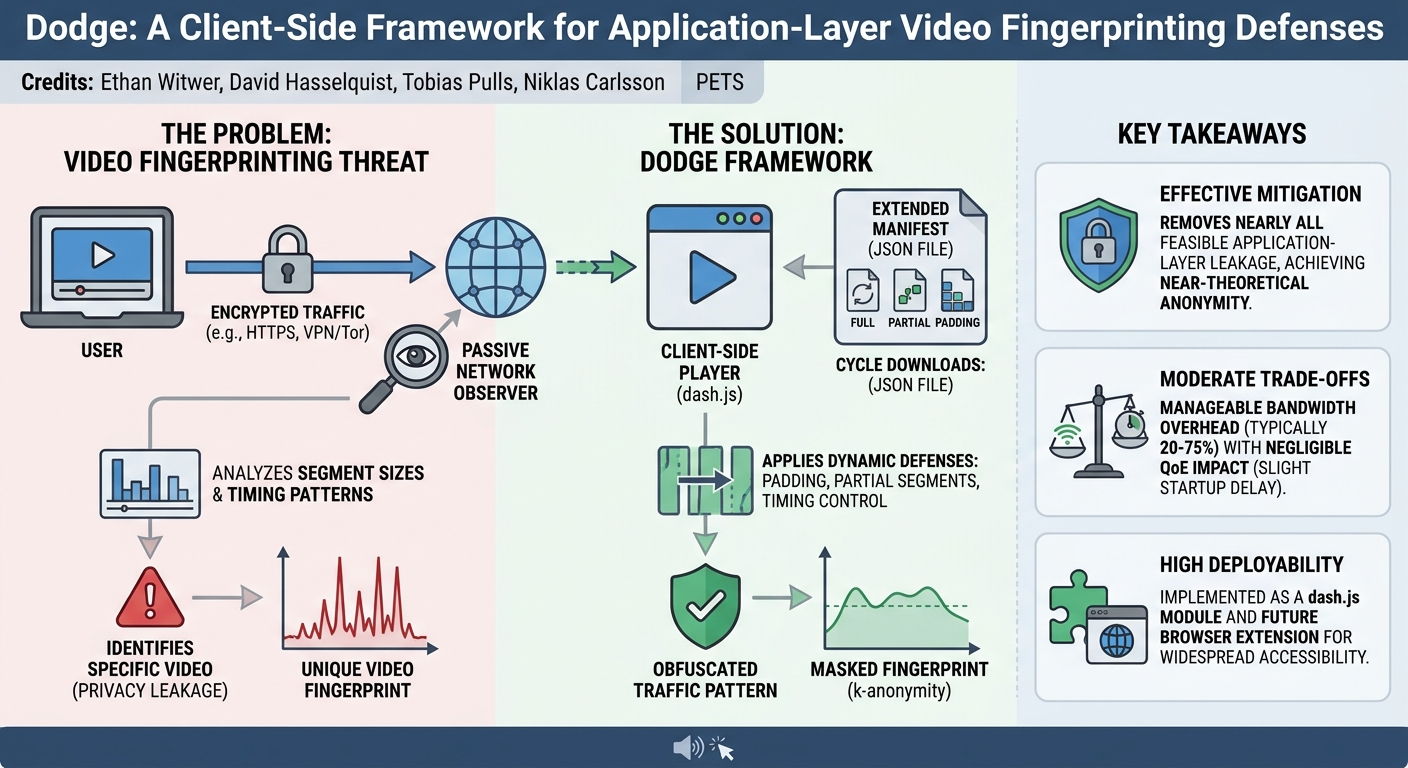
The core problem addressed is that even when video traffic is encrypted and routed through privacy-enhancing technologies like VPNs or Tor, the unique patterns formed by segment sizes and timing in Adaptive Bitrate (ABR) streaming protocols like DASH (Dynamic Adaptive Streaming over HTTP) can serve as a highly identifiable "fingerprint" for specific videos. Traditional, hard-coded defenses against such attacks are often fragile and quickly rendered obsolete by evolving attack methodologies. Dodge tackles this challenge by introducing an in-player framework where defenses are not fixed but rather dynamically specified through a JSON-based file format called extended manifests, offering unparalleled adaptability and ease of deployment.
The significance of Dodge lies in its innovative approach to client-side defense, moving beyond static, protocol-specific countermeasures to a dynamic, extensible system. By integrating directly with widely used video players like dash.js and offering a forthcoming browser extension, Dodge aims to make advanced video fingerprinting defenses accessible to a broad audience, from content providers to individual users. This work represents a crucial step towards safeguarding user privacy in the context of online video consumption, demonstrating that effective protection can be achieved with moderate overhead and minimal impact on quality of experience.
Background
▶ Watch: Introduction and video fingerprinting threat model (0:00)
The landscape of online video streaming is dominated by Adaptive Bitrate (ABR) technologies, with DASH being a prominent standard. ABR streaming works by breaking video content into small, sequentially numbered segments, often just a few seconds long, encoded at various quality levels (bitrates). The client player dynamically requests segments based on network conditions, buffering status, and user preferences. While the video content itself is typically encrypted (e.g., via HTTPS), the metadata surrounding these segment requests – specifically, their sizes, timings, and the sequence in which they are downloaded – inadvertently creates a unique signature for each video. This signature is what researchers refer to as a video fingerprint.
A passive network observer, such as an Internet Service Provider (ISP), a network administrator, or even another user on the same local network, can monitor this encrypted traffic and infer which video a user is watching. Even when users employ privacy tools like Virtual Private Networks (VPNs) or Tor, which encrypt and tunnel traffic, the fundamental segment-level patterns often remain discernible. This is because these tools primarily obscure the origin and destination of traffic, but they do not fundamentally alter the timing and size characteristics of the application-layer data flow in a way that consistently defeats fingerprinting. The attacks are surprisingly effective, leading to significant privacy leakage.
Historically, defenses against video fingerprinting have often been specific to certain attack vectors or protocols. For instance, a defense might focus on padding segments to uniform sizes or introducing artificial delays. However, such specific defenses suffer from inherent fragility. New attack techniques, perhaps leveraging more sophisticated machine learning classifiers or analyzing different features of the traffic, can quickly circumvent them, necessitating constant re-implementation and adaptation. Furthermore, different use cases might demand different trade-offs between privacy protection, bandwidth overhead, and quality of experience (QoE). A rigid, hard-coded defense cannot accommodate this spectrum of requirements. This recognized limitation highlighted the need for a more general, adaptable, and extensible approach – a framework – that could host various defense strategies and evolve alongside the threat landscape. Dodge was conceived precisely to address this critical gap, providing a client-side mechanism to apply and customize these defenses.
Key Findings
▶ Watch: Dodge's core mechanism: cycles and extended manifests (2:27)
The research behind Dodge yielded several critical findings that underscore its effectiveness and practical viability as a defense against video fingerprinting:
First and foremost, the Dodge framework successfully demonstrates the ability to remove virtually all feasible leakage attributable to application-layer video fingerprinting. Through rigorous experimentation with its proof-of-concept defense, Dodge Mimic, the attacker accuracy was found to be remarkably close to the theoretical bounds of k-anonymity. While a small residual leakage (a few percentage points higher in the worst case) was observed, attributed to intra-segment timing that cannot be controlled at the application layer, the researchers anticipate this to be less exploitable in real-world scenarios compared to their tightly controlled experimental setup. This indicates a high degree of privacy protection achieved by the framework.
Secondly, Dodge Mimic achieves this robust protection with moderate bandwidth overhead. Experimental results show overheads typically ranging between 20% and 75%. This range represents a manageable trade-off for enhanced privacy, especially considering that the k-anonymity algorithm allows for adjustment of the K parameter to control this balance between protection level and bandwidth consumption. The ability to dynamically tune this trade-off is a significant feature, allowing content providers or users to select a level of privacy that aligns with their resources and threat model.
Thirdly, the implementation of Dodge Mimic demonstrated minimal degradation in Quality of Experience (QoE). Metrics for QoE, such as buffering events or playback interruptions, were found to be similar to those of undefended traffic. The primary impact observed was a slightly longer startup delay in the worst case, which is a common and often acceptable trade-off for enhanced security and privacy. This finding is crucial for practical deployment, as severe QoE issues would deter widespread adoption.
Finally, a standout finding is Dodge's exceptional deployability. The framework is implemented as a module for the dash.js video player, which is the reference player for the DASH standard and is widely used by content providers. Deployment requires only swapping out one JavaScript file and adding another. Furthermore, the researchers announced that Dodge is actively being merged into the official dash.js player, expected as part of the next minor version, making it even easier for content providers to opt-in. The ongoing development of a browser extension will also allow ordinary users to leverage Dodge's defenses directly, significantly broadening its reach and impact. This ease of integration and planned broad availability position Dodge as a highly practical and impactful solution to a persistent privacy threat.
Technical Deep Dive
▶ Watch: Proof-of-concept defense: Dodge Mimic (k-anonymity) (3:30)
Dodge is designed as an in-player framework operating entirely on the client side, providing a flexible and extensible mechanism for implementing video fingerprinting defenses. Its core innovation lies in abstracting defense strategies into a standardized, machine-readable format, moving away from rigid, hard-coded solutions.
The cornerstone of the Dodge framework is the concept of extended manifests. These are JSON-based files that specify how a video should be downloaded and processed by the client player to obfuscate its traffic fingerprint. Unlike standard DASH manifests (MPDs) that merely describe available segments and their properties, extended manifests dictate the actual download behavior in a privacy-preserving manner.
At a more granular level, extended manifests utilize a fundamental building block called cycles. A cycle is a generalization of a video segment download, allowing for more intricate control over the network traffic pattern. Each cycle can specify one of three primary actions:
- Full Segment Downloads: This is the standard operation, where an entire video segment is downloaded as usual.
- Partial Segment Downloads: Only a specified byte range of a segment is downloaded. This allows for fine-grained control over the size of network packets and can be used to create traffic patterns that do not directly correspond to full segment boundaries. The player is responsible for later reassembling these partial segments before they are buffered for playback.
- Padding Downloads: These are downloads of arbitrary data that are immediately discarded upon receipt by the player. Padding cycles are crucial for artificially inflating traffic sizes or introducing noise into the timing patterns without affecting the actual video content. This allows a defense to match target traffic characteristics without consuming excessive resources on actual video data that isn't needed.
Extended manifests specify several key parameters for each cycle, enabling precise control over the outgoing traffic pattern:
- Segment Index: Which logical video segment (from the original DASH manifest) the cycle pertains to.
- Byte Range: For partial segment downloads, this indicates the specific portion of the segment to retrieve. For full segments or padding, it might implicitly cover the entire resource or a defined padding size.
- Timing Control: The manifest dictates when all pending data (from partial segments that need reassembly, or any buffered data) should be sent to the player's buffer. This controls the timing of cycle downloads and the reassembly of partial segments, which is critical for masking timing-based fingerprints. By carefully orchestrating these events, Dodge can align the observed network activity with a chosen anonymity set.
- Padding Indication: Explicitly marks cycles as padding, ensuring the downloaded data is discarded and does not interfere with playback.
The entire process is client-side, meaning the privacy-enhancing logic resides within the user's video player. This architecture offers significant advantages:
- Decentralization: Defenses can be deployed without requiring modifications to video servers or network infrastructure.
- Flexibility: Different extended manifests can be used for different videos or user preferences, allowing for tailored privacy-bandwidth trade-offs.
- User Control: With a browser extension, users can potentially choose their preferred defense strategy, even if the content provider hasn't explicitly opted in.
To deploy a defense using Dodge, a content provider or user simply needs to provide the player with the URL of an extended manifest file. This JSON file then instructs the Dodge module within the player on how to modify its segment fetching and buffering behavior to achieve the desired privacy-preserving traffic pattern. This modularity makes Dodge highly adaptable to new attacks and evolving defense strategies without requiring a complete overhaul of the player or streaming infrastructure.
Demo / Proof of Concept
▶ Watch: Deployability: dash.js integration and browser extension (5:45)
To thoroughly test and validate the capabilities of the Dodge framework, the researchers developed a specific proof-of-concept defense called Dodge Mimic. This defense is not necessarily intended as the ultimate, production-ready solution, but rather as a robust testing ground for the framework's core functionalities.
Dodge Mimic is based on the principle of k-anonymity. In the context of video fingerprinting, k-anonymity aims to make the traffic pattern of a watched video indistinguishable from at least k-1 other videos within a chosen anonymity set. Essentially, it transforms the traffic profile of a video so that it "looks identical" to k other videos, thereby preventing an attacker from uniquely identifying the specific video being watched among that set. The choice of k-anonymity for the proof-of-concept was strategic: it provides strong theoretical bounds against classifier-based attackers, allowing the researchers to quantitatively verify the effectiveness of the framework against known benchmarks.
The operation of Dodge Mimic involves a live algorithm that generates the necessary extended manifests. This algorithm works by creating a target traffic pattern for a set of k videos such that their combined patterns are indistinguishable. It does this by minimizing a cost function primarily based on bandwidth overhead. Users or content providers can adjust the K value to control the trade-off between the level of protection (higher K for more anonymity) and the incurred bandwidth overhead. The algorithm iteratively refines these patterns; allowing it to run longer generally results in the generation of "better sets" with lower bandwidth overheads for a given K.
The experimental setup for evaluating Dodge Mimic was meticulously controlled:
- Environment: Two directly connected machines were used: a client running the
dash.jsplayer with the Dodge module, and a video server hosting the content. This setup minimized external network noise, allowing for precise measurement of the defense's impact. - Dataset: A substantial dataset of 1,400 videos was employed, providing a diverse range of content to test the robustness of the fingerprinting and defense mechanisms.
The results of these experiments were highly encouraging. Dodge Mimic effectively removed "all of the leakage that can feasibly be removed" at the application layer. Attacker accuracy was observed to be very close to the theoretical bounds of k-anonymity, indicating that the framework successfully obfuscated video fingerprints. A slight deviation of "a few percentage points higher in the worst case" was noted, attributed to intra-segment timing characteristics that are beyond the control of application-layer defenses. However, the researchers expressed confidence that such micro-timing variations would be significantly less exploitable in the unpredictable environment of real-world networks compared to their tightly controlled laboratory conditions.
Furthermore, the demo confirmed the practical implications discussed earlier: moderate bandwidth overheads (typically between 20% and 75%) and negligible degradation in Quality of Experience, with only a "slightly longer startup delay in the worst case." This comprehensive evaluation demonstrated that the Dodge framework, through its Mimic implementation, is not only theoretically sound but also practically effective in mitigating video fingerprinting attacks.
Defensive Implications
▶ Watch: Summary of findings and future outlook (7:01)
The Dodge framework offers significant defensive implications for various stakeholders involved in online video streaming, empowering them to actively counter video fingerprinting attacks.
For content providers and streaming platforms, Dodge presents a straightforward and powerful mechanism to enhance user privacy without overhauling their existing infrastructure. Since Dodge is implemented as a module for dash.js, the reference player for the DASH standard, and is in the process of being officially merged into its codebase, adoption becomes exceptionally easy. Content providers can "opt into" using Dodge simply by updating their dash.js player and hosting the extended manifests for their videos. These manifests can reside alongside the video files on the same server, on a separate server, or even be generated dynamically. By doing so, providers can offer a privacy-enhanced viewing experience, potentially attracting privacy-conscious users and complying with stricter data protection regulations. The ability to specify different extended manifests also means they can offer varying levels of privacy protection, allowing users to choose their preferred balance between bandwidth overhead and anonymity.
For developers of video players and streaming applications, Dodge provides a robust, extensible foundation for building privacy-aware features. Instead of developing bespoke, fragile defenses for each new attack, they can integrate the Dodge framework and focus on creating new defense strategies as extended manifests. This modularity fosters innovation and reduces the maintenance burden associated with evolving threat models. The framework's client-side nature means that developers can implement and test new defenses without requiring server-side changes or complex coordination with content delivery networks.
For individual users, the forthcoming browser extension for Dodge is a game-changer. This extension will allow ordinary users to apply Dodge's defenses directly within their web browsers, regardless of whether the content provider has officially integrated the framework. This provides an unprecedented level of user control over their streaming privacy, allowing them to activate defenses against video fingerprinting on virtually any DASH-based streaming service. This empowers users to take proactive steps to protect their viewing habits from passive network observers, even when using VPNs or Tor, which, as the research highlights, are often insufficient on their own against these types of application-layer attacks.
From a broader security perspective, Dodge highlights the importance of application-layer defenses against sophisticated traffic analysis attacks. It underscores that encryption alone is not a panacea for privacy in all contexts. Defenders must consider the metadata and side-channel leakage inherent in application protocols. The framework approach of Dodge also serves as a model for future security developments, demonstrating that flexible, configurable, and client-side mechanisms can be more resilient and adaptable than static countermeasures. While the bandwidth overhead (20-75%) is a consideration, its moderate nature suggests that privacy can be significantly enhanced without making streaming impractical, especially as network bandwidths continue to increase globally.
Key Takeaways
- Video Fingerprinting is a Potent Threat: Even with encrypted traffic and privacy tools like VPNs/Tor, passive network observers can successfully identify streamed videos by analyzing segment sizes and timing patterns, leading to significant privacy leakage.
- Frameworks Outperform Specific Defenses: A flexible, extensible framework like Dodge is superior to hard-coded, specific defenses because it can adapt to evolving attacks, reduce re-implementation burden, and allow for tailored defense strategies based on specific use cases and desired privacy-bandwidth trade-offs.
- Dodge Effectively Mitigates Leakage: The Dodge framework, demonstrated through its k-anonymity-based proof-of-concept (Dodge Mimic), successfully removes nearly all feasible application-layer video fingerprinting leakage, bringing attacker accuracy close to theoretical limits with minimal residual.
- Moderate Overhead, High QoE: Dodge achieves strong privacy protection with moderate bandwidth overheads (typically 20-75%) and negligible impact on Quality of Experience, primarily just a slightly longer startup delay in the worst case.
- High Deployability and Accessibility: Dodge is implemented as a module for the widely used
dash.jsplayer, is in the process of being officially merged, and will soon be available as a browser extension, making it highly deployable for content providers and accessible for ordinary users.
About the Speaker(s)
The research and presentation for "Dodge: A Client-Side Framework for Application-Layer Video Fingerprinting Defenses" was a collaborative effort. The talk was primarily presented by Ethan Witwer, a paper author affiliated with Linköping University. He worked alongside David Hasselquist, also a paper author from Linköping University and Sectra Communications. Their work was guided by their advisors, Tobias Pulls, a paper author from Karlstad University, and Niklas Carlsson, a paper author from Linköping University. Together, this team of researchers contributed to developing and validating the innovative Dodge framework.
Reviews
Dr. Zero (Offensive Security Researcher) — SOLID
Traffic analysis against ABR streaming is a solved attack, but practical defenses have always lagged. Witwer and team built a client-side framework to pad and delay DASH segments, and actually got it merged into the dash.js reference player instead of just abandoning the code on GitHub.
Heather Calloway (CISO) — WEAK
Solid academic privacy research demonstrating that network encryption alone doesn't hide video consumption patterns. The proposed defense framework works but incurs up to a 75% bandwidth penalty—a hard trade-off for commercial adoption. Worth a look if your threat model involves high-target executive protection, but otherwise not a priority for enterprise security programs.
→ Top-rated talks at Privacy Enhancing Technologies Symposium (PETS) 2026
All talks from Privacy Enhancing Technologies Symposium (PETS) 2026