Website fingerprinting on Nym: Attacks and Defenses
Eric Jollès (Paper author · EPFL), Simon Wicky (Paper author · Nym Technologies), Ania M. Piotrowska (Paper author · Nym Technologies), Harry Halpin (Paper author · Nym Technologies), Carmela Troncoso (Paper author · EPFL & MPI-SP)
Privacy Enhancing Technologies Symposium (PETS) 2026 · Day 1 · Beaver
Overview
In this insightful talk from PETS, Eric Jollès, representing a collaborative effort between EPFL, Nym Technologies, and MPI-SP, presents the first comprehensive study on website fingerprinting (WF) attacks against the Nym mixnet. The Nym mixnet, originally conceived for secure messaging, has been adapted to facilitate anonymous web browsing. While traditional anonymous communication networks (ACNs) like Tor aim to obscure a user's IP address and encrypt traffic, they remain vulnerable to sophisticated traffic analysis techniques that infer visited websites based on packet timing, size, and direction. This research critically examines Nym's effectiveness in mitigating such attacks in a web browsing context.
Key moments
- 0:00 Introduction: Website fingerprinting threat on Nym
- 1:45 Nym's four core privacy mechanisms explained
- 4:00 Nym's vulnerability: Identifiable burst patterns
- 6:00 Mixing delay's unexpected detrimental effect on defense
- 6:40 Requester Poisson rate: partial improvement, high overhead
- 8:00 Proposed defense: WTF for Nym (low overhead)
- 8:40 Conclusion: Nym's limitations and effective adapted defenses
Website fingerprinting on Nym: Attacks and Defenses
Speakers: Eric Jollès (Paper author, EPFL); Simon Wicky (Paper author, Nym Technologies); Ania M. Piotrowska (Paper author, Nym Technologies); Harry Halpin (Paper author, Nym Technologies); Carmela Troncoso (Paper author, EPFL & MPI-SP)
Conference: PETS
YouTube: https://www.youtube.com/watch?v=E7tryfhK0gQ
Overview
In this insightful talk from PETS, Eric Jollès, representing a collaborative effort between EPFL, Nym Technologies, and MPI-SP, presents the first comprehensive study on website fingerprinting (WF) attacks against the Nym mixnet. The Nym mixnet, originally conceived for secure messaging, has been adapted to facilitate anonymous web browsing. While traditional anonymous communication networks (ACNs) like Tor aim to obscure a user's IP address and encrypt traffic, they remain vulnerable to sophisticated traffic analysis techniques that infer visited websites based on packet timing, size, and direction. This research critically examines Nym's effectiveness in mitigating such attacks in a web browsing context.
The presentation highlights a significant challenge: Nym's default configuration, despite employing several traffic obfuscation mechanisms, proves to be highly susceptible to website fingerprinting when used for web browsing. The core issue lies in how Nym handles traffic from the website back to the user, particularly the default disabling of a crucial rate-limiting mechanism. The research team not only demonstrates the feasibility and effectiveness of these attacks but also proposes and evaluates novel defenses tailored to Nym's architecture, offering pathways to significantly enhance its privacy guarantees for web users.
This work is particularly important as Nym positions itself as a next-generation privacy infrastructure aiming to provide stronger metadata protection than existing solutions. Understanding its vulnerabilities to website fingerprinting, a well-established threat against Tor, is paramount for its adoption and for ensuring robust anonymity. The findings underscore that mechanisms effective for messaging do not automatically translate to secure web browsing, demanding specific adaptations and careful configuration to withstand sophisticated traffic analysis.
Background
▶ Watch: Introduction: Website fingerprinting threat on Nym (0:00)
The fundamental challenge addressed by anonymous communication networks (ACNs) is protecting user privacy by obscuring their online activities. While standard internet traffic might be encrypted, a user's IP address remains visible, allowing intermediaries such as Internet Service Providers (ISPs), intelligence agencies, or even network administrators to infer which websites a user visits. ACNs like Nym and Tor are designed to circumvent this by hiding the IP header, preventing direct association between a user and their destination.
However, even with IP address concealment and traffic encryption, a persistent adversary can still glean valuable information by observing metadata: the timing, size, and direction of packets flowing between a user and the ACN entry point. This information can be fed into machine learning models to identify patterns unique to specific websites, a technique known as website fingerprinting (WF). The adversary, often located between the user (Alice) and the first hop of the anonymous network (the proxy), trains a model on known traffic patterns from various websites. When Alice browses anonymously, the model attempts to match her observed traffic patterns to its training data, thereby predicting the websites she visits.
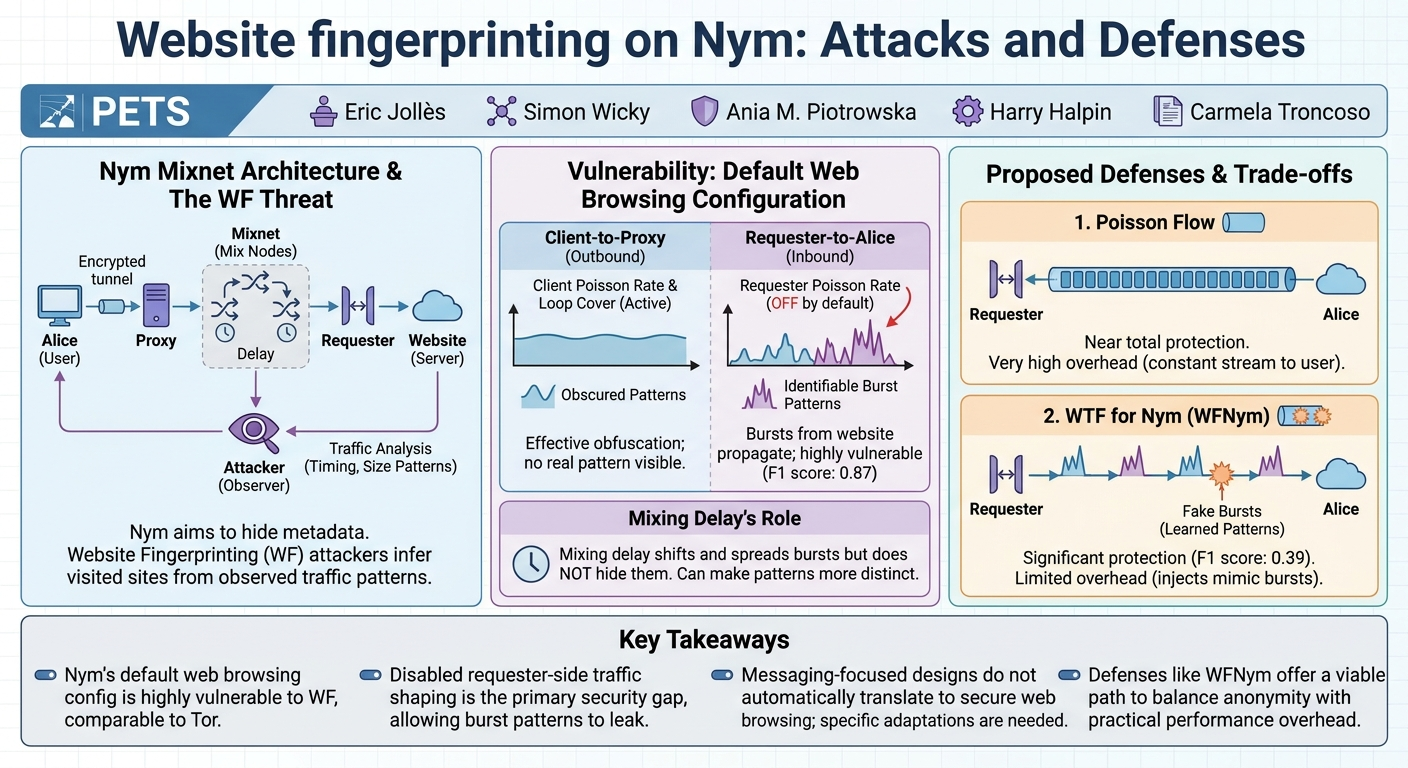
Nym's architecture for web browsing involves Alice sending packets to a proxy, which then forwards them through a mixnet consisting of three mix nodes. These mix nodes are designed to shuffle and delay packets to break timing correlations. After traversing the mixnet, packets reach a requester, which then directs the request to the target website in the clear. Responses from the website follow the reverse path: website -> requester -> mixnet -> proxy -> Alice.
To protect against traffic analysis, Nym employs four primary obfuscation mechanisms:
- Mixing Delay: At each of the three mix nodes, packets are held for a random amount of time, with a default average delay of approximately 50 milliseconds. The intent is to decouple incoming and outgoing packets from a mix node, making it difficult for an observer to link them and trace a flow.
- Loop Cover Traffic: Alice's client continuously generates and sends "cover traffic" to herself through the mixnet as a background process. These packets are sent at a steady rate, typically separated by about 200 milliseconds, creating a constant stream of noise intended to obscure periods of genuine activity.
- Client Poisson Rate: When Alice has actual data packets (e.g., HTTP requests) to send, her client sends them at a steady rate, by default every 20 milliseconds. If there are no real packets, the client sends loop cover traffic instead. This mechanism aims to smooth out the timing patterns of real requests and hide when Alice is truly active versus inactive.
- Requester Poisson Rate: This mechanism mirrors the client-side Poisson rate but operates on the return path, from the requester to Alice. Its purpose is to ensure that packets arriving from the browser are sent to Alice at a steady rate, preventing bursts from the website from directly translating into observable patterns at the edge of the mixnet. Crucially, as highlighted in the talk, this mechanism is off by default in Nym's current implementation for web browsing. The rationale behind this decision is the significant cost and network flooding associated with maintaining a dedicated constant-rate link for every user through the mixnet. This default configuration proves to be the Achilles' heel for Nym's web browsing anonymity.
The interplay of these mechanisms, particularly the default state of the requester Poisson rate, forms the core of the investigation into Nym's website fingerprinting vulnerability.
Key Findings
▶ Watch: Nym's vulnerability: Identifiable burst patterns (4:00)
The research unequivocally demonstrates that Nym, in its default configuration for web browsing, is significantly vulnerable to website fingerprinting attacks. The primary culprit identified is the disabled requester Poisson rate, which leaves the return path from the website to Alice largely unprotected against timing analysis.
The investigation revealed stark differences in traffic patterns depending on the direction of flow:
- Client-to-Proxy Traffic: The client Poisson rate and loop cover traffic mechanisms effectively obscure Alice's outbound activity. An adversary observing the link between Alice and her proxy would see "no real pattern," indicating that the cover traffic is performing its intended function well on this segment.
- Requester-to-Alice Traffic: This is where the vulnerability becomes apparent. When Alice browses a website, the browser typically sends bursts of data back to the requester. Because the requester Poisson rate is off by default, these bursts are not smoothed out. Instead, they are simply delayed and spread by the mixing delay as they traverse the mixnet. The critical finding is that while the mixing delay shifts and slightly spreads the bursts, the underlying bursty pattern remains identifiable.
The effectiveness of the website fingerprinting attack against Nym's default configuration was quantified using the F1 score, a common metric for classification model performance. The attack achieved an F1 score of 0.87, which is remarkably high. To put this into perspective, the researchers reported that in their captures, a similar WF attack against Tor yields an F1 score close to 0.95. This indicates that Nym's default web browsing configuration offers only marginally better protection against WF than Tor, despite Nym's significantly higher inherent bandwidth overhead. This high overhead for minimal anonymity gain is a critical concern.
Further analysis explored the impact of individual mechanisms:
- Mixing Delay: The study found that mixing delay alone does not effectively prevent website fingerprinting. Its primary effect is to shift and spread traffic bursts, but the characteristic patterns persist. Surprisingly, the research revealed that increasing the mixing delay could even be detrimental. Larger delays tend to separate bursts further in time, making them more distinct and, paradoxically, "more identifiable by the machine learning model." This leads to a counterintuitive outcome where a small mixing delay provided better defense than a larger one when other cover traffic mechanisms were removed.
- Requester Poisson Rate (Enabled): When the requester Poisson rate was explicitly enabled, the F1 score for the WF attack improved to 0.75. While this represents a noticeable improvement over the default 0.87, it is still not as robust as some dedicated Tor defenses. Furthermore, enabling this mechanism comes with a "very high bandwidth and latency overhead." The reason for its limited effectiveness, even when enabled, is that the cover traffic generated by the requester is typically looped back to the requester itself and does not reach Alice. Consequently, an adversary positioned between Alice and her proxy would still observe only the real traffic, enabling classification.
In summary, the key findings highlight a significant gap between Nym's design intentions for messaging and its practical security for web browsing. The default disabling of requester-side traffic shaping creates a direct channel for website fingerprinting, and even enabling it partially fails due to the cover traffic not reaching the user.
Technical Deep Dive
▶ Watch: Mixing delay's unexpected detrimental effect on defense (6:00)
The vulnerability of Nym to website fingerprinting, as identified by this research, stems from a critical architectural choice and the inherent characteristics of web traffic. To understand this, we must delve deeper into Nym's packet flow and the precise operation (or non-operation) of its obfuscation mechanisms.
When Alice browses the internet through Nym, her request follows a path: Alice → Nym Client → Proxy → Mixnet (three mix nodes) → Requester → Target Website. The response flows in reverse: Target Website → Requester → Mixnet → Proxy → Nym Client → Alice.
Nym's strength lies in its layered encryption and the mixing operations performed by the mix nodes. Each packet is encrypted multiple times, with each layer deciphered by a subsequent mix node. The mixing delay mechanism is designed to break temporal correlations: a packet entering a mix node will wait for a random duration (default ~50ms) before being forwarded. This makes it difficult for an observer to link an incoming packet to an outgoing one from a specific mix node.
On the client side, Nym implements two crucial mechanisms:
- Loop Cover Traffic: Alice's client constantly sends dummy packets to itself through the mixnet, at a relatively steady rate (e.g., every 200ms). This generates background noise, ensuring that the link between Alice and her proxy is always active, even when she's not actively browsing. This makes it harder for an adversary to detect periods of true inactivity or activity based on simple presence/absence of traffic.
- Client Poisson Rate: When Alice generates real traffic (e.g., an HTTP request), her client injects these packets into the outbound stream at a steady rate (e.g., every 20ms). If there are no real packets to send, the client substitutes them with loop cover traffic. This smooths out the burstiness of Alice's outbound requests, making the client-to-proxy link appear as a constant, uniform stream of traffic. The research confirms that these client-side mechanisms are quite effective, as the "number of packets sent per second" from Alice to the proxy shows "no real pattern."
The critical failure point, however, occurs on the return path, specifically at the Requester. Web browsers often receive data in bursts (e.g., loading images, scripts, or large content). These bursts are sent from the target website to the Requester. Nym's design includes a Requester Poisson Rate mechanism, intended to smooth out these inbound bursts by sending packets to Alice at a constant rate, similar to the client-side mechanism. However, this mechanism is off by default.
The implications of the disabled Requester Poisson Rate are profound:
- Direct Burst Propagation: Without the Requester Poisson Rate, the bursts of packets arriving from the website at the Requester are not buffered or smoothed. They are immediately forwarded into the mixnet.
- Mixing Delay's Limitations: While the packets still traverse the mixnet and experience the mixing delay, this delay primarily acts as a temporal shift and a spreading effect. A burst of 10 packets arriving close together will still exit the mixnet as a burst of 10 packets, albeit slightly delayed and with their inter-arrival times slightly randomized. The overall "shape" or "signature" of the burst remains largely intact. The presentation explicitly states, "we'll have the same burst but shifted and spread it out. And we can see that there is still like a pattern that exist."
- Adversary's View: An adversary observing the traffic between the Nym proxy and Alice (or even the mixnet entry/exit points if they have broader visibility) can analyze these characteristic bursts. Machine learning models can be trained to recognize these burst patterns associated with different websites. The high F1 score of 0.87 for the attack on this return path confirms the effectiveness of this observation.
- Detrimental Mixing Delay: The research even noted that a larger mixing delay could be detrimental. If bursts are already distinct, spreading them out further in time with a larger delay can make their individual characteristics even more pronounced and easier for a machine learning model to distinguish, rather than merging them into an indistinguishable flow.
When the Requester Poisson Rate was manually enabled, the F1 score dropped to 0.75, an improvement, but still susceptible. The reason for this partial effectiveness is that the cover traffic generated by the Requester often loops back to the Requester itself and does not reach Alice. Therefore, the adversary observing the Alice-to-proxy link still sees only the real data packets (albeit rate-limited by the Requester), allowing for classification. For full protection, the cover traffic would need to be sent all the way to Alice, essentially flooding her connection with dummy data.
This deep dive reveals that Nym's strength in obfuscating client-side traffic is undermined by a critical vulnerability on the return path, allowing the distinct burst patterns of web browsing to leak through, enabling effective website fingerprinting.
Demo / Proof of Concept
▶ Watch: Proposed defense: WTF for Nym (low overhead) (8:00)
The talk does not describe a live demonstration of the website fingerprinting attack or a specific tool used in a real-time setting. Instead, the "Proof of Concept" aspect is presented through the empirical results obtained from their research. The methodology involved:
- Traffic Capture: The researchers captured network traffic generated by Alice browsing various websites through the Nym mixnet under different configurations (e.g., default settings, with requester Poisson rate enabled, with proposed defenses).
- Feature Extraction: From the captured packet traces, features related to timing, size, and direction of packets were extracted. These features form the basis for website fingerprinting.
- Machine Learning Model Training: A machine learning model (likely a classifier commonly used in WF research, such as a Support Vector Machine or Deep Learning model) was trained on a dataset of known website traffic patterns.
- Attack Evaluation: The trained model was then used to classify unknown traffic traces, and its performance was evaluated using metrics like the F1 score.
The F1 scores of 0.87 for the default Nym configuration, 0.75 for Nym with the requester Poisson rate enabled, and 0.39 for one of the proposed defenses (WTF for Nym) serve as the concrete proof of concept. These numerical results demonstrate the attack's feasibility and effectiveness against Nym's current design and quantify the improvements offered by the proposed countermeasures. The visual representation of traffic patterns, showing distinct bursts on the requester-to-Alice link versus the obscured patterns on the Alice-to-proxy link, further illustrates the mechanism of the attack.
Defensive Implications
▶ Watch: Conclusion: Nym's limitations and effective adapted defenses (8:40)
The findings of this research carry significant implications for the Nym mixnet, particularly for its aspirations as a robust anonymity solution for web browsing. The primary takeaway is that Nym's default configuration is inadequate for protecting against website fingerprinting, necessitating immediate and well-engineered defensive measures.
The research proposes two main categories of defenses, each with different trade-offs in terms of protection and overhead:
- Poisson Flow: This defense involves a modification to the requester Poisson rate mechanism. Instead of the requester's cover traffic looping back to itself, it is now designed to reach Alice. This ensures that the entire path from the requester to Alice maintains a constant, steady flow of packets, effectively hiding real traffic within a continuous stream of cover traffic.
- Protection Level: This approach offers "near total protection" against website fingerprinting, as the adversary observing the Alice-to-proxy link would see a truly uniform packet stream, making it impossible to discern real traffic patterns.
- Overhead: The significant drawback is the "very high overhead." This is "higher than vanilla Nym," which already incurs substantial bandwidth costs. Sending a constant stream of cover traffic to every active user can quickly become resource-intensive for the mixnet and the users' connections, potentially impacting scalability and usability.
- WTF for Nym (WFNym): Inspired by existing defenses like WTF-PAD for Tor, this defense focuses on manipulating the traffic patterns to confuse the adversary. Instead of simply generating constant cover traffic, WFNym injects "fake bursts" into the traffic stream. These fake bursts are "learned from real burst patterns," meaning they are designed to mimic the statistical properties of actual website traffic bursts.
- Protection Level: WFNym achieves a significantly lower F1 score of 0.39, indicating a substantial reduction in the effectiveness of website fingerprinting attacks. This level of protection is a marked improvement over Nym's default (0.87 F1) and even over the enabled requester Poisson rate (0.75 F1).
- Overhead: This defense offers a much more "limited" bandwidth overhead compared to Poisson flow. By strategically adding fake bursts rather than maintaining a constant high-rate stream, WFNym provides a more efficient balance between anonymity and resource consumption.
For Nym developers and operators, the implications are clear:
- Prioritize Requester-Side Protection: The current default state of the requester Poisson rate is a critical vulnerability. Developers must either enable and properly implement this mechanism so that cover traffic reaches the user, or integrate alternative burst-shaping defenses like WFNym.
- Balance Anonymity and Performance: The choice between Poisson flow and WFNym depends on the desired level of anonymity and acceptable overhead. For scenarios demanding the absolute highest level of protection, Poisson flow might be considered, but WFNym offers a more practical and scalable solution for general web browsing.
- Re-evaluate Design for Web Browsing: The research underscores that Nym's original design for messaging does not directly translate to robust web browsing anonymity. Specific adaptations and a re-evaluation of default configurations are necessary to achieve the promised metadata privacy for web traffic.
For users of Nym, the defensive implications are:
- Be Aware of Current Limitations: Understand that Nym, in its default state, is vulnerable to website fingerprinting. Users seeking strong anonymity for web browsing should be aware that their traffic patterns might still be discernible.
- Advocate for Stronger Defaults: As Nym evolves, users should advocate for the integration and default activation of robust defenses like WFNym to ensure out-of-the-box protection.
In conclusion, Nym must integrate sophisticated, web-browsing-specific traffic shaping mechanisms on the return path to effectively counter website fingerprinting. WFNym appears to be a promising candidate, offering a significant boost in anonymity with manageable overhead.
Key Takeaways
- Nym's Default Configuration is Vulnerable: Despite its advanced mixnet architecture, Nym's default settings for web browsing are highly susceptible to website fingerprinting attacks, achieving an F1 score of 0.87, comparable to reported vulnerabilities in Tor.
- Requester-Side Traffic is the Achilles' Heel: The primary cause of this vulnerability is the default disabling of the requester Poisson rate, which allows bursts of traffic from websites to pass through the mixnet with their characteristic patterns largely intact, only shifted and spread by mixing delays.
- Mixing Delay Alone is Insufficient: The mixing delay mechanism, while important for unlinkability, does not effectively prevent website fingerprinting. In some cases, larger mixing delays can even be detrimental by making traffic bursts more distinct and identifiable to machine learning models.
- Partial Defenses Have Limitations: Enabling the requester Poisson rate improves protection (F1 score of 0.75) but still incurs high overhead and is not fully effective because the cover traffic often does not reach the user, leaving the Alice-to-proxy link vulnerable to observation.
- Effective Defenses Exist: Two proposed defenses, Poisson flow and WTF for Nym (WFNym), offer significantly enhanced protection. Poisson flow provides near-total protection but with very high overhead, while WFNym reduces the F1 score to 0.39 with more limited and practical bandwidth overhead.
- Messaging Design Doesn't Translate Directly: Nym's original design for robust messaging privacy does not automatically translate into secure web browsing. Specific, web-traffic-aware adaptations and configurations are essential to deliver on its promise of metadata privacy for general internet use.
About the Speaker(s)
The research presented was a collaborative effort by a team of distinguished academics and industry experts. The talk was delivered by Eric Jollès, a paper author affiliated with EPFL (École Polytechnique Fédérale de Lausanne), a leading research institution. He presented the findings of this joint work.
Other key contributors and paper authors include Simon Wicky, Ania M. Piotrowska, and Harry Halpin, all representing Nym Technologies. Nym Technologies is at the forefront of developing the Nym mixnet, a decentralized infrastructure designed to protect metadata privacy. Their involvement underscores the practical relevance of this research to the ongoing development of the Nym platform.
Additionally, Carmela Troncoso, another paper author, is affiliated with both EPFL and MPI-SP (Max Planck Institute for Security and Privacy). Her dual affiliation highlights the strong academic foundation and interdisciplinary nature of this security research, combining expertise in privacy, security, and network systems.
Reviews
Dr. Zero (Offensive Security Researcher) — SOLID
Nym claims to be the next evolution in metadata privacy, but Jollès and the EPFL team proved the default web config leaks like a sieve. They didn't just run standard website fingerprinting; they isolated exactly how Nym's bandwidth trade-offs break the anonymity set. This is rigorous, counter-intuitive research that forces a platform to face its own architectural reality.
Heather Calloway (CISO) — WEAK
A rigorous reality check on the privacy claims surrounding the Nym mixnet. Worth forwarding to your threat intel or executive protection teams if they are evaluating next-generation anonymity networks, but otherwise too niche for general leadership.
→ Top-rated talks at Privacy Enhancing Technologies Symposium (PETS) 2026
All talks from Privacy Enhancing Technologies Symposium (PETS) 2026