Humanitarian Aid Distribution with Privacy-Preserving Assessment Capabilities
Christian Knabenhans (Paper author · EPFL), Lucy Qin (Paper author · Georgetown), Justinas Sukaitis (Paper author · ICRC), Vincent Graf Narbel (Paper author · ICRC), Carmela Troncoso (Paper author · MPI-SP,EPFL)
Privacy Enhancing Technologies Symposium (PETS) 2026 · Day 3 · Beaver
Overview
The digital transformation of humanitarian aid distribution promises increased efficiency and accountability, yet it introduces significant privacy and security challenges, particularly in unstable and high-risk environments. This talk, presented by Christian Knabenhans from EPFL, alongside co-authors from Georgetown, the International Committee of the Red Cross (ICRC), and MPI-SP, addresses a critical gap in existing privacy-preserving protocols for aid distribution: the inability to conduct necessary post-distribution assessments. While current privacy-enhancing technologies (PETs) excel at protecting recipient data during the aid distribution process, they often render the outcomes opaque, preventing humanitarian organizations from verifying success, identifying vulnerable populations, or ensuring non-discrimination.
Key moments
- 0:00 Introduction and problem: assessing privacy-preserving aid.
- 2:00 Defining simple and complex assessment types.
- 2:40 Challenging deployment constraints and speed requirements.
- 4:00 Agility and graceful degradation meta-requirements.
- 5:00 One-time functional encryption for restricted evaluation.
- 6:30 Physical auditor certifies inputs for accountability.
- 7:30 Practical efficiency results for low-end devices.
Humanitarian Aid Distribution with Privacy-Preserving Assessment Capabilities
Speakers: Christian Knabenhans (Paper author, EPFL), Lucy Qin (Paper author, Georgetown), Justinas Sukaitis (Paper author, ICRC), Vincent Graf Narbel (Paper author, ICRC), Carmela Troncoso (Paper author, MPI-SP, EPFL)
Conference: PETS
YouTube: https://www.youtube.com/watch?v=9-HMigalohI
Overview
The digital transformation of humanitarian aid distribution promises increased efficiency and accountability, yet it introduces significant privacy and security challenges, particularly in unstable and high-risk environments. This talk, presented by Christian Knabenhans from EPFL, alongside co-authors from Georgetown, the International Committee of the Red Cross (ICRC), and MPI-SP, addresses a critical gap in existing privacy-preserving protocols for aid distribution: the inability to conduct necessary post-distribution assessments. While current privacy-enhancing technologies (PETs) excel at protecting recipient data during the aid distribution process, they often render the outcomes opaque, preventing humanitarian organizations from verifying success, identifying vulnerable populations, or ensuring non-discrimination.
The research presented here introduces a novel framework that integrates robust assessment capabilities into privacy-preserving aid distribution protocols without compromising the sensitive data of recipients. This work directly responds to a practical need articulated by organizations like the ICRC, who require the means to audit their operations and fulfill their "duty of care" responsibilities, even as they embrace digitalization. The proposed solution is designed to operate within the severe operational constraints of humanitarian contexts, including limited computing power, intermittent connectivity, and low-end recipient devices, while maintaining critical speed to minimize risk to both aid workers and recipients.
The core contribution lies in the development of a system that leverages one-time functional encryption (OTFE) and predicate one-time functional encryption (POTFE), combined with a physical world auditor, to enable specific, pre-defined assessments. This allows organizations to answer vital questions – such as the percentage of a specific demographic receiving aid or identifying individuals who haven't claimed aid over multiple periods – without revealing individual-level sensitive information. Furthermore, the protocol incorporates crucial "meta-requirements" of agility and graceful degradation, enabling it to adapt to rapidly changing threat models inherent in humanitarian operations, thereby enhancing the resilience and trustworthiness of digital aid systems.
Background
▶ Watch: Introduction and problem: assessing privacy-preserving aid. (0:00)
Historically, humanitarian aid distribution has been a labor-intensive and manual process, often leading to inefficiencies, errors, and significant operational costs. The global push towards digitalizing these operations aims to streamline aid delivery, improve record-keeping, and enhance accountability. However, this digitalization introduces substantial risks, particularly given the highly sensitive nature of recipient data (e.g., health status, displacement history, financial situation) and the often volatile, unstable contexts in which aid is deployed (e.g., conflict zones, natural disaster areas). Early efforts in privacy-preserving aid distribution have focused on developing protocols that ensure recipients can claim aid without revealing unnecessary personal information, achieving what the speaker terms "optimal privacy."
The critical challenge identified by organizations like the ICRC, and addressed by this research, is that these "optimal privacy" protocols, while effective at protecting individual data, often create an impenetrable veil over the entire distribution process. This opacity prevents humanitarian agencies from conducting essential assessments crucial for their mission. These assessments fall into two main categories:
- Simple Assessments: These are aggregate statistics, such as "What percentage of pregnant aid recipients were able to successfully claim aid in this distribution?" Such questions are vital for evaluating the reach and effectiveness of aid programs and ensuring they meet the needs of specific vulnerable groups.
- Complex Assessments: These involve more intricate queries, often spanning multiple distribution periods or targeting specific individuals for follow-up. An example given is: "What is the contact information of all recipients that are above the age of 60 and also haven't been claiming aid in the last three periods?" These assessments are critical for "duty of care" responsibilities, allowing organizations to check on at-risk individuals who may have fallen through the cracks. The need to identify individuals who didn't show up, or to track behavior across multiple periods, highlights the limitations of simple, single-period, aggregate privacy solutions.
The operational environment for aid distribution imposes severe constraints that significantly influence protocol design. Registration and distribution stations typically operate with limited computing power, perhaps an old laptop, and limited connectivity, relying on intermittent satellite connections. Recipients themselves often possess very low-end devices, such as old mobile phones, or may have no personal computing device at all, instead being issued smart cards with tiny CPUs by the ICRC. Crucially, recipients are not expected to have any network connectivity, necessitating physical interaction with stations via technologies like NFC or Bluetooth to exchange information. Furthermore, speed is paramount. Any additional minute spent on cryptographic computations during aid distribution directly translates to increased risk for recipients and staff in potentially dangerous or uncertain situations, such as disaster zones or active conflict areas. Therefore, the system must not slow down the physical aid distribution process.
The threat model assumes recipients are honest for assessment purposes but may be corrupted up to a certain threshold in general. The registration station is modeled as honest but curious, representing a relatively stable, one-time setup. Distribution stations, however, might be semi-honest or malicious, depending on the fluctuating security situation on the ground. The desired guarantees for assessments are unforgeability (accurately reflecting ground truth) and privacy (the output party learns only the assessment, nothing else about recipients).
Beyond these standard security and privacy guarantees, the research introduces two critical meta-requirements specific to humanitarian action:
- Agility: Aid operations are highly dynamic. A deployed protocol must be able to adapt quickly if the threat model changes (e.g., an armed militia takes over a station). This means having mechanisms to either strengthen the protocol or safely shut it down without catastrophic data loss.
- Graceful Degradation: In the interim period, before agility measures can be fully implemented, the system should not catastrophically fail and leak all sensitive information. The potential leakage and harm under stronger, un-anticipated threat models must be bounded and acceptable, ensuring a controlled failure rather than a complete collapse of privacy. These meta-requirements underscore the practical, real-world focus of the research, acknowledging the inherent unpredictability of humanitarian contexts.
Key Findings
▶ Watch: Challenging deployment constraints and speed requirements. (2:40)
The central contribution of this research is the successful integration of robust assessment capabilities into privacy-preserving humanitarian aid distribution protocols, addressing a critical unmet need for organizations like the ICRC. The key findings and contributions are multifaceted, spanning cryptographic primitives, system design, and practical deployment considerations:
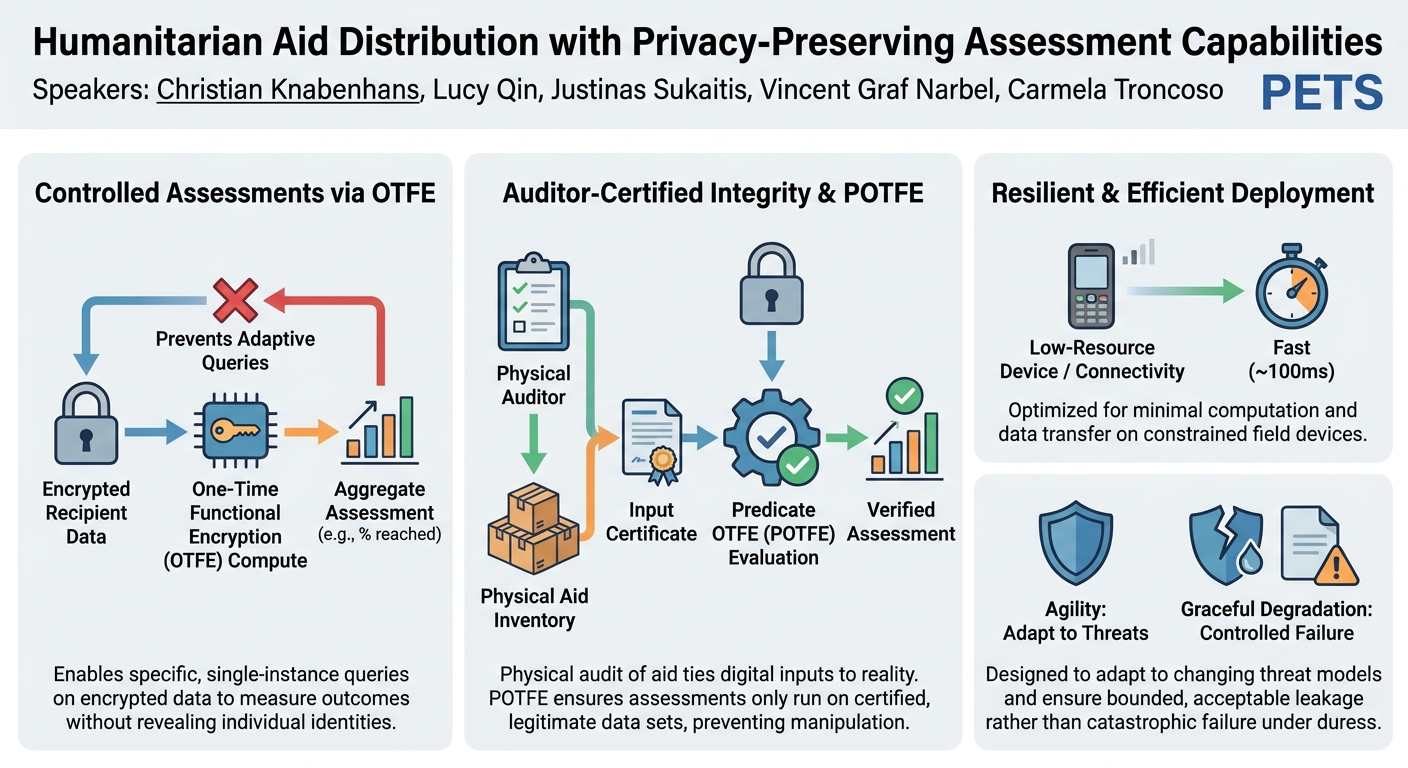
First, the talk highlights the inherent limitation of standard functional encryption (FE) in sensitive contexts. While FE allows computation over encrypted data, an adversary with the secret key could query the function multiple times or on specific subsets of data, potentially revealing more than just the desired aggregate assessment. To counter this, the authors introduce and formalize the concept of one-time functional encryption (OTFE). This primitive restricts the evaluation of a function to a single instance for a given context (e.g., one assessment per distribution period), thereby preventing adaptive queries that could compromise privacy.
Second, the system addresses the challenge of ensuring the integrity of the data input to the assessment. Even with OTFE, an adversary could manipulate the set of ciphertexts provided for evaluation, leading to a biased or incorrect assessment. The solution ingeniously leverages the role of a physical auditor, a party already present in traditional aid distribution for verifying physical inventory. This auditor acts as an "oracle" connecting the digital protocol to the physical world. By requiring the distribution station to submit its chosen input set to the auditor for certification against physical records, the system ensures that the digital assessment accurately reflects the physically distributed aid.
Third, building on OTFE and the auditor's role, the research develops predicate one-time functional encryption (POTFE). This advanced primitive combines the one-time evaluation property with a predicate that validates the input set's certificate, issued by the auditor. This means an assessment can only be computed once, and only if the underlying data set has been physically verified as legitimate. This critical innovation binds the privacy-preserving digital assessment directly to the tangible reality of aid distribution, preventing digital manipulation.
Fourth, the research demonstrates the practicality and efficiency of the proposed system under stringent operational constraints. Performance metrics reveal that the protocol requires minimal data transfer (only a few hundred bytes at most) and very low computational overhead (around 100 milliseconds on a low-end phone) during the critical aid distribution phase. This speed is crucial for minimizing risk to recipients and staff in precarious environments, directly addressing one of the most challenging deployment requirements.
Finally, the talk introduces and integrates two vital meta-requirements for real-world humanitarian systems: agility and graceful degradation. Agility ensures the system can adapt to evolving threat models, allowing for secure protocol strengthening or safe shutdown. Graceful degradation guarantees that if unexpected threat model violations occur, the system fails in a controlled manner, with bounded and acceptable privacy leakage, rather than a catastrophic collapse. These meta-requirements transform the protocol from a theoretical construct into a resilient, deployable solution tailored for the unpredictable nature of humanitarian work.
Technical Deep Dive
▶ Watch: Agility and graceful degradation meta-requirements. (4:00)
The technical foundation of this privacy-preserving assessment system begins by acknowledging the limitations of standard functional encryption (FE) in the specific context of humanitarian aid. In a typical FE scheme, a key generation algorithm produces a secret key for a function F (e.g., an assessment function) and a public key. Recipients encrypt their sensitive information using the public key, producing ciphertexts. An evaluation function, using the secret key and a collection of these ciphertexts, then computes the result of F on the underlying plaintext data. The inherent flaw for privacy-preserving assessments is that the party holding the secret key (the adversary in a semi-honest model, or the distribution station) is not constrained in how they evaluate. They could perform multiple evaluations, select specific subsets of ciphertexts, or even evaluate on a single ciphertext. This adaptive querying capability allows an attacker to learn far more than the intended aggregate assessment, fundamentally undermining privacy.
To address this, the authors introduce one-time functional encryption (OTFE). The core idea behind OTFE is to enforce that the assessment function F can be evaluated only once for a given context, such as a specific distribution period. If an attempt is made to evaluate it a second time, the primitive returns nothing. This stateful property means that OTFE cannot be achieved solely with "pure traditional crypto"; it requires an additional component to maintain and track state. In their proposed architecture, this role is fulfilled by a helper party. While the speaker acknowledges that the helper might appear to be "pulled out of thin air," they emphasize that it represents a very reasonable and practical deployment setting for organizations like the ICRC, with further details available in their poster. The cryptographic primitives underlying the semi-honest construction of OTFE are standard and lightweight, including public encryption, signatures, and either secret sharing or lightweight threshold homomorphic encryption. These choices are crucial for meeting the stringent computational and connectivity constraints of the humanitarian context.
However, even with OTFE preventing multiple evaluations, a potential vulnerability remains: an adversary (e.g., a malicious distribution station) could still choose which set of ciphertexts to evaluate. This could lead to a skewed assessment or, in an extreme case, selecting a single ciphertext to attempt to deduce individual information. To mitigate this, the system integrates a crucial link to the physical world through an auditor. This auditor is an existing entity in humanitarian operations, responsible for verifying physical aid amounts. The mechanism works as follows:
- The distribution station, before performing an assessment, selects the set of inputs (ciphertexts or commitments to them) that it intends to evaluate.
- It sends these inputs, along with associated metadata, to the auditor for certification.
- The auditor then performs an out-of-band verification, checking if the metadata (e.g., the number of aid packages, types of aid) is consistent with what is physically present on the ground (e.g., in the warehouse inventory).
- If the physical and digital records align, the auditor issues a certificate for that specific set of inputs.
This auditor-based certification process is then incorporated into a more advanced primitive: predicate one-time functional encryption (POTFE). POTFE extends OTFE by adding a condition: the evaluation function will only yield a result if it is called once and if the provided input set is accompanied by a valid certificate issued by the auditor. This effectively "ties back and binds" the digital assessment to the physical amount of aid distributed, ensuring that the assessment reflects genuine, audited activity. Like OTFE, POTFE also relies on a helper party and uses standard cryptographic primitives, ensuring its practicality.
The overall flow for an assessment would be:
- A central authority generates keys for the assessment function F.
- Recipients, during aid claims, encrypt their relevant personal data (e.g., pregnancy status, age) using the public key and store it on their smart cards or low-end devices.
- At the end of a distribution period, the distribution station collects the encrypted data from all relevant recipients.
- The station then selects the set of encrypted inputs for the desired assessment and sends commitments to these inputs, along with metadata, to the auditor.
- The auditor verifies the consistency of this metadata with physical records and issues a certificate.
- Finally, the distribution station (or an authorized party) uses the secret key for F, the collected encrypted data, and the auditor's certificate to perform a one-time evaluation using the POTFE scheme. This yields the desired assessment (e.g., the percentage of pregnant recipients) without revealing individual data, and only after the input set has been physically validated.
The talk highlights efficiency numbers, particularly for the operations that occur during the distribution phase (marked in yellow in their internal presentation). For both simple (e.g., pregnant recipients) and complex (e.g., contact info for specific non-claimants) assessments, the overhead is remarkably low: only a few hundred bytes of data are transmitted at most, and the computational cost on a low-end phone is around 100 milliseconds at most. This demonstrates that the cryptographic overhead is minimal and does not impede the critical speed requirements of aid distribution, making the system highly practical for its intended environment.
Demo / Proof of Concept
▶ Watch: Physical auditor certifies inputs for accountability. (6:30)
While the talk does not describe a live, interactive demonstration of the system, it provides compelling quantitative evidence that serves as a robust proof of concept for the practicality and efficiency of their proposed protocols. The speaker presents efficiency numbers directly derived from their implementation, focusing on the most critical phase: the actual aid distribution. This phase is paramount because any delay directly translates to increased risk for recipients and staff in potentially volatile environments.
The key metrics highlighted are:
- Data Transfer: The system requires the transfer of "a few hundred bytes at most." This minimal data footprint is crucial for environments with limited and intermittent connectivity, such as satellite links, and for low-end recipient devices.
- Computational Overhead: On a "very low-end phone," the cryptographic operations during distribution take "100 milliseconds at most." This sub-second processing time is vital for ensuring that the privacy-preserving mechanisms do not slow down the physical act of dispensing aid, directly addressing one of the most stringent deployment requirements.
The speaker emphasizes that these numbers apply to both simple assessment functions (e.g., counting pregnant recipients who claimed aid) and more complex ones (e.g., identifying contact information for elderly non-claimants across multiple periods). The consistency of low overhead across different assessment complexities underscores the scalability and robustness of their approach. The fact that these overheads are measured and validated against low-end device capabilities (like an old phone or a smart card CPU) strongly supports the claim that the system is "very, very practical" for real-world humanitarian deployment. This performance data, while not a visual demo, functions as a critical demonstration of the system's viability under severe operational constraints, proving that the integration of advanced privacy-preserving cryptography does not come at an unacceptable cost to speed or resource utilization.
Defensive Implications
▶ Watch: Practical efficiency results for low-end devices. (7:30)
The research presented in "Humanitarian Aid Distribution with Privacy-Preserving Assessment Capabilities" offers several critical defensive implications for humanitarian organizations, security architects, and privacy engineers working in sensitive, resource-constrained environments.
For humanitarian aid organizations and NGOs like the ICRC, the primary implication is the recognition that "optimal privacy" in aid distribution must be balanced with the need for accountability and assessment. Simply deploying systems that hide all data may protect individual privacy but can cripple an organization's ability to verify aid effectiveness, ensure non-discrimination, or fulfill duty-of-care obligations. Defenders should actively seek and adopt privacy-preserving protocols that explicitly integrate assessment capabilities, allowing for targeted, aggregate queries without exposing individual sensitive data. This means moving beyond basic anonymization or pseudonymization to more advanced cryptographic solutions like functional encryption.
Organizations must also prioritize systems designed with agility and graceful degradation in mind. Given the inherently unpredictable nature of humanitarian contexts (e.g., sudden changes in political stability, emergence of new armed groups), the threat model can shift rapidly. Defensive strategies must include:
- Contingency Planning: Protocols should have built-in mechanisms to quickly adapt to a strengthened adversary, either by switching to a more robust (though potentially less efficient) cryptographic mode or by safely shutting down operations to prevent mass data leakage.
- Risk Assessment and Bounded Leakage: Before deployment, organizations should conduct thorough risk assessments to understand the potential privacy leakage under various, even unexpected, threat models. The system should be designed to ensure this leakage is "bounded and acceptable," preventing catastrophic privacy failures. This requires a transparent understanding of the protocol's security guarantees under duress.
The integration of a physical auditor into the digital protocol is another crucial defensive strategy. This highlights the importance of connecting digital security measures with physical world realities. Defenders should:
- Hybrid Security Architectures: Design systems that leverage existing physical verification processes (like warehouse audits) to enhance the integrity and trustworthiness of digital data. This prevents manipulation of input sets for privacy-preserving computations and ensures that digital assessments reflect actual physical events.
- Trusted Parties: Carefully consider the role and trustworthiness of "helper" parties or auditors within the system. While these entities are necessary for stateful cryptographic primitives, their security and operational integrity are paramount for the overall system's robustness.
For security researchers and privacy engineers, this work underscores the need to develop practical, stateful cryptographic primitives optimized for low-resource environments. Future research should focus on:
- Efficiency: Continued development of cryptographic schemes that are highly efficient in terms of computation, communication, and storage, capable of running on low-end hardware (old laptops, smart cards) with intermittent connectivity.
- Real-world Applicability: Designing protocols that explicitly account for the operational realities and dynamic threat models of sensitive deployments, moving beyond idealized assumptions. The meta-requirements of agility and graceful degradation should become standard considerations in protocol design for such contexts.
- Auditable PETs: Further exploration of how to make privacy-enhancing technologies (PETs) more auditable and accountable without sacrificing their core privacy guarantees. This involves innovative ways to link digital operations to physical world verification.
In essence, the defensive implication is a call for a more nuanced, context-aware approach to privacy in humanitarian aid, where robust technical controls are harmonized with operational realities, dynamic risk management, and existing physical world processes to achieve both strong privacy and essential accountability.
Key Takeaways
- Balancing Privacy and Assessment: Digital humanitarian aid requires a delicate balance between protecting sensitive recipient data and enabling essential assessments for accountability and duty of care, a gap current "optimal privacy" protocols often fail to address.
- One-Time Functional Encryption (OTFE) for Controlled Access: The research introduces and leverages one-time functional encryption (OTFE) as a foundational primitive to enable privacy-preserving assessments by strictly limiting cryptographic evaluations to a single instance per context, preventing adaptive attacks.
- Predicate One-Time Functional Encryption (POTFE) with Physical Audit: The system employs predicate one-time functional encryption (POTFE), integrating a physical auditor to certify assessment input sets, thereby binding digital assessments to real-world aid distribution and preventing data manipulation.
- Practicality in Resource-Constrained Environments: The proposed protocols are highly efficient, requiring minimal data transfer (hundreds of bytes) and low computational overhead (around 100 milliseconds on low-end devices), making them practical for deployment in humanitarian settings with limited resources and connectivity.
- Agility and Graceful Degradation are Critical Meta-Requirements: Beyond standard security, the system incorporates agility (ability to adapt to changing threat models) and graceful degradation (controlled, bounded leakage during unexpected threat model violations), crucial for resilience in dynamic and unpredictable humanitarian contexts.
- Hybrid Approach to Security: The work demonstrates the power of a hybrid security architecture that combines advanced cryptography with physical verification mechanisms, enhancing both privacy and integrity in real-world applications.
About the Speaker(s)
The research presented is a collaborative effort by a distinguished team of academics and practitioners. Christian Knabenhans, a PhD student at EPFL, was the primary presenter of this work, showcasing his expertise in privacy-preserving technologies. He collaborated with Lucy Qin from Georgetown University, contributing academic insights to the project. Representing the practical, on-the-ground perspective of humanitarian aid were Justinas Sukaitis and Vincent Graf Narbel, both from the International Committee of the Red Cross (ICRC), whose real-world requirements and operational constraints heavily influenced the protocol design. Finally, Carmela Troncoso, affiliated with both MPI-SP and EPFL, brought her significant expertise in privacy engineering and cryptographic research to the team, guiding the theoretical and practical development of the privacy-preserving assessment capabilities. This interdisciplinary collaboration between leading academic institutions and a major humanitarian organization underscores the practical relevance and robust theoretical underpinnings of the work.
Reviews
Dr. Zero (Offensive Security Researcher) — MUST SEE
Knabenhans and the ICRC crew actually solved a brutal privacy paradox: how to audit aid distribution in a warzone without turning the database into a targeting list. They didn't just invent new cryptographic primitives with OTFE and POTFE; they proved they could make them run in 100 milliseconds on absolute garbage hardware. This is exactly what applied cryptography is supposed to look like.
Heather Calloway (CISO) — SOLID
This research solves the core conflict between privacy-enhancing technologies and institutional audit requirements. By binding cryptographic assessments to a physical-world auditor, the authors deliver a viable path for deploying zero-knowledge systems without losing operational oversight. It is a necessary watch for any enterprise struggling to balance strict data minimization with compliance reporting.
→ Top-rated talks at Privacy Enhancing Technologies Symposium (PETS) 2026
All talks from Privacy Enhancing Technologies Symposium (PETS) 2026