Between a Rock and a Hard Place: Examining Public Understanding and Perceptions of Data Practices in Smart Cities
Wejdan Alsarih (Paper author · University of Bristol), Inah Omoronyia (Paper author · University of Bristol), Kopo Marvin Ramokapane (Paper author · University of Bristol)
Privacy Enhancing Technologies Symposium (PETS) 2026 · Day 3 · Beaver
Overview
In an era defined by rapid technological advancement and urban transformation, smart cities promise a future of enhanced quality of life, sustainability, and efficiency through the pervasive integration of digital technologies and data-driven services. However, this vision inherently relies on the extensive collection and processing of vast amounts of personal data from citizens. The talk "Between a Rock and a Hard Place: Examining Public Understanding and Perceptions of Data Practices in Smart Cities," presented by Wejdan Alsarih from the University of Bristol, along with colleagues Inah Omoronyia and Kopo Marvin Ramokapane, delves into the critical, yet often overlooked, human element of this technological paradigm.
Key moments
- 0:00 Introduction: The smart city data dilemma
- 2:00 Defining the three core research questions
- 2:40 Methodology: Bottom-up vs. top-down smart cities
- 4:00 Finding 1: Fragmented understanding of smart cities
- 4:30 Finding 2: Conditional data acceptance and cultural trust
- 6:00 Finding 3: Low data control and absent consent
- 6:35 Implications: Improving transparency and awareness campaigns
Between a Rock and a Hard Place: Examining Public Understanding and Perceptions of Data Practices in Smart Cities
Speakers: Wejdan Alsarih (Paper author, University of Bristol); Inah Omoronyia (Paper author, University of Bristol); Kopo Marvin Ramokapane (Paper author, University of Bristol)
Conference: PETS
YouTube: https://www.youtube.com/watch?v=5DGPhDC5w8Y
Overview
In an era defined by rapid technological advancement and urban transformation, smart cities promise a future of enhanced quality of life, sustainability, and efficiency through the pervasive integration of digital technologies and data-driven services. However, this vision inherently relies on the extensive collection and processing of vast amounts of personal data from citizens. The talk "Between a Rock and a Hard Place: Examining Public Understanding and Perceptions of Data Practices in Smart Cities," presented by Wejdan Alsarih from the University of Bristol, along with colleagues Inah Omoronyia and Kopo Marvin Ramokapane, delves into the critical, yet often overlooked, human element of this technological paradigm.
The research presented highlights a fundamental tension: citizens are caught "between a benefit and the risk" – enjoying the promised advantages of smart city services while simultaneously confronting the inherent privacy risks associated with ubiquitous data collection and sharing. While much prior research has concentrated on the technological underpinnings, infrastructure, and security aspects of smart cities, there remains a significant void in understanding how the public perceives, comprehends, and engages with these complex data practices, particularly concerning their consent and control over their personal information. This talk addresses that gap, providing crucial insights into citizen perspectives that are indispensable for designing truly human-centric smart urban environments.
This article unpacks the key findings of their qualitative study, which investigates residents' understanding of smart cities, their perceptions of data collection and sharing, and their sense of control and consent over their data. The research underscores a fragmented public understanding, conditional acceptance of data practices, significant cultural variations in trust, and a pervasive feeling among citizens that they lack meaningful control and that their consent is often absent. These findings carry profound implications for policymakers, urban planners, and technology developers striving to build ethical, transparent, and trustworthy smart cities.
Background
▶ Watch: Introduction: The smart city data dilemma (0:00)
The concept of a smart city has gained considerable traction globally, envisioning urban centers that leverage digital technology, connected infrastructure, and data-driven services to enhance operational efficiency, improve public services, foster sustainability, and ultimately elevate the quality of life for their inhabitants. From intelligent traffic management systems and optimized energy grids to predictive policing and personalized public transport, the promises are extensive and transformative. However, the realization of these benefits is inextricably linked to the continuous and often granular collection of data from citizens residing within these urban ecosystems. This data can range from anonymized traffic flow patterns to highly personal information gathered through public Wi-Fi, CCTV cameras, environmental sensors, and smart meters.
This pervasive data collection creates a unique dilemma for citizens, placing them "between a rock and a hard place." On one side are the tangible benefits: improved safety, greater convenience, and more efficient resource allocation. On the other side are the inherent risks: potential privacy infringements, the misuse of personal data, and the erosion of individual autonomy. The decision to participate in a smart city, therefore, becomes a tacit acceptance of this trade-off, often without full comprehension of its implications.
Historically, academic and industry discourse surrounding smart cities has predominantly focused on the technological advancements required to build such environments. This includes research into Internet of Things (IoT) deployments, big data analytics platforms, cybersecurity protocols for critical infrastructure, and the development of innovative smart services. While these technical considerations are undoubtedly vital, they often overshadow the crucial human element: the citizens whose data fuels these systems. Prior studies have largely neglected the public's understanding, perceptions, and concerns regarding how their data is collected, processed, shared, and ultimately controlled within these increasingly data-intensive urban landscapes.
To address this critical knowledge gap, the researchers posed three foundational questions:
- How do residents understand the concept of smart cities? This question probes the mental models and general awareness citizens possess regarding the nature and scope of their smart urban environment.
- How do residents perceive and understand the collection, processing, and sharing of data in smart cities? This delves into their attitudes towards specific data practices, their awareness of data flows, and their comfort levels with different types of data usage.
- How do residents perceive their consent and control over their data in smart cities? This explores the mechanisms, or lack thereof, through which citizens believe they can manage, modify, or withdraw their personal data within smart city frameworks.
By exploring these questions, the study aims to provide a citizen-centric perspective, offering valuable insights that can inform the ethical development and governance of future smart cities, moving beyond a purely technological focus to one that prioritizes public trust and individual privacy.
Key Findings
▶ Watch: Methodology: Bottom-up vs. top-down smart cities (2:40)
The research employed a qualitative semi-structured interview methodology to gather in-depth insights from participants. The study was conducted across two distinct smart city contexts: Bristol in the United Kingdom and the King Abdullah Financial District (KAFD) in Saudi Arabia. Bristol was categorized as a bottom-up smart city, representing a traditional city that is progressively integrating smart technologies. In contrast, KAFD was classified as a top-down smart city, designed and built as a smart city from its inception, with integrated smart infrastructure from the planning phase. Participants, aged 18 or older and living or working in these smart cities, totaled 19 individuals: 8 from the UK and 11 from Saudi Arabia. Data analysis was performed using thematic analysis, with two independent coders reaching research saturation after eight participants, indicating robust data collection and analysis.
The study yielded several critical findings across its three research questions:
For Research Question 1: Understanding of Smart Cities
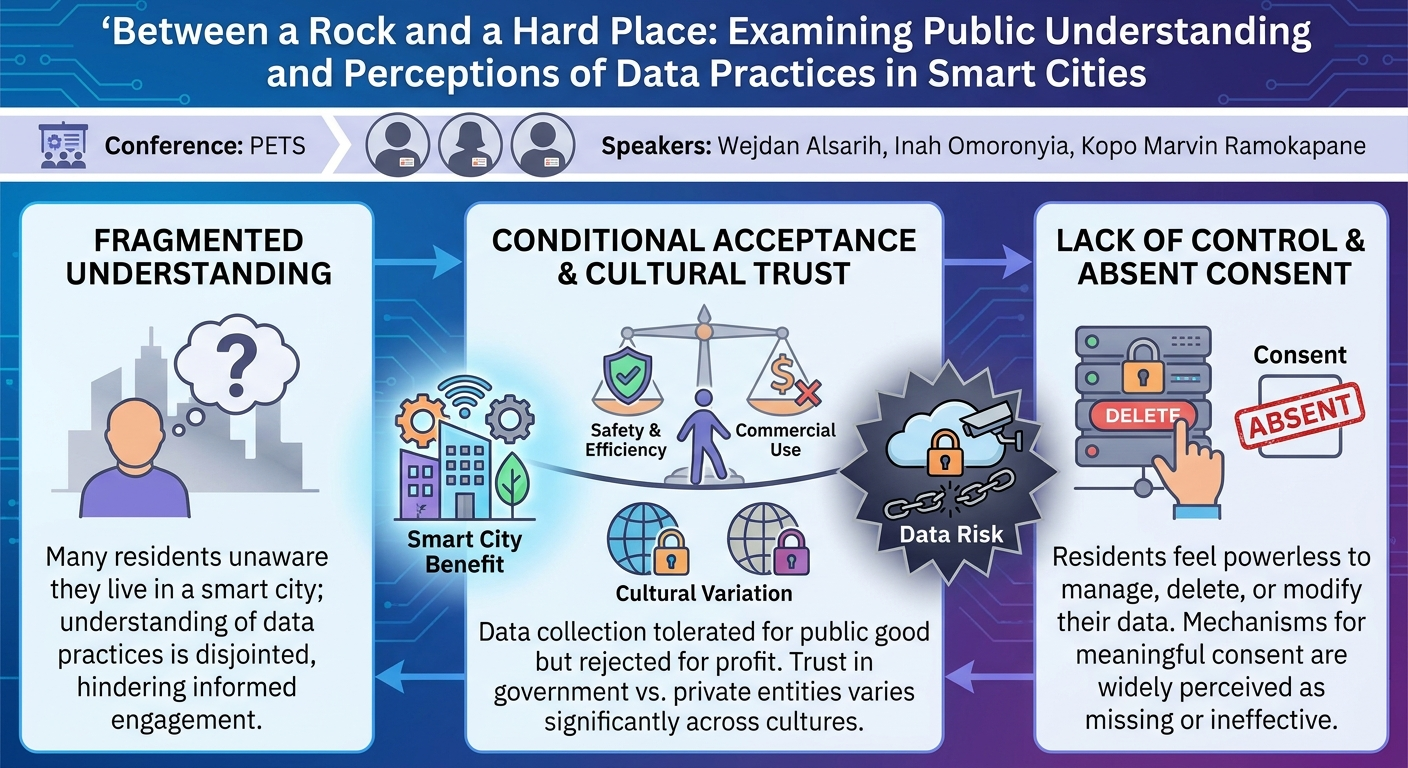
- Fragmented Understanding of Smart Cities: A pervasive finding was the lack of a coherent and consistent understanding of what constitutes a smart city among residents. Participants exhibited diverse mental models, with many unaware that they were even living or working in a designated smart city. This suggests a significant disconnect between the official narrative and citizen awareness, hindering informed engagement with smart city initiatives and data practices.
For Research Question 2: Perception of Data Collection, Processing, and Sharing
- Conditional Acceptance of Data Collection: Residents demonstrated a nuanced and conditional acceptance of data collection. Data collection was generally accepted when perceived to contribute to safety and efficiency (e.g., for emergency services, traffic management). However, there was strong resistance to data collection for commercial purposes. Participants explicitly stated a reluctance to share highly personal financial and health information. One participant articulated this sentiment, stating, "I wouldn't want to share how much money I make or um health stuff." Furthermore, family and women's data were frequently cited as particularly sensitive categories, underscoring specific cultural and social sensitivities.
- Cultural Differences in Trust: A notable divergence emerged in trust perceptions between the two study locations. Saudi Arabian participants generally expressed higher levels of trust in government entities for data collection and management. Conversely, UK participants exhibited a preference against sharing data with both government bodies and private companies. This finding highlights the profound influence of socio-political contexts and cultural norms on public trust in data custodians. In Saudi Arabia, the sensitivity surrounding gender and family privacy was particularly pronounced, with a participant noting, "Many girls and women don't want to be a photographer. Yes, it is a part of Saudi culture," illustrating the deep cultural roots of these privacy concerns.
For Research Question 3: Perception of Consent and Control over Data
- Low Sense of Control over Data: A widespread sentiment among residents was a profound lack of control over their data. Participants felt powerless to manage their personal information, specifically citing an inability to delete or modify their data once collected. This was encapsulated by a participant's remark: "we can't control that they they taken our keypads," suggesting a perception of passive data extraction without agency.
- Consent is Absent: Perhaps the most striking finding was the pervasive feeling that consent for data collection was largely absent or ineffective. The majority of participants felt they had not provided meaningful consent for the data practices occurring around them. As one participant bluntly stated, "Constant, I think it's quite absent." This indicates that current mechanisms for obtaining consent, if they exist, are failing to adequately inform or empower citizens, leading to a sense of being opted-in by default without genuine choice.
These findings collectively paint a picture of a populace that is largely uninformed about smart city data practices, selectively accepting of data collection based on perceived benefit and purpose, and critically, disempowered concerning their fundamental rights to privacy and data control.
Technical Deep Dive
▶ Watch: Finding 1: Fragmented understanding of smart cities (4:00)
While the talk focuses on user perceptions, the implications for the technical architecture and data governance of smart cities are profound. The findings directly challenge the assumptions often made by engineers and urban planners regarding citizen awareness, consent, and trust in data collection technologies and data processing pipelines.
The "fragmented understanding of smart cities" among residents underscores a significant gap in the mental model of how ubiquitous computing and IoT sensors operate. Smart cities rely on a vast array of data sources, including CCTV cameras, traffic sensors, environmental monitors, smart meters, public Wi-Fi networks, and even facial recognition systems. Each of these technologies contributes to a complex data ecosystem. From a technical standpoint, the design of these systems often prioritizes efficiency and functionality, sometimes at the expense of transparent data flows and user-friendly privacy controls. For instance, the data provenance – where data comes from, how it's processed, and where it goes – is often opaque even to experts, let alone the general public. This opacity contributes directly to the fragmented understanding observed in the study.
The "conditional acceptance of data collection" for safety and efficiency, but not for commercial purposes, highlights the need for purpose limitation at a technical level. Data architectures in smart cities should ideally be designed to enforce strict controls over how data is used. This could involve data anonymization or pseudonymization techniques for certain datasets, or differential privacy mechanisms to ensure that individual identities cannot be re-identified, especially when data is shared with third parties or used for analytics. The perceived sensitivity of "family and women's data" and "financial/health stuff" also points to the necessity of data classification systems that can apply varying levels of protection and access control based on the sensitivity of the information. Technically, this translates to robust access control lists (ACLs), encryption at rest and in transit, and secure multi-party computation for sensitive analyses.
The "cultural differences in trust" between Saudi and UK participants have significant implications for data governance frameworks and the design of privacy-enhancing technologies (PETs). In environments where government trust is higher, centralized data repositories and government-led initiatives might be more readily accepted. However, this still necessitates strong internal auditing and accountability mechanisms to prevent misuse. In contexts with lower trust in government and private entities, the technical design must lean towards decentralized data management, self-sovereign identity (SSI) solutions, and blockchain-based consent mechanisms that give individuals verifiable control over their data. The contrasting "bottom-up" (Bristol) and "top-down" (KAFD) smart city models further illustrate this. A bottom-up approach might require more adaptable and modular data infrastructures that can integrate diverse community-led initiatives, while a top-down model might leverage a more unified, but still privacy-by-design, data platform.
Perhaps the most critical technical challenge highlighted by the study is the "low sense of control over data" and the perception that "consent is absent." Modern smart city infrastructures, often built around large-scale data lakes and cloud-based analytics platforms, are not inherently designed for granular individual control. Providing mechanisms for citizens to "delete or modify their data" requires sophisticated data lifecycle management capabilities, including robust data retention policies and right-to-be-forgotten functionalities, which are technically complex to implement across distributed and integrated systems. The absence of consent points to a failure in the user interface (UI) and user experience (UX) design of privacy controls. Technical solutions could include dynamic consent dashboards, privacy-preserving preference management systems, and context-aware consent prompts that explain data usage in real-time and in plain language. Instead of static, unread privacy policies, smart cities need to develop interactive consent frameworks that integrate seamlessly into daily urban interactions, leveraging technologies like QR codes or NFC tags for micro-consent opportunities in specific contexts. The challenge is to bridge the gap between complex backend data operations and intuitive, empowering frontend user controls, ensuring that consent is not merely a legal checkbox but a meaningful act of informed choice.
Demo / Proof of Concept
▶ Watch: Finding 3: Low data control and absent consent (6:00)
The presented talk focused on a qualitative user study and its findings. As such, there was no technical demonstration or proof of concept presented during the session. The research primarily aimed to uncover public perceptions and understandings rather than showcasing a specific technological solution or prototype.
Defensive Implications
▶ Watch: Implications: Improving transparency and awareness campaigns (6:35)
The findings of this study provide critical insights for smart city defenders, encompassing urban planners, cybersecurity professionals, data privacy officers, and policymakers. The pervasive lack of understanding and control among citizens represents a significant vulnerability, not just for individual privacy but for the long-term social license and trustworthiness of smart city initiatives.
- Prioritize Transparency and Awareness Campaigns: Smart city operators must move beyond opaque data practices. This requires developing and implementing transparent data policies that are easily accessible, understandable, and communicate clearly what data is collected, why it's collected, how it's processed, and who has access to it. Launching comprehensive awareness campaigns using diverse channels (public forums, digital platforms, educational materials) is crucial to demystify smart city operations and inform residents about their data rights and the trade-offs involved. This proactive communication builds trust and mitigates the "fragmented understanding" observed.
- Develop Robust and Granular Consent Mechanisms: The perception that "consent is absent" is a severe indictment of current practices. Defenders must advocate for and implement dynamic, context-sensitive consent mechanisms that go beyond generic terms-of-service agreements. This could involve:
- Just-in-time consent: Prompting users for consent at the point of data collection for specific uses.
- Granular control panels: Providing citizens with dashboards or mobile applications where they can review, manage, and revoke consent for different data types and purposes.
- Plain language explanations: Ensuring consent requests are framed in clear, unambiguous language, avoiding legal jargon.
- Opt-in defaults: Shifting from opt-out to opt-in models for non-essential data collection, especially for commercial purposes.
- Implement Strong Data Governance with Purpose Limitation: The conditional acceptance of data collection (e.g., for safety/efficiency but not commercial use) necessitates strict purpose limitation in data governance frameworks. Technically, this means enforcing access controls and data usage policies that prevent data collected for one purpose from being repurposed without explicit, renewed consent. Defenders should push for data minimization principles, collecting only the data absolutely necessary for a defined purpose. Regular privacy impact assessments (PIAs) should be mandatory for all new smart city deployments to identify and mitigate privacy risks proactively.
- Embrace Privacy-by-Design and Context-Sensitive Design: Smart city infrastructure and services must be built with privacy-by-design (PbD) principles from the ground up. This includes using data anonymization, pseudonymization, and encryption where appropriate. Furthermore, acknowledging "cultural differences in trust" and varying sensitivities (e.g., family/women's data) requires context-sensitive design. This means that data practices and privacy controls might need to be localized or adaptable to specific cultural norms and social expectations, rather than adopting a one-size-fits-all approach. For instance, specific regions might require enhanced protections or different consent flows for certain types of personal information.
- Empower Citizens with Data Control Tools: To counter the "low sense of control over data," smart cities must provide citizens with tangible tools to exercise their data rights. This includes functionalities for:
- Data access: Allowing individuals to view what data has been collected about them.
- Data rectification: Enabling correction of inaccurate personal data.
- Data deletion (Right to be forgotten): Providing mechanisms for individuals to request the deletion of their data, in compliance with regulations like GDPR.
- Data portability: Allowing individuals to receive their data in a structured, commonly used, and machine-readable format.
These tools are not just legal requirements in many jurisdictions but are fundamental to fostering trust and promoting genuine citizen engagement in smart urban environments.
By proactively addressing these defensive implications, smart cities can move beyond merely collecting data to building truly trustworthy and citizen-centric urban ecosystems, where the benefits of technology are realized without compromising fundamental privacy rights.
Key Takeaways
- Pervasive Lack of Understanding: Many citizens have a fragmented understanding of what constitutes a smart city and are often unaware they live in one, hindering informed engagement with data practices.
- Conditional Acceptance of Data Collection: Public acceptance of data collection is highly conditional, generally tolerated for safety and efficiency, but strongly rejected for commercial exploitation.
- Significant Cultural Trust Differences: Trust in data custodians (government vs. private companies) varies substantially across cultures, necessitating context-specific approaches to data governance and privacy.
- Profound Lack of Data Control: Residents feel disempowered, believing they have minimal to no control over their personal data, including the inability to delete or modify it.
- Absent or Ineffective Consent: Current consent mechanisms are largely perceived as absent or ineffective, indicating a failure to genuinely inform and empower citizens regarding data collection and usage.
- Urgent Need for Transparency and Empowerment: Smart cities must prioritize radical transparency, implement robust, dynamic consent mechanisms, and provide citizens with tangible tools for data control to build trust and ensure ethical data practices.
About the Speaker(s)
The research presented was authored by Wejdan Alsarih, Inah Omoronyia, and Kopo Marvin Ramokapane, all affiliated with the University of Bristol. Wejdan Alsarih delivered the presentation at the PETS conference, representing the collaborative efforts of the team. Their work focuses on the critical intersection of smart city technologies and public perception, aiming to bridge the gap between technological development and human-centric design in urban environments.
Reviews
Dr. Zero (Offensive Security Researcher) — PASS
Wejdan Alsarih and the Bristol team interviewed exactly 19 people to discover that citizens don't understand urban surveillance and don't feel in control of their data. No shit. It's a microscopic qualitative study confirming things the privacy community has known for over a decade.
Heather Calloway (CISO) — WEAK
A qualitative academic study confirming that citizens in smart cities don't understand data collection and feel entirely stripped of meaningful consent. While the findings won't surprise any seasoned privacy leader, the data serves as a useful warning about the regulatory and reputational fragility of infrastructure-level data harvesting.
→ Top-rated talks at Privacy Enhancing Technologies Symposium (PETS) 2026
All talks from Privacy Enhancing Technologies Symposium (PETS) 2026