More Space, Less Privacy? Measuring the Effectiveness of IP-based Website Fingerprinting in IPv6
Sumeer Ahmad (Paper author · Stony Brook University), Michalis Polychronakis (Paper author · Stony Brook University), Theophilus A. Benson (Paper author · Carnegie Mellon University), Nguyen Phong Hoang (Paper author · University of British Columbia)
Privacy Enhancing Technologies Symposium (PETS) 2026 · Day 1 · Beaver
Overview
In an era where online privacy is increasingly under threat, and sophisticated adversaries seek to identify user activity, the shift from IPv4 to IPv6 presents both opportunities and challenges. This talk, "More Space, Less Privacy? Measuring the Effectiveness of IP-based Website Fingerprinting in IPv6," presented by Sumeer Ahmad at PETS, delves into the critical question of whether the vast address space of IPv6 inherently leads to reduced privacy through more effective website fingerprinting. The research challenges a prevailing community assumption that a perceived one-to-one mapping between domain names and IPv6 addresses would simplify the task of identifying visited websites.
Key moments
- 0:15 Posing the core question: IPv6 and privacy
- 2:00 Understanding the threat model and data collection
- 5:00 Real-world IPv6 adoption metrics and site categories
- 7:20 Surprising finding: IPv6 doesn't inherently increase fingerprintability
- 8:40 Why IPv6 fingerprinting is harder: IP churn, shared infrastructure
- 9:50 Provider deployment strategies dictate fingerprinting risk
- 11:00 Strategies for providers to reduce IPv6 fingerprintability
More Space, Less Privacy? Measuring the Effectiveness of IP-based Website Fingerprinting in IPv6
Speakers: Sumeer Ahmad (Paper author, Stony Brook University), Michalis Polychronakis (Paper author, Stony Brook University), Theophilus A. Benson (Paper author, Carnegie Mellon University), Nguyen Phong Hoang (Paper author, University of British Columbia)
Conference: PETS
YouTube: https://www.youtube.com/watch?v=WTHwaKGKEQw
Overview
In an era where online privacy is increasingly under threat, and sophisticated adversaries seek to identify user activity, the shift from IPv4 to IPv6 presents both opportunities and challenges. This talk, "More Space, Less Privacy? Measuring the Effectiveness of IP-based Website Fingerprinting in IPv6," presented by Sumeer Ahmad at PETS, delves into the critical question of whether the vast address space of IPv6 inherently leads to reduced privacy through more effective website fingerprinting. The research challenges a prevailing community assumption that a perceived one-to-one mapping between domain names and IPv6 addresses would simplify the task of identifying visited websites.
The presentation details the largest empirical study to date on IPv6 website fingerprinting, meticulously analyzing the practices of hosting providers and CDNs across a dataset of over half a million IPv6-enabled websites. Ahmad and his co-authors — Michalis Polychronakis, Theophilus A. Benson, and Nguyen Phong Hoang — demonstrate that, contrary to popular belief, IPv6 does not automatically make website fingerprinting easier. Instead, the effectiveness of such attacks hinges significantly on the specific deployment strategies adopted by hosting providers, particularly their approach to IP address allocation and resource distribution.
This work is crucial for both network defenders and privacy advocates. By dissecting the underlying structural causes of fingerprinting behavior in IPv6, the researchers provide actionable insights for providers to enhance user privacy. The findings not only debunk a key community assumption but also introduce a comprehensive and reproducible measurement framework, paving the way for future research and more privacy-preserving IPv6 deployments.
Background
▶ Watch: Posing the core question: IPv6 and privacy (0:15)
The landscape of internet privacy has undergone significant changes with the widespread adoption of domain name encryption protocols such as DNS over HTTPS (DoH) and DNS over TLS (DoT), alongside advancements like Encrypted Server Name Indication (ESNI) in TLS Client Hello messages. These technologies aim to obscure domain names, preventing on-path observers from directly identifying which websites users are visiting by inspecting DNS queries or TLS handshakes. While this is a substantial step forward for privacy, adversaries have adapted by shifting their focus to other observable traffic characteristics.
Traditionally, adversaries have relied on traffic pattern analysis, employing machine learning techniques to infer visited websites based on packet timing, size, and other flow-level metrics. However, another potent vector for website fingerprinting involves analyzing the destination IP addresses of outgoing packets. If an adversary can consistently link a set of IP addresses to a specific website, they can effectively bypass domain name encryption. Prior research has explored this IP-based website fingerprinting technique, but almost all of it has been confined to the IPv4 ecosystem.
The transition to IPv6 introduces a new dimension to this problem. The IPv6 address space is astronomically larger than IPv4, offering an immense pool of addresses. This led to a significant concern within the security community: the belief that IPv6 would facilitate a more direct, perhaps even one-to-one, mapping between domain names and IP addresses. If true, this could dramatically simplify IP-based website fingerprinting, making it easier for an adversary to identify a website simply by observing a few IPv6 addresses. The core question addressed by this research is precisely this: "Does more space lead to less privacy?"
To thoroughly investigate this, the researchers formulated several key questions:
- Is IPv6 more or less effective for website fingerprinting compared to IPv4?
- Are existing entropy-based techniques, proven useful in IPv4, scalable to the vastness of IPv6?
- How do the deployment practices of hosting providers influence fingerprintability in IPv6?
- What are the variations in IPv6 deployment across different hosting providers and Content Delivery Networks (CDNs)?
The threat model for this study is straightforward yet potent. The adversary is an on-path observer, which could be an Internet Service Provider (ISP), an Internet Exchange Point (IXP), a network administrator, or even a censoring firewall. This adversary has the capability to observe the destination IP addresses of all packets within a browsing session and to capture sequential browsing sessions. Crucially, the model assumes that all DNS queries are encrypted, thereby denying the adversary direct access to domain names. Furthermore, it assumes users browse one site at a time, and the adversary does not leverage any other metadata, such as flow-level metrics or TLS fingerprints, focusing solely on IP addresses. This strict threat model isolates the impact of IP addresses on fingerprinting effectiveness.
Key Findings
▶ Watch: Real-world IPv6 adoption metrics and site categories (5:00)
The study yielded several critical findings that challenge established assumptions and provide a nuanced understanding of IPv6 website fingerprinting:
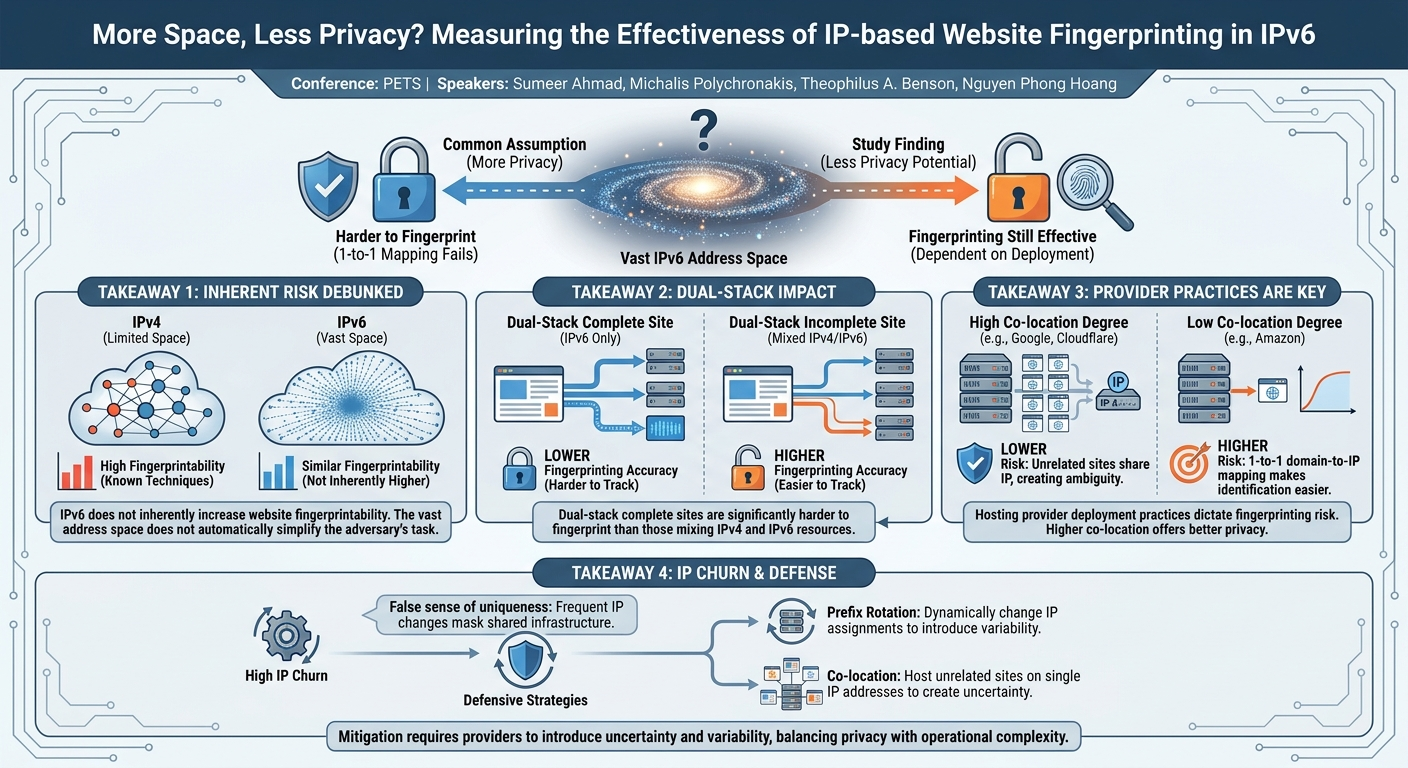
- IPv6 Does Not Inherently Increase Fingerprintability: Contrary to widespread community concerns, the research definitively showed that IPv6 does not inherently lead to greater website fingerprintability. The initial hypothesis that the vastness of IPv6 would enable easier one-to-one mappings between domains and IPs, thus making fingerprinting more effective, was largely disproven.
- Dual-Stack Complete Sites Are Harder to Fingerprint: The most striking finding was the significant difference in fingerprinting accuracy between dual-stack complete sites and dual-stack incomplete sites. Dual-stack complete sites, defined as those fetching all their resources exclusively over IPv6, were found to be substantially harder to fingerprint. In contrast, incomplete sites, which rely on a mix of IPv4 and IPv6 resources, remained highly fingerprintable. For incomplete sites, the difference in accuracy between IPv4 and IPv6 fingerprinting was negligible, but for complete sites, this difference diverged significantly, with IPv6 showing much lower accuracy.
- High IP Churn Inflates IPv6 Entropy, Masking Actual Shared Infrastructure: The study initially observed that IPv6 addresses appeared to have a higher number of high entropy values compared to IPv4, suggesting greater uniqueness. However, further investigation revealed that this was an "illusion of uniqueness" caused by heavy IP churn in IPv6. Throughout the measurement period, new IPv6 addresses were continually discovered and accumulated in the dataset, artificially inflating entropy values. When the researchers instead plotted the entropy values of IP connections (rather than individual IPs), they found that 35% of IPv6 connections exhibited less entropy than IPv4 addresses, indicating more shared infrastructure than initially apparent.
- Hosting Provider Practices Dictate Fingerprinting Risk: The research unequivocally demonstrated that the risk of IP-based website fingerprinting is primarily determined by how hosting providers deploy and manage their IPv4 and IPv6 address spaces. Specifically, the co-location degree — the average number of domains a provider hosts per IP address — emerged as a critical factor. Providers with higher co-location degrees (e.g., Google, Fastly, Cloudflare) tended to have lower fingerprinting accuracy, as many unrelated sites shared IP addresses. Conversely, providers with low co-location degrees (e.g., Amazon, which often hosts a single domain per IP) resulted in higher fingerprinting accuracies. This highlights that the effectiveness of fingerprinting is a consequence of architectural decisions, not an inherent property of IPv6.
Technical Deep Dive
▶ Watch: Surprising finding: IPv6 doesn't inherently increase fingerprintability (7:20)
The study's methodology was robust, involving a comprehensive data collection and analysis framework tailored to the unique characteristics of IPv6.
Dataset Acquisition and Filtering:
The foundation of the study was a massive dataset of websites. The researchers merged the Tranco 1 Million and Radar 1 Million lists, resulting in an initial pool of 1.3 million sites. To ensure relevance to IPv6, this list was filtered based on the availability of a valid AAAA record (IPv6 address record) for the primary domain when queried through public encrypted resolvers. This rigorous filtering process yielded approximately 520,000 IPv6-enabled websites, ensuring that the primary domain of each site could be reached via IPv6. It's important to note that while the primary domain was IPv6-enabled, the availability of IPv6 for secondary resources (e.g., images, scripts, CDN content) was not guaranteed at this stage.
Crawling and Data Extraction:
To capture website traffic patterns, custom crawlers were deployed. These crawlers operated in a sequential manner from a single vantage point within a specific network. For each website, the crawler generated a HAR (HTTP Archive) file, which meticulously records all network requests made during a browsing session. From these HAR files, the researchers extracted an unordered set of all domains contacted during that session. The choice of an unordered set for domains was deliberate, as the order of resource loading can be influenced by numerous uncontrollable factors such as network configuration, resource prioritization by the browser, and browser caching mechanisms.
Fingerprint Generation:
The core of the analysis involved constructing two types of fingerprints:
- Domain-based Fingerprint: This was defined as an unordered set of all domains (primary and secondary) contacted during a browsing session. In a hypothetical scenario without domain name encryption, this would be sufficient for fingerprinting.
- IP-based Fingerprints: Since the threat model assumes domain name encryption, the domain-based fingerprints were augmented with DNS resolution data. The researchers periodically resolved all domains identified in the HAR files using multiple public encrypted resolvers. This provided the necessary mapping from domains to IP addresses. Two distinct IP-based fingerprints were then created:
- IPv4 Fingerprint: Comprised solely of the IPv4 addresses associated with the contacted domains.
- IPv6 Fingerprint: This preferred IPv6 addresses. If a domain had an AAAA record, its IPv6 address was included. In the absence of an IPv6 address, it would fall back to its IPv4 address, mimicking the behavior of modern dual-stack browsers.
IPv6 Adoption Metrics:
During the analysis of IP-based fingerprints, the study provided unique insights into the actual adoption of IPv6 for fetching web resources. They categorized websites based on their resource fetching behavior:
- 32% of websites fetched all their resources exclusively over IPv6. These were termed dual-stack complete sites.
- 58% of websites exhibited a mix of IPv4 and IPv6 resource fetching. These were categorized as dual-stack incomplete sites.
- 7% of websites, despite having an IPv6-enabled primary domain, fetched no resources at all (e.g., due to errors or being placeholders).
- 2% of websites only had their landing page (primary domain) hosted on IPv6, with all other resources fetched over IPv4.
Fingerprinting Technique and Entropy Measurement:
To test the effectiveness of these fingerprints, the researchers employed the concept of information entropy. In this context, an IP address or domain appearing in almost every website (low entropy) is a weak identifier, while one appearing rarely (high entropy) is a strong, distinctive identifier.
The entropy of an IP address was calculated as the average entropy of all the domains it was observed hosting throughout the study. A Cumulative Distribution Function (CDF) of entropy values showed that domains were the most distinctive, followed by IPv6 addresses, and then IPv4 addresses. However, as noted in Key Findings, this initial observation for IPv6 was later attributed to IP churn.
For testing, IP connections were reconstructed from the DNS data, taking the first IP address seen closest to the crawl timestamp. The fingerprinting process involved:
- Filtering candidate IP-based fingerprints based on the primary IP address.
- For each matching secondary IP address, its entropy value was added to a total score for that candidate website.
- The candidate with the highest total score was selected as the predicted website.
This process was repeated five to six times to evaluate the robustness and stability of the fingerprints.
Jaccard Similarity and Co-location Degree:
To understand the underlying reasons for fingerprinting accuracy variations, the researchers calculated Jaccard similarity scores between all pairs of fingerprints. A higher Jaccard similarity indicates more shared IP addresses between websites. The probability distribution of non-zero similarity pairs revealed that for incomplete sites, scores were closer to zero, suggesting more distinct IP sets. However, for complete sites, scores ranged from zero to one, pointing to a highly shared infrastructure.
This led to the investigation of co-location degree, defined as the average number of domains a provider hosts per IP address. This metric directly correlated with fingerprinting accuracy:
- Google, Fastly, and Cloudflare were identified as leading providers with high co-location degrees. For instance, Google hosted an average of 65 domains per IP address. Providers with higher co-location degrees exhibited lower fingerprinting accuracy, as sharing IPs among many unrelated sites introduced significant uncertainty for the adversary.
- Conversely, Amazon was observed to host, on average, just a single domain per IP address. Providers with such low co-location degrees resulted in higher fingerprinting accuracies, as the IP-to-domain mapping was more predictable.
The technical deep dive reveals that the success of IP-based website fingerprinting in IPv6 is not an inherent property of the protocol's address space but rather a direct consequence of the architectural decisions made by hosting providers regarding their IP allocation and resource management strategies.
Demo / Proof of Concept
▶ Watch: Provider deployment strategies dictate fingerprinting risk (9:50)
This research focused on an empirical measurement study and theoretical analysis of IPv6 website fingerprinting effectiveness. As such, the presentation did not include a live demonstration or a proof of concept of a specific exploit tool. The goal was to quantify and understand the privacy implications of IPv6 deployments, rather than to showcase an active attack.
Defensive Implications
▶ Watch: Strategies for providers to reduce IPv6 fingerprintability (11:00)
The findings of this study provide crucial actionable intelligence for various stakeholders in the internet ecosystem, particularly for hosting providers and CDNs, who play a pivotal role in shaping the privacy landscape of IPv6.
The core principle for defense against IP-based website fingerprinting is to introduce uncertainty and variability into the IP resolutions that an adversary observes. If domain names consistently resolve to stable and predictable IP addresses, fingerprinting becomes feasible. The goal, therefore, is to break these stable mappings.
The researchers propose several concrete strategies for hosting providers:
- Server-Side Prefix Rotation: Providers should implement mechanisms for dynamically rotating IPv6 prefixes assigned to their hosted services. Instead of static assignments, frequently changing the IP addresses associated with domains makes it significantly harder for an adversary to build consistent IP-based fingerprints over time. This introduces ephemeral mappings that frustrate long-term tracking.
- Co-locate Unrelated Sites on a Single IP Address: As demonstrated by the study's findings on co-location degree, hosting multiple, diverse, and unrelated websites on the same IPv6 address substantially reduces fingerprinting accuracy. When an adversary observes an IP address, they cannot definitively link it to a single target website if that IP is shared by many other sites. This strategy leverages the vastness of the IPv6 address space to create ambiguity, making it difficult to distinguish between different browsing sessions. The example of Google hosting 65 domains per IP address serves as a model for effective mitigation.
- Use IPv6 Address Space in a Limited and Wise Manner: While the IPv6 address space is vast, deploying it carelessly by assigning unique IP addresses to every single domain or resource can inadvertently aid adversaries. Providers should thoughtfully manage their IPv6 allocations, avoiding one-to-one or highly sparse mappings that simplify the adversary's task. This implies a strategic approach to IP addressing that prioritizes privacy by design, rather than simply consuming addresses from the enormous pool.
It is important to acknowledge the trade-offs associated with these defensive strategies. Introducing greater variability and co-location can add a layer of complexity to existing network operations. For instance, dynamic IP assignments and shared IP infrastructure can complicate DNS load balancing, making it harder to direct user traffic efficiently based on geographical location or server load. Similarly, network maintenance and troubleshooting can become more challenging when IP-to-service mappings are less predictable. Therefore, hosting providers need to carefully evaluate these strategies to find a "sweet spot" that balances enhanced user privacy with operational efficiency and maintainability. The research underscores that this balance is critical for the future of IPv6 deployment.
For individual users and other defenders, the key implication is awareness. While users cannot directly control provider deployment strategies, understanding that IP-based fingerprinting remains a threat, and that IPv6 can be deployed in a privacy-preserving manner, is crucial. It empowers users to advocate for privacy-centric practices from their service providers and highlights the ongoing need for research into privacy-enhancing technologies at all layers of the network stack.
Key Takeaways
- IPv6 does not inherently increase website fingerprintability. The widespread community concern that the vast IPv6 address space would lead to easier one-to-one domain-IP mappings and thus higher fingerprinting accuracy was debunked by this empirical study.
- Dual-stack complete sites are significantly harder to fingerprint. Websites that fetch all their resources exclusively over IPv6 showed substantially lower fingerprinting accuracy compared to dual-stack incomplete sites which mix IPv4 and IPv6 resources.
- Hosting provider deployment practices are the primary determinant of fingerprinting risk. The study found a strong correlation between a provider's co-location degree (domains per IP) and fingerprinting accuracy. Providers like Google, Fastly, and Cloudflare, which host many domains per IP, offer better privacy against this attack vector.
- High IP churn in IPv6 can create a false sense of uniqueness. While initial entropy measurements suggested greater distinctiveness for IPv6, this was an artifact of frequent new IP address discoveries. When considering IP connections, a significant portion of IPv6 connections showed less entropy than IPv4, indicating shared infrastructure.
- Defensive strategies for providers focus on introducing uncertainty and variability. To mitigate IP-based fingerprinting, hosting providers should implement server-side prefix rotation, co-locate unrelated sites on single IP addresses, and use their IPv6 address space wisely to avoid predictable mappings.
- A trade-off exists between privacy and operational complexity. Implementing privacy-enhancing IPv6 deployment strategies may add complexity to DNS load balancing and network maintenance, requiring providers to find an optimal balance.
About the Speaker(s)
The research presented in this talk was a collaborative effort by Sumeer Ahmad, Michalis Polychronakis, Theophilus A. Benson, and Nguyen Phong Hoang.
Sumeer Ahmad was the primary presenter of this work at PETS and is listed as a paper author. At the time of the talk, he was affiliated with Stony Brook University. His presentation demonstrated a deep understanding of the empirical methodology and the nuanced implications of IPv6 adoption for online privacy.
Michalis Polychronakis is also a paper author and was affiliated with Stony Brook University. His expertise likely contributed significantly to the architectural and security analysis aspects of the research.
Theophilus A. Benson is another paper author, affiliated with Carnegie Mellon University. His contributions would have been valuable in the broader context of network measurements and infrastructure analysis.
Nguyen Phong Hoang is the fourth paper author, affiliated with the University of British Columbia. Their involvement suggests expertise in areas such as data analysis, privacy research, or distributed systems.
Together, this team brought a diverse set of skills and academic backgrounds to conduct a comprehensive and impactful study on IPv6 website fingerprinting.
Reviews
Dr. Zero (Offensive Security Researcher) — SOLID
Everyone assumed IPv6's massive address space would mean 1:1 domain mappings, making website fingerprinting trivial. Ahmad and the Stony Brook crew actually crawled half a million sites to test it, proving the exact opposite: CDN infrastructure pools IPv6 addresses so aggressively that fingerprinting is often harder than in IPv4.
Heather Calloway (CISO) — SOLID
Solid academic research that debunks the assumption that IPv6's massive address space makes website fingerprinting easier. For most enterprise threat models, this is edge-case privacy research. But if your organization hosts high-risk portals where user anonymity matters, this study dictates exactly how your infrastructure team needs to deploy your CDN.
→ Top-rated talks at Privacy Enhancing Technologies Symposium (PETS) 2026
All talks from Privacy Enhancing Technologies Symposium (PETS) 2026