PriVA-C: Defending Voice Assistants from Fingerprinting Attacks
Dilawer Ahmed (Paper author · North Carolina State University), Aafaq Sabir (Paper author · North Carolina State University), Ahsan Zafar (Paper author · North Carolina State University), Anupam Das (Paper author · North Carolina State University)
Privacy Enhancing Technologies Symposium (PETS) 2026 · Day 1 · Beaver
Overview
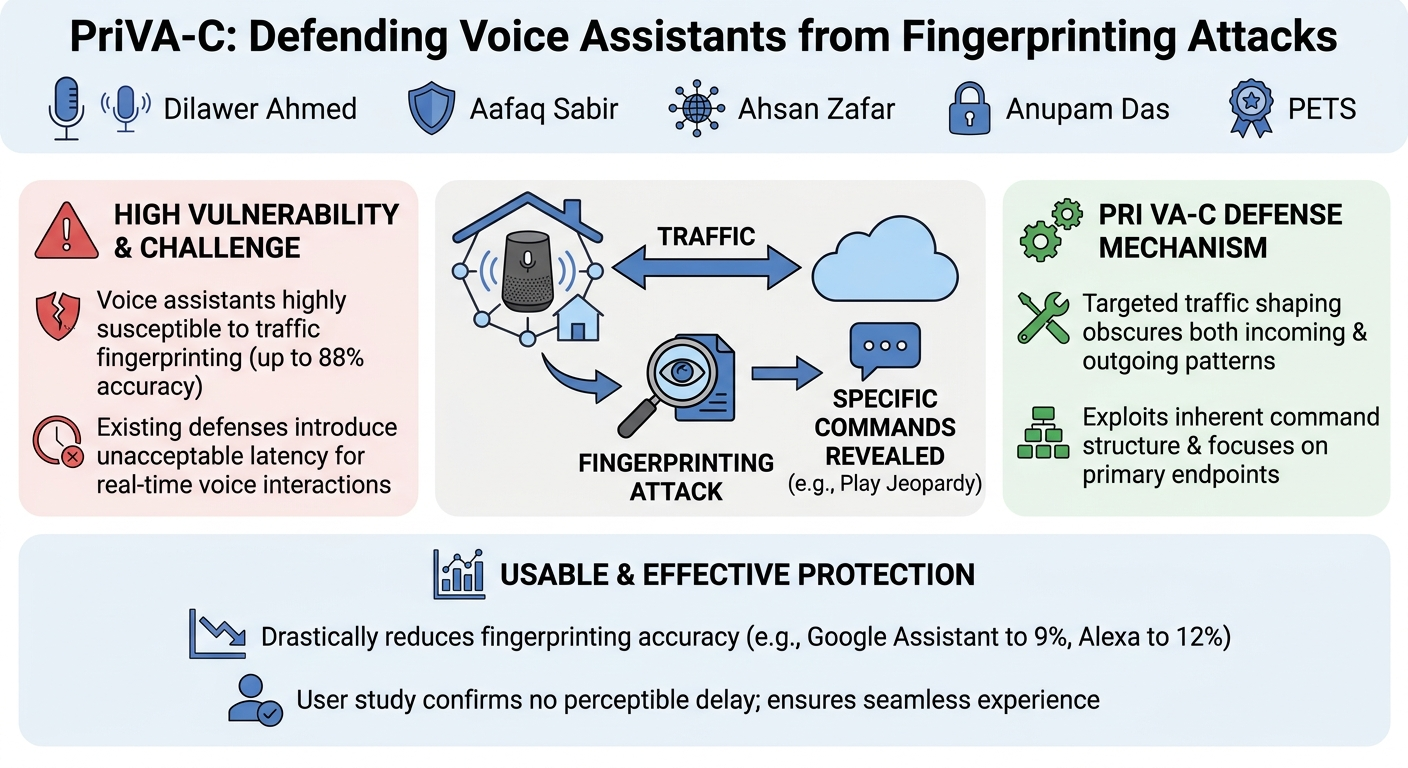
This talk, presented by Anupam Das at PETS, introduces "PriVA-C," a novel defense mechanism designed to protect voice assistants from sophisticated traffic fingerprinting attacks. As smart homes increasingly integrate voice assistants and smart appliances, the privacy implications of these pervasive technologies become critical. The research builds upon previous work that demonstrated the high susceptibility of major voice platforms like Amazon Alexa, Google Assistant, and Apple Siri to being fingerprinted by passive adversaries, revealing specific voice commands issued by users.
Key moments
- 0:45 Voice assistants highly vulnerable to fingerprinting attacks
- 2:15 Existing web defenses too costly for voice assistants
- 3:15 Three fundamental questions for usable defense design
- 4:30 Insights into voice assistant traffic patterns
- 5:45 PriVA-C's two practical defense prototypes
- 7:05 PriVA-C drastically reduces fingerprinting accuracy
- 9:00 User study confirms no perceptible delay with defense
PriVA-C: Defending Voice Assistants from Fingerprinting Attacks
Speakers: Dilawer Ahmed, Paper author, North Carolina State University; Aafaq Sabir, Paper author, North Carolina State University; Ahsan Zafar, Paper author, North Carolina State University; Anupam Das, Paper author, North Carolina State University
Conference: PETS
YouTube: https://www.youtube.com/watch?v=1A0rY9BqpmY
Overview
This talk, presented by Anupam Das at PETS, introduces "PriVA-C," a novel defense mechanism designed to protect voice assistants from sophisticated traffic fingerprinting attacks. As smart homes increasingly integrate voice assistants and smart appliances, the privacy implications of these pervasive technologies become critical. The research builds upon previous work that demonstrated the high susceptibility of major voice platforms like Amazon Alexa, Google Assistant, and Apple Siri to being fingerprinted by passive adversaries, revealing specific voice commands issued by users.
The core challenge addressed by PriVA-C is the lack of a usable defense against such attacks. While existing web fingerprinting defenses can reduce accuracy, they typically introduce significant bandwidth overhead and delays, rendering them impractical for real-time voice interactions. PriVA-C aims to provide a practical and effective solution that minimizes overheads while maintaining a seamless user experience, thereby enhancing the privacy of individuals interacting with their voice-activated devices.
The researchers at North Carolina State University, including PhD students Dilawer Ahmed, Aafaq Sabir, and Ahsan Zafar, recognized the urgent need for a tailored defense. Their work dissects the unique characteristics of voice assistant traffic to develop a traffic shaping strategy that effectively obscures command patterns without compromising usability. This article delves into their findings, technical approach, and the implications for both users and developers of voice assistant technologies.
Background
▶ Watch: Voice assistants highly vulnerable to fingerprinting attacks (0:45)
The genesis of this research lies in a foundational paper from 2023 (likely a reference to a Usenix paper from 2023, though the speaker mentions 2013 and then 2023 again, implying the prior work was recent) that established the significant vulnerability of voice ecosystems to traffic fingerprinting. In that earlier work, researchers demonstrated that a passive adversary, merely by sniffing network traffic leaving a user's home, could accurately predict the specific voice commands being issued to popular voice assistants. This threat model assumes the adversary has no access to the encrypted content of the commands but can analyze metadata such as packet sizes, timing, and direction.
The 2023 study evaluated the top three voice platforms—Amazon Alexa, Google Assistant, and Apple Siri—across over 100 voice commands. Both closed-world (commands known to the adversary) and open-world (unseen commands) evaluations revealed alarmingly high fingerprinting accuracy, with some platforms achieving up to 88% success. This demonstrated a critical privacy gap, as sensitive information about a user's daily activities, preferences, and even specific requests (e.g., "add items to shopping list," "play Jeopardy") could be inferred.
Following this discovery, the natural progression was to investigate potential defenses. The research team first explored whether existing traffic fingerprinting defense mechanisms, widely applied in the context of web browsing, could be adapted for voice assistants. These traditional defenses, often involving padding or delaying traffic to obscure patterns, were evaluated using standard metrics like accuracy reduction, bandwidth overhead, and latency. The findings were discouraging: while these defenses could significantly reduce fingerprinting accuracy, they introduced "significantly high" bandwidth consumption and unacceptable delays. For instance, a visual representation showed web fingerprinting defenses (colored yellow-red) achieving good accuracy reduction but at a prohibitive cost in terms of bandwidth, pushing them far from the desired "left bottom corner" of low bandwidth and low accuracy. This performance trade-off rendered them unusable for voice assistants, where real-time interaction and minimal latency are paramount for a positive user experience. This critical usability gap motivated the development of PriVA-C, a defense specifically designed to be practical for the voice ecosystem.
Key Findings
▶ Watch: Three fundamental questions for usable defense design (3:15)
The research behind PriVA-C yielded several critical insights that informed the design of its effective and usable defense mechanism:
- Bidirectional Fingerprintability: The study conclusively found that both incoming and outgoing traffic associated with voice commands are equally fingerprintable. This necessitates a defense strategy that addresses traffic in both directions, making the problem inherently more complex and potentially costly than if only one direction needed protection.
- Endpoint Centralization: A significant observation was that "most of the voice commands were communicating with one endpoint." This means that rather than needing to protect traffic flowing to a multitude of backend services, a large proportion of sensitive voice command data converges on a single, primary endpoint. This finding is crucial for designing a more practical and efficient defense, as it allows for targeted protection efforts.
- Exploitable Traffic Structure: Voice service traffic exhibits a distinct, predictable structure. Commands typically involve an "incoming or outgoing phase" where the voice assistant listens to the user's request, followed by processing, sending packets to the backend, and then receiving responses. This inherent pattern, exemplified by various commands like adding items to a shopping list or playing Jeopardy, provides an opportunity for traffic shaping that can exploit these structural regularities to obscure command types without introducing excessive overhead.
- Significant Accuracy Reduction with Usability: PriVA-C demonstrated substantial success in reducing fingerprinting accuracy. For Google Assistant, accuracy was reduced from a baseline of 88% down to 9%. For Amazon Alexa, it dropped to 12%. Siri proved "a little bit more difficult to protect against" compared to the other two platforms, though specific reduction numbers for Siri were not explicitly stated in the provided segment. Crucially, this reduction was achieved while maintaining usability.
- Cost-Benefit of Targeted Protection: The research compared two prototypes: one protecting all traffic and another focusing only on AVS (Alexa Voice Service)-specific traffic domains or similar primary endpoints. It was found that protecting specific endpoints was a "little bit more cheaper option" while still achieving effective defense, indicating a more practical and resource-efficient approach.
- No Perceptible User Delay: A user study involving 25 participants interacting with various defense variants (including a vanilla Alexa service and three PriVA-C variants with different bandwidth/window sizes) confirmed that "none of the participants saw any perceptible delay." This is a cornerstone finding, validating that PriVA-C's approach is truly usable and does not degrade the user experience, a critical hurdle that previous defenses failed to overcome.
- Real-World Implementability: The researchers successfully implemented PriVA-C using custom-built man-in-the-middle proxies for both client and server sides, leveraging the Alexa SDK. This demonstrated the feasibility of deploying such a defense on real services and devices, moving beyond purely simulated environments.
These key findings collectively demonstrate that a usable and effective defense against voice assistant fingerprinting is not only possible but also achievable through a targeted, ecosystem-aware approach.
Technical Deep Dive
▶ Watch: Insights into voice assistant traffic patterns (4:30)
The technical foundation of PriVA-C is built upon addressing three fundamental research questions, leading to a tailored traffic shaping defense.
The first question was whether protection was needed for all traffic or only in specific directions. The analysis revealed that both incoming and outgoing traffic streams are fingerprintable. This implies that a comprehensive defense must actively monitor and modify traffic in both directions to be effective, increasing the complexity and resource requirements compared to a unidirectional approach.
The second question explored whether all endpoints contacted by voice assistants require protection. The critical insight here was that "most of the voice commands were communicating with one endpoint." This centralization of communication significantly simplifies the defense problem. Instead of broadly obscuring all network traffic, PriVA-C can focus its efforts on shaping traffic specifically directed to and from these highly utilized, fingerprintable primary endpoints. This targeted approach is more resource-efficient and contributes to the defense's practicality.
The third question focused on exploiting the inherent structure of voice service traffic. Unlike generic web traffic, voice commands follow a distinct pattern: a listening phase (user speaks), a processing phase (data sent to backend), and a response phase (results returned). This predictable structure, evident in examples like "adding items to a shopping list" or "playing Jeopardy," allows for intelligent traffic shaping. The goal is to make the traffic patterns of different commands appear as uniform as possible to an adversary, thereby preventing differentiation, while simultaneously minimizing overhead.
To implement this defense, the team developed two primary prototypes or variants:
- Protecting all outgoing traffic: This variant applies traffic shaping broadly to all data leaving the user's device.
- Focusing on specific endpoints: This more practical variant concentrates protection efforts only on traffic communicating with the identified primary, fingerprintable endpoints. This approach proved to be a "cheaper option" in terms of overhead while still being effective.
The core defense mechanism is traffic shaping, which involves manipulating packet timing and sizes to obscure the unique "fingerprints" of different commands. Key techniques employed include:
- Opportunistic Overlapping: A challenge with traffic shaping is the potential for introducing significant delays if buffer windows (the period during which traffic is collected and shaped) are too large. To mitigate this, PriVA-C employs opportunistic overlapping. Instead of strictly waiting for a buffer to fill before sending, if useful traffic is available, it can be sent strategically to reduce perceived latency. If no useful traffic is present, dummy traffic (e.g., padding packets) can be sent to maintain a consistent flow pattern, making it harder for an adversary to infer command boundaries or types based on traffic cessation.
- Ignoring Persistent Traffic: The researchers identified heartbeat traffic that consistently flows from devices regardless of user commands. Protecting this constant, non-command-specific traffic would be wasteful and unnecessary, as it does not contribute to fingerprinting specific commands. By ignoring such persistent, indistinguishable traffic, the defense mechanism can further optimize resource usage and reduce overhead.
The efficacy of these techniques was demonstrated through evaluations. The defense mechanism achieved substantial reductions in fingerprinting accuracy: Google Assistant's accuracy plummeted from 88% to 9%, and Alexa's to 12%. While Siri proved "a little bit more difficult to protect against," the overall trend showed significant improvements in privacy. The comparison between the "all traffic" and "specific endpoint" prototypes confirmed that the latter achieved a good balance of security and efficiency, bringing the solution closer to the ideal "left bottom corner" of low accuracy and low bandwidth.
Crucially, the researchers moved beyond simulation. They built custom man-in-the-middle (MITM) proxies for both the client and server sides, as no existing proxy solutions were suitable for voice assistant traffic. These proxies, implemented using the Alexa SDK, allowed for real-world testing and validation. Although a "5% to 6% gap" was observed between simulated and realistic evaluations (attributed to traffic variations over time and implementation nuances), the real-world deployment confirmed the practicality and effectiveness of PriVA-C.
Demo / Proof of Concept
▶ Watch: PriVA-C drastically reduces fingerprinting accuracy (7:05)
While the talk did not feature a live, interactive demonstration in the traditional sense, the researchers presented a robust proof of concept through their real-world implementation and comprehensive evaluation. The core of this proof of concept was the development and deployment of custom man-in-the-middle (MITM) proxies. As the speaker noted, "there's no proxy for voice assistant at this point," necessitating the creation of their own infrastructure.
Two distinct MITM proxies were built: one operating on the client side (likely intercepting traffic from the user's device) and another on the server side (presumably managing traffic before it reaches the cloud voice assistant services). This dual-proxy setup allowed the researchers to fully control and shape both incoming and outgoing traffic streams, which they had identified as both being fingerprintable. The implementation utilized the Alexa SDK, indicating a practical integration with a major voice assistant platform.
The effectiveness of this real-world implementation was rigorously tested and compared against their simulated results. While a small "5% to 6% gap" in accuracy reduction was observed between the simulated and realistic deployments—attributed to natural variations in network traffic over time and potential implementation-related issues—the overall trend of significant accuracy reduction held true. This demonstrated that the proposed traffic shaping techniques are not merely theoretical but can be practically deployed and achieve substantial privacy benefits in a live environment.
Furthermore, the ultimate validation of PriVA-C's usability came from a user study involving 25 participants. These users interacted with four different variants of the voice assistant service in a randomized, blinded fashion. One variant was the standard, undefended "vanilla Alexa service," while the other three were PriVA-C implementations with varying bandwidth and buffer window configurations. The critical finding was that "none of the participants saw any perceptible delay with any of the variants we had." This user-centric evaluation confirms that PriVA-C's defenses can be seamlessly integrated without degrading the user experience, a crucial aspect for adoption in consumer-facing technologies. The researchers also made their code open source, encouraging further research and development in this area, solidifying the practical nature of their proof of concept.
Defensive Implications
▶ Watch: User study confirms no perceptible delay with defense (9:00)
The research presented on PriVA-C carries significant implications for both developers of voice assistant technologies and users concerned about their privacy. The primary defensive implication is the stark reality that passive network adversaries can, with high accuracy, infer specific voice commands issued to major voice assistants. This goes beyond knowing a user has a voice assistant; it reveals what they are asking, creating a detailed profile of their daily activities, preferences, and potentially sensitive information.
For voice assistant developers and platform providers (e.g., Amazon, Google, Apple), this work highlights a critical vulnerability that demands attention. Relying solely on encryption for content privacy is insufficient when traffic metadata itself leaks sensitive information. The traditional web fingerprinting defenses are not viable due to their performance overhead, meaning a tailored approach is necessary. PriVA-C demonstrates that such a usable and effective defense is achievable by understanding and exploiting the unique characteristics of voice assistant traffic. Developers should consider integrating ecosystem-specific traffic shaping mechanisms into their voice assistant architectures. This could involve standardizing traffic patterns, introducing adaptive padding, or implementing smart buffering strategies to obscure command-specific signatures at the network layer. The finding that targeting specific endpoints is more efficient suggests that architectural changes focusing on central communication hubs could yield significant privacy benefits with minimal resource expenditure.
For defenders and security practitioners advising on smart home security, this research provides concrete evidence of a privacy risk and a potential mitigation strategy. Users should be made aware that even encrypted communications with voice assistants are not entirely private from a traffic analysis perspective. While direct user-side deployment of PriVA-C might be complex (requiring custom proxies or modified firmware), the findings empower users to demand greater privacy-preserving features from their device manufacturers. Until such features are natively integrated, users might consider network-level protections if available, though this remains challenging for non-technical users.
Crucially, the work emphasizes that an effective defense must:
- Address both incoming and outgoing traffic, as both directions contribute to fingerprintability.
- Target the most significant communication endpoints, rather than attempting to obscure all network traffic, for efficiency.
- Leverage the inherent structure of voice assistant interactions (e.g., listening, processing, response phases) to intelligently shape traffic without introducing perceptible delay.
PriVA-C serves as a blueprint for building a more privacy-preserving voice ecosystem, urging manufacturers to move beyond basic encryption and actively design their systems to resist traffic fingerprinting attacks.
Key Takeaways
- High Fingerprintability: Voice assistant commands are highly susceptible to traffic fingerprinting attacks, allowing passive adversaries to infer specific commands with accuracy up to 88% for platforms like Google Assistant and Alexa.
- Existing Defenses are Insufficient: Generic web traffic fingerprinting defenses introduce prohibitive bandwidth overhead and latency, rendering them unusable for the real-time interaction required by voice assistants.
- PriVA-C Offers a Usable Solution: The PriVA-C defense mechanism effectively reduces fingerprinting accuracy (e.g., Google Assistant to 9%, Alexa to 12%) without introducing any perceptible delay for users, as confirmed by a user study.
- Targeted & Structural Approach: PriVA-C's success stems from its understanding of the voice ecosystem, protecting both incoming and outgoing traffic, focusing on primary communication endpoints, and exploiting the inherent structural patterns of voice commands through intelligent traffic shaping.
- Real-World Feasibility: The defense was implemented using custom man-in-the-middle proxies on real hardware with the Alexa SDK, demonstrating its practical deployability beyond theoretical simulations.
- Urgent Call for Privacy: This research underscores the need for voice assistant manufacturers to integrate advanced privacy-preserving features, such as traffic shaping, to protect user command privacy against network-level adversaries.
About the Speaker(s)
The talk "PriVA-C: Defending Voice Assistants from Fingerprinting Attacks" was presented by Anupam Das, a faculty member at North Carolina State University. He introduced the work as a collaborative effort with his PhD students, Dilawer Ahmed, Aafaq Sabir, and Ahsan Zafar, all affiliated with North Carolina State University. The students were co-authors of the paper but were unable to attend the conference in person due to visa issues. The research reflects North Carolina State University's ongoing commitment to exploring and mitigating privacy and security challenges in emerging technologies, particularly within the pervasive domain of voice assistants and smart home ecosystems.
Reviews
Dr. Zero (Offensive Security Researcher) — WEAK
Solid academic exercise in traffic shaping, but completely dead in the water for real-world deployment. They proved you can mask Alexa traffic patterns without ruining latency, but until Amazon actually cares to implement this at the firmware level, it's just a proxy experiment.
Heather Calloway (CISO) — SOLID
This research proves that passive network adversaries can fingerprint encrypted voice assistant traffic to infer specific user commands. It's a clean, well-executed academic study that successfully demonstrates a traffic-shaping defense without breaking usability. For enterprise security, it validates why we isolate IoT devices on separate networks, though the defense itself is not something a CISO can deploy today.
→ Top-rated talks at Privacy Enhancing Technologies Symposium (PETS) 2026
All talks from Privacy Enhancing Technologies Symposium (PETS) 2026