Privacy by Voice: Designing Usable Privacy Notices for the Voice Interface
Aafaq Sabir (Paper author · North Carolina State University), Abhinaya S.B. (Paper author · North Carolina State University), Dilawer Ahmed (Paper author · North Carolina State University), Anupam Das (Paper author · North Carolina State University)
Privacy Enhancing Technologies Symposium (PETS) 2026 · Day 3 · Moose
Overview
The proliferation of voice assistants (VAs) and voice interfaces in everyday life has introduced a new frontier for privacy challenges. This talk, "Privacy by Voice: Designing Usable Privacy Notices for the Voice Interface," presented by researchers from North Carolina State University, delves into the critical need for effective and user-centric privacy notices tailored specifically for the voice modality. As voice interfaces become increasingly dominant, integrated into smart homes, cars, and appliances, the traditional visual permission models prevalent in smartphones and web browsers prove inadequate, leaving users without clear mechanisms to understand and control data requests.
Key moments
- 0:00 Introduction: Privacy challenges in voice interfaces
- 2:10 Defining the research questions for voice privacy
- 4:00 Five key user factors for voice privacy notices
- 6:50 Timing and voice format are predominant factors
- 7:10 Different notice designs for relevant vs. irrelevant data
- 8:00 Recommendations for voice assistant platform owners
- 9:00 Key advice for third-party skill developers
Privacy by Voice: Designing Usable Privacy Notices for the Voice Interface
Speakers: Aafaq Sabir (Paper author, North Carolina State University); Abhinaya S.B. (Paper author, North Carolina State University); Dilawer Ahmed (Paper author, North Carolina State University); Anupam Das (Paper author, North Carolina State University)
Conference: PETS
YouTube: https://www.youtube.com/watch?v=GmirWe55os4
Overview
The proliferation of voice assistants (VAs) and voice interfaces in everyday life has introduced a new frontier for privacy challenges. This talk, "Privacy by Voice: Designing Usable Privacy Notices for the Voice Interface," presented by researchers from North Carolina State University, delves into the critical need for effective and user-centric privacy notices tailored specifically for the voice modality. As voice interfaces become increasingly dominant, integrated into smart homes, cars, and appliances, the traditional visual permission models prevalent in smartphones and web browsers prove inadequate, leaving users without clear mechanisms to understand and control data requests.
The presentation highlights that a staggering 62% of adults have purchased some form of voice assistant, with the ecosystem, particularly around platforms like Alexa, rapidly expanding to include numerous third-party applications or "skills." These skills often request personal data verbally, without offering users explicit choices or controls that are easily discernible. The research presented here addresses this gap by exploring user preferences for privacy features in voice interfaces, identifying crucial design factors for voice-native privacy notices, and evaluating various prototypes to determine the most usable and preferred designs. The findings offer actionable recommendations for both platform owners and third-party developers to enhance user privacy in the voice-driven era.
The core problem tackled by this research is the mismatch between the growing prevalence of voice-based data collection and the lack of suitable privacy notification and control mechanisms. Unlike installing a mobile app where users can review a list of permissions, voice interactions often involve instantaneous verbal data requests, making informed consent difficult. This work is significant because it moves beyond simply adapting visual privacy models to voice, instead focusing on designing privacy experiences that are inherently intuitive and effective within the unique constraints and opportunities of the voice interface.
Background
▶ Watch: Introduction: Privacy challenges in voice interfaces (0:00)
The landscape of human-computer interaction has undergone a significant transformation with the rise of voice interfaces. What began with standalone smart assistants like Amazon Alexa and Google Assistant has rapidly expanded into a pervasive ecosystem, integrating into a multitude of devices including smart cars, home appliances, and more. This ubiquity is underscored by statistics indicating that approximately 62% of adults in the United States have adopted some form of voice assistant technology into their homes. The growth extends not only to the core devices but also to the thriving ecosystem of third-party applications, or "skills" in the context of Alexa, which significantly broaden the functionality and utility of these platforms.
However, this rapid adoption and expansion have introduced novel challenges, particularly concerning user privacy. Traditional digital interfaces, such as smartphones and web browsers, have established conventions for privacy notifications and permission management. When installing a mobile application, users are typically presented with a visual list of permissions the app requests, allowing them to explicitly approve or disapprove access to various data types. Similarly, on the web, cookie banners and privacy settings provide visual cues and controls for data collection. These visual and explicit permission models have become the de facto standard for digital privacy.
The challenge with voice interfaces is that these established models do not translate effectively to a purely auditory interaction. Data requests in voice environments frequently occur verbally and in real-time. For instance, a third-party Alexa skill might verbally ask for a user's age before providing certain activities. In such scenarios, the user often lacks an immediate, clear, and intuitive method to consent, deny, or even understand the implications of such a request. The absence of a visual interface means there is no permission list to review, no explicit "allow" or "deny" button, and often, insufficient context provided regarding why the data is being requested or how it will be used. This leads to a significant gap in user agency and control over their personal data in a rapidly evolving technological domain.
The research directly addresses this critical gap, recognizing that the unique characteristics of voice interaction necessitate a fundamentally different approach to privacy notices. The objective is not merely to port existing visual privacy paradigms to voice, but to design voice-native privacy notices that are usable, informative, and empower users to make informed decisions about their data in a conversational, auditory context. This involves understanding user expectations, identifying key design parameters, and prototyping solutions that overcome the inherent limitations of a screen-less, voice-only interaction.
Key Findings
▶ Watch: Five key user factors for voice privacy notices (4:00)
The research embarked on addressing three high-level questions: first, what privacy features do users desire when interacting with voice interfaces, particularly concerning data requests; second, what specific design factors should inform the creation of voice privacy notices; and third, which of the prototyped designs do users ultimately prefer. To answer these questions, the study employed a comprehensive two-phase user study methodology.
Phase 1 involved in-depth interviews with active voice assistant users. Participants were rigorously recruited, requiring them to demonstrate ownership and active use of a voice assistant via a Zoom session, ensuring genuine engagement with the technology. This initial phase provided crucial qualitative insights, identifying five primary factors that users considered paramount for privacy notices in voice interactions:
- Context: Users expressed a strong desire to understand the relevance of a data request. This factor distinguished between data genuinely needed for a skill's functionality (e.g., age for workout suggestions) and data requested without a direct connection to the stated purpose (irrelevant data).
- Control: This factor explored whether users wanted to block a data request before the application could utilize the data, or if a non-blocking approach was acceptable, where the application would proceed, but the user would be informed and could make a decision later.
- Modality: While the focus was on voice, users also considered whether the privacy notice should be delivered only through audio or if an audio + app display (e.g., a companion app notification) was preferred, particularly for situations where listening to audio might be inconvenient.
- Timing: A critical aspect was when the notification should occur – before the data request is made or after the data has already been requested or processed.
- Voice: An interesting finding was the user preference regarding the tone or identity of the voice delivering the privacy notice. Should it be the default voice of the voice assistant, or a distinct voice to signify a privacy-related interaction?
Phase 2 built upon these factors by conducting an exploration study using prototypes. Researchers developed an emulated third-party Alexa skill for task listing, creating 20 distinct design variants based on combinations of the identified factors. Participants, recruited via Prolific, interacted with these prototypes in a within-subject design, meaning each participant experienced multiple variants, but specifically within either the "relevant data" or "irrelevant data" context to avoid confusion.
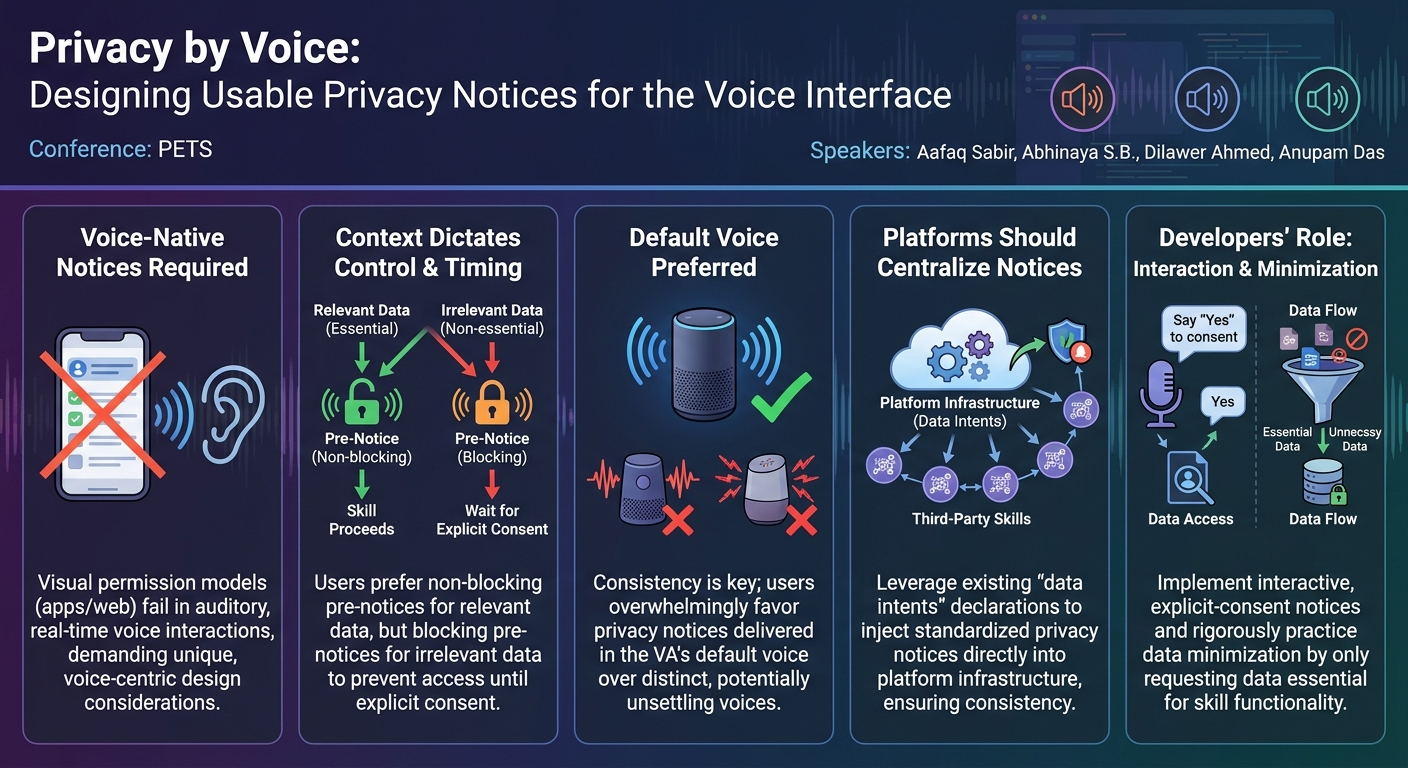
The statistical analysis of user feedback from Phase 2 revealed that Voice and Timing were the most predominant factors influencing user preference for privacy notice design. A key finding regarding the "Voice" factor was an overwhelming preference for the default voice of the voice assistant. Users reported feeling "spooked" or uncomfortable when a different voice was used for privacy notices, indicating that consistency in the VA's persona is crucial for user trust and comfort.
Regarding Timing, preferences diverged significantly based on the relevance of the data request:
- For relevant data requests (data directly tied to the skill's functionality), users preferred the notice to be delivered before the data was requested but in a non-blocking manner. This allowed the application to proceed while informing the user about the data's use, implying a degree of trust when the data is clearly functional.
- For irrelevant data requests (data not directly necessary for the skill), users strongly preferred the notice to be delivered before the data request, and critically, in a blocking manner. This meant that the data should not be transmitted to the third party until the user had explicitly made a choice, highlighting a heightened need for control when data relevance is questionable.
In summary, the research underscored the unique needs of voice interfaces for privacy notices, emphasizing the importance of interactive, context-aware notifications delivered in a consistent voice. The findings provide a clear roadmap for designing privacy experiences that align with user expectations and empower them to manage their data effectively in the voice-first world.
Technical Deep Dive
▶ Watch: Timing and voice format are predominant factors (6:50)
The technical core of this research involved a systematic exploration of the design space for voice-based privacy notices, followed by the development and evaluation of prototypes. The initial identification of five key factors—Context, Control, Modality, Timing, and Voice—each with at least two distinct values, theoretically yielded a combinatorial explosion of design possibilities. Specifically, with five factors and binary choices for each (e.g., relevant/irrelevant, blocking/non-blocking), there were 2^5 = 32 possible design combinations.
To manage this complexity and focus on practically meaningful scenarios, the researchers narrowed down the design space to 20 distinct variants. This reduction was based on practical considerations, as some theoretical combinations were deemed nonsensical or less relevant in a real-world user interaction context. For instance, a scenario where a notice for irrelevant data was non-blocking and post-request would likely be universally rejected, thus removed from the experimental set.
For the purpose of prototyping and user testing, the team developed a third-party Alexa skill. This skill was designed to emulate a common type of application, a "task-listing" service, which allowed users to interact with it naturally while the researchers could programmatically inject various data requests and corresponding privacy notices. The choice of an Alexa skill was strategic, given Alexa's dominant market share and its robust ecosystem for third-party developers.
The 20 design variants were then integrated into this prototyped skill. These variants systematically manipulated the identified factors. For example, some variants would present a notice before a data request, while others would present it after. Some would use the default Alexa voice, while others would introduce a distinct voice for the privacy notification. Crucially, the relevancy of the data request (whether it was essential for the task-listing skill's core functionality) was a primary differentiator in the experimental design. This allowed the researchers to test how user preferences for timing and control changed based on their perception of the data's necessity.
The user study itself employed a within-subject design. This meant that each participant interacted with multiple design variants. However, a critical design choice was to present participants with variants that were either all focused on "relevant" data requests or all focused on "irrelevant" data requests. Participants did not switch between these two contexts during their interaction with the prototypes. This approach was adopted to prevent user confusion and ensure that their responses were consistently contextualized, allowing for clearer insights into preferences concerning data relevance.
While the talk mentions "different kind of statistical analysis" and "P factors" were used to analyze the collected data, it does not delve into the specific statistical methods (e.g., ANOVA, regression models) applied. However, the rigor of the experimental design, with its focus on systematically varying factors and controlling for potential confounds (like mixing relevant/irrelevant contexts), suggests a robust approach to data interpretation.
A significant technical implication for platform owners like Amazon is derived from the Alexa skill registration process. When developers create and deploy an Alexa skill, they are required to register data intents. This means they must declare what types of data their skill intends to request from users. This existing infrastructure provides a powerful hook for platforms to intervene in the privacy notification process. The research suggests that because platforms already know the declared data intents, they are in a unique position to inject privacy notices directly into their infrastructure. This would allow the platform to control the timing, modality, and voice of the privacy notice, reducing reliance on individual third-party developers to implement these safeguards correctly and consistently. By leveraging this existing technical capability, platforms can enforce a baseline level of privacy protection and user awareness across their entire ecosystem.
Demo / Proof of Concept
▶ Watch: Recommendations for voice assistant platform owners (8:00)
The core of the practical demonstration and proof of concept in this research was the development and deployment of a prototyped third-party Alexa skill. This wasn't a live, publicly available skill, but rather a carefully crafted application designed to simulate real-world interactions while allowing for controlled experimentation with different privacy notice designs.
The skill itself was functionally straightforward: it emulated a task-listing application. Users could, for instance, list different tasks they wanted to accomplish. This simple functionality served as a realistic backdrop against which various data requests could be made. For example, the skill might ask for a user's age, location, or other personal information, either genuinely relevant to an extended feature (e.g., suggesting age-appropriate tasks) or as an "irrelevant" request to test user reactions.
The "demo" aspect of the research involved users interacting with this prototyped skill, which was programmed with 20 different design variants for privacy notices. These variants systematically incorporated the five identified factors:
- Context: The skill could make requests for data that was clearly relevant to task management (e.g., "Do you want to share your current location to find nearby task-related events?") or irrelevant (e.g., "Can I have your favorite color for a better experience?").
- Control: Depending on the variant, the notice for a data request would either block further interaction until a decision was made or allow the skill to proceed while informing the user.
- Modality: While the primary interaction was voice, some variants might have simulated a companion app notification.
- Timing: Notices were presented either immediately before a data request or after a hypothetical data transmission.
- Voice: Some variants used the standard Alexa voice for the privacy notice, while others used a distinctly different, perhaps more formal or warning-like, voice.
During the user study (Phase 2), participants engaged directly with these variants. They would activate the task-listing skill, and at various points, the skill would verbally request data, accompanied by one of the designed privacy notices. Users would then respond verbally, and their preferences, comfort levels, and choices were recorded and analyzed. This hands-on interaction with the prototyped skill allowed the researchers to gather empirical data on which design elements were most effective, least disruptive, and most empowering for users in a voice-first environment. The demonstration, therefore, was not a singular presentation of a finished product, but rather a methodical, iterative testing of design principles embedded within a functional, albeit experimental, voice application.
Defensive Implications
▶ Watch: Key advice for third-party skill developers (9:00)
The findings from this research provide critical insights and actionable recommendations for both the developers of voice assistant platforms and the creators of third-party skills, aiming to bolster user privacy in the voice interface ecosystem.
For Platform Owners (e.g., Amazon, Google, Apple), the research highlights several strategic opportunities:
- Leverage Data Intents for Centralized Notice Injection: Voice assistant platforms already require third-party skill developers to register data intents, declaring what types of data their applications will request. This existing technical infrastructure is a powerful lever. The platform is uniquely positioned to inject privacy notices directly into its own infrastructure, rather than relying on individual developers to implement them. This ensures consistency, adherence to best practices, and a baseline level of user protection across all third-party skills. The platform can programmatically differentiate between relevant and irrelevant data requests based on declared intents and tailor the notice behavior accordingly (e.g., blocking for irrelevant data, non-blocking for relevant data).
- Standardize on the Default Voice: A strong user preference emerged for using the default voice of the voice assistant for privacy notices. Users reported feeling "spooked" or uncomfortable when a different voice was used. Platforms should enforce this consistency, ensuring that privacy-related communications maintain the established, trusted persona of the voice assistant.
- Provide a Centralized Data Dashboard: Platforms should develop and offer users a data dashboard accessible through their account (e.g., via a web portal or companion app). This dashboard would summarize all data requests made by various skills, which permissions have been granted, and when. Since platforms have access to the registered data intents of all skills, they can easily aggregate and present this information in a transparent and user-friendly manner. This empowers users to review and manage their privacy settings retrospectively.
For Developers of third-party voice skills, the research offers clear guidance:
- Avoid Changing Voice for Notices: Aligning with platform recommendations, developers should never switch the voice used for privacy notices. Even if technical options exist to change the voice, doing so will likely undermine user trust and comfort.
- Implement Interactive Notices: For all data requests, especially those for data perceived as less relevant, developers must integrate interactive notices. This means prompting the user for explicit consent (e.g., "Do you allow me to use your age for X? Say 'yes' or 'no.'") and waiting for a response before proceeding with data collection or functionality. The design should clearly communicate the purpose of the data request.
- Practice Data Minimization: A fundamental principle of privacy, echoed by user preferences, is data minimization. Developers should only request data that is absolutely essential for the core functionality of their skill. Unnecessary data requests not only increase privacy risk but also trigger user suspicion and a stronger demand for blocking controls, as demonstrated by the study's findings for irrelevant data.
Overall, the defensive implications underscore the need for a paradigm shift in how privacy is handled in voice interfaces. It's not enough to simply adapt visual permission models; a voice-native permission model is required that respects the unique characteristics of auditory interaction, prioritizes user control, and leverages platform capabilities for consistent and effective implementation.
Key Takeaways
- Voice interfaces demand unique privacy notice designs: Traditional visual permission models from apps and web do not translate effectively to the auditory, real-time nature of voice interactions, necessitating dedicated design considerations.
- Default voice and timing are paramount design factors: Users overwhelmingly prefer privacy notices delivered in the voice assistant's default voice, and the timing of the notice (before or after a request) is critical for user acceptance and control.
- Context dictates control behavior: For relevant data essential to a skill's function, users prefer non-blocking notices before the request. For irrelevant data, users demand blocking notices before the request, preventing data transmission until explicit consent.
- Platforms are key enforcers of privacy: Voice assistant platform owners can leverage existing "data intents" declarations by third-party skills to inject privacy notices directly into their infrastructure, ensuring consistent and robust privacy protection across their ecosystems.
- Developers must prioritize user control and data minimization: Third-party skill developers should implement interactive notices that clearly communicate data requests and allow for explicit consent, and rigorously practice data minimization by only requesting data essential for their skill's functionality.
- Transparency through data dashboards is crucial: Platforms should provide users with a centralized data dashboard summarizing all granted permissions and data requests, empowering users with retrospective oversight and control over their data footprint.
About the Speaker(s)
The research presented in "Privacy by Voice: Designing Usable Privacy Notices for the Voice Interface" was a collaborative effort by Aafaq Sabir, Abhinaya S.B., Dilawer Ahmed, and Anupam Das, all affiliated with North Carolina State University. Anupam Das delivered the presentation, outlining the team's findings and recommendations. Their work focuses on addressing critical privacy challenges within the rapidly expanding domain of voice interfaces and smart assistant technologies.
Reviews
Dr. Zero (Offensive Security Researcher) — SOLID
This is a classic HCI privacy paper that spends months proving the obvious: users don't want Alexa skills quietly siphoning data, and they hate it when privacy warnings use a creepy custom voice. The talk earns its spot not through the user study, but through the architectural demand to rip permission handling away from third-party developers entirely. Solid academic work.
Heather Calloway (CISO) — SOLID
This is academic usable-security research that provides a concrete blueprint for building privacy consent flows in voice applications. While the scope is niche, it is required reading for any B2C privacy or product security team developing voice-assistant skills. It replaces design guesswork with empirical data on how users perceive and consent to verbal data requests.
→ Top-rated talks at Privacy Enhancing Technologies Symposium (PETS) 2026
All talks from Privacy Enhancing Technologies Symposium (PETS) 2026