"The city isn't uploading me to TikTok": Exploring Privacy Attitudes towards Data Collection in Urban Public Spaces
Julian Todt (Paper author · Karlsruhe Institute of Technology), Emiram Kablo (Paper author · Paderborn University), Felix Morsbach (Paper author · Karlsruhe Institute of Technology), Patricia Arias Cabarcos (Paper author · European Commission, Joint Research Centre (JRC)), Thorsten Strufe (Paper author · Karlsruhe Institute of Technology)
Privacy Enhancing Technologies Symposium (PETS) 2026 · Day 3 · Moose
Overview
This talk, presented by Julian Todt and Miriam Kablo on behalf of their co-authors, delves into the critical area of public privacy attitudes concerning data collection in urban public spaces. As cities increasingly deploy "smart" technologies, the proliferation of various sensors—beyond traditional video cameras—raises significant questions about surveillance, individual privacy, and public trust. The presenters highlight that while the privacy risks of conventional video cameras are well-established, there's a growing trend to introduce alternative sensors like thermal cameras, Lidar, and wireless sensing under the guise of being "privacy-friendly." This talk rigorously investigates the public's awareness of these alternative sensors' capabilities, their concerns about deployment, and how these attitudes shift when individuals are better informed.
Key moments
- 0:00 Introduction: Privacy risks of urban data collection
- 2:00 Study design: Smart city prototype and sensor types
- 2:50 Initial awareness: Misconceptions about alternative sensors
- 3:55 Initial concerns: Transparency and understanding are key
- 5:00 Impact of intervention: Increased belief in PII inference
- 7:00 Key takeaways: Transparency, understanding, and context matter
"The city isn't uploading me to TikTok": Exploring Privacy Attitudes towards Data Collection in Urban Public Spaces
Speakers: Julian Todt (Paper author, Karlsruhe Institute of Technology); Emiram Kablo (Paper author, Paderborn University); Felix Morsbach (Paper author, Karlsruhe Institute of Technology); Patricia Arias Cabarcos (Paper author, European Commission, Joint Research Centre (JRC)); Thorsten Strufe (Paper author, Karlsruhe Institute of Technology)
Conference: PETS
YouTube: https://www.youtube.com/watch?v=WhP3vteS_HU
Overview
This talk, presented by Julian Todt and Miriam Kablo on behalf of their co-authors, delves into the critical area of public privacy attitudes concerning data collection in urban public spaces. As cities increasingly deploy "smart" technologies, the proliferation of various sensors—beyond traditional video cameras—raises significant questions about surveillance, individual privacy, and public trust. The presenters highlight that while the privacy risks of conventional video cameras are well-established, there's a growing trend to introduce alternative sensors like thermal cameras, Lidar, and wireless sensing under the guise of being "privacy-friendly." This talk rigorously investigates the public's awareness of these alternative sensors' capabilities, their concerns about deployment, and how these attitudes shift when individuals are better informed.
The research directly addresses a crucial disconnect: the unsubstantiated claims of privacy-friendliness for alternative sensors versus their actual, often overlooked, capabilities for inferring sensitive attributes and even identification. By conducting an intervention-based lab study featuring a smart city prototype resembling a train station, the researchers systematically explored public perception before and after exposure to these technologies, including visualizations of the data they can collect. The findings underscore a widespread lack of understanding among the public regarding these advanced sensors, revealing significant implications for urban planning, regulatory frameworks, and the design of transparent smart city initiatives.
Background
▶ Watch: Introduction: Privacy risks of urban data collection (0:00)
The deployment of pervasive sensing technologies in urban public spaces has long been a subject of public concern, primarily due to the well-documented privacy risks associated with video cameras. These cameras are capable of inferring a wide range of personal attributes and activities, and crucially, they enable individual identification through advanced techniques like face recognition and gait recognition. This capability has fueled legitimate fears of mass surveillance and tracking, leading to public apprehension and calls for stricter oversight.
In response to these concerns, and often driven by the desire to implement smart city infrastructures, industry, law enforcement, and even academia have proposed and begun deploying alternative sensor technologies. These include thermal cameras, which detect heat signatures; Lidar (Light Detection and Ranging), which creates detailed 3D maps using laser pulses; and various forms of wireless sensing, which can detect presence and movement through radio frequency signals. A common and often unsubstantiated claim accompanying the introduction of these technologies is that they are inherently more "privacy-friendly" than video cameras, typically because they do not capture visually identifiable images.
However, the existing literature and expert analysis frequently contradict these claims. Research indicates that many of these alternative sensors possess similar, if not identical, inference capabilities to video cameras. They can often be used to infer attributes such as gender, age, and activity patterns, and in many cases, can still facilitate individual identification. For instance, device-free wireless sensing can identify individuals even when they are not connected to a network, a capability often underestimated by the public. This fundamental discrepancy between perceived privacy protection and actual data inference capabilities forms the core problem addressed by this research. The study was thus designed to answer three critical research questions:
- To what extent is the public aware of the sensing capabilities of these alternative technologies?
- To what extent are individuals concerned about their deployment in public spaces?
- How do these attitudes change when individuals are provided with more information about the sensors and their data collection potential?
By exploring these questions, the research aims to bridge the knowledge gap between technical capabilities and public understanding, providing essential insights for policymakers, technology developers, and privacy advocates.
Key Findings
▶ Watch: Initial awareness: Misconceptions about alternative sensors (2:50)
The study yielded several crucial insights into public awareness, concerns, and the impact of transparency regarding data collection in urban environments.
Initial Awareness (Before Intervention):
Before any intervention, participants demonstrated a stark contrast in their understanding of different sensor types:
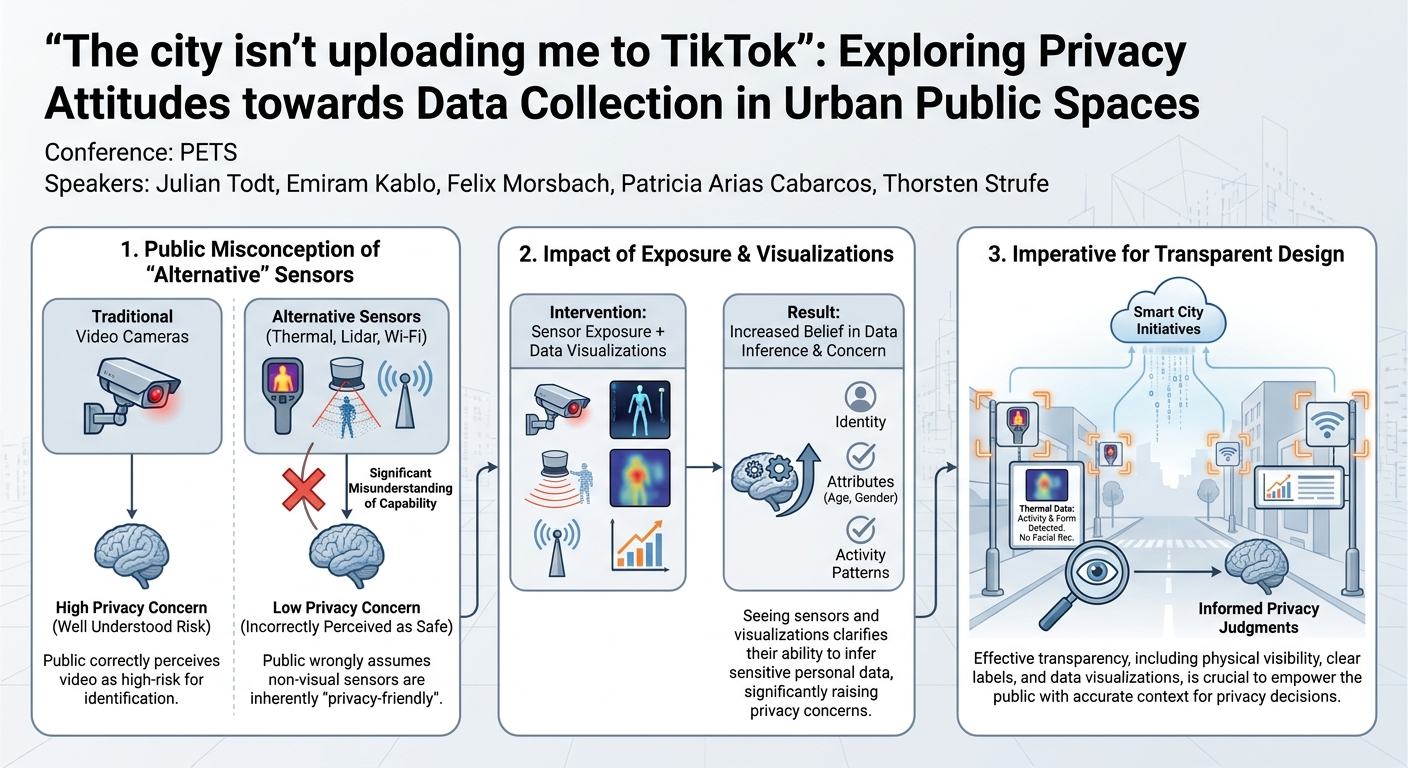
- Video Cameras: The inference capabilities of traditional video cameras were "well understood," with a high majority of participants correctly believing that these cameras could infer various attributes and facilitate identification.
- Alternative Sensors: In contrast, there was "significant misconception" regarding alternative sensors. A large majority of participants incorrectly believed that these sensors were not capable of making similar inferences. For example, many did not realize that thermal cameras or depth cameras could reveal personal attributes or identity.
- Wi-Fi Identification: A notable 71% of participants believed that identification through Wi-Fi was possible. However, qualitative findings suggested this belief was predominantly tied to scenarios where individuals were actively connected to a network. This highlights a critical gap, as literature confirms that identification is possible even via device-free wireless sensing, without direct network connection.
Initial Concerns (Before Intervention):
Prior to the intervention, participants' concern levels varied significantly across sensor types:
- Highest Concern: Predictably, video cameras elicited the most significant concerns from participants.
- Lowest Concern: Radar technologies generated the least concern, aligning with the general misconception about alternative sensors' capabilities.
- Reasons for Concerns: Participants' concerns were highly dependent on their perceived transparency and understanding of the technology. Key factors included not knowing when data was being collected, for what purpose, or how it would be used. While familiarity and perceived usefulness could slightly mitigate these concerns, the lack of transparency was a dominant driver.
- Reasons for Non-Concerns: Conversely, reasons for lower concerns included the perception that technologies were generally "safe" or "useful," particularly when participants were familiar with them. A "clear social benefit" or the operation under "legitimate authority" also reduced concerns. For instance, one participant in Germany felt protected by the GDPR.
Change of Inference Beliefs (After Intervention):
The intervention, which involved exposure to sensors and, for the treatment group, visualizations, significantly altered participants' beliefs about sensor capabilities:
- Control Group (Sensors Only): Even just seeing the physical sensors led to statistically significant increases in belief that a depth camera could reveal age, and that thermal and depth cameras could reveal an individual's identity. This suggests that mere physical presence can trigger some realization.
- Treatment Group (Sensors + Visualizations): This group, exposed to visualizations of the data, showed an even more pronounced shift. There was a statistically significant increase in the belief that thermal cameras could reveal identity, age, and origin, and similarly for video cameras.
- General Trend: Overall, the intervention led to an "increased belief of personal identifiable information (PII) inference" specifically for image-based sensors (e.g., video, thermal, depth cameras). In contrast, non-image-based sensors (like radar or Wi-Fi) appeared less revealing to participants even after the intervention, indicating that the visualizations primarily clarified the capabilities of visual/imaging technologies.
Change of Concerns (After Intervention):
The intervention also had a substantial impact on participants' levels of concern:
- Increased Concerns: For "nearly every sensor group pair," there was an observed increase in concern levels (measured on a Likert scale from 1 to 5).
- Treatment Group Reasons: Participants in the treatment group attributed their increased concerns to a realization that "more data was being collected than previously assumed" or that the data was "actually clearer" than they initially thought. The visualizations made the abstract concrete.
- Control Group Reasons: For the control group, reasons for increased concerns were more "emotional," with participants reporting that they "felt observed" simply by the physical presence of the sensors.
- Reasons for Decreased Concerns: In some cases, concerns decreased. This occurred when participants realized "less data was being collected than they initially expected" or when the data appeared "abstract or non-threatening" to them.
- Overall Realization: The study concluded that the intervention facilitated a "realization" among participants. Crucially, the visualizations played a key role in reducing uncertainty and helping participants, especially those who were initially uncertain, to form a more informed privacy judgment.
Technical Deep Dive
▶ Watch: Initial concerns: Transparency and understanding are key (3:55)
The study's methodology was robust, centered around an intervention-based lab study utilizing a meticulously designed smart city prototype. This prototype was envisioned as a realistic "train station scenario," a common urban public space where individuals frequently move through choke points and are exposed to various sensing technologies.
Participants in the study walked through a simulated turnstile within this prototype environment, all while being "recorded" by a suite of commonly proposed alternative sensors. The specific sensors deployed included:
- Millimeter Wave Radar: This technology uses radio waves to detect presence, motion, and in some advanced applications, even fine-grained movements like breathing, without capturing visual information.
- Lidar (Light Detection and Ranging): Lidar sensors emit pulsed lasers to measure distances and create highly accurate 3D point clouds of the environment and objects within it. While often touted as privacy-preserving due to its non-photographic nature, these point clouds can still reveal body shape, size, gait, and track individual movements over time, potentially leading to identification.
- Thermal Imaging Cameras: These cameras detect infrared radiation (heat) emitted by objects and people, forming an image based on temperature differences. While not capturing facial features, they can clearly delineate human forms, infer activity, and in some contexts, even provide clues about age or origin based on thermal signatures and clothing.
- Regular Video Cameras: Included as a baseline, these represent the traditional visual surveillance technology, known for its high capacity to capture PII.
- Depth Cameras: Similar to those used in gaming consoles or facial recognition systems, depth cameras capture 3D spatial information. They can detect human skeletons, body posture, and movement, inferring activities and potentially identity without capturing traditional visual images.
- Wi-Fi Antennas: These sensors detect Wi-Fi signals. While often associated with network connectivity, the study highlights their capability for device-free wireless sensing, meaning they can detect the presence, movement, and even identify individuals based on their unique Wi-Fi signal reflections, even if their devices are not actively connected to a network. This capability was a significant point of public misconception.
The study involved 172 participants, evenly distributed between a control group and a treatment group. Both groups experienced the smart city prototype and saw the physical sensors. However, the crucial differentiator was the visualizations provided to the treatment group. These visualizations were "designed to be straightforward and with minimal processing," aiming to make the abstract data collection capabilities of the sensors more tangible and understandable. For example, a visualization for a depth camera might show a skeletonized representation of a person, or for Lidar, a point cloud representation, rather than a full photographic image. This direct visual feedback was intended to bridge the gap between perceived and actual sensor capabilities.
The research design allowed for within-subject differences to be investigated by administering pre- and post-intervention questionnaires. Before the intervention, participants were asked about their awareness of each sensor's inference capabilities and their concerns about being recorded. After walking through the prototype (and seeing visualizations for the treatment group), these questions were repeated. This enabled a direct comparison of how exposure and information influenced participants' beliefs and concerns. The findings consistently demonstrated that, particularly for image-based sensors, providing even basic visualizations or simply exposing individuals to the physical sensors could significantly increase their understanding of PII inference and consequently, their privacy concerns. The persistent misconception regarding device-free wireless sensing via Wi-Fi antennas, despite a high initial belief in Wi-Fi identification (albeit for different reasons), underscores the challenge of communicating advanced technical capabilities to a general audience.
Demo / Proof of Concept
▶ Watch: Impact of intervention: Increased belief in PII inference (5:00)
While this talk did not present a traditional "product demonstration" or "exploit proof-of-concept," the entire intervention-based lab study itself served as a sophisticated demonstration of how smart city sensing technologies operate and what data they can reveal. The core of this demonstration was the smart city prototype, envisioned as a train station scenario. This physical environment, equipped with a range of alternative sensors, allowed participants to directly experience what it feels like to be subject to pervasive data collection in a public space.
Participants were not merely told about sensors; they actively walked through an area where millimeter wave radar, Lidar, thermal imaging cameras, regular video cameras, depth cameras, and Wi-Fi antennas were deployed. This hands-on, immersive experience was critical for the study's findings, as it moved the discussion from abstract concepts to tangible reality.
Furthermore, a key element of the "proof of concept" was the use of visualizations for the treatment group. These visualizations, displayed in real-time or near real-time, were designed to be "straightforward and with minimal processing." They acted as a direct demonstration of the type of data each sensor could collect and what inferences could be drawn from it, even if the raw, complex data streams were not fully exposed. For example, showing a skeletal representation from a depth camera or a heat map from a thermal camera provided a concrete illustration of PII inference without necessarily revealing explicit facial details. This visual evidence was instrumental in demonstrating to participants that even "privacy-friendly" alternative sensors could still capture information that contributes to identity inference or reveals personal attributes, thereby serving as a powerful proof-of-concept for the actual capabilities of these technologies. The study successfully demonstrated that seeing these sensors in action, especially with accompanying visualizations, significantly alters public perception and concern.
Defensive Implications
▶ Watch: Key takeaways: Transparency, understanding, and context matter (7:00)
The findings of this research carry significant implications for individuals, organizations, and policymakers involved in urban development and privacy protection. The prevalent incomplete understanding of smart city sensor capabilities among the public represents a substantial vulnerability. Defenders, whether individuals or privacy advocates, cannot assume that the public inherently understands the risks posed by these technologies.
Firstly, there is an urgent need for enhanced public education and awareness campaigns. These initiatives should clearly describe the specific privacy implications of various sensor types, moving beyond generic statements to explain what attributes and activities can be inferred and how identification is possible even with "alternative" sensors. This includes clarifying concepts like device-free wireless sensing for Wi-Fi, which remains largely misunderstood.
Secondly, the researchers recommend regulatory interventions to scrutinize and potentially restrict "privacy-friendliness claims" made by industry or government bodies. Unsubstantiated claims mislead the public and undermine trust. Regulations should demand transparent, evidence-based disclosures about actual data collection capabilities and risks associated with each sensor type. This could involve mandatory third-party audits or standardized privacy impact assessments for all public space deployments.
Thirdly, transparency must become a cornerstone of smart city design. This involves making sensor technologies physically visible in public spaces, rather than concealing them. Beyond visibility, transparency formats such as clear labels, informative visualizations, and explicit warnings (e.g., audio announcements, universally recognized icons) should be employed to communicate when data is being collected, for what purpose, and by whom. The study demonstrated that visualizations significantly reduce uncertainty and help individuals form informed privacy judgments. Developing and standardizing effective transparency formats that convey complex technical information simply and intuitively is a crucial area for future work.
Finally, the research highlights that privacy concerns are profoundly contextual, depending heavily on the "purpose of the data collection" and the "location of the sensor." This means that a one-size-fits-all approach to privacy protection will be insufficient. Defensive strategies must incorporate this contextual understanding. For instance, data collection for public safety in a high-risk area might be perceived differently than collection for commercial analytics in a recreational park. Future defensive frameworks should consider the lens of contextual integrity, investigating specific information flows, including the data recipient, the attributes being collected, and the transmission principles. This approach can help design nuanced policies that align data collection practices with societal norms and expectations for specific contexts, rather than relying on blanket prohibitions or permissions. Ultimately, defenders must push for proactive, transparent, and context-aware privacy safeguards that empower individuals with knowledge and control, rather than leaving them vulnerable to unknown surveillance capabilities.
Key Takeaways
- Public Misconception: There is a widespread and significant misunderstanding among the public regarding the actual data inference capabilities of alternative smart city sensors (e.g., thermal, Lidar, depth cameras, wireless sensing), often incorrectly perceiving them as more privacy-friendly than they are.
- Transparency Drives Judgment: Privacy judgments are heavily influenced by the transparency and clarity of information provided about sensor technologies. When individuals learn more about what data is collected, their concerns and beliefs about PII inference significantly increase.
- Visualizations are Key: Explicit visualizations of sensor data, even if abstract, are highly effective in reducing uncertainty and helping individuals form informed privacy judgments, particularly for image-based sensors.
- Physical Visibility Matters: Simply making sensors physically visible in public spaces can trigger a "feeling of being observed" and increase concerns, even without explicit data visualizations.
- Context is Paramount: Privacy concerns related to smart city sensing are highly contextual, depending on factors such as the purpose of data collection, the location of the sensor, and the perceived legitimacy of the authority collecting the data.
- Regulatory & Design Imperatives: There is a clear need for regulatory oversight on "privacy-friendly" claims for alternative sensors and for smart city designers to implement proactive transparency measures, including physical visibility, clear labels, and effective data visualizations.
About the Speaker(s)
The talk was presented by Julian Todt and Miriam Kablo, who are among the paper's authors. Julian Todt is affiliated with the Karlsruhe Institute of Technology, and Emiram Kablo is associated with Paderborn University. Their co-authors include Felix Morsbach, also from the Karlsruhe Institute of Technology; Patricia Arias Cabarcos of the European Commission, Joint Research Centre (JRC); and Thorsten Strufe, also from the Karlsruhe Institute of Technology. Their collective expertise spans privacy, human-computer interaction, and smart city technologies, contributing to this critical investigation into public attitudes towards urban data collection.
Reviews
Dr. Zero (Offensive Security Researcher) — STRONG ACCEPT
Todt and Kablo built a fake train station just to prove what we already knew: the public is clueless about ambient surveillance. But more importantly, they empirically dismantled the 'privacy-preserving' marketing bullshit that smart city vendors slap on Lidar and thermal cameras. It's solid usable-privacy research that arms regulators with actual data.
Heather Calloway (CISO) — MUST SEE
This research systematically dismantles the vendor lie that non-video sensors like Lidar and thermal are inherently privacy-friendly. It proves that public trust collapses the moment people see what these tools actually collect. If your organization is modernizing physical security or retail analytics with 'anonymized' sensors, your leadership team needs to understand the privacy exposure you are actually buying.
→ Top-rated talks at Privacy Enhancing Technologies Symposium (PETS) 2026
All talks from Privacy Enhancing Technologies Symposium (PETS) 2026