More Modalities, More Problems: Examining User Understanding of The Meta Quest Permissions Framework
Sarah Radway (Paper author · Harvard University), Matthew Soto (Paper author · Tufts University), Suvi Lama (Paper author · University of Southern Mississippi), Carson Powers (Paper author · Tufts University), Daniel Votipka (Paper author · Tufts University)
Privacy Enhancing Technologies Symposium (PETS) 2026 · Day 3 · Moose
Overview
In an era where virtual reality (VR) devices are becoming increasingly ubiquitous, the privacy implications of the vast amounts of highly sensitive data they collect are a pressing concern. This talk, presented by Sarah Radway and her co-authors from Harvard University, Tufts University, and the University of Southern Mississippi, delves into a critical aspect of this challenge: user understanding of the Meta Quest permission framework. The research highlights a significant disconnect between the sophisticated data collection capabilities of devices like the Meta Quest 2 and the user's perception and control over their biometric information.
Key moments
- 0:00 Introduction: VR data privacy risks and Quest 2 context
- 2:35 Meta Quest's 'ask once per device' global permissions flow
- 4:00 Study methodology: interviewing users about Quest 2 permissions
- 4:55 Major user misconceptions about VR data collection
- 6:05 Users often miss passive VR data tracking
- 7:30 Proposed new indicators: passthrough with tracking points
- 8:15 User concerns about global permissions' privacy overreach
More Modalities, More Problems: Examining User Understanding of The Meta Quest Permissions Framework
Speakers: Sarah Radway (Paper author, Harvard University); Matthew Soto (Paper author, Tufts University); Suvi Lama (Paper author, University of Southern Mississippi); Carson Powers (Paper author, Tufts University); Daniel Votipka (Paper author, Tufts University)
Conference: PETS
YouTube: https://www.youtube.com/watch?v=Qcmb9V5JhY8
Overview
In an era where virtual reality (VR) devices are becoming increasingly ubiquitous, the privacy implications of the vast amounts of highly sensitive data they collect are a pressing concern. This talk, presented by Sarah Radway and her co-authors from Harvard University, Tufts University, and the University of Southern Mississippi, delves into a critical aspect of this challenge: user understanding of the Meta Quest permission framework. The research highlights a significant disconnect between the sophisticated data collection capabilities of devices like the Meta Quest 2 and the user's perception and control over their biometric information.
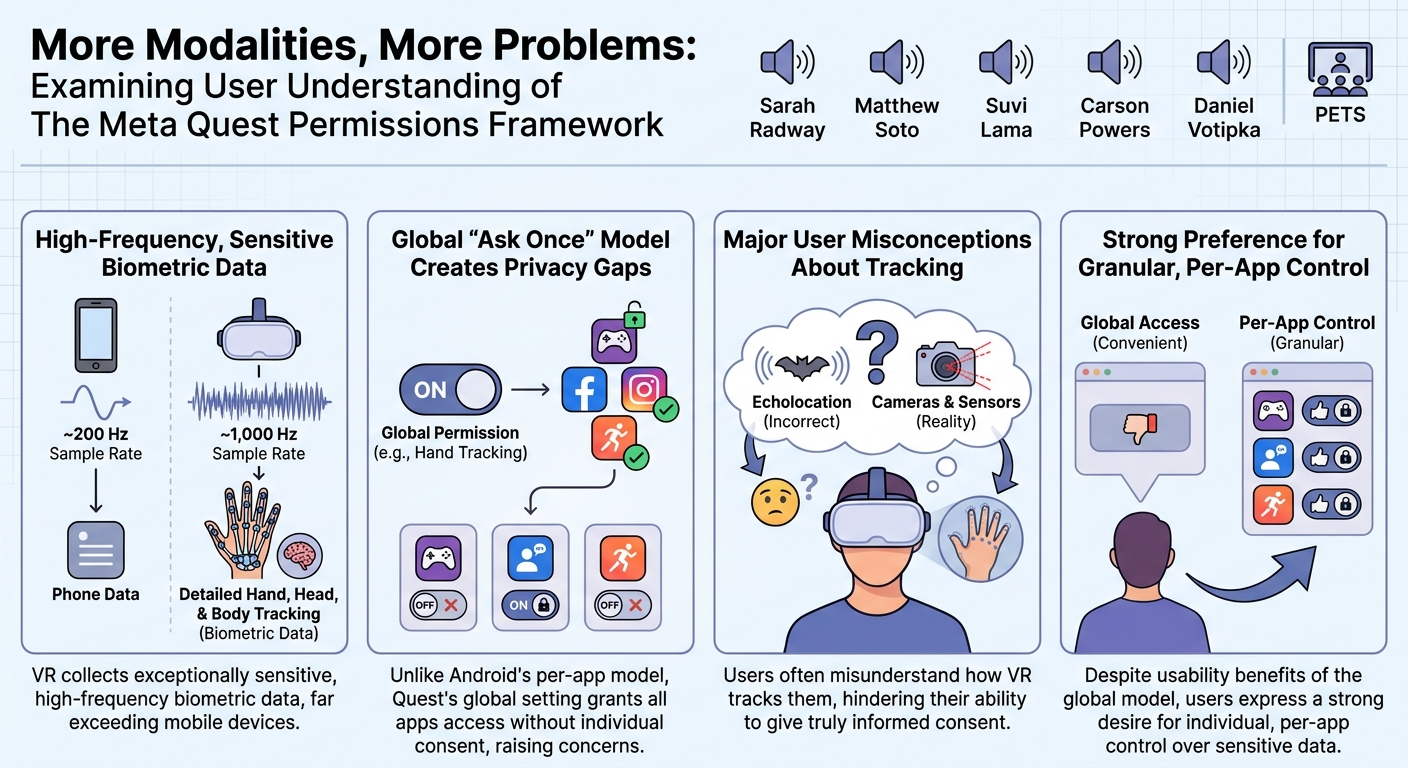
The core of the issue lies in the unique nature of VR data, which necessitates frequent and granular collection of biometric information such as hand, head, and body movements. Unlike traditional mobile devices, VR headsets operate at significantly higher sampling rates—up to 1,000 Hz on the Quest 2 compared to a typical smartphone's 200 Hz—capturing intricate details of user interaction and physiology. This rich data stream, while crucial for an immersive experience, introduces profound privacy risks, including the potential for user identification, inference of personal attributes like cognitive load, and even the detection of medical conditions such as anxiety or Parkinson's. The talk underscores the urgent need to re-evaluate how permission systems, the primary mechanism for user data control, are designed and communicated in this emerging modality.
The study specifically investigates the Meta Quest 2, the most popular VR headset at the time of the research, which leverages an operating system built upon the Android Open Source Project (AOSP). While many traditional Android permissions are replicated, the Quest 2 introduces a novel "global permissions flow" for new biometric data types. This departure from Android's familiar per-app prompt model for sensitive data creates a critical privacy gap. The research team explored how users interpret these new permissions and data flows, revealing major misconceptions and concerns that challenge the notion of informed consent in VR environments.
Background
▶ Watch: Introduction: VR data privacy risks and Quest 2 context (0:00)
The rapid evolution of virtual reality technology has brought with it an unprecedented capacity for data collection, fundamentally altering the landscape of digital privacy. VR devices, exemplified by the Meta Quest 2, are designed to create highly immersive and realistic experiences, which inherently demand the precise and continuous collection of user data. This includes detailed biometric information such as hand tracking (capturing 26 distinct points on a user's hand), head tracking, and body data. The sheer frequency of this collection is a key differentiator; the Quest 2 is capable of sampling data at up to 1,000 Hz, a five-fold increase over the typical 200 Hz sampling rate found in Android smartphones. This high-resolution, high-frequency data is essential to prevent adverse user experiences like decreased realism or medical side effects such as nausea, but it also renders the data exceptionally sensitive.
Previous research has already illuminated the profound privacy implications of such intensive data collection. This biometric data can be leveraged to uniquely identify users, infer a wide range of personal attributes (from physical characteristics to mental states like cognitive load), and even detect sensitive medical conditions, including anxiety and Parkinson's disease. Given these substantial risks, permission systems emerge as the frontline defense, serving as the primary mechanism through which users can control access to their personal data.
The Meta Quest operating system, being built on the Android Open Source Project (AOSP), shares a foundational architecture with Android devices. This lineage naturally leads to an expectation of parallel permission systems. On a typical Android smartphone, users are accustomed to a clear, contextual pop-up whenever an app requests access to sensitive data types, such as the microphone. These permissions are often assigned a protection level of dangerous, signifying their potential impact on user privacy and necessitating explicit, per-app user consent. For instance, the RECORD_AUDIO permission, which grants microphone access, is classified as dangerous on Android and, consequently, on the Quest 2, triggering a familiar pop-up.
However, the Quest 2 introduces a critical divergence for its new, highly sensitive biometric data types: hand, head, and body tracking. Instead of the familiar per-app, contextual prompts, Meta implemented a new global permissions flow. This system requires users to navigate to a dedicated settings page, toggle the permission on, review a privacy notice, and complete a brief tutorial. Crucially, these new biometric permissions are assigned a protection level of normal, not dangerous. This seemingly minor technical distinction has a profound practical consequence: it transforms them into an "ask once per device" permission. Once a user enables hand tracking, for example, all applications on the device can access this data without requiring individual, per-app consent. This contrasts sharply with Android's "special permissions," which, while also requiring a visit to settings, maintain their dangerous protection level and thus demand per-app activation (e.g., enabling "Do Not Disturb" for Instagram and then separately for Snapchat). This novel permission architecture on the Quest 2, coupled with the inherent sensitivity of VR biometric data, formed the impetus for the research team to investigate how users truly interpret and understand these new permission flows and the scope of data collection.
Key Findings
▶ Watch: Study methodology: interviewing users about Quest 2 permissions (4:00)
The study, conducted through semi-structured interviews with 23 participants recruited from a university campus, involved hands-on interaction with a real Meta Quest 2 headset. Participants engaged with five distinct applications: one control app (no permissions), two requesting microphone access (triggering traditional Android pop-ups), and two requesting hand tracking (one initiating the global flow, the other automatically granted access). The findings revealed several critical insights into user perception and understanding of VR data collection and permission frameworks.
First and most broadly, the research exposed major misconceptions surrounding VR data collection. Participants demonstrated a profound lack of understanding regarding how the device tracks their movements. Extreme examples included one participant believing hand tracking occurred via "echolocation" and another repeatedly asserting it was "through my eyeballs." These fundamental misunderstandings raise serious questions about the validity of informed consent in VR. If users hold such basic inaccuracies about the underlying technology, their ability to make informed decisions about data sharing is severely compromised. The study suggests a pressing need for platforms to educate users on the technical mechanisms of data collection.
Second, the study highlighted a significant disparity in user awareness between active tracking and passive tracking. Participants readily recognized active tracking, which involves actions directly related to gameplay or specific interactions (e.g., pressing a button, slashing a block in Beat Saber). However, they rarely noted instances of passive tracking, such as gait analysis or general movement within a physical space that is not directly tied to an in-game action. This indicates that users perceive data collection as event-driven and intentional, rather than continuous and pervasive. This limited understanding of the scope of tracking means users may not realize their movements are being monitored constantly, not just during explicit interactions.
Third, the researchers found that experienced users of VR headsets generally possessed a better understanding of the differences between immersive and non-immersive modalities. This suggests that initial exposure to VR technology presents a steep learning curve for privacy comprehension. The implication is that notifications about data collection, particularly those occurring only "on first use," might be insufficient. New users, lacking prior context, are least equipped to understand the implications. The study proposes rethinking notification strategies, potentially including re-prompting users later on, once they have gained more familiarity with the VR environment and its unique characteristics.
Fourth, participants frequently derived data collection mental models from interactions with previous technology. While some existing indicators proved effective (e.g., a microphone indicator light on the Quest 2, similar to those seen on tablets), others led to incorrect assumptions. For instance, one participant incorrectly assumed the Quest 2 was tracking their heart rate because the controllers or headset visually resembled a device they had previously used that performed such tracking. This reliance on outdated or inappropriate mental models highlights that current indicators are often ineffective or misleading in the novel VR context, underscoring the need for new, modality-specific indicators.
Finally, regarding the new global permissions flow for biometric data, the study yielded mixed results. On the positive side, participants did understand that enabling this permission was a global setting, largely because they had to navigate to a dedicated global settings page. This indicates good usability in terms of communicating the global scope. However, this understanding was tempered by significant privacy concerns. While users acknowledged the convenience of a one-time activation, many expressed confusion and discomfort that the permission was not requested on a per-app basis. Several participants explicitly stated they wished to be asked multiple times or for every game, indicating a desire for more granular control over highly sensitive biometric data. This finding reveals a fundamental tension between usability (the "ask once per device" framework) and privacy control, suggesting that current implementations may prioritize convenience over user privacy expectations for such sensitive information.
Technical Deep Dive
▶ Watch: Major user misconceptions about VR data collection (4:55)
The Meta Quest 2's operating system, built upon the Android Open Source Project (AOSP), forms the technical backbone for its permission framework. This foundation dictates many parallels with traditional Android permissions, but the unique requirements of virtual reality introduce significant modifications, particularly concerning biometric data.
The core data types at the heart of this discussion are hand, head, and body tracking. For example, hand tracking on the Quest 2 is remarkably granular, capturing 26 distinct points on the user's hand. This level of detail, combined with exceptionally high sampling rates, underscores the sensitivity of the data. While typical Android smartphones might sample data at around 200 Hz, the Quest 2 is capable of capturing this biometric information at up to 1,000 Hz. This high frequency is critical for maintaining an immersive VR experience, preventing latency-induced nausea, and ensuring realistic interactions. However, it also means that a vast, continuous stream of deeply personal data is being collected, far exceeding the volume and resolution of typical mobile device data.
When comparing the permission systems of Android and the Quest 2, the researchers identified both similarities and critical differences.
Similarities: For permissions that pre-existed on Android, such as RECORD_AUDIO (microphone access), the Quest 2 largely mirrors the Android implementation. These permissions are assigned a protection level of dangerous within the system manifest files. This classification dictates that any application requesting such a permission must trigger a clear, explicit user interface (UI) pop-up, requiring the user to grant or deny access. This familiar, contextual prompt ensures that users are actively aware when sensitive data is being requested by a specific application.
Differences and the New Global Permissions Flow: The significant divergence occurs with the introduction of new biometric data types: hand, head, and body tracking. For these, Meta implemented a novel global permissions flow. Instead of per-app pop-ups, users must navigate to the device's global settings page. There, they find a toggle to enable or disable these tracking features. Activating the toggle triggers a privacy notice, followed by a brief tutorial on how to use the feature (e.g., how to click and scroll with hand tracking).
Crucially, these new biometric permissions are assigned a protection level of normal in the Quest 2's system manifest files. This is a critical technical distinction from dangerous permissions. While Android also has "special permissions" that require users to go to settings (e.g., enabling "Do Not Disturb" for an app), those special permissions often retain their dangerous protection level, meaning they still require individual, per-app activation. In contrast, the normal protection level for Quest's biometric permissions translates into an "ask once per device" model. Once a user enables hand tracking (or head/body tracking) in the global settings, all applications on the Meta Quest 2 gain access to this data without any further individual prompts or consent requests from specific apps. This fundamental architectural choice dramatically shifts the locus of control and transparency from the application-level to a device-wide setting, impacting user privacy.
The research methodology itself employed a rigorous approach to assess user understanding. The semi-structured interview study involved 23 participants interacting with a live Quest 2 headset. The experimental design included five distinct application scenarios:
- Control Application: No permissions requested, establishing a baseline.
- Microphone App 1 & 2: Both requested
RECORD_AUDIO, triggering the traditional Android-style pop-up. This allowed the researchers to observe user familiarity with existing permission models. - Hand Tracking App 1: This app was designed to be the first to request hand tracking from the user, thereby triggering the new global permissions flow (settings toggle, privacy notice, tutorial).
- Hand Tracking App 2: This app requested hand tracking after it had already been globally enabled by the user via App 1. Consequently, it was automatically granted the permission without any further user interaction or prompt.
Through these scenarios, the study meticulously assessed two primary areas:
- Participant perception of data collection: This involved probing participants on what data they believed was being collected, how it was being collected, and why it was necessary. This aimed to address the second research question: "how users interpret Quest 2's collection of new biometric data types."
- Participant understanding of permission requests: This focused on whether users understood what they were agreeing to when interacting with permission prompts, particularly the scope of both traditional microphone permissions and, more critically, the new global hand tracking permission. This addressed the third research question: "how users interpret new permissions flows."
The technical design of the Quest 2's permission system, particularly the normal protection level for biometric data and the resulting "ask once per device" model, is the central technical detail driving the study's findings regarding user misunderstanding and privacy concerns. It represents a significant architectural decision with profound implications for user privacy in immersive environments.
Demo / Proof of Concept
▶ Watch: Proposed new indicators: passthrough with tracking points (7:30)
This talk primarily presented findings from a comprehensive user study rather than a traditional technical demonstration or proof of concept of an exploit. However, the study itself served as a powerful "proof of concept" for the lack of user understanding regarding the Meta Quest 2's permission framework and the practical implications of its design choices.
The "demonstration" within the study involved 23 participants directly interacting with a live Meta Quest 2 headset and a controlled set of five applications. This setup allowed the researchers to observe user behavior and elicit their mental models in response to both familiar Android-style permission prompts (for microphone access) and the novel global permission flow for hand tracking. The sequence where the first hand-tracking app triggered the global settings flow, and a subsequent hand-tracking app automatically gained access without further prompting, effectively demonstrated the "ask once per device" mechanism in action from a user's perspective. While not a technical exploit, this empirical demonstration highlighted the critical gap between the system's design and user comprehension, proving that the current implementation leads to significant privacy blind spots for the average user.
Defensive Implications
▶ Watch: User concerns about global permissions' privacy overreach (8:15)
The findings from this study have crucial defensive implications for both platform developers, particularly Meta, and end-users of VR devices. Addressing these issues is paramount to building a trustworthy and privacy-respecting immersive ecosystem.
For Platform Developers (e.g., Meta):
- Enhance User Education on Data Collection Mechanisms: The pervasive misconceptions about how VR data is collected (e.g., "echolocation," "through my eyeballs") indicate a severe failure in user education. Platforms must develop intuitive and accessible mechanisms to explain the underlying technology. This could involve interactive tutorials that visually demonstrate the 26 tracking points on a hand, or use passthrough mode (where the user sees their real-world surroundings through the VR cameras) to explicitly show when cameras are active for tracking. Overlaying visual cues onto the passthrough view, such as the actual tracking points, could significantly improve understanding.
- Improve Awareness of Passive vs. Active Tracking: Users primarily recognize active tracking. Platforms need to better cue users to the continuous nature of data collection. This could involve persistent visual indicators when passive tracking is active, or periodic reminders about the scope of data collection, emphasizing that movement is tracked even when not directly interacting with an application feature.
- Re-evaluate "First Use" Notification Strategies: The finding that experienced users have better understanding suggests that single "first use" notifications are insufficient for complex new modalities like VR. Platforms should consider strategies for re-prompting users or providing refresher courses on privacy settings, especially after significant software updates or after a certain period of device ownership. Contextual prompts that reappear after a user has gained more experience could be more effective.
- Develop New, Effective Permission Indicators for VR: Reliance on mental models from older technologies (e.g., mic lights) is insufficient for VR's unique data types. New, modality-specific indicators are needed. Beyond passthrough overlays, this could include subtle haptic feedback, audio cues, or dedicated UI elements within the VR environment that clearly and unambiguously communicate when specific data types are being accessed. These indicators must be distinct and intuitive within the immersive context.
- Reconsider the "Ask Once Per Device" Model for Sensitive Biometric Data: The primary finding regarding privacy concerns with the global permission flow highlights a critical design flaw. For highly sensitive biometric data like hand, head, and body tracking, a "normal" protection level leading to "ask once per device" is inadequate. Meta should explore implementing more granular, per-app permission controls for these data types, similar to how Android handles
dangerousspecial permissions. If a global toggle is maintained for usability, it should be accompanied by clear, persistent warnings about its scope and an easy-to-access review mechanism for users to see which apps are currently leveraging the global permission. Furthermore, the platform could investigate "just-in-time" prompts that appear when an app first attempts to use a globally enabled permission, even if the global toggle is on.
For Users of Meta Quest Devices:
- Be Aware of Data Sensitivity: Understand that your VR headset collects highly sensitive biometric data (hand movements, head position, body posture) at very high frequencies (up to 1,000 Hz). This data can reveal deeply personal information, far beyond what traditional smartphones collect.
- Understand Global Permissions: Recognize that enabling permissions like "Hand Tracking" in your Quest's settings grants access to all applications on the device, not just the one that initially prompted you. There is no per-app consent for these specific biometric data types once the global toggle is on.
- Actively Review Privacy Settings: Regularly visit the privacy settings on your Meta Quest device. Understand which global permissions are enabled and what data they allow apps to access. If you are not actively using a feature like hand tracking, consider disabling it.
- Seek Information: Don't rely solely on default notifications. Actively seek out information from Meta's privacy policy or support documentation to understand how your device tracks you and what data is being collected.
- Exercise Caution with New Apps: When installing new applications, be mindful that if global biometric permissions are enabled, these new apps will automatically gain access to that data without explicit consent. Research an app's privacy practices before installing if this is a concern.
Ultimately, the defensive implications underscore the need for a fundamental shift in how privacy is approached in VR. It requires a move beyond simply replicating mobile permission models to designing systems that genuinely empower users with informed control over their highly sensitive biometric data in a complex, immersive environment.
Key Takeaways
- VR data is exceptionally sensitive and frequently collected: Devices like the Meta Quest 2 collect highly detailed biometric data (e.g., 26 hand points, head, body tracking) at significantly higher sampling rates (up to 1,000 Hz) than traditional smartphones, enabling inferences about personal attributes and even medical conditions.
- Meta Quest 2's global permissions framework for biometric data creates a privacy risk: Unlike Android's per-app "dangerous" permissions, Quest's hand, head, and body tracking permissions are "normal" and operate on an "ask once per device" model. Once enabled in settings, all apps gain access without individual prompts, leading to user confusion and privacy concerns.
- Users harbor major misconceptions about VR data collection: Many users lack a fundamental understanding of how their VR headset tracks data (e.g., believing in "echolocation"), hindering their ability to provide informed consent regarding data sharing.
- Current permission indicators and "first use" prompts are inadequate for VR: Users often rely on outdated mental models from other technologies, and single-instance notifications for new modalities are insufficient. New, intuitive, and persistent indicators (e.g., visual overlays in passthrough mode showing tracking points) are needed.
- The balance between usability and privacy control is critical in VR: While a global, one-time permission offers usability benefits, users expressed a strong desire for more granular, per-app control over highly sensitive biometric data, highlighting a tension that platforms must address.
- Enhanced user education and transparency are crucial for informed consent: Platforms must invest in better mechanisms to explain what data is collected, when it's collected (active vs. passive tracking), and what it can be used for, to truly empower users in the VR ecosystem.
About the Speaker(s)
The research presented in this talk was a collaborative effort by a team of academics from several institutions. Sarah Radway, serving as a paper author, represents Harvard University. She delivered the talk, articulating the team's findings and implications. Her co-authors include Matthew Soto and Carson Powers from Tufts University, Suvi Lama from the University of Southern Mississippi, and Daniel Votipka, also from Tufts University. Together, their interdisciplinary expertise contributed to this important investigation into user understanding of privacy frameworks in virtual reality.
Reviews
Dr. Zero (Offensive Security Researcher) — SOLID
This is competent usable-privacy research that exposes how Meta actively downgraded 1000Hz biometric telemetry to 'normal' AOSP permissions to bypass per-app consent. Half the talk is standard academic HCI fluff about confused users, but the underlying architectural observation is dead on. Solid work for a privacy con.
Heather Calloway (CISO) — MUST SEE
If your company is piloting VR headsets for remote collaboration or employee training, this research is mandatory reading for your procurement and privacy teams. It proves that the underlying permission model of the Meta Quest fundamentally fails to isolate sensitive biometric telemetry between applications. You cannot rely on user consent or standard OS sandboxing to protect corporate data on this platform.
→ Top-rated talks at Privacy Enhancing Technologies Symposium (PETS) 2026
All talks from Privacy Enhancing Technologies Symposium (PETS) 2026