User Perceptions and Attitudes Toward Untraceability in Messaging Platforms
Carla Florencia Griggio (Paper author · Department of Computer Science, Aalborg University), Boel Nelson (Paper author · Department of Computer Science, University of Copenhagen), Zefan Sramek (Paper author · IIS Lab, The University of Tokyo), Aslan Askarov (Paper author · Department of Computer Science, Aarhus University)
Privacy Enhancing Technologies Symposium (PETS) 2026 · Day 3 · Moose
Overview
This talk delves into the critical, yet often overlooked, area of user perceptions and attitudes towards untraceability in messaging platforms. Presented by one of the paper authors, this joint work with Carla Florencia Griggio, Boel Nelson, Zefan Sramek, and Aslan Askarov, aims to bridge the gap between sophisticated privacy-enhancing technologies and the actual understanding and needs of end-users. The core objective of the research is to ascertain whether users truly understand, desire, and value the specific type of untraceability that anonymous communication protocols are designed to provide, particularly at the network layer.
Key moments
- 0:00 Introduction to untraceability and privacy trilemma
- 2:00 Low user adoption motivates a user study
- 3:40 User study methodology with positive and negative vignettes
- 5:35 Crucial finding: Users unaware of network layer threats
- 7:00 User requested features and three privacy personas
- 8:10 Addressing misconceptions and design implications for untraceability
User Perceptions and Attitudes Toward Untraceability in Messaging Platforms
Speakers: Carla Florencia Griggio, Paper author, Department of Computer Science, Aalborg University; Boel Nelson, Paper author, Department of Computer Science, University of Copenhagen; Zefan Sramek, Paper author, IIS Lab, The University of Tokyo; Aslan Askarov, Paper author, Department of Computer Science, Aarhus University
Conference: PETS
YouTube: https://www.youtube.com/watch?v=iYhA5813E48
Overview
This talk delves into the critical, yet often overlooked, area of user perceptions and attitudes towards untraceability in messaging platforms. Presented by one of the paper authors, this joint work with Carla Florencia Griggio, Boel Nelson, Zefan Sramek, and Aslan Askarov, aims to bridge the gap between sophisticated privacy-enhancing technologies and the actual understanding and needs of end-users. The core objective of the research is to ascertain whether users truly understand, desire, and value the specific type of untraceability that anonymous communication protocols are designed to provide, particularly at the network layer.
The significance of this research stems from the persistent challenge of low user adoption rates for deployed anonymous communication systems like Tor, Lokinet, and Nym. Despite decades of cryptographic and network protocol innovation, these systems struggle to attract a broad user base. The presenters, themselves protocol designers, questioned if their focus on technical trade-offs aligns with what users actually want or perceive as necessary. This talk posits that a lack of user awareness and prevalent misconceptions about untraceability might be key impediments to wider adoption, suggesting that purely technical advancements are insufficient without a deeper understanding of human factors.
By exploring user mental models of privacy and untraceability, the research seeks to inform future protocol design and communication strategies. It highlights the potential disconnect between the rigorous definitions of untraceability held by security researchers (e.g., protection against network-layer traffic analysis) and the broader, often more superficial, understanding held by the general public. Understanding these perceptions is crucial for designing systems that not only offer strong privacy guarantees but also resonate with user needs, ultimately fostering greater adoption and, consequently, stronger privacy for all participants within an anonymity set.
Background
▶ Watch: Introduction to untraceability and privacy trilemma (0:00)
The concept of untraceability in communication protocols, particularly at the network layer, forms the foundational context for this research. From a protocol designer's perspective, untraceability primarily refers to the ability to prevent a powerful adversary—often termed "Mallory"—from determining who is communicating with whom, when, and how often. This adversary might employ traffic analysis techniques to infer communication patterns by observing transport layer metadata. While Alice and Bob might be exchanging encrypted messages, Mallory could still observe the flow of data packets, their sizes, timing, and endpoints, thereby linking communication partners. This is the specific threat model that many anonymous communication protocols aim to mitigate.
The design of such protocols is inherently constrained by a fundamental "trilemma," a known result from Oakland in 2018. This trilemma dictates that achieving three desirable properties—strong privacy, low bandwidth overhead, and low latency—simultaneously is impossible; designers must always choose only two. This necessitates making difficult trade-offs. For instance, Chaum's DC-Net from 1981 represents an early seminal work prioritizing strong privacy, often at the expense of performance. In contrast, systems like Tor (The Onion Router) lean towards better performance and lower latency, accepting a comparatively lower level of privacy under certain attack models. The presenters themselves, through their work on protocols like Dena (USENIX Security '24), have faced these very trade-offs, prompting the critical question: are they optimizing for the right parameters from a user's perspective?
The motivation for this user study is underscored by the stark reality of anonymous communication systems (ACS) deployment. Despite the theoretical elegance and robust security guarantees offered by some protocols, their real-world adoption remains remarkably low. Tor, arguably the most widely known ACS, reports approximately 3 to 5 million daily users. Lokinet, another contender, sees only about 200,000 daily users—a factor of ten difference. Nym, a newer mixnet technology, has even fewer users, with specific numbers often undisclosed. These low user numbers are problematic because the privacy guarantees of many untraceable communication protocols scale directly with the size of their anonymity set—the larger the pool of users, the harder it is for an attacker to pinpoint individual communications.
This discrepancy between the technical sophistication of untraceable communication protocols and their limited user base led the researchers to question whether the problem lies not just in protocol design, but in user perception. Do users even perceive the need for network-layer untraceability, or do they conflate it with other forms of privacy like end-to-end encryption or message deletion? The research was thus conceived to move beyond the technical "trilemma" and explore the user's "mental model" of untraceability, aiming to understand what users think they need, rather than assuming they understand the specific protections offered by network-layer anonymity.
Key Findings
▶ Watch: User study methodology with positive and negative vignettes (3:40)
The research employed a meticulously designed user study to probe user perceptions and attitudes towards untraceability. To avoid biasing respondents towards specific technical concepts or pre-conceived notions, the study utilized a methodology called vignettes. These were short, fictional stories designed to present untraceability in different contexts without explicitly mentioning network protocols. Two primary vignettes were used:
- Vignette 1 (Whistleblower Scenario): Portrayed a positive use case, where untraceable communication facilitated a whistleblower revealing important information. Respondents were asked about potential negative consequences.
- Vignette 2 (Criminal Scenario): Depicted a negative use case, involving criminals obstructing justice through untraceable communication. Respondents were asked about potential positive uses.
The order of these vignettes was randomized to mitigate order effects. A crucial third part of the survey then informed respondents that the same underlying technology facilitated both scenarios, compelling them to consider inherent trade-offs. Responses were collected as free text answers, allowing for rich qualitative data. The study involved 189 respondents recruited via Prolific, an online crowdsourcing platform, with data collected in 2024. The qualitative data was analyzed using reflexive thematic analysis, a technique that acknowledges and accounts for researcher biases, particularly relevant given the diverse backgrounds of the research team (some from security/privacy, others from usability).
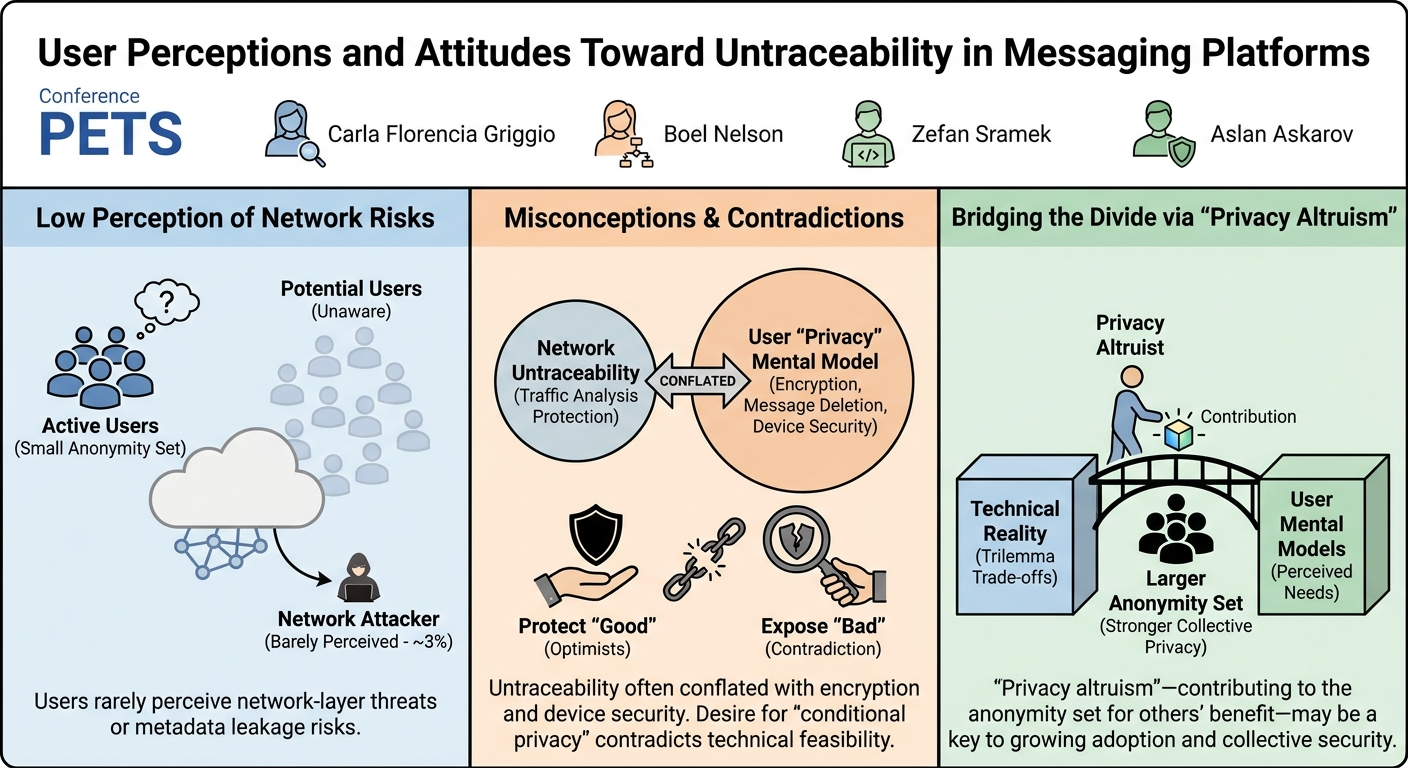
The most striking and central finding of the study was that most respondents do not seem to think about network attackers. This was highlighted as the single most important takeaway from the talk. While this might initially seem disheartening for protocol designers, the presenters argued that it indicates a profound lack of awareness, rather than a definitive rejection of untraceable communication protocols. Users simply do not perceive the risk associated with network-layer metadata leakage, aligning with Tversky and Kahneman's seminal work in behavioral economics, which suggests that individuals do not become risk-averse until they perceive a risk with meaningful consequences.
Several misconceptions about untraceability were uncovered:
- Conditional Privacy (Optimists): A significant group, labeled "optimists," expressed a desire for untraceability that could be selectively applied—protecting "good people" but not "bad people." This mirrors debates around "chat control" and indicates a fundamental misunderstanding of how such technologies operate, as true untraceability inherently applies universally. They fail to recognize the inherent contradiction in wanting both strong anonymity and selective accountability.
- Conflation with Other Privacy Features: Many respondents associated untraceability with concepts like encryption, message deletion, disappearing messages, or protection against device seizure. While these are valid privacy concerns, they are distinct from network-layer untraceability. Users often focused on what happens on their device or with message content, rather than the metadata of who is talking to whom.
- Stalking/Bullying Concerns: Some respondents worried about issues like stalking or bullying, where the ability to send messages without revealing identity could be misused. This highlights a concern about the sender's anonymity, which is a component of untraceability, but often conflated with broader identity management issues.
When asked about desired features, common themes emerged:
- Encryption: Universally desired, which is a positive sign as it is a necessary, though not sufficient, condition for secure communication.
- Anonymity from Sender and Receiver: Users desired protection from both parties knowing their identity, suggesting a broader threat model than just network observers.
- Message Deletion/Disappearing Messages: A strong demand for control over message longevity and data on devices.
Crucially, very few respondents (approximately 3%) explicitly mentioned network layer attackers, or specific technologies like Tor or VPNs. This quantitative insight powerfully reinforces the qualitative finding about low awareness.
The study also identified three distinct privacy personas:
- Privacy Fundamentalists: Believe privacy is a fundamental human right and prioritize it above other concerns.
- Safety Fundamentalists: Prioritize accountability and safety, often viewing untraceability as a tool for malicious actors.
- Optimists: The most challenging group from a technological perspective, as they desire the benefits of both strong privacy and accountability without recognizing the inherent contradictions.
Finally, the concept of privacy altruism was introduced as a potential avenue for increasing adoption. This refers to the idea that users might opt into an untraceable communication system simply to help others contribute to the anonymity set, even if they do not personally perceive a direct need for metadata privacy. This could be a powerful mechanism for expanding the user base and, by extension, the overall privacy guarantees for all participants.
Technical Deep Dive
▶ Watch: Crucial finding: Users unaware of network layer threats (5:35)
The technical foundation of this research lies in the domain of anonymous communication protocols and the inherent trade-offs involved in their design. The talk began by establishing a clear definition of untraceability from a technical standpoint: the ability to conceal network layer metadata from a powerful adversary ("Mallory"). This metadata includes critical information such as "who talks to who, when conversations happen, and how often." The primary attack vector against which untraceability protocols defend is traffic analysis, where an attacker observes patterns in communication flows to infer relationships between parties, even if the content of their messages is encrypted.
A central concept in this field is the trilemma—a well-established theoretical result (Oakland, 2018) stating that a communication protocol cannot simultaneously achieve strong privacy, low bandwidth overhead, and low latency. Designers must compromise and choose only two. This means every protocol occupies a specific point within this trade-off space:
- Strong Privacy: Often achieved through techniques like mixnets (e.g., Chaum's DC-Net from '81), which introduce delays and reorder messages to obfuscate timing and sender-receiver links. This typically incurs higher latency and bandwidth overhead.
- Low Bandwidth Overhead: Minimizing the amount of data transmitted beyond the actual message content.
- Low Latency: Ensuring messages are delivered with minimal delay, crucial for interactive applications.
Examples of protocols operating within this trilemma include:
- Chaum's DC-Net: A seminal work that prioritizes strong privacy by ensuring that even if all but one participant in a group are compromised, the communication remains anonymous. This typically comes with significant performance costs.
- Tor: A widely deployed anonymous communication system that offers a balance, leaning more towards performance and lower latency compared to pure mixnets. It routes traffic through multiple relays (the "onion" structure) to obscure the origin and destination, but its design makes it more susceptible to traffic analysis under certain global adversary models than systems with stronger mixing properties.
- Dena (USENIX Security '24): A more recent protocol, co-authored by some of the presenters, which positions itself within this trilemma by making specific design choices to optimize for a particular balance of privacy and performance.
A critical technical detail emphasized is that the privacy guarantees in untraceable communication scale with the anonymity set. The anonymity set refers to the number of potential users who could be sending or receiving a particular message. A larger anonymity set makes it exponentially harder for an attacker to correlate traffic and de-anonymize individuals. This technical principle directly underpins the research's concern with low user numbers in deployed systems. The current user statistics for prominent ACS—Tor (3-5 million users/day), Lokinet (~200,000 users/day), Nym (undisclosed but acknowledged as low)—demonstrate that these systems operate with anonymity sets far smaller than what would be ideal for maximum privacy.
The technical deep dive into the user study itself was not about a new protocol, but rather about understanding user perception of these existing technical realities. The study aimed to answer if users appreciate the value of protecting against network-layer traffic analysis, or if their understanding of "privacy" is broader, encompassing concepts like end-to-end encryption, message deletion, or device security. The finding that only approximately 3% of users mentioned network-layer attackers or specific tools like Tor or VPNs directly highlights this disconnect. Protocol designers are optimizing for a threat model (network-level metadata leakage) that the vast majority of users do not even perceive as a risk. This implies that the technical solutions, while robust, are not effectively addressing a recognized user need, thus hindering the growth of the crucial anonymity set.
Demo / Proof of Concept
▶ Watch: User requested features and three privacy personas (7:00)
This talk focused on a comprehensive user study and its empirical findings regarding user perceptions of untraceability, rather than presenting a technical demonstration or proof of concept of a specific untraceable communication system. The "proof" in this context was the rich qualitative and quantitative data gathered from the 189 respondents, which served to validate the researchers' hypotheses about user awareness and misconceptions.
Defensive Implications
▶ Watch: Addressing misconceptions and design implications for untraceability (8:10)
The findings of this user study carry significant defensive implications for privacy-enhancing technology developers, security educators, and policymakers. The core challenge is the profound lack of user awareness regarding network-layer attackers and the risks associated with metadata leakage. Defenders must actively work to bridge this knowledge gap.
- Raise Awareness about Metadata Risks: The most critical implication is the need for targeted education campaigns. Defenders should clearly explain what untraceable communication protocols protect against (e.g., traffic analysis, correlation of communication patterns, surveillance of "who talks to who, when, and how often"). This education should highlight the specific risks of metadata exposure, perhaps by illustrating real-world scenarios where metadata has been used for de-anonymization or surveillance, thus making the risk concrete and "meaningful enough" for users to perceive, as per Tversky and Kahneman's theory.
- Clarify the Scope of Protection: It is equally important to communicate what untraceable communication cannot protect against. Users frequently conflate untraceability with encryption, message deletion, or device seizure protection. Defenders need to articulate that while these are vital components of overall digital security, they are distinct from network-layer untraceability. For instance, an untraceable communication system might protect against traffic analysis but does not automatically encrypt messages end-to-end, nor does it secure a device from physical compromise. Clear differentiation will manage user expectations and prevent a false sense of security.
- Address Misconceptions and Trade-offs: The prevalent "optimist" persona, desiring conditional privacy ("only for good people"), poses a significant challenge. Defenders must clearly explain that true untraceability, by its very nature, is universal. Technologies designed to provide strong anonymity cannot, by design, selectively reveal identities based on the perceived "goodness" or "badness" of users. This is a fundamental trade-off that users need to understand. Education should focus on the inherent design principles and limitations of these systems, rather than allowing users to cling to technologically impossible ideals.
- Explore "Privacy Altruism" in Design: The concept of privacy altruism offers a novel defensive strategy for bolstering the anonymity set. Protocol designers could explore mechanisms that incentivize users to join and remain part of an untraceable communication network, even if they don't perceive an immediate personal need for its strongest privacy features. This could involve gamification, social incentives, or clear messaging about how individual participation contributes to the collective privacy of all users, thereby strengthening the system's overall security guarantees. Increasing the anonymity set directly enhances the difficulty for attackers to perform traffic analysis.
- Design for User Mental Models: While technical untraceability remains the core focus for protocol designers, the findings indicate that users have broader privacy concerns. While not directly part of network untraceability, designers should consider how their protocols interact with or are perceived alongside features like message deletion or disappearing messages. If users are primarily worried about device security or content longevity, integrating or clearly delineating these features could improve user adoption and trust, even if they are orthogonal to the primary untraceability goal.
In essence, defensive strategies must shift from an assumption of technical understanding to a proactive approach of user education, expectation management, and potentially, novel incentive structures that leverage human psychology to grow the critical user base for truly effective untraceable communication.
Key Takeaways
- Low Awareness of Network-Layer Threats: The vast majority of users (approximately 97% in the study) do not perceive network-layer attackers or the risks associated with metadata leakage, highlighting a critical awareness gap that hinders the adoption of untraceable communication protocols.
- Widespread Misconceptions about Untraceability: Users often conflate untraceability with other privacy features like end-to-end encryption, message deletion, or device security, and many desire a technologically contradictory "conditional privacy" that protects "good people" but not "bad people."
- The Trilemma and User Priorities: Protocol designers face a fundamental trilemma between strong privacy, low bandwidth, and low latency, making trade-offs that users often do not understand or prioritize in the same way, leading to a disconnect between technical solutions and perceived user needs.
- Crucial Role of Education: Raising user awareness about the specific threats untraceable communication mitigates (e.g., traffic analysis), what it cannot protect against, and the inherent trade-offs involved is paramount for fostering understanding and driving adoption.
- Potential for Privacy Altruism: The concept of "privacy altruism," where users contribute to the anonymity set to help others even without a direct personal need for metadata privacy, offers a promising avenue for increasing user numbers and, consequently, the overall privacy guarantees of these systems.
- Understanding User Personas is Key: Recognizing distinct user personas—privacy fundamentalists, safety fundamentalists, and optimists—is essential for developing effective communication strategies and designing protocols that better align with diverse user expectations and values.
About the Speaker(s)
The research presented in this talk was a collaborative effort by a team of academics specializing in computer science, security, and usability. The paper authors include Carla Florencia Griggio from the Department of Computer Science at Aalborg University, Boel Nelson from the Department of Computer Science at the University of Copenhagen, Zefan Sramek from the IIS Lab at The University of Tokyo, and Aslan Askarov from the Department of Computer Science at Aarhus University. The presenter, one of the paper's authors, self-identified as "breaking into the area" of usability research, having a background primarily in protocol design. This interdisciplinary approach, combining expertise from security/privacy and usability, was acknowledged as crucial for interpreting the study's qualitative data and understanding the diverse perspectives on untraceability. Aslan Askarov and the presenter are also co-authors on the Dena protocol, presented at USENIX Security '24, demonstrating their ongoing contributions to the field of anonymous communication.
Reviews
Dr. Zero (Offensive Security Researcher) — SOLID
A desperately needed cold shower for cryptographers and mixnet designers. This research proves that normal humans do not give a single damn about network-layer metadata leakage because they don't even know it exists.
Heather Calloway (CISO) — SOLID
Academic research confirming what enterprise security leaders already live with: end-users do not understand metadata and routinely conflate encryption with absolute anonymity. It's a rigorous study that serves as a useful reminder of why we cannot rely on user judgment for secure communication tool selection.
→ Top-rated talks at Privacy Enhancing Technologies Symposium (PETS) 2026
All talks from Privacy Enhancing Technologies Symposium (PETS) 2026