Cryptographically-Secured Domain Validation
Grace H. Cimaszewski (Paper author · Princeton University), Henry Birge-Lee (Paper author · Princeton University), Cyrill Krähenbühl (Paper author · Princeton University), Liang Wang (Paper author · Princeton University), Aaron Gable (Paper author · Lets Encrypt), Prateek Mittal (Paper author · Princeton University)
Privacy Enhancing Technologies Symposium (PETS) 2026 · Day 1 · Moose
Overview
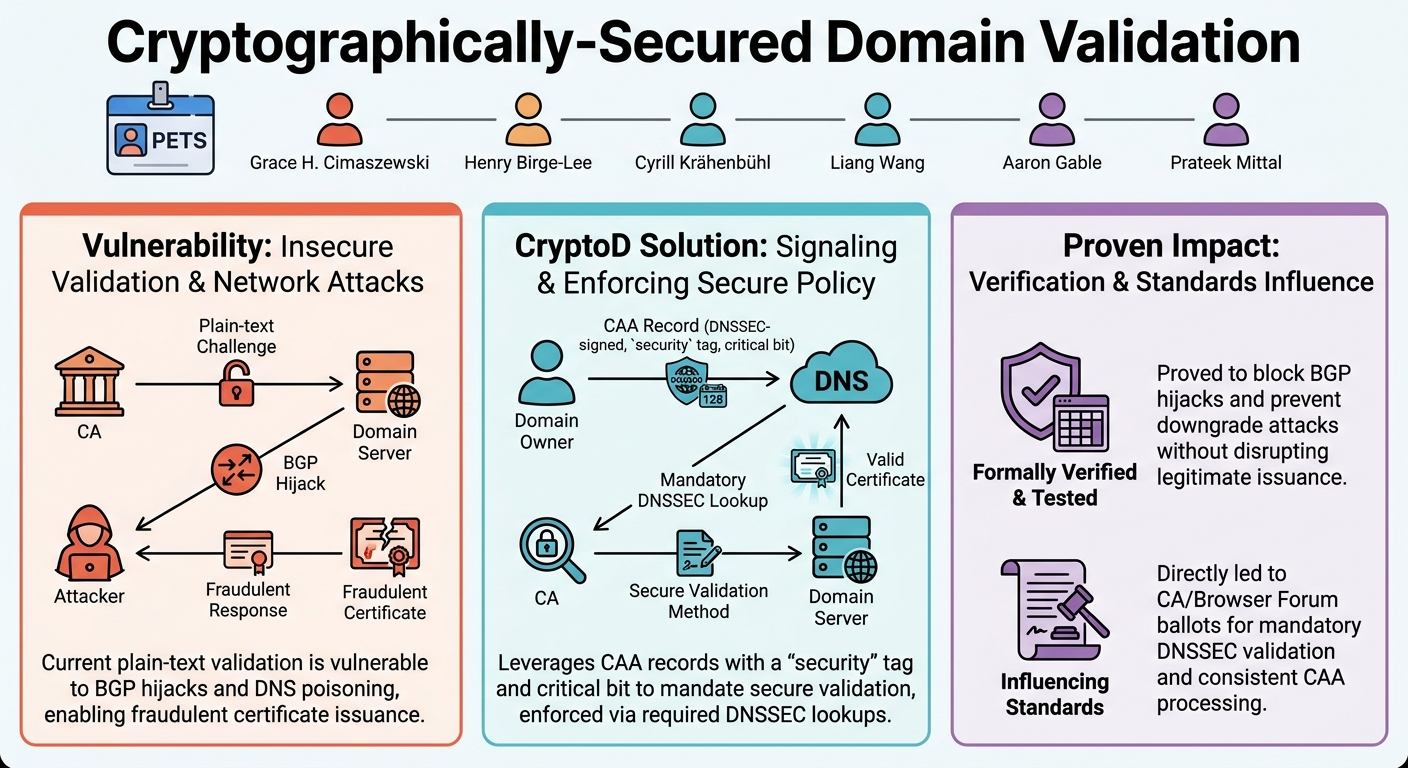
The internet's security backbone, HTTPS, encrypts billions of connections daily, yet its foundational trust mechanism—certificate issuance—relies on a surprisingly vulnerable, plain-text challenge-response protocol. This critical flaw has been repeatedly demonstrated to be susceptible to network-level attacks, such as BGP hijacks and DNS poisoning, allowing adversaries to fraudulently obtain certificates for domains they do not own. Such misissuances enable highly sophisticated impersonation attacks that can even bypass the protections offered by the TLS layer, undermining the very trust HTTPS is designed to provide.
Key moments
- 0:00 Insecure certificate issuance and existing solution failures
- 3:00 Proposed framework: secure policy and required secure methods
- 5:00 Identified critical DNSSEC validation gap by CAs
- 6:40 Real-world adoption potential with 'ready-to-go' domains
- 8:00 Formal verification and blocking real network attacks
- 10:10 Successfully influenced CA/Browser Forum and web PKI standards
Cryptographically-Secured Domain Validation
Speakers: Grace H. Cimaszewski (Paper author, Princeton University); Henry Birge-Lee (Paper author, Princeton University); Cyrill Krähenbühl (Paper author, Princeton University); Liang Wang (Paper author, Princeton University); Aaron Gable (Paper author, Lets Encrypt); Prateek Mittal (Paper author, Princeton University)
Conference: PETS
YouTube: https://www.youtube.com/watch?v=YxujtIS1wdw
Overview
The internet's security backbone, HTTPS, encrypts billions of connections daily, yet its foundational trust mechanism—certificate issuance—relies on a surprisingly vulnerable, plain-text challenge-response protocol. This critical flaw has been repeatedly demonstrated to be susceptible to network-level attacks, such as BGP hijacks and DNS poisoning, allowing adversaries to fraudulently obtain certificates for domains they do not own. Such misissuances enable highly sophisticated impersonation attacks that can even bypass the protections offered by the TLS layer, undermining the very trust HTTPS is designed to provide.
In this pivotal work, "Cryptographically-Secured Domain Validation" (CryptoD), Grace Cimaszewski and her colleagues from Princeton University and Let's Encrypt present a robust framework to inject cryptographic assurance directly into the domain validation process at the Certificate Authority (CA) side. Their research addresses the fundamental vulnerability by proposing a two-pronged approach: first, enabling domain owners to declaratively signal a secure issuance policy via authenticated DNS lookups of Certificate Authority Authorization (CAA) records, and second, mandating that CAs adhere to these policies by employing cryptographically secure validation methods.
This article delves into the technical intricacies of CryptoD, exploring its design principles, its measured feasibility within the current ecosystem, its formal security guarantees, and its practical effectiveness against real-world network attacks. Critically, the work has already begun to influence Web PKI standards, marking a significant step towards a more secure certificate issuance landscape and offering concrete defensive implications for domain owners and CAs alike.
Background
▶ Watch: Insecure certificate issuance and existing solution failures (0:00)
The pervasive use of HTTPS for securing internet communications hinges on the trustworthiness of digital certificates. These certificates, issued by Certificate Authorities (CAs), vouch for a domain's ownership, allowing clients to establish encrypted connections with confidence. However, the process by which CAs verify domain ownership—known as domain validation—has long been a critical weak point in the Web PKI. The standard practice involves a CA requesting a specific token to be placed on a network resource (e.g., via HTTP or DNS), and if the CA can successfully retrieve this token, it issues a certificate. This seemingly straightforward process is inherently insecure because it relies on plain-text network lookups, making it vulnerable to various network-layer attacks.
Adversaries capable of intercepting or redirecting traffic to these validation resources can complete the challenge on behalf of the legitimate domain owner. Common attack vectors include BGP hijacks, where an attacker reroutes internet traffic to their own infrastructure, and DNS poisoning attacks, where they manipulate DNS records to point the CA's validation queries to an attacker-controlled server. In both scenarios, the attacker can trick the CA into believing they control the domain, leading to the fraudulent issuance of a certificate. This misissuance then enables sophisticated impersonation, phishing, and man-in-the-middle attacks that are indistinguishable from legitimate connections to an unsuspecting user.
Numerous attempts have been made to secure the Web PKI, but none have fully closed the gap of cryptographic assurance at the CA side. On the CA side, initiatives like Certificate Transparency (CT) have been deployed, requiring CAs to log all issued certificates publicly. While CT is invaluable for detecting misissuances after they occur, it does not prevent them. Multi-Perspective Issuance Collaboration (MPIC) involves CAs probing validation challenges from multiple independent network paths, but this is merely a heuristic defense, offering no strong cryptographic guarantees. Existing CAA records allow domain owners to specify authorized CAs, but their semantics were incomplete to effectively prevent the types of network attacks discussed.
Client-side solutions have also faced significant deployment hurdles. DANE (DNS-based Authentication of Named Entities), for instance, aimed to secure TLS by leveraging DNSSEC records to bind certificates to domain names. However, DANE required DNSSEC adoption at every connecting client and struggled to achieve widespread browser support. HTTP Public Key Pinning (HPKP) allowed websites to instruct browsers to remember specific public keys, preventing impersonation with rogue certificates. Yet, HPKP was eventually decommissioned due to its high risk of denial-of-service issues and the potential for catastrophic bad key pins that could render a site inaccessible. These failures underscore the difficulty of securing every client connection and highlight the need for a more fundamental solution at the source of certificate issuance.
The core insight behind CryptoD is that the most effective approach is to tackle the problem at the issuance side, specifically at the Certificate Authority. By focusing on strengthening the validation process itself, CryptoD aims to eliminate the fundamental vulnerability rather than merely detecting its aftermath or shifting the burden to the client.
Key Findings
▶ Watch: Identified critical DNSSEC validation gap by CAs (5:00)
The CryptoD research yielded several critical findings, encompassing ecosystem measurements, identification of existing vulnerabilities, formal security proofs, practical attack evaluations, and significant influence on Web PKI standards. These findings collectively demonstrate both the necessity and the feasibility of the proposed framework.
Firstly, a comprehensive measurement of the existing CA ecosystem revealed a surprising level of readiness for CryptoD's adoption. By examining Let's Encrypt issued domains over a 90-day renewal cycle, involving nearly 401 million unique domains, the researchers performed full tree-climbing CAA lookups and assessed DNSSEC signing status. They discovered that over 13% of these domains already possess a relevant CAA record at some point in their DNS hierarchy, indicating a significant existing engagement with issuance policies. Furthermore, 11.7 million domains were found to be DNSSEC signed, consistent with broader ecosystem measurements and demonstrating a crucial prerequisite for CryptoD's cryptographic assurances. Most notably, almost 700,000 domains met both prerequisites (CAA record presence and DNSSEC signing) and were already utilizing more sophisticated CAA policies. These "ready-to-go users" could readily adopt CryptoD by simply modifying their existing records. This group included high-stakes domains such as debian.org, the bitcoin core project, and torproject.net, highlighting the immediate applicability and impact of CryptoD.
Secondly, the research identified a critical security gap in current CA practices: DNSSEC validation of CAA records was not universally required by CAs. This meant that a domain's carefully defined CAA policy could be suppressed, spoofed, or blackholed by an attacker through DNS manipulation, effectively bypassing any intended issuance constraints. To quantify this vulnerability, the team configured a test domain with DNSSEC invalid CAA records. Their measurements revealed that two of the top seven Certificate Authorities, specifically DigiCert and GoDaddy, issued certificates even when faced with this DNSSEC invalid zone state. This finding underscored the urgent need for mandatory authenticated DNS lookups for all CA policy queries.
Thirdly, CryptoD's design was formally analyzed using the Tamarind verifier, a tool for cryptographic protocol analysis. The researchers modeled a scenario with a Dolev-Yao attacker, who possesses full control over the network but cannot forge or modify cryptographic signatures. This rigorous analysis formally proved two key security properties of CryptoD:
- An attacker cannot obtain a certificate for a domain without satisfying the legitimate owner's secure issuance policy.
- An attacker cannot suppress the secure policy or force a downgrade to an insecure validation method.
These proofs provide strong theoretical guarantees for CryptoD's effectiveness against sophisticated adversaries.
Fourthly, the framework's resilience was evaluated against real-world network attacks. A test victim domain was hosted within an autonomous system (AS), while an adversary in a separate network performed various BGP-enabled network hijacks. The attacker attempted several attack scenarios:
- Suppression of the CAA policy: By blackholing or forging the CAA response.
- Hijacking the DNS challenge: Taking control of the traditional validation process.
- Forcing fallback to an insecure method: By testing a lower-security validation method.
In all tested scenarios, CryptoD successfully blocked every attack without disrupting legitimate certificate issuances. This practical evaluation validated the framework's ability to withstand common and advanced network-based threats.
Finally, a significant contribution of this work lies in its direct impact on the standards and Web PKI ecosystem bodies. The researchers actively translated their findings into concrete security improvements, leading to the proposal of two critical ballots at the CA/Browser Forum, the governing body for publicly trusted CAs:
- One ballot mandated DNSSEC validation for all validation-related DNS lookups. This directly addressed the vulnerability discovered with DigiCert and GoDaddy, making authenticated policy lookups a requirement for all CAs.
- A second ballot enforced consistent processing of CAA parameters beyond just the initial tag value, ensuring that CAs properly interpret and adhere to the full scope of domain owner policies.
Furthermore, the team is actively working on an Internet Draft for the security CAA tag and its associated validation methods, which has been adopted by the LAMPS working group, indicating its progression towards formal standardization. These efforts demonstrate CryptoD's immediate and tangible influence on improving the security posture of the entire Web PKI.
Technical Deep Dive
▶ Watch: Real-world adoption potential with 'ready-to-go' domains (6:40)
The CryptoD framework is engineered around two foundational pillars that collectively deliver cryptographically secured domain validation: signaling a secure issuance policy and enforcing that policy through secure validation methods. The design prioritizes backward compatibility, downgrade attack prevention, and effectiveness even in partial deployment scenarios.
Pillar 1: Signaling a Secure Issuance Policy
The first pillar leverages and extends the existing Certificate Authority Authorization (CAA) records, a DNS record type already familiar to domain owners and CAs. CAA records enable domain owners to specify which CAs are authorized to issue certificates for their domain and to define additional issuance policies. The brilliance of CryptoD's approach is to reuse this established workflow, as CAA checking is already a mandatory step for CAs during every certificate issuance.
To implement a declarative security policy, CryptoD introduces a new CAA tag called security. This tag signals to a CA that the domain owner demands a cryptographically secure validation process. Crucially, the security tag is designed to utilize a special mechanism within the CAA specification: the critical bit (value 128). When a CA encounters a CAA record with the critical bit set for a tag it doesn't understand or support, it is mandated to "fail close" – meaning it must deny the certificate issuance request rather than falling back to an insecure method or ignoring the policy. This fail close behavior is paramount for security under partial deployment, as it prevents non-implementing CAs from inadvertently downgrading to insecure validation, thereby preserving the integrity of the secure policy for adopting domains.
A critical security gap identified and remedied by CryptoD pertains to the lookup of these CAA records themselves. Prior to this work, DNSSEC validation of CAA record lookups was not universally required by CAs. This meant an attacker could manipulate, spoof, or blackhole the CAA record via DNS attacks, effectively suppressing the domain owner's defined policy. As a direct corollary to the secure policy definition, CryptoD mandates that CAs perform authenticated DNS lookups, specifically DNSSEC validation, for all CAA records. This ensures that the policy itself is retrieved securely and cannot be tampered with by network adversaries, directly addressing the vulnerability observed with CAs like DigiCert and GoDaddy.
Pillar 2: Enforcement of Secure Policy through Cryptographically Secure Validation Methods
The second pillar focuses on ensuring that once a secure policy is signaled, the CA is compelled to use a validation method that is genuinely cryptographically secure. CryptoD achieves this by integrating existing trust roots in DNS (DNSSEC) and HTTPS (existing certificates) into CA validation workflows. The proposed secure methods either:
- Repurpose an existing validation method with cryptography: This involves adapting current methods, such as DNS record changes or HTTP validation, to incorporate cryptographic proofs. For instance, a secure DNS record change could be validated using DNSSEC signatures, where the token is signed by the domain's DNSSEC key. Similarly, HTTP validation could be performed over TLS using either the domain's existing HTTPS certificate or DNSSEC signatures to authenticate the server presenting the token.
- Add an orthogonal authorization check: This involves introducing a separate record (e.g., in DNS) that contains a cryptographic key or an account ID. The CA can then query this record separately from the main validation challenge, using its contents to cryptographically verify the domain owner's authorization.
A key design principle here is full backward compatibility with existing CA/Browser Forum (CA/B Forum) requirements. The CA/B Forum's Baseline Requirements (BRs) define the mandatory methods CAs must use for validation. Revising these BRs is a lengthy and arduous process, often taking months of ballot proposals, voting, and review. CryptoD's secure methods are meticulously designed to align with the existing BRs, allowing CAs to adopt and use them "out of the box" without requiring immediate, fundamental changes to the BRs. This strategic alignment significantly lowers the barrier to adoption and ensures compliance with ongoing audit requirements.
Formal Analysis and Security Guarantees
Beyond practical implementation, CryptoD's security properties were rigorously proven through formal analysis using the Tamarind verifier. This tool models cryptographic protocols and attacker capabilities, allowing researchers to mathematically demonstrate security guarantees. In their model, the attacker is a Dolev-Yao adversary, meaning they have full control over network traffic (e.g., intercepting, redirecting, dropping messages) but cannot forge cryptographic signatures or break cryptographic primitives.
The formal analysis provided strong proofs for two critical properties:
- Misissuance Prevention: An attacker, despite their network control, cannot obtain a certificate for a domain without the domain owner explicitly satisfying the secure policy defined in the CAA record. This confirms that even sophisticated network attacks cannot circumvent the cryptographic protections.
- Downgrade Attack Prevention: The attacker cannot suppress the secure policy (e.g., by manipulating CAA records) or force the CA to fall back to an insecure validation method. This is largely guaranteed by the
critical bitmechanism and mandatory DNSSEC validation for CAA records, ensuring that the secure policy is either enforced or issuance is denied.
In essence, the technical architecture of CryptoD introduces a robust, cryptographically-backed layer of security to the domain validation process, mitigating long-standing vulnerabilities by shifting the burden of trust from insecure plain-text lookups to verifiable cryptographic proofs.
Demo / Proof of Concept
▶ Watch: Formal verification and blocking real network attacks (8:00)
While the talk did not feature a live, interactive demonstration in the traditional sense, the researchers performed a rigorous "evaluation of real-world network attacks" that serves as a robust proof of concept for the CryptoD framework. This evaluation was designed to test CryptoD's resilience against the very types of adversaries and attack vectors it aims to mitigate.
The setup for this evaluation involved a controlled environment simulating realistic network conditions. A test victim domain was hosted within an autonomous system (AS), representing a legitimate domain owner's infrastructure. To simulate adversarial capabilities, a separate network was established from which an adversary could launch various BGP-enabled network hijacks. BGP hijacks are a potent form of network attack, allowing an attacker to reroute internet traffic, including CA validation queries, to their own systems.
The adversary systematically attempted several distinct attack scenarios, each targeting a different aspect of the domain validation workflow:
- Suppression of the CAA policy: In this scenario, the attacker attempted to prevent the CA from correctly retrieving or processing the domain's secure CAA policy. This was done by either blackholing the DNS responses containing the CAA record (making it appear as if no policy existed) or by forging a malicious CAA response designed to mislead the CA. The goal was to bypass the domain owner's explicit security requirements.
- Hijacking the DNS challenge altogether: This attack directly targeted the traditional, insecure DNS-based validation challenge. The adversary would intercept the CA's query for the validation token and provide a fraudulent response from their controlled infrastructure, aiming to satisfy the challenge and trigger a misissuance.
- Forcing fallback to an insecure method: This scenario tested CryptoD's ability to prevent downgrade attacks. The attacker would attempt to manipulate the validation process to compel the CA to revert to a less secure, plain-text validation method, thereby nullifying the cryptographic protections intended by CryptoD.
In all of these carefully constructed attack scenarios, the CryptoD framework demonstrated its effectiveness. The results were conclusive: CryptoD successfully blocked all of the tested attacks. Crucially, this robust security was achieved without disrupting legitimate certificate issuances. This outcome is vital for real-world deployability, as a security mechanism that prevents attacks but also breaks normal operations would be impractical. The successful mitigation of these BGP-enabled hijacks, policy suppressions, and downgrade attempts provides strong empirical evidence of CryptoD's ability to protect against sophisticated network adversaries and secure the domain validation process.
Defensive Implications
▶ Watch: Successfully influenced CA/Browser Forum and web PKI standards (10:10)
The CryptoD framework offers clear and actionable defensive implications for various stakeholders within the Web PKI ecosystem, significantly enhancing protection against certificate misissuance and sophisticated network attacks.
For Domain Owners
Domain owners are at the forefront of benefiting from CryptoD's protections. To leverage this framework, they should:
- Enable DNSSEC for their domains: This is the foundational prerequisite. DNSSEC provides cryptographic authentication for DNS data, ensuring that CAA records and other critical DNS information cannot be spoofed or tampered with. Without DNSSEC, the authenticity of the
securityCAA tag and its associated policies cannot be guaranteed. - Configure CAA records with the new
securitytag: Domain owners should modify their existing CAA records or create new ones to include thesecuritytag. This tag, with its critical bit set, explicitly signals to CAs that cryptographically secure validation methods are required for their domain. - Specify desired secure validation methods: Within the
securitytag, domain owners can specify which cryptographically secure methods they prefer or require. This gives them granular control over how their domain ownership is verified, preventing CAs from falling back to insecure options. By adopting these measures, domain owners can gain strong cryptographic assurance that no certificate will be issued for their domain without their explicit, cryptographically verifiable authorization, even in the face of BGP hijacks or DNS poisoning.
For Certificate Authorities (CAs)
CAs play a pivotal role in implementing and enforcing CryptoD. Their responsibilities include:
- Implement support for the
securityCAA tag and its critical bit: CAs must update their systems to recognize and correctly process the newsecurityCAA tag. Crucially, they must adhere to thefail closeprinciple dictated by the critical bit, meaning if they encounter asecuritytag and do not support its functionality or the specified secure validation methods, they must deny issuance. This prevents downgrade attacks and ensures security even during partial deployment. - Mandatory DNSSEC validation for all validation-related DNS lookups: As highlighted by the research's discovery of vulnerabilities with DigiCert and GoDaddy, CAs must rigorously perform DNSSEC validation for all DNS queries related to domain validation, especially for CAA records. This ensures the integrity and authenticity of domain owner policies. This critical defensive measure has already been influenced by the researchers' ballot at the CA/Browser Forum.
- Prioritize adoption and implementation of cryptographically secure validation methods: CAs should actively integrate the secure validation methods proposed by CryptoD (e.g., DNSSEC-signed token challenges, HTTPS-authenticated HTTP challenges) into their issuance workflows. By offering these methods, CAs can provide their customers with enhanced security and comply with the
securityCAA tag requirements.
For the Web PKI Ecosystem
Beyond individual stakeholders, the broader Web PKI ecosystem benefits from and must continue to support CryptoD's advancements:
- Continued standardization efforts: The ongoing work on CA/Browser Forum ballots and the Internet Draft for the
securityCAA tag are crucial. The community must support these efforts to ensure widespread adoption and consistent implementation across all publicly trusted CAs. - Encourage wider DNSSEC adoption: Since DNSSEC is a prerequisite for CryptoD's full security benefits, efforts to promote and simplify DNSSEC deployment for domain owners are essential.
- Education and awareness: Raising awareness about the vulnerabilities of current domain validation and the protective capabilities of CryptoD will drive its adoption and strengthen the overall security posture of the internet.
By embracing CryptoD's principles, the Web PKI can move towards a future where certificate issuance is no longer the weakest link, providing robust, cryptographically assured trust for all internet users.
Key Takeaways
- Fundamental Vulnerability: The current HTTPS certificate issuance process relies on insecure, plain-text challenge-response protocols, making it vulnerable to network attacks like BGP hijacks and DNS poisoning, leading to fraudulent certificate issuance.
- CryptoD's Solution: The "Cryptographically-Secured Domain Validation" (CryptoD) framework introduces cryptographic assurance to domain validation by enabling domain owners to signal secure issuance policies via authenticated CAA records and requiring CAs to use secure validation methods.
- Secure Policy Signaling: CryptoD leverages existing CAA records with a new
securitytag and the critical bit (128 value). This mandates that CAs either support the secure policy or "fail close" (deny issuance), preventing downgrade attacks and ensuring security even during partial deployment. - Mandatory DNSSEC Validation: The research identified a critical flaw where CAs (e.g., DigiCert, GoDaddy) did not always perform DNSSEC validation for CAA records. CryptoD mandates this, ensuring the integrity and authenticity of domain owner policies.
- Proven Effectiveness: Formal analysis using the Tamarind verifier proved CryptoD prevents misissuance and downgrade attacks. Real-world evaluations against BGP-enabled network hijacks confirmed CryptoD blocks all tested attacks without disrupting legitimate issuances.
- Influencing Standards: CryptoD has already significantly impacted Web PKI standards, leading to CA/Browser Forum ballots for mandatory DNSSEC validation and consistent CAA parameter processing, and an Internet Draft for the
securityCAA tag.
About the Speaker(s)
The research on Cryptographically-Secured Domain Validation was a collaborative effort involving several distinguished individuals. Grace H. Cimaszewski, the primary presenter of the talk, is a paper author affiliated with Princeton University. She was joined by fellow paper authors from Princeton University: Henry Birge-Lee, Cyrill Krähenbühl, Liang Wang, and Prateek Mittal. Additionally, Aaron Gable, a paper author from Let's Encrypt (ISRG), contributed to this significant work, bridging academic research with practical implementation in the certificate authority ecosystem.
Reviews
Dr. Zero (Offensive Security Researcher) — MUST SEE
Most academic PKI research is theoretical bullshit that dies in a PDF. Cimaszewski and the Princeton/Let's Encrypt crew actually caught DigiCert and GoDaddy dead to rights ignoring DNSSEC on CAA lookups, weaponized BGP to prove the exploit, and forced a CA/B Forum ballot to fix it. This is a masterclass in how you actually secure the internet.
Heather Calloway (CISO) — SOLID
This is a rare, structural fix to a fundamental internet vulnerability—certificate misissuance via BGP hijacking. It shifts the burden of trust from fragile network routing to actual cryptography and gives enterprise domain owners a strict protocol-level enforcement mechanism.
→ Top-rated talks at Privacy Enhancing Technologies Symposium (PETS) 2026
All talks from Privacy Enhancing Technologies Symposium (PETS) 2026