EXADPrinter: Semi-Exhaustive Permissionless Device Fingerprinting Within the Android Ecosystem
Sihem Bouhenniche (Paper author · Univ. Lille, CNRS, Inria), Pierre Laperdrix (Paper author · Univ. Lille, CNRS, Inria), Walter Rudametkin (Paper author · Univ. Rennes, CNRS, Inria)
Privacy Enhancing Technologies Symposium (PETS) 2026 · Day 1 · Moose
Overview
In this compelling talk at PETS, Sihem Bouhenniche, a PhD student at the University of Lille, presented EXADPrinter, a groundbreaking semi-exhaustive framework designed to study Android device fingerprinting. Co-authored with Pierre Laperdrix and Walter Rudametkin, this research delves into the critical privacy implications of how much information a third-party application can glean from an Android device without requiring explicit user permissions. The talk highlights a significant blind spot in mobile privacy, revealing how applications can construct unique device identities by combining numerous seemingly innocuous attributes.
Key moments
- 0:00 Introduction to Android fingerprinting problem
- 1:35 EXADPrinter: framework for permissionless fingerprinting
- 3:30 Scale of collected fingerprint data
- 4:30 Sensitive user identifiers leaked without permissions
- 5:55 Examples of high-entropy permissionless attributes
- 7:45 Small set of attributes achieves full uniqueness
- 8:25 Key findings and conclusions
EXADPrinter: Semi-Exhaustive Permissionless Device Fingerprinting Within the Android Ecosystem
Speakers: Sihem Bouhenniche (Paper author, Univ. Lille, CNRS, Inria); Pierre Laperdrix (Paper author, Univ. Lille, CNRS, Inria); Walter Rudametkin (Paper author, Univ. Rennes, CNRS, Inria)
Conference: PETS
YouTube: https://www.youtube.com/watch?v=nkS-VflXcpY
Overview
In this compelling talk at PETS, Sihem Bouhenniche, a PhD student at the University of Lille, presented EXADPrinter, a groundbreaking semi-exhaustive framework designed to study Android device fingerprinting. Co-authored with Pierre Laperdrix and Walter Rudametkin, this research delves into the critical privacy implications of how much information a third-party application can glean from an Android device without requiring explicit user permissions. The talk highlights a significant blind spot in mobile privacy, revealing how applications can construct unique device identities by combining numerous seemingly innocuous attributes.
The research is particularly vital given Android's dominant position in the global smartphone market and the vast ecosystem of mobile applications users interact with daily. While browser-based fingerprinting has received substantial attention, the native application environment offers a considerably larger attack surface due to direct access to native APIs. EXADPrinter addresses this gap by systematically exploring and analyzing the extensive data available to Android applications without any special privileges, thereby exposing the ease with which users can be tracked persistently and often unknowingly.
Background
▶ Watch: Introduction to Android fingerprinting problem (0:00)
User tracking in the digital realm has long been a concern, with methods ranging from temporary identifiers to persistent ones like advertising IDs, or even the collection of personally identifiable information (PII) typically protected by permissions. However, fingerprinting presents a more insidious threat. Instead of relying on a single, easily changeable identifier, fingerprinting aggregates multiple device attributes to forge a unique, persistent identity. This technique bypasses traditional privacy controls that focus on permission-gated data access, as it leverages information that is freely available to any application.
Historically, much of the research and public discourse around fingerprinting has concentrated on the browser environment. Websites can access a limited set of device attributes through browser APIs, which has led to the development of sophisticated browser fingerprinting techniques. In contrast, native mobile applications possess a significantly broader "fingerprinting space." They can directly invoke native Android APIs, potentially accessing a wealth of system-level and device-specific information without ever prompting the user for permissions. This distinction underscores a critical disparity: while users might be increasingly aware of browser-based tracking, the extent of native application fingerprinting has remained largely underexplored and, consequently, underestimated. The EXADPrinter project was specifically conceived to illuminate this hidden dimension of Android privacy, questioning how much information is truly exposed to unprivileged applications and what the implications are for user privacy.
Key Findings
▶ Watch: Scale of collected fingerprint data (3:30)
The EXADPrinter research yielded several critical findings that underscore the pervasive nature of permissionless fingerprinting within the Android ecosystem:
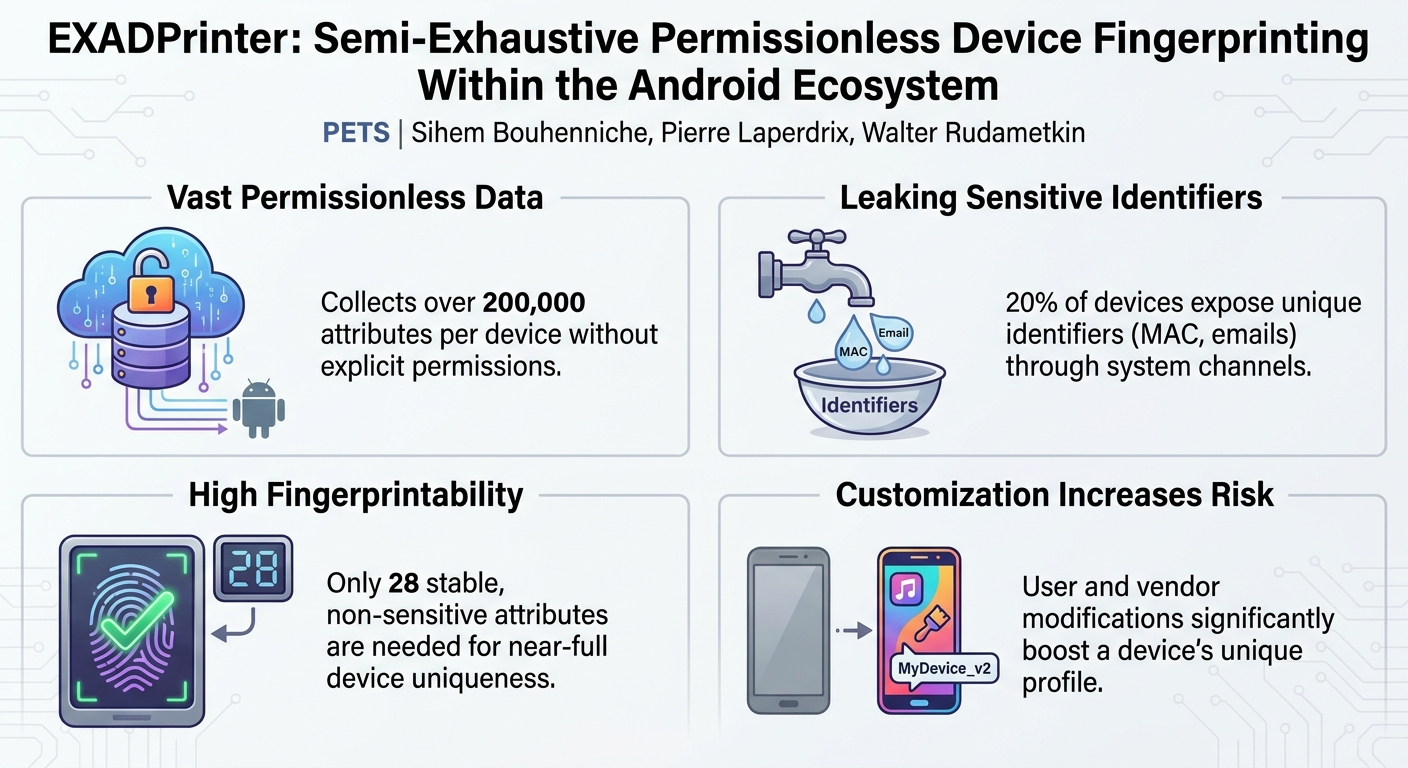
- Widespread Leakage of Sensitive Identifiers: The study uncovered over 100 "access channels" that inadvertently leak sensitive user identifiers without requiring any permissions. Approximately 20% of the devices in their dataset were found to leak at least one unique identifier. The most commonly leaked identifiers included MAC addresses and emails. Specific examples cited include the Android OS itself leaking the MAC address of connected headsets via system settings, vendor customizations (like Xiaomi devices) leaking emergency contacts, and even IMEI addresses being accessible on some Samsung devices. These findings highlight fundamental vulnerabilities in how certain pieces of sensitive data are exposed.
- High Fingerprintability Without Sensitive Data: Even after filtering out all explicitly sensitive identifiers, the researchers demonstrated that Android devices remain highly "fingerprintable." By combining a small set of stable, permissionless, and discriminative attributes, EXADPrinter could uniquely identify nearly all devices in their dataset. For instance, with attributes stable on 90% of devices, only six attributes were needed to achieve full uniqueness. Even under the most conservative scenario, considering only attributes stable across all devices, near full uniqueness was achieved with just 28 attributes. This proves that even without direct access to PII or traditional identifiers, a unique device profile can be constructed.
- Impact of User and Vendor Customizations: The research revealed that both user and vendor customizations significantly contribute to a device's uniqueness. User actions like changing device names or ringtones, or even the precise "system up since" timestamp (the last reboot time combined with reboot count), create highly discriminative attributes. Similarly, vendor-specific modifications to the Android Open Source Project (AOSP) introduce unique attributes that further differentiate devices, often leading to the unintended exposure of sensitive information or unique device characteristics.
- Extensive Data Collection Capability: The EXADPrinter framework successfully extracted exceptionally large fingerprints, containing more than 200,000 attributes per fingerprint. This sheer volume of accessible, permissionless data underscores the vast potential for sophisticated tracking. The ability to collect such a comprehensive profile demonstrates the broad attack surface available to unprivileged applications.
- Long-Term Persistence and Stability: The study emphasized that for effective fingerprinting, attributes must not only be discriminative but also stable over time. By evaluating attribute stability across repeated collections, the researchers confirmed that a sufficient number of stable attributes exist to enable reliable, long-term tracking without user consent.
Technical Deep Dive
▶ Watch: Sensitive user identifiers leaked without permissions (4:30)
The EXADPrinter framework is designed as a semi-exhaustive approach to Android device fingerprinting, meticulously structured into three primary stages: exploration, extraction, and analysis. This systematic methodology allows for the collection of a maximal set of permissionless device attributes.
The first stage, exploring the Android domain, began with a comprehensive scraping of Android documentation specifically tailored for developers. This process aimed to compile an exhaustive list of documented classes available within the Android framework. This foundational step was crucial for identifying potential sources of device attributes that could be accessed programmatically.
The core of EXADPrinter lies in its extraction phase, where three distinct techniques were combined to maximize attribute collection:
- Shell Commands: The framework leveraged the execution of 41 shell commands. These commands interact directly with the underlying Android operating system, often providing access to system properties, hardware details, and configuration settings that do not require explicit application permissions. Examples might include
getpropfor system properties, or commands to query kernel information.
- Java Reflection: This was arguably the most technically complex and powerful extraction technique. The researchers utilized Java Reflection to dynamically inspect the classes identified in the exploration stage. This involved:
- Inspecting Classes: At runtime, EXADPrinter could examine the structure of classes, listing their fields and methods.
- Invoking Methods: Crucially, it could invoke methods within these classes. This process is inherently challenging as it necessitates instantiating classes and correctly resolving parameters for the methods being called. Many Android APIs provide information through getter methods on system services or utility classes, which can often be accessed without permissions if the method itself doesn't gate access based on privileges. Reflection allows for a dynamic, broad sweep of these APIs without needing to hardcode every possible call.
- Content Providers: EXADPrinter accessed the content of three specific Content Providers:
Settings.Global,Settings.System, andSettings.Secure. These providers expose various system-wide settings and configurations. While some settings require permissions to modify, many can be read without any special privileges. For example,Settings.Globalmight contain information about the device's clock format,Settings.Systemcould offer current volume levels, andSettings.Securemight expose whether developer options are enabled. The ability to query these providers provides a rich source of device-specific and user-configured attributes.
To implement and validate these extraction techniques on real-world devices, the researchers developed an Ionic Android application. This application was strategically deployed on the Google Play Store starting in October 2024. Crucially, this application requested no permissions whatsoever, except for internet access, which was solely used to transmit the collected fingerprints from the device to their server. Before a large-scale data collection, a pilot study with team members surprisingly revealed the collection of emails, prompting the team to seek IRB (Institutional Review Board) approval for ethical data handling.
By December 2025 (13 months after deployment), the EXADPrinter application successfully collected 4,004 fingerprints from 3,143 unique devices. This dataset spanned a wide range of Android versions, from Android 8 to 16, across 69 different manufacturers. Each collected fingerprint was remarkably extensive, containing more than 200,000 attributes.
The final stage, analysis, focused on understanding the collected data. The first step involved identifying sensitive identifiers. This was achieved using regex-based filtering and by cross-referencing with known "access channels" reported in prior literature for leaking user identifiers. This process revealed over 100 such channels, with MAC addresses and emails being the most prevalent leaks.
For attributes not considered sensitive, the analysis quantified their discriminating power using three metrics:
- Number of distinct values: How many different values an attribute can take.
- Number of unique values: How many times an attribute's value appears only once in the dataset.
- Shannon entropy: A measure of the overall discriminating power, indicating how much information an attribute provides to distinguish devices.
Beyond discrimination, the researchers also assessed stability over time. An attribute's value must remain consistent across repeated collections from the same device to be useful for persistent fingerprinting. They computed stability for each device individually, then selected attributes stable on 90%, 95%, 99%, and 100% of the dataset. This rigorous analysis allowed them to determine the minimum combination of stable, permissionless, and discriminative attributes required to uniquely identify devices, demonstrating that even a small set (e.g., 6 attributes for 90% stability, 28 for full stability) could achieve near-complete uniqueness.
Demo / Proof of Concept
▶ Watch: Small set of attributes achieves full uniqueness (7:45)
The core proof of concept for EXADPrinter was the Ionic Android application itself, developed and deployed on the Google Play Store. This application served as the real-world testbed for the framework's extraction capabilities.
The demonstration of concept wasn't a live, interactive demo during the talk but rather the successful, large-scale data collection achieved through this application. The app was specifically engineered to run on Android devices without requesting any permissions beyond basic internet access (necessary for transmitting the collected data to the research server). This design choice was critical to proving the "permissionless" aspect of the research.
The app's deployment allowed the researchers to gather a substantial dataset: 4,004 fingerprints from 3,143 distinct devices over a 13-month period. This diverse dataset, spanning Android versions 8 through 16 and 69 manufacturers, provided empirical evidence that the techniques (shell commands, Java Reflection, Content Provider access) were effective across a broad spectrum of real-world Android devices. The fact that the pilot study immediately identified sensitive data leaks (like emails) through this app further validated its efficacy as a data collection tool, prompting the crucial step of obtaining IRB approval for ethical collection. The resulting dataset, with over 200,000 attributes per fingerprint, stands as a testament to the framework's capability to semi-exhaustively extract device information without user consent.
Defensive Implications
▶ Watch: Key findings and conclusions (8:25)
The findings from EXADPrinter present significant implications for Android users, application developers, and the Android ecosystem as a whole. The pervasive nature of permissionless fingerprinting necessitates a multi-faceted defensive strategy.
For Android users, the primary takeaway is a heightened awareness that their devices are far more transparent than previously understood, even to applications that request minimal permissions. While direct action to prevent all forms of permissionless fingerprinting is challenging, users should be cautious about installing unnecessary applications, especially from less reputable sources. Understanding that even seemingly innocuous actions like customizing device names or ringtones can increase uniqueness might influence user behavior. Regular reboots, while not a silver bullet, can reset some ephemeral attributes like "system up since," potentially disrupting short-term tracking.
Android application developers have a critical role in mitigating this threat. They should adhere to a strict principle of least privilege, ensuring their applications only access the absolute minimum data required for their functionality. Furthermore, developers should be acutely aware of what information their applications implicitly expose and actively work to minimize this leakage. This includes being mindful of how vendor-specific APIs or common utility functions might unintentionally expose sensitive data or highly discriminative attributes. Transparency with users about data collection practices, even for permissionless data, is crucial for building trust.
For Android OS vendors and Google, the research points to fundamental design weaknesses. The leakage of sensitive identifiers like MAC addresses (from connected headsets via OS settings), emergency contacts (on Xiaomi devices), and IMEI addresses (on some Samsung devices) directly implicates the OS and vendor customizations. Google and device manufacturers need to conduct a thorough audit of all APIs and system attributes that can be accessed without permissions. Any attribute that is highly discriminative or can be combined with others to form a unique identifier, and which is not essential for core system functionality, should be restricted or randomized. This could involve:
- Restricting access: Implementing stricter controls on certain system properties, shell command outputs, or Content Provider entries that currently offer permissionless access to sensitive or highly unique data.
- Randomization: For attributes that are necessary but highly unique (e.g., certain hardware identifiers that are not permission-gated), consider providing randomized or ephemeral values to unprivileged applications.
- Standardization: Working with vendors to ensure that customizations do not inadvertently introduce new vectors for fingerprinting or sensitive data leakage.
- Education: Providing clearer guidelines and best practices to developers regarding sensitive data handling and the implications of permissionless data access.
Ultimately, the defensive implications call for a paradigm shift: privacy by design must extend beyond permission-gated access to encompass all system attributes accessible to applications. The current model, where anything not explicitly permission-gated is considered "free game," is demonstrably insufficient for protecting user privacy in the sophisticated landscape of mobile tracking.
Key Takeaways
- Android devices are highly susceptible to permissionless fingerprinting: Any third-party application can collect a vast amount of data (over 200,000 attributes) without requesting explicit user permissions.
- Sensitive identifiers are leaking widely: Approximately 20% of devices in the study leaked at least one unique identifier, including MAC addresses, emails, and even IMEI numbers, often due to OS or vendor-specific implementations.
- Uniqueness doesn't require sensitive data: Even after filtering out sensitive identifiers, a small set of stable, permissionless attributes (as few as 6 for 90% stability, 28 for full uniqueness) is sufficient to uniquely identify almost all devices.
- User and vendor customizations increase fingerprintability: Personalizing device settings or using vendor-specific features often introduces unique attributes that make a device more easily identifiable.
- Current permission models are insufficient: The traditional focus on explicit permissions fails to address the extensive data accessible to unprivileged applications, necessitating a re-evaluation of Android's privacy architecture.
- Actionable steps are needed from all stakeholders: Users need awareness, developers need to practice stricter data minimization, and OS vendors must audit and restrict permissionless access to highly discriminative or sensitive attributes.
About the Speaker(s)
Sihem Bouhenniche is a PhD student at the University of Lille, where she conducts research focused on Android device fingerprinting and mobile privacy. Her work, including the EXADPrinter framework, contributes to understanding and mitigating user tracking in the Android ecosystem. She collaborated on this research with Pierre Laperdrix, also from the University of Lille and CNRS and Inria, and Walter Rudametkin from the University of Rennes and CNRS and Inria, both recognized for their contributions to privacy research.
Reviews
Dr. Zero (Offensive Security Researcher) — MUST SEE
This is what real privacy research looks like. Bouhenniche didn't just whine about tracking; she weaponized Java reflection to prove a zero-permission app can scrape 200,000 attributes from modern Android devices. When Samsung hands over your IMEI and Xiaomi leaks your emergency contacts without a single permission prompt, the OS threat model is fundamentally broken.
Heather Calloway (CISO) — STRONG ACCEPT
This is academic privacy research that translates directly into enterprise fleet risk. If you run a large BYOD or corporate-owned Android program, this fundamentally undermines the baseline assumptions of the OS permission model. Required reading for the mobility and architecture teams.
→ Top-rated talks at Privacy Enhancing Technologies Symposium (PETS) 2026
All talks from Privacy Enhancing Technologies Symposium (PETS) 2026