No Privacy for Privates: How Military Communities Experience and Perceive the Privacy Risks of Military-Marketed Mobile Apps
Joshua Shinkle (Paper author · Purdue University), Chandrika Mukherjee (Paper author · Purdue University), Abdullah Imran (Paper author · Purdue University), Arjun Arunasalam (Paper author · Florida International University), Donna Artusy (Paper author · Army Cyber Institute), Antonio Bianchi (Paper author · Purdue University), Z. Berkay Celik (Paper author · Purdue University), Alexander Master (Paper author · United States Military Academy)
Privacy Enhancing Technologies Symposium (PETS) 2026 · Day 1 · Moose
Overview
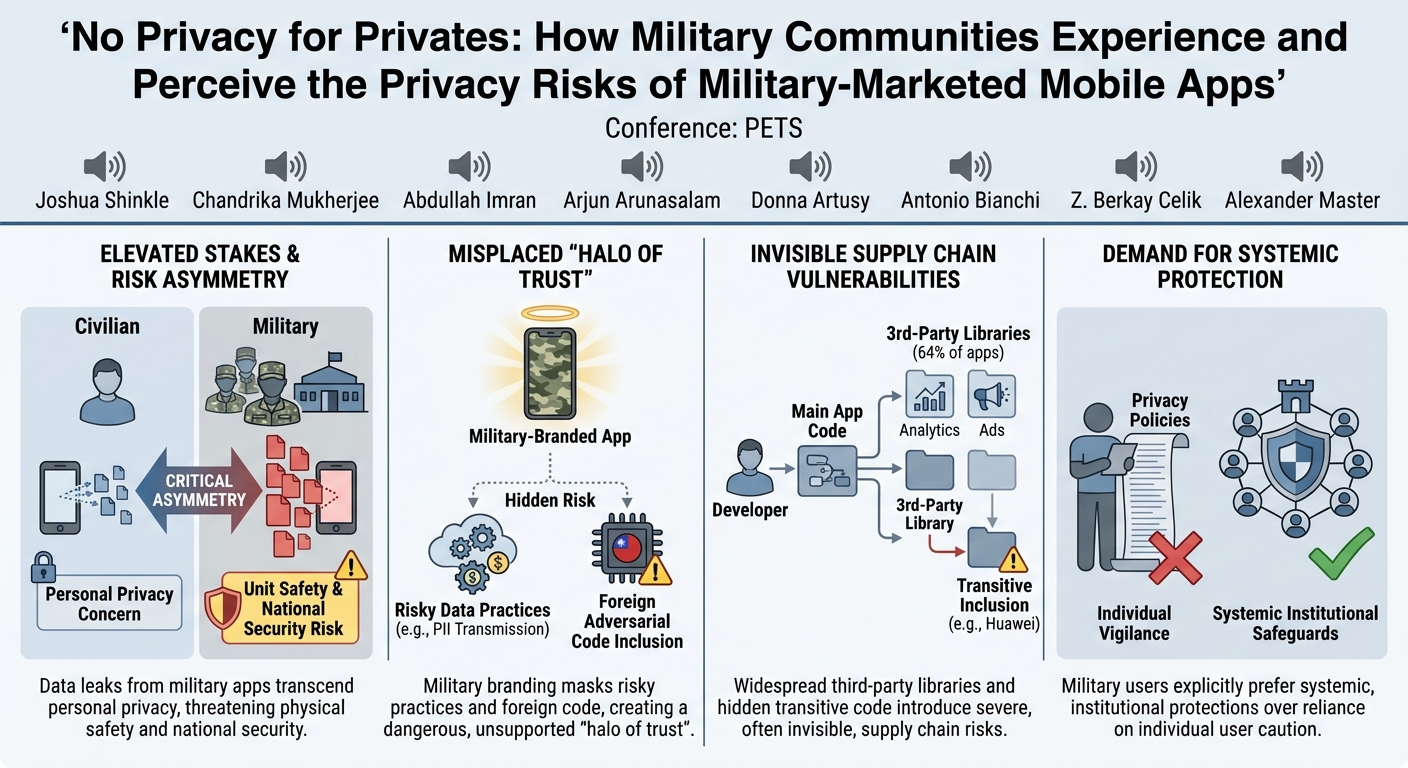
In an era where personal data is a commodity, the privacy implications for military personnel extend far beyond individual concern, directly impacting national security. Joshua Shinkle, a PhD student from Purdue University, presented "No Privacy for Privates" at PETS, a seminal work co-authored with colleagues from Purdue, Florida International University, the Army Cyber Institute, and the United States Military Academy. This research critically examines the unique and elevated privacy risks posed by mobile applications specifically marketed to military communities, highlighting a dangerous asymmetry where common app data practices carry radically different stakes for service members compared to civilians. The paper, a recipient of an award at the conference and featured in a Wired article, underscores how seemingly innocuous data collection can expose sensitive military installations, patrol routes, and even compromise the physical safety of entire units.
Key moments
- 0:40 Strava heatmap incident reveals secret military installations
- 2:10 Trusted apps solicit data from at-risk military personnel
- 4:30 64% of apps include third-party analytics and advertising libraries
- 5:45 Case study: Hidden Huawei code via transitive supply chain inclusion
- 7:30 Users' perceived risks misalign with actual app data practices
- 9:00 Data leaks threaten national security, not just personal privacy
No Privacy for Privates: How Military Communities Experience and Perceive the Privacy Risks of Military-Marketed Mobile Apps
Speakers: Joshua Shinkle (Paper author, Purdue University); Chandrika Mukherjee (Paper author, Purdue University); Abdullah Imran (Paper author, Purdue University); Arjun Arunasalam (Paper author, Florida International University); Donna Artusy (Paper author, Army Cyber Institute); Antonio Bianchi (Paper author, Purdue University); Z. Berkay Celik (Paper author, Purdue University); Alexander Master (Paper author, United States Military Academy)
Conference: PETS
YouTube: https://www.youtube.com/watch?v=BxaMbkpqiko
Overview
In an era where personal data is a commodity, the privacy implications for military personnel extend far beyond individual concern, directly impacting national security. Joshua Shinkle, a PhD student from Purdue University, presented "No Privacy for Privates" at PETS, a seminal work co-authored with colleagues from Purdue, Florida International University, the Army Cyber Institute, and the United States Military Academy. This research critically examines the unique and elevated privacy risks posed by mobile applications specifically marketed to military communities, highlighting a dangerous asymmetry where common app data practices carry radically different stakes for service members compared to civilians. The paper, a recipient of an award at the conference and featured in a Wired article, underscores how seemingly innocuous data collection can expose sensitive military installations, patrol routes, and even compromise the physical safety of entire units.
The core of this research lies in its two-pronged approach: a rigorous technical analysis of 242 military-marketed mobile apps and a comprehensive user study involving 103 military-affiliated participants. The findings reveal a significant disconnect between the perceived trustworthiness of these apps—often bolstered by military branding—and their actual data practices, which frequently involve transmitting personal identifiable information (PII) to third parties and incorporating code from potentially adversarial nations. This talk serves as a crucial wake-up call, demonstrating that the "halo of trust" surrounding military-branded applications is often unsupported by technical reality, thereby creating a critical vulnerability for an at-risk population whose data exposure can have dire consequences for national security. The study not only quantifies these risks but also explores military personnel's perceptions of these threats and their preferred mitigations, advocating for systemic protections over individual user vigilance.
Background
▶ Watch: Strava heatmap incident reveals secret military installations (0:40)
The motivation for "No Privacy for Privates" stems from a stark realization of the unique vulnerabilities faced by military personnel in the digital age. A prominent incident in 2018, where the fitness tracking app Strava released a global heat map, inadvertently exposed the locations of US service members on forward operating bases. This data made secret military installations identifiable and mappable, revealing patrol routes and operational patterns. For a civilian, a location data leak is a privacy concern; for a service member, it directly jeopardizes the physical safety of their entire unit and broader national security. This incident vividly illustrates the fundamental asymmetry in risk: identical app data practices carry profoundly different consequences for military populations.
This problem is not isolated to Strava but is endemic to the modern app economy, which is predicated on the collection, aggregation, and sale of user data. A robust data broker industry specifically targets active service members, compiling and selling data types that, when aggregated, can enable sophisticated surveillance, social engineering, and targeted attacks. Within this ecosystem, a distinct category of applications—military-marketed mobile apps—takes center stage. These apps, exemplified by organizations like USAA, explicitly brand themselves as "founded by military members for military members," cultivating a powerful sense of trust within the military community. Crucially, the research highlights that the vast majority of these apps are commercial, third-party offerings, not developed by the government or military itself.
Prior to this study, there was a significant research gap concerning the actual data practices of these trusted, military-marketed apps and how their target users perceived the associated risks. This unexamined territory formed the basis for the researchers' two core questions:
- In-practice risks: What data practices and code provenance characteristics (the geographic origin of all code, including third-party libraries) are present in military-marketed apps?
- Perception of risk: How well do these data practices and code provenance characteristics align with what military-affiliated personnel consider appropriate? What data inferences and threat scenarios do they believe are possible, which security domains are at risk, and which mitigations do they believe are most effective and likely to be adopted or supported? By addressing these questions, the study aims to bridge the critical understanding gap between perceived trust and actual risk in a sensitive population.
Key Findings
▶ Watch: 64% of apps include third-party analytics and advertising libraries (4:30)
The research employed a rigorous two-pronged methodology: a technical analysis of 242 military-marketed mobile apps and a user study involving 103 military-affiliated participants. The findings from both prongs exposed significant discrepancies and vulnerabilities.
From the technical analysis of the 242 apps, several critical findings emerged regarding data practices and code provenance:
- Third-Party Library Prevalence: A staggering 64% of the analyzed apps contained at least one third-party library. The majority of these libraries were related to analytics and advertising, precisely the types of components most likely to collect and sell user data to data brokers. This highlights a systemic reliance on external services that can inadvertently funnel sensitive user information into the broader data ecosystem.
- Foreign Code Inclusion: More alarmingly, 15 of the apps included Chinese third-party libraries. Of these, 12 apps specifically incorporated Huawei Mobile Services Core. This finding is particularly significant given the geopolitical context: the United States' 2023 cyber strategy document labeled China, among others, as an adversarial nation, and the US FCC designated Huawei as a national security threat in 2020 due to its ties to the Communist Party of China and legal requirements for corporations to cooperate with Chinese intelligence services. This introduces a direct supply chain risk for military users.
- Discrepancy in Disclosures: The study also conducted a discrepancy analysis, comparing what apps actually do versus what developers report on privacy disclosure pages. The talk did not give specific percentages, but the analysis points to a potential mismatch, contributing to user misunderstanding.
The user study with 103 military-affiliated participants revealed profound insights into their perceptions of risk:
- Discomfort with Adversarial Code: Nearly all participants expressed extreme discomfort with code originating from the four nations identified as adversarial by the DoD in their cyber strategy document. This indicates a clear awareness among military personnel of geopolitical risks.
- Widespread Unwitting Risk Exposure: When participants' reported app usage frequencies were combined with their self-reported discomfort levels regarding specific data practices and correlated with the technical analysis, a striking revelation emerged: 83.5% of participants were already using at least one app that engaged in practices they considered inappropriate. On average, each participant was using approximately three such apps, underscoring a pervasive, often unwitting, exposure to privacy risks.
- Misplaced Trust in Military Branding: Participants demonstrated a significantly higher level of discomfort with foreign or third parties collecting their data compared to military-marketed apps. This intuition, however, is fundamentally flawed, as the technical analysis showed no guaranteed difference in actual data practices. Over 15% of military-marketed apps included foreign code, and 16% transmitted PII to third parties. One participant's quote encapsulates this misplaced trust: "I trust military-affiliated apps and I don't trust who I don't know." This "halo of trust" created by military branding is not supported by the technical reality of these commercial applications.
- National Security Implications: A substantial 67% of participants believed that data leaks from these apps could impact national security. This confirms the researchers' premise that the stakes for military personnel extend far beyond personal privacy, encompassing broader strategic concerns.
- Demand for Systemic Protection: When presented with potential mitigations, participants did not ask for more careful reading of privacy policies. Instead, their highest-rated mitigations indicated a strong desire for systemic protection, suggesting a need for broader policy and technical interventions rather than individual user responsibility.
These findings collectively paint a concerning picture: military personnel, a highly sensitive and at-risk population, are unknowingly exposed to significant privacy and national security risks through apps they trust, largely due to opaque data practices and complex software supply chains.
Technical Deep Dive
▶ Watch: Case study: Hidden Huawei code via transitive supply chain inclusion (5:45)
The technical analysis component of "No Privacy for Privates" was central to quantifying the privacy risks posed by military-marketed mobile applications. The researchers meticulously analyzed 242 such apps, employing a multi-faceted approach to uncover their underlying data practices and code origins. This involved identifying what Personally Identifiable Information (PII) these apps collect, to whom they transmit this data, which third-party libraries they include, and what permissions they request from the user's device. Furthermore, a crucial aspect was the discrepancy analysis, comparing the actual data practices observed in the app's code with the privacy disclosures provided by developers on app store pages, often revealing a gap between stated policy and technical reality. The code provenance analysis specifically focused on tracing the geographic origin of all code within an app, including both the developer's own code and all included third-party components.
A significant revelation from this analysis was the widespread inclusion of third-party libraries. The study found that 64% of the examined apps integrated at least one such library. Predominantly, these were analytics and advertising libraries, designed to track user behavior, collect data, and often facilitate targeted advertising. These components are notorious for their role in the data broker industry, which actively aggregates and sells user profiles, including those of military service members. The concern here is not just about individual privacy, but the potential for malicious actors to leverage this aggregated data for highly targeted surveillance, social engineering, or even physical attacks against service members and their units.
The most striking and technically illustrative finding, however, revolved around the inclusion of foreign-sourced code, particularly from nations designated as adversarial. The analysis identified Chinese third-party libraries in 15 apps, with 12 of these specifically incorporating Huawei Mobile Services Core (HMS Core). This is not merely a technical detail but a geopolitical one. The US Department of Defense's 2023 cyber strategy document explicitly labels China as an adversarial nation, and the US Federal Communications Commission (FCC) designated Huawei as a national security threat in 2020. The FCC's concern stems from Huawei's ties to the Communist Party of China and Chinese laws that compel corporations to cooperate with intelligence services, raising fears of potential data exfiltration or backdoors.
To underscore the complexity and stealth of these supply chain risks, the researchers presented a compelling case study involving an app called Hot and Cot. This application functions as a Yelp-like platform, enabling military service members to rate living and dining conditions at military installations. During their analysis, the researchers discovered the presence of the Huawei library within Hot and Cot. What made this particularly insightful was that the Huawei library was transitively included. The developer of Hot and Cot utilized a popular third-party library, One Signal, for push notifications. One Signal, in turn, had included the Huawei SDK as part of its own dependencies. This layered dependency meant that the Hot and Cot developer was completely unaware of the Huawei code's presence in their app.
Upon notification, the developer's response was telling: "I'm not anti-Huawei, but there are valid privacy concerns, especially for service members in government adjacent users. Even if unused, just having those classes present can trigger red flags during audits or app reviews." This quote powerfully illustrates the dilemma: well-intentioned developers, focused on functionality and leveraging existing tools, can inadvertently introduce significant supply chain risks into their applications, especially when dealing with critical user bases like military personnel. The developer of Hot and Cot subsequently undertook a complete re-engineering of their notification stack to remove the Huawei code, demonstrating the tangible impact of these findings. This case study serves as a stark warning about the often-invisible nature of software supply chain vulnerabilities and the critical need for developers to scrutinize not only their direct dependencies but also the transitive ones.
Demo / Proof of Concept
▶ Watch: Users' perceived risks misalign with actual app data practices (7:30)
While the presentation did not feature a live, interactive demo or a traditional proof-of-concept exploit, the research itself functions as a comprehensive demonstration of the identified vulnerabilities. The technical analysis of 242 military-marketed apps, coupled with the detailed Hot and Cot case study, serves as a powerful real-world "proof of concept" for the supply chain risks and opaque data practices discussed. The researchers effectively demonstrated how foreign code from adversarial nations can end up in trusted apps, how developers can be unaware of these inclusions, and how common third-party analytics and advertising libraries contribute to the broader data exposure problem for military personnel. The findings from the user study further solidify the impact, illustrating the direct misalignment between user perception and technical reality, and the grave implications for national security.
Defensive Implications
▶ Watch: Data leaks threaten national security, not just personal privacy (9:00)
The findings of "No Privacy for Privates" carry profound defensive implications for various stakeholders, including military personnel, app developers, military leadership, and policymakers. Addressing these systemic vulnerabilities requires a multi-pronged approach that moves beyond individual user education towards robust, institutional safeguards.
For Military Personnel:
The most immediate implication is the need for heightened awareness regarding the "halo of trust" phenomenon. Service members must understand that an app's military branding does not equate to military vetting or guaranteed security. They should exercise critical scrutiny of all applications, regardless of their marketing, and be aware that commercial apps, even those tailored to their community, are subject to the same data collection practices as other consumer applications. Education should emphasize the unique risks their data poses, extending beyond personal privacy to collective unit safety and national security.
For App Developers (especially those targeting military communities):
- Supply Chain Transparency and Auditing: Developers must adopt rigorous practices for auditing their software supply chains. This includes not only direct dependencies but also transitive ones, as demonstrated by the Hot and Cot case study. Tools and processes should be implemented to identify the code provenance of all included libraries and SDKs, particularly scrutinizing those originating from high-risk or adversarial nations.
- Enhanced Privacy by Design: Prioritize privacy and security from the initial design phase. This includes minimizing data collection, anonymizing data where possible, and securely handling sensitive PII.
- Truthful Privacy Disclosures: Developers should strive for complete and accurate privacy disclosures that genuinely reflect their app's data practices, including third-party data sharing. This helps bridge the gap between perceived and actual risk.
- Contextual Risk Assessment: Recognize that data practices acceptable for a general civilian population may pose unacceptable risks for military personnel. Developers should conduct specific risk assessments for their military user base.
For Military Leadership and Government Institutions:
- Develop Strict Vetting and Guidelines: The military should establish formal vetting processes or guidelines for apps marketed to service members. This could involve an approved list of apps, security audits, or clear standards for data handling and third-party library inclusion.
- Comprehensive Cybersecurity Education: Implement robust and continuous education programs for service members that specifically address mobile app privacy risks, the nature of the data broker industry, and the concept of supply chain vulnerabilities.
- Policy on Foreign Components: Consider developing clear policies regarding the inclusion of software components from adversarial nations in any applications used by or marketed to military personnel, even if indirectly.
- Promote Systemic Protections: As users desire, focus on implementing systemic protections rather than solely relying on individual user vigilance. This could involve secure device configurations, network-level protections, or even developing military-specific, vetted alternatives for common app functionalities.
For Policymakers:
- Regulate Data Brokers: Address the data broker industry's practice of specifically targeting and selling data on military personnel. Legislation or regulations could restrict this practice, given the elevated national security risks.
- Incentivize Secure Development: Create incentives for developers to adopt secure coding practices and transparent data handling, especially for applications serving sensitive populations.
Ultimately, defending against the risks highlighted in "No Privacy for Privates" requires a collaborative effort across technology, policy, and military domains. It necessitates a shift from a reactive, individual-centric approach to a proactive, systemic one that acknowledges the unique and critical vulnerabilities of military communities in the digital landscape.
Key Takeaways
- Elevated Stakes: For military personnel, mobile app data leaks transcend personal privacy, directly impacting unit safety and national security, a critical asymmetry compared to civilian users.
- Misplaced Trust: Military branding creates a dangerous "halo of trust" around commercial apps, leading service members to believe these apps are safer, despite technical analysis revealing widespread risky data practices and foreign code inclusion.
- Pervasive Unwitting Exposure: A significant majority (83.5%) of military-affiliated users are unknowingly using apps that engage in data practices they deem inappropriate, averaging three such apps per person.
- Supply Chain Vulnerabilities: The prevalence of third-party libraries (64% of apps) for analytics and advertising facilitates data selling, and transitive inclusion of code from adversarial nations (e.g., Huawei Mobile Services Core in 15 apps) poses severe, often invisible, supply chain risks.
- Demand for Systemic Protection: Military users are not asking for more privacy policies to read; they explicitly desire systemic protections and institutional safeguards rather than solely relying on individual vigilance.
- Geopolitical Dimension: The inclusion of code from nations labeled as adversarial (e.g., China/Huawei) introduces a direct national security concern, highlighting the need for rigorous code provenance analysis.
About the Speaker(s)
The research presented in "No Privacy for Privates" is the product of a collaborative effort across multiple academic and military institutions. Joshua Shinkle, a PhD student from Purdue University, served as the primary presenter of this significant work. His presentation highlighted the interdisciplinary nature of the research, which involved co-authors from Purdue University, Florida International University, the Army Cyber Institute, and the United States Military Academy. This diverse authorship, combining expertise from computer science, cybersecurity, and military operations, underscores the comprehensive approach taken to understand and address the complex privacy and security challenges faced by military communities in the digital realm.
Reviews
Dr. Zero (Offensive Security Researcher) — SOLID
Shinkle and team tear down the marketing bullshit of 'military-branded' apps to show they're just as infested with third-party trackers and adversarial SDKs as any random consumer garbage. The real value here isn't the user survey data—it's the technical proof that transitive supply chain failures are silently putting OPSEC at risk. Strong, actionable research that forces developers to look at their actual compiled code, not just their intentions.
Heather Calloway (CISO) — STRONG ACCEPT
This is a rigorous dissection of how software supply chain risks bypass enterprise controls via user-targeted mobile apps. It permanently dismantles the idea that user education is a viable control for data exposure, making it highly recommended for any security leader managing BYOD or executive protection.
→ Top-rated talks at Privacy Enhancing Technologies Symposium (PETS) 2026
All talks from Privacy Enhancing Technologies Symposium (PETS) 2026