SoK: Multi-Perspective-Video-Anonymization
Islam Amar (Paper author · Karlsruhe Institute of Technology), Omar Moured (Paper author · Karlsruhe Institute of Technology), Simon Hanisch (Paper author · Technical University Dresden), Thorsten Strufe (Paper author · Karlsruhe Institute of Technology)
Privacy Enhancing Technologies Symposium (PETS) 2026 · Day 3 · Caribou
Overview
In an increasingly surveilled world, the proliferation of multi-camera systems in sensitive environments—from operating rooms to public spaces—presents significant privacy challenges. While single-camera video anonymization has seen considerable research, the complexities introduced by multiple synchronized views for privacy preservation remain largely unaddressed. This talk, presented by Simon Hanisch at PETS, introduces a Systematization of Knowledge (SoK) paper titled "SoK: Multi-Perspective-Video-Anonymization." The research, co-authored with Islam Amar, Omar Moured, and Thorsten Strufe, provides the first comprehensive survey of existing literature in this critical domain.
Key moments
- 0:30 Multi-camera benefits introduce new privacy challenges
- 2:15 Challenges: Synchronizing anonymization across multiple views
- 3:10 Paper's contribution: First comprehensive video anonymization survey
- 5:00 Taxonomy of anonymization methods: obfuscation vs. substitution
- 7:20 Evolution of anonymization techniques: GANs, diffusion models
- 7:40 Overlooked targets and lack of multi-view evaluation metrics
- 8:40 Main takeaway: Need for holistic, consistent anonymization
SoK: Multi-Perspective-Video-Anonymization
Speakers: Islam Amar (Paper author, Karlsruhe Institute of Technology); Omar Moured (Paper author, Karlsruhe Institute of Technology); Simon Hanisch (Paper author, Technical University Dresden); Thorsten Strufe (Paper author, Karlsruhe Institute of Technology)
Conference: PETS
YouTube: https://www.youtube.com/watch?v=seQ08bOc-Qs
Overview
In an increasingly surveilled world, the proliferation of multi-camera systems in sensitive environments—from operating rooms to public spaces—presents significant privacy challenges. While single-camera video anonymization has seen considerable research, the complexities introduced by multiple synchronized views for privacy preservation remain largely unaddressed. This talk, presented by Simon Hanisch at PETS, introduces a Systematization of Knowledge (SoK) paper titled "SoK: Multi-Perspective-Video-Anonymization." The research, co-authored with Islam Amar, Omar Moured, and Thorsten Strufe, provides the first comprehensive survey of existing literature in this critical domain.
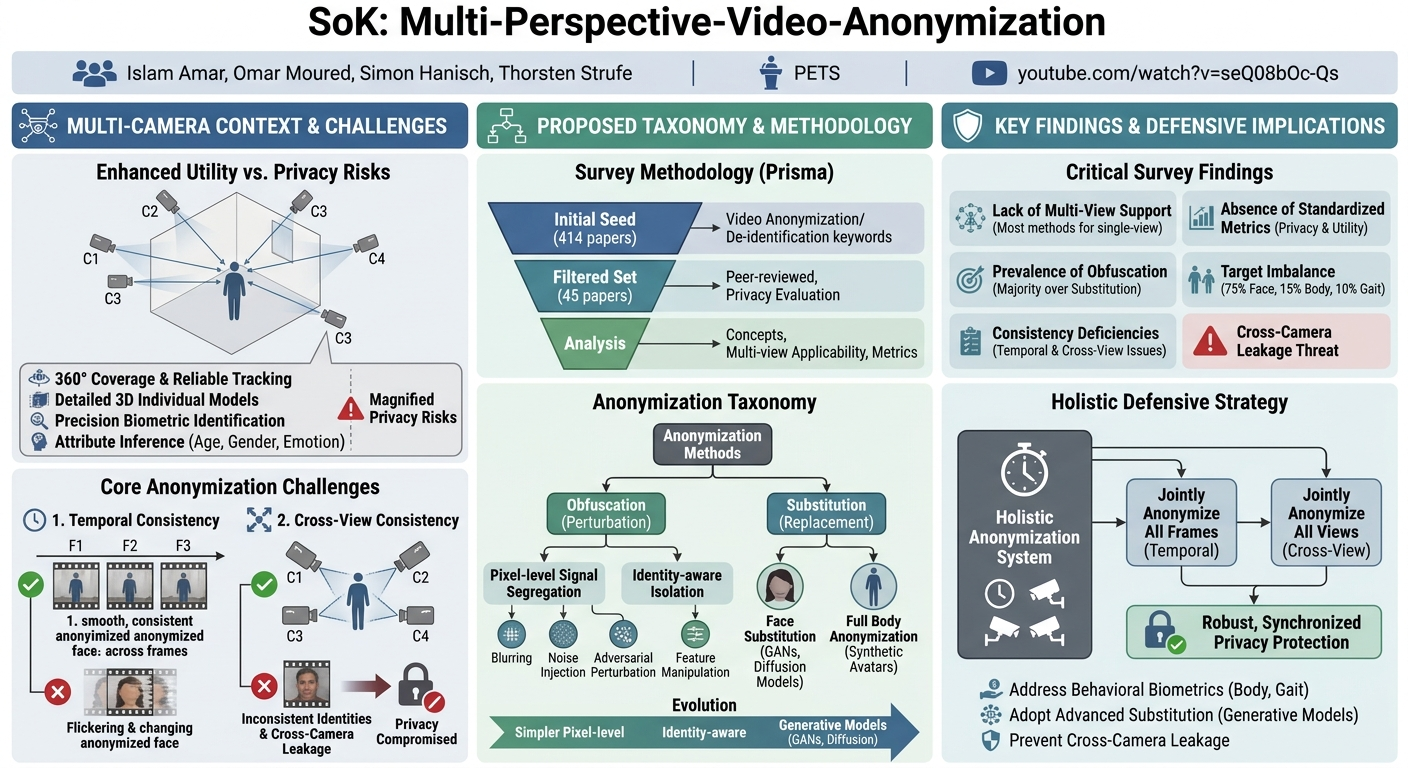
The core motivation behind this work stems from the inherent tension between the enhanced utility offered by multi-perspective video capture and the magnified privacy risks it entails. Such systems provide 360° coverage, enable more reliable tracking, and facilitate the creation of detailed 3D models of individuals, offering invaluable insights for applications like medical training or security monitoring. However, this wealth of data also dramatically improves the precision of biometric identification and attribute inference, making robust anonymization paramount. The paper highlights the unique challenges of maintaining both temporal and cross-view consistency in anonymization, issues often overlooked by methods designed for single-view scenarios.
Background
▶ Watch: Multi-camera benefits introduce new privacy challenges (0:30)
The evolution of video capture technology has seen a significant shift from single-camera setups to sophisticated multi-camera systems. In contexts such as medical operating rooms, this transition allows for comprehensive observation, enabling new doctors to learn from intricate procedures captured from every angle. The fusion of data from multiple cameras provides a holistic view, facilitating advanced capabilities like highly reliable 3D tracking and the generation of detailed human models. While these advancements offer substantial benefits, they simultaneously introduce profound privacy implications that far exceed those of traditional single-view video.
In a single-view scenario, biometric information, such as a face, might only be partially visible, making identification more challenging. However, multi-view systems capture complete biometric data. For instance, a person's entire face can be reconstructed from multiple angles, leading to highly accurate identification or precise attribute inference (e.g., age, gender, emotional state). The same principle applies to body biometrics, where a full 360° view significantly enhances the ability to identify individuals based on their physique or posture, even if they are only seen from the back in a single frame.
Anonymization in this multi-perspective context faces two primary, interconnected challenges that are often absent or simplified in single-view approaches:
- Time Consistency: In any video anonymization, the applied obfuscation or substitution must remain consistent across consecutive frames. If the anonymized identity (e.g., a synthetic face) changes erratically from one frame to the next, it creates distracting artifacts like "flickering" and undermines the perceived stability of the anonymization, potentially making it less effective or even reversible through temporal analysis.
- Cross-View Consistency: This is the defining challenge for multi-perspective systems. When the same individual is captured by multiple cameras simultaneously, their anonymized representation must be synchronized across all views. As illustrated in the talk, applying different synthetic faces to the same person in different camera feeds renders the anonymization nonsensical and ineffective. More critically, if even a single camera view is left inadequately anonymized, it can compromise the privacy protection offered by all other views, as the original identity can still be inferred from the unprotected perspective—a phenomenon termed cross-camera leakage. This "forgetting one view" problem underscores the need for a holistic approach to anonymization that considers the entire multi-camera environment as a single, interconnected system.
Prior to this SoK, there was a noticeable gap in the literature regarding a comprehensive overview and categorization of methods addressing these multi-perspective privacy concerns. The presented work aims to fill this void by systematically analyzing existing techniques, identifying their limitations, and outlining directions for future research.
Key Findings
▶ Watch: Paper's contribution: First comprehensive video anonymization survey (3:10)
The central contribution of this SoK is the delivery of the first comprehensive survey on both single and multi-perspective video anonymization. This involved a rigorous methodology to analyze the current state of research and highlight critical deficiencies, particularly concerning multi-view scenarios.
The research employed a Prisma surveying strategy, utilizing keywords such as "video anonymization" and "video de-identification." This initial search yielded a substantial seed of 414 papers published between 2011 and 2025. This initial corpus was then meticulously filtered to a final set of 45 papers, ensuring each included work featured a proper privacy evaluation and was peer-reviewed. For each of these 45 papers, the researchers analyzed the anonymization concepts, their applicability to multi-view scenarios, and the privacy and utility metrics employed.
Key findings emerging from this comprehensive analysis include:
- Lack of Multi-View Support: A significant observation was that the vast majority of existing anonymization methods are not adequately designed for or evaluated in multi-view scenarios. Most techniques focus on single frames or single-view videos, failing to address the complexities of cross-camera consistency.
- Absence of Standardized Metrics: The field currently suffers from a critical absence of standardized privacy and utility evaluation metrics specifically tailored for multi-perspective video anonymization. This makes it challenging to objectively compare the effectiveness and trade-offs of different anonymization approaches.
- Consistency Deficiencies: A pervasive issue across the surveyed methods is the lack of robust temporal consistency (anonymization consistency over time within a single video stream) and cross-view consistency (anonymization consistency across different camera streams for the same individual). This often leads to visual artifacts like flickering in videos and inconsistent identities across different views, undermining privacy guarantees.
- Proposed Taxonomy: The authors developed a novel taxonomy to classify anonymization methods based on their underlying mechanisms, as well as their targets (e.g., face, body, gait) and utility objectives. This taxonomy provides a structured framework for understanding the landscape of current techniques and identifying areas for future development.
- Prevalence of Obfuscation: The survey revealed that obfuscation-based methods constitute the majority of current anonymization techniques. These methods primarily perturb existing information within the video. More advanced substitution-based methods, which completely replace identifying information, are emerging but are less common overall.
- Target Imbalance: There is a strong bias in current research towards anonymizing the face, with 75% of methods focusing on this target. The body is addressed by only 15% of methods, and gait (behavioral biometrics) by a mere 10%, indicating that behavioral aspects are often overlooked despite their potential for identification.
- Evolution of Techniques: Historically, simpler pixel-level techniques like blurring, noise injection, and adversarial perturbations were common. Later, identity-aware isolation methods appeared. More recently, the field has seen a shift towards sophisticated generative models, with GAN-based approaches and, most recently, diffusion models representing the state-of-the-art in substitution-based anonymization.
- Cross-Camera Leakage: The analysis underscored the severe threat of cross-camera leakage, where a single overlooked or improperly anonymized view can nullify the privacy efforts of all other cameras. This highlights the need for a truly holistic approach to multi-perspective anonymization.
In summary, the key findings point to a fragmented research landscape, where methods are often developed in isolation without adequately considering the temporal and spatial interdependencies inherent in multi-camera systems. The SoK provides a much-needed foundation for understanding these challenges and guiding future research towards more robust and comprehensive solutions.
Technical Deep Dive
▶ Watch: Taxonomy of anonymization methods: obfuscation vs. substitution (5:00)
The technical core of this SoK lies in its proposed taxonomy for video anonymization methods, which serves as a crucial framework for understanding the diverse approaches to privacy preservation in video data. The taxonomy categorizes methods into two primary branches: obfuscation and substitution.
Obfuscation methods work by perturbing existing information within the image or video frames, rather than replacing it entirely. They aim to make the identifying features unrecognizable while retaining some underlying visual structure. This branch is further divided:
- Pixel-level Signal Segregation: These techniques operate directly on the pixels without requiring deep semantic understanding of the content. They are generally simpler and computationally less intensive.
- Blurring: One of the oldest and most common methods, blurring applies a filter (e.g., Gaussian blur) to areas containing identifying information (like faces), making them indistinct.
- Noise Injection: Random noise is added to specific regions, disrupting patterns necessary for identification. This can include simple additive noise or more complex methods.
- Adversarial Perturbation: More advanced techniques involve adding carefully crafted, often imperceptible, perturbations to the pixels. These perturbations are designed to fool machine learning models used for identification, making them misclassify or fail to detect the identity.
- Identity-aware Isolation: Unlike pixel-level methods, these techniques semantically understand and target identity-specific information. They attempt to alter features directly related to identity while preserving other attributes. This can involve manipulating facial features to create a new, non-identifiable face that still resembles a human face, but without the original person's unique identifiers.
The second primary branch is Substitution, which involves completely replacing the identifying information with new, synthetic data. This approach is generally considered more robust as it removes the original identifying features entirely.
- Face Substitution: The most common application involves generating a new, synthetic face and superimposing it over the original face. Early methods often relied on basic face swapping, while modern approaches leverage sophisticated generative models.
- Full Body Anonymization: This extends the concept of substitution to the entire human body, generating synthetic bodies or avatars that replace the original individuals in the video. This is particularly relevant for scenarios where gait or body shape could be identifying.
The evolution of these techniques has progressed significantly. Early methods predominantly utilized blurring, noise, and adversarial perturbations. Over time, identity-aware isolation techniques emerged, offering more nuanced control over anonymization. The advent of Generative Adversarial Networks (GANs) marked a major leap, enabling the creation of highly realistic synthetic faces and bodies for substitution. More recently, diffusion models have emerged as the cutting edge, offering even higher fidelity and control in generating synthetic content for anonymization.
A critical aspect highlighted in the deep dive is the analysis of multi-perspective privacy threats. Beyond the challenges of time and cross-view consistency, the talk emphasized cross-camera leakage. If, for example, a person's face is anonymized in three out of four camera views but left untouched in the fourth, the entire anonymization effort is nullified. The original identity can still be inferred from the unprotected view, rendering the other three anonymized views meaningless. This underscores the need for a coordinated, system-wide anonymization strategy rather than isolated application to individual camera feeds.
Furthermore, the paper addresses the problem of fusion of inconsistent anonymizations. If different attributes of a person (e.g., age, gender) are inconsistently anonymized across different views and then fused, this could inadvertently reveal more information than intended or create a nonsensical composite identity. For example, if one view anonymizes a person as an older male, and another view anonymizes the same person as a younger female, the fusion of these attributes could lead to data corruption or a privacy breach if the original attributes are somehow inferred from the inconsistencies. This necessitates that not only the visual identity but also the metadata or inferred attributes associated with the anonymized subjects remain consistent across all views.
The survey found that existing methods largely fall short in addressing these multi-perspective challenges. Most techniques focus on single frames or sequences, overlooking the synchronization requirements across multiple spatial perspectives. The result is often flickering artifacts in videos (lack of temporal consistency) or, more critically for multi-view, inconsistent identities for the same person across different cameras (lack of cross-view consistency). This foundational analysis of existing methods and their inherent limitations provides a clear roadmap for future research towards developing truly holistic and robust multi-perspective video anonymization solutions.
Demo / Proof of Concept
▶ Watch: Overlooked targets and lack of multi-view evaluation metrics (7:40)
As a Systematization of Knowledge (SoK) paper, this talk primarily focuses on surveying, categorizing, and analyzing existing literature within the domain of multi-perspective video anonymization. It does not present a novel tool, algorithm, or a live demonstration of a specific anonymization technique developed by the authors. Instead, the contribution lies in the comprehensive review, the proposed taxonomy, and the identification of critical gaps and challenges in the current research landscape. Therefore, no specific demo or proof of concept was presented during the talk.
Defensive Implications
▶ Watch: Main takeaway: Need for holistic, consistent anonymization (8:40)
The insights garnered from this SoK carry significant implications for developers, researchers, and organizations deploying multi-camera surveillance or analytical systems. The primary defensive imperative is the shift towards holistic anonymization. This means that privacy-preserving measures must be designed to operate jointly across two critical dimensions: all frames over time (ensuring temporal consistency) and all views together (ensuring cross-view consistency). Piecemeal or single-view anonymization strategies are demonstrably insufficient and can lead to severe privacy breaches.
Defenders must prioritize the integration of anonymization solutions early in the system design lifecycle, rather than treating them as an afterthought. Retrofitting anonymization onto complex multi-camera architectures is often challenging and prone to inconsistencies. A robust system should inherently support synchronized anonymization across all connected cameras, ensuring that the same individual is consistently anonymized with the same synthetic identity across every perspective and throughout the entire duration of their presence in the footage.
A critical vulnerability highlighted is cross-camera leakage. Organizations must implement stringent validation processes to ensure that no single camera view is left unanonymized or inadequately protected, as this can nullify all other anonymization efforts. This requires sophisticated tracking and identity management across views to ensure every instance of an individual is correctly identified and uniformly anonymized.
Furthermore, the lack of standardized privacy and utility evaluation metrics for multi-view scenarios poses a challenge for defenders. Without common benchmarks, it is difficult to objectively assess the effectiveness of different anonymization tools or to make informed decisions about trade-offs between privacy protection and the utility of the video data (e.g., for training or analysis). The research community needs to converge on such metrics to enable better defensive choices.
Beyond facial anonymization, which currently dominates research (75%), defenders must expand their focus to include other biometric identifiers. The talk revealed that only 15% of methods target the body and a mere 10% address gait (behavioral biometrics). As identification techniques become more sophisticated, relying solely on facial anonymization will become insufficient. Comprehensive defensive strategies must consider anonymizing body shape, posture, movement patterns, and other behavioral cues that can uniquely identify individuals, especially in scenarios where faces are obscured or distant.
Finally, the trend towards substitution-based methods using advanced generative models (like GANs and diffusion models) suggests a path towards more robust anonymization. Defenders should explore and adopt these advanced techniques where appropriate, as they offer the potential for stronger privacy guarantees by completely replacing identifying features rather than merely perturbing them. However, careful validation is required to ensure that these synthetic substitutions do not inadvertently introduce new vulnerabilities or biases. The goal is to preserve the necessary utility of the video (e.g., observing movement patterns for medical analysis) while ensuring that individual identities are irretrievably protected.
Key Takeaways
- Lack of Multi-View Evaluation Metrics: There is a critical absence of standardized privacy and utility metrics specifically designed for multi-perspective video anonymization, hindering objective comparison and development.
- Consistency is Key: Most current anonymization methods severely lack both temporal consistency (across video frames) and cross-view consistency (across multiple camera perspectives) for the same individual.
- Holistic Anonymization Required: Effective multi-perspective privacy protection demands a holistic approach that jointly anonymizes all frames over time and all synchronized camera views for consistent results.
- Cross-Camera Leakage is a Major Threat: Forgetting to properly anonymize even one camera view can compromise the privacy protection offered by all other views, enabling identity inference.
- Behavioral Biometrics are Overlooked: While faces are heavily targeted (75%), critical identifiers like body shape (15%) and gait (10%) are largely neglected, creating significant privacy gaps.
- Taxonomy Provides a Roadmap: The proposed taxonomy offers a valuable framework for understanding, classifying, and guiding future research and development in video anonymization techniques.
About the Speaker(s)
The talk was presented by Simon Hanisch, one of the paper's co-authors. The research was a collaborative effort involving Islam Amar, Omar Moured, Simon Hanisch, and Thorsten Strufe. Islam Amar, specifically noted as a first-year PhD student, contributed to this work as his first accepted paper, highlighting the early career success of a promising researcher. The authors are affiliated with prominent academic institutions, including the Karlsruhe Institute of Technology and Technical University Dresden, indicating a strong foundation in computer science and privacy research.
Reviews
Dr. Zero (Offensive Security Researcher) — SOLID
This is a Systematization of Knowledge (SoK) paper from PETS, meaning it's a rigorous literature review rather than novel research. It doesn't drop a new tool, but it systematically proves that current video anonymization is fundamentally broken the second you add a second camera. Solid academic baseline that maps the problem without actually solving it.
Heather Calloway (CISO) — MUST SEE
This research exposes a structural failure in how the industry handles video anonymization for multi-camera environments. It demonstrates that standard privacy masking tools are fundamentally broken when applied to modern enterprise surveillance. I would mandate this reading for any team involved in physical security procurement or privacy engineering.
→ Top-rated talks at Privacy Enhancing Technologies Symposium (PETS) 2026
All talks from Privacy Enhancing Technologies Symposium (PETS) 2026