Di5Guise: 5G Privacy with vSIM
Shirin Ebadi (Paper author · University of Colorado Boulder), Zach Moolman (Paper author · University of Colorado Boulder), Tamara Lehman (Paper author · University of Colorado Boulder), Eric Keller (Paper author · University of Colorado Boulder)
Privacy Enhancing Technologies Symposium (PETS) 2026 · Day 3 · Caribou
Overview
The talk "Di5Guise: 5G Privacy with vSIM," presented by Eric Keller from the University of Colorado Boulder, introduces a groundbreaking approach to fortify user privacy in 5G cellular networks. Acknowledging the foundational work of his students and co-authors Shirin Ebadi, Zach Moolman, and Tamara Lehman, Keller delves into the pervasive threat of pattern-of-life analysis. This sophisticated surveillance technique meticulously documents and understands an individual's or population's habits by correlating various data points. Cellular communication, by its very nature, presents a unique privacy conundrum, as it exposes not only online activities but also critical physical details like location and movement patterns to network operators.
Key moments
- 0:15 Problem: Pattern of life analysis in 5G metadata
- 2:40 Di5Guise addresses SIM card linkability problem
- 4:00 Goal: Multiple burner phones from one device
- 5:15 vSIM uses Trusted Execution Environments for secrets
- 6:50 Remote attestation for secure device profile provisioning
- 8:40 Evaluation: Significantly reduces subscriber profile linkability
- 9:00 Conclusion: Di5Guise impairs operator linking of profiles
Di5Guise: 5G Privacy with vSIM
Speakers: Shirin Ebadi (Paper author, University of Colorado Boulder); Zach Moolman (Paper author, University of Colorado Boulder); Tamara Lehman (Paper author, University of Colorado Boulder); Eric Keller (Paper author, University of Colorado Boulder)
Conference: PETS
YouTube: https://www.youtube.com/watch?v=15suWbrOA18
Overview
The talk "Di5Guise: 5G Privacy with vSIM," presented by Eric Keller from the University of Colorado Boulder, introduces a groundbreaking approach to fortify user privacy in 5G cellular networks. Acknowledging the foundational work of his students and co-authors Shirin Ebadi, Zach Moolman, and Tamara Lehman, Keller delves into the pervasive threat of pattern-of-life analysis. This sophisticated surveillance technique meticulously documents and understands an individual's or population's habits by correlating various data points. Cellular communication, by its very nature, presents a unique privacy conundrum, as it exposes not only online activities but also critical physical details like location and movement patterns to network operators.
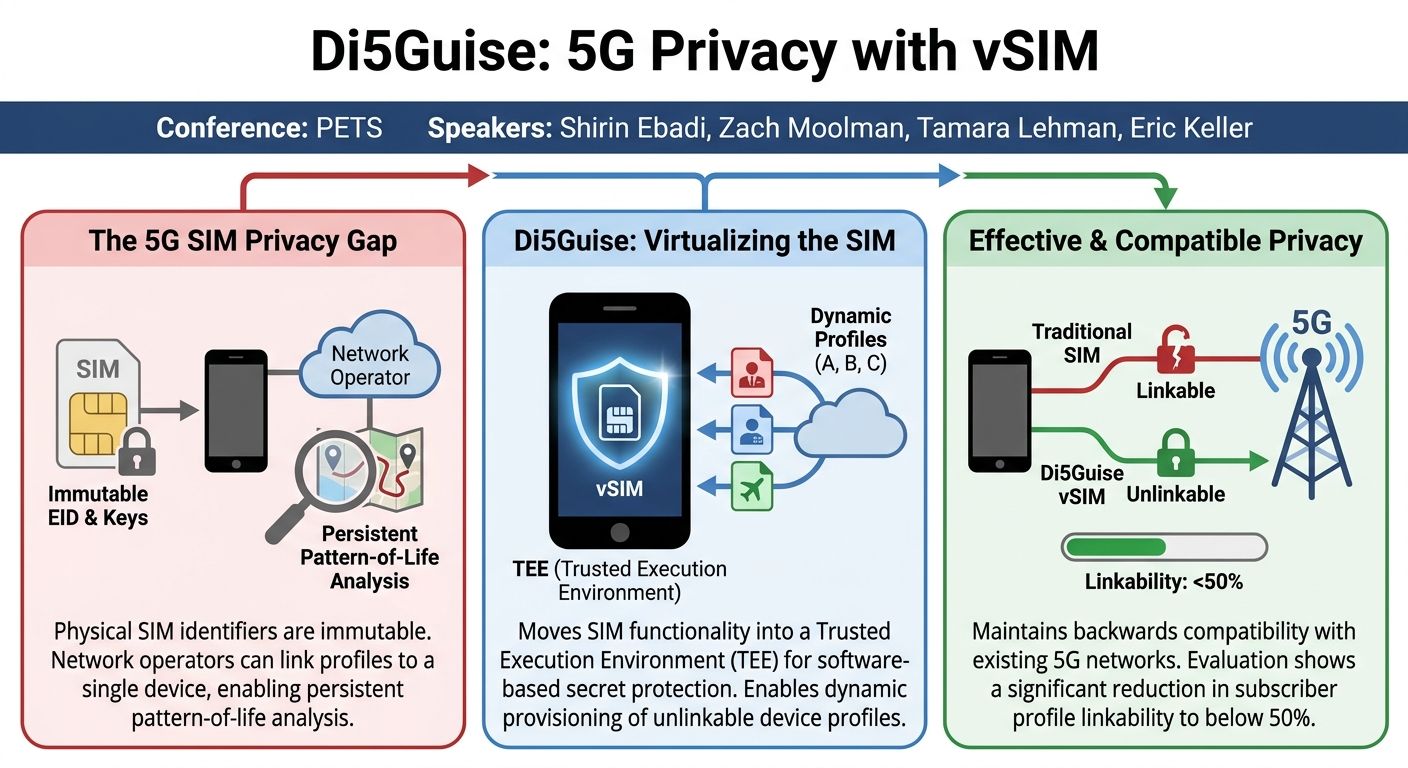
While 5G networks inherently encrypt traffic, a significant amount of metadata—including packet headers, sizes, timing, and communication patterns—remains observable. This metadata can be leveraged to infer who a user is communicating with and what activities they are engaged in. Existing privacy defenses, such as VPNs for traffic obfuscation, eSIMs for swapping subscriber profiles, and measures against IMEI tracking, have addressed various aspects of this problem. However, as Di5Guise highlights, a critical vulnerability persists: the SIM card itself. The immutable identifiers and secret keys embedded within physical SIMs create an inescapable link between disparate subscriber profiles and a single physical device, enabling persistent pattern-of-life tracking.
Di5Guise directly confronts this challenge by proposing a novel architecture that virtualizes the SIM card's functionality. By moving the Embedded Identity Document (EID) and secret key into software, specifically a vSIM (virtual SIM) operating within a Trusted Execution Environment (TEE), the system enables the dynamic provisioning of device profiles. This innovation aims to break the inherent linkability that traditional SIM cards impose, effectively allowing a single physical phone to appear as multiple, unlinkable "burner phones" to the network operator. The significance of this work lies in its ability to overcome 5G's implicit trust model, which traditionally relies on the physical security of the SIM and established business relationships, thereby offering a robust new paradigm for user privacy in an increasingly connected world.
Background
▶ Watch: Problem: Pattern of life analysis in 5G metadata (0:15)
The pervasive nature of cellular communication has rendered it a double-edged sword: a conduit for global connectivity and an unprecedented vector for surveillance. The core threat addressed by Di5Guise is pattern-of-life analysis, a method of intelligence gathering that meticulously constructs profiles of individuals or groups based on their routine behaviors, associations, and movements. In the context of cellular networks, this analysis is particularly potent because operators have visibility into both a user's digital footprint (online activities) and their physical presence (location and movement).
While 5G standards have significantly advanced security, particularly through the encryption of user plane traffic, the problem of pattern-of-life analysis remains largely unmitigated due to the wealth of metadata available to network operators. This metadata, encompassing packet headers, traffic patterns, packet sizes, and timing information, can be highly revealing. Even with encrypted content, an adversary—or a curious operator—can infer application usage, communication partners, and activity types by analyzing these observable characteristics. To counter this, existing defenses include VPNs (Virtual Private Networks) and various traffic obfuscation techniques designed to mask the characteristics of network flows.
Beyond traffic analysis, other identifiers contribute to linkability. The subscriber profile, typically managed through a physical SIM card or its digital counterpart, the eSIM, associates a phone number, billing information, and service plan with an individual. While eSIMs allow users to swap profiles, academic research has explored more advanced anonymization techniques to prevent operators from correlating different profiles belonging to the same person. Further down the hardware stack, the IMEI (International Mobile Equipment Identity) serves as a unique identifier for the device's modem, akin to a MAC address in Ethernet. The IMEI can bind a subscriber profile to a specific physical device, and efforts have been made to circumvent or anonymize this identifier to prevent device-centric tracking.
Despite these layered defenses, a critical privacy gap persists, stemming directly from the fundamental design of the SIM card. As the Di5Guise researchers identified, even if a user employs VPNs, regularly swaps eSIM profiles, and mitigates IMEI tracking, the underlying physical SIM card still provides a persistent link. Each SIM card contains an Embedded Identity Document (EID) and a secret key, which are provisioned by the manufacturer and shared with the network operator. These identifiers are inherently unchangeable and unreadable by the user, forming the bedrock of the 5G authentication process. This implicit trust, built upon the physical nature of the SIM and the established business relationships between hardware manufacturers and network operators, creates an unassailable linkability vector. An operator can, therefore, correlate various subscriber profiles to the same physical device simply by observing which SIM card (and its associated EID/secret key) is being used, effectively undermining all other privacy measures and enabling comprehensive pattern-of-life analysis. Di5Guise directly targets this vulnerability, aiming to sever this persistent link.
Key Findings
▶ Watch: Goal: Multiple burner phones from one device (4:00)
The central and most significant finding of the Di5Guise research is the identification of the SIM card as the critical, unaddressed linkability vector in 5G cellular networks. Despite existing privacy mechanisms targeting traffic, subscriber profiles, and device identifiers like the IMEI, the immutable identifiers (EID) and secret keys embedded within physical SIM cards enable network operators to consistently link disparate subscriber profiles back to a single physical device. This inherent design flaw facilitates persistent pattern-of-life analysis, allowing operators to track an individual's activities and movements over time, even if they attempt to use multiple "identities" or obfuscate their network traffic.
To counter this, the project introduces Di5Guise, a novel architectural approach centered around a virtual SIM (vSIM). The key contribution here is the successful conceptualization and design of a system that moves the hardware-level identifiers and secret keys traditionally associated with a physical SIM into a software-defined environment. This vSIM operates within a Trusted Execution Environment (TEE), ensuring the confidentiality and integrity of these critical secrets even when they are no longer physically embedded. This fundamental shift from hardware-rooted trust to software-rooted, TEE-protected trust represents a significant leap in cellular privacy.
A core capability enabled by Di5Guise is the dynamic provisioning of device profiles. Unlike traditional SIMs that have fixed, unchangeable identifiers, the vSIM architecture allows for on-demand generation and management of these device-level profiles. This means a single physical phone can logically present itself with different, unlinkable identities to the network at different times, effectively mimicking the use of multiple "burner phones" without requiring physical hardware swaps. Crucially, this dynamic provisioning is achieved while maintaining backwards compatibility with existing 5G authentication protocols, meaning Di5Guise can integrate seamlessly into current network infrastructure without requiring fundamental changes to 5G standards or operator systems.
The practical efficacy of Di5Guise was demonstrated through an evaluation that, despite using a proxy dataset due to the unavailability of suitable 5G traffic data, showed a significant impairment of network operators' ability to link various subscriber profiles. By combining the vSIM approach with traffic obfuscation techniques, the researchers were able to reduce the correlation or linkability between different subscriptions to below 50%. This effectively pushes the operator's ability to link profiles into the realm of random guessing, thereby substantially degrading the viability of pattern-of-life analysis based on SIM-level identifiers. The findings underscore that Di5Guise provides a robust, software-centric solution to a long-standing privacy challenge in cellular communication.
Technical Deep Dive
▶ Watch: vSIM uses Trusted Execution Environments for secrets (5:15)
The Di5Guise architecture is designed to fundamentally disrupt the linkability imposed by traditional SIM cards in 5G networks. It achieves this by virtualizing the SIM's core functionality—the storage and use of the Embedded Identity Document (EID) and secret key—and moving it into a secure software environment. The architecture comprises four key technical pillars, meticulously engineered to overcome the challenges of maintaining security and compatibility in a virtualized context.
The first and paramount technical challenge is keeping secret keys secret in software. In conventional systems, the SIM's secret key is embedded in tamper-resistant hardware, making it inherently trusted and unreadable. Moving this critical secret into software immediately raises security concerns. Di5Guise addresses this by leveraging Trusted Execution Environments (TEEs), which are prevalent in modern mobile device architectures, such as ARM TrustZone. The vSIM software, which encapsulates the EID and secret key, is designed to run exclusively within this isolated, hardware-backed TEE. The TEE provides a secure execution space, separate from the main operating system, protecting the vSIM's secrets from compromise even if the primary OS is breached. This ensures that the cryptographic operations performed by the vSIM, which rely on the secret key, remain confidential and tamper-proof.
The second pillar focuses on establishing initial trust in the vSIM. Traditional SIM cards rely on a chain of trust rooted in business relationships between hardware manufacturers and network operators, who provision the physical SIMs with their unique identifiers and keys. Di5Guise replaces this model with a cryptographically verifiable trust mechanism. Instead of linking trust to a single physical device, the system employs group keys. This allows the network provider to trust the underlying hardware and the vSIM software without necessarily knowing the specific identity of the individual device. This group key approach is coupled with secure boot mechanisms for the vSIM software. Secure boot ensures that only authorized, untampered vSIM code can execute within the TEE. Together, group keys and secure boot establish a verifiable and anonymous trust chain from the device's hardware up through the vSIM functionality, guaranteeing that the vSIM instance is legitimate and running as expected.
The third critical component is the mechanism for provisioning device profiles. Once initial trust in the vSIM's secure execution environment is established, the system needs a way for a "provider" (which could be the network operator or a third-party privacy service) to securely install new device profiles—essentially, new EIDs and secret keys—into the vSIM. This process cannot rely on pre-established business relationships as with physical SIMs. Di5Guise outlines a protocol that employs remote attestation. When a provider wants to provision a new profile, the device's vSIM within the TEE performs a remote attestation, proving to the provider that it is indeed running the known, untampered vSIM software stack within a legitimate TEE. Once this verification is successful, a secure channel is established, allowing the provider to securely transmit and install a new, dynamically generated device profile (EID and secret key) into the vSIM. This ensures that new profiles are only provisioned to trusted, secure vSIM instances.
Finally, the architecture addresses dynamically provisioning and authenticating the subscriber to the 5G network. The ultimate goal is for the vSIM, with its dynamically provisioned device profiles, to seamlessly connect to and authenticate with existing 5G networks. A crucial design principle here is backwards compatibility. The researchers emphasized that there was "really no innovation" in the authentication process itself once the device profile was provisioned. Instead, the innovation lies in how these profiles are managed and presented. Di5Guise achieves this by leveraging open-source 5G implementations and ensuring that the vSIM's interaction with the network's authentication mechanisms remains identical to that of a physical SIM. This means that from the network's perspective, the vSIM behaves exactly like a traditional SIM, allowing the device to connect and authenticate without requiring any modifications to the 5G core network or base stations. This seamless integration is vital for practical deployment and adoption.
In summary, the Di5Guise architecture meticulously combines TEEs for secret protection, group keys and secure boot for establishing anonymous trust, remote attestation for secure provisioning, and a commitment to backwards compatibility to deliver a robust and practical solution for enhanced 5G privacy.
Demo / Proof of Concept
▶ Watch: Evaluation: Significantly reduces subscriber profile linkability (8:40)
While the talk did not feature a live, interactive demonstration of Di5Guise in action, the researchers presented a compelling proof of concept through their evaluation methodology and results. The speaker mentioned that an "FPGA based prototype" was available for discussion during the break, indicating a tangible, hardware-backed implementation of their vSIM concept.
The primary objective of the evaluation was to quantify Di5Guise's impact on privacy, specifically its ability to thwart linkability—the capacity for a network operator to correlate different subscriber profiles to the same individual or device. The core hypothesis was that by dynamically modifying the device profile (the vSIM's EID and secret key), traffic associated with different profiles would become unlinkable from the operator's perspective.
A significant challenge in this evaluation was the scarcity of suitable 5G traffic datasets that could directly address the linkability problem. To overcome this, the research leveraged a proxy dataset derived from a USENIX Security paper. This dataset focused on a campus network scenario where dynamic IP addresses were assigned, and researchers were able to correlate different traffic streams back to the same device despite the changing IP addresses. This proxy provided a suitable analogue for demonstrating how seemingly disparate network activities could still be linked to a single underlying entity.
Using this proxy dataset, the Di5Guise team demonstrated that when their vSIM architecture was combined with existing traffic obfuscation techniques, the ability of an observer (simulating a network operator) to correlate various subscriptions or device profiles was significantly impaired. The evaluation results showed that the linkability was brought down to "below 50%." In practical terms, this means that an operator attempting to link different profiles would essentially be guessing, as the accuracy of their correlation attempts would be no better than random chance. This outcome strongly validates the Di5Guise approach, proving its effectiveness in breaking the persistent link between a physical device and its various digital identities, thereby making pattern-of-life analysis based on SIM-level identifiers largely ineffective.
Defensive Implications
▶ Watch: Conclusion: Di5Guise impairs operator linking of profiles (9:00)
Di5Guise presents profound defensive implications for both individual users seeking enhanced privacy and for the broader cellular industry grappling with the evolving landscape of surveillance and data protection.
For individual users, the widespread adoption of Di5Guise-like technologies would represent a significant leap forward in personal privacy. Currently, even with VPNs and eSIMs, the physical SIM card remains a persistent identifier, allowing network operators to build comprehensive pattern-of-life profiles. Di5Guise offers a pathway to break this fundamental link. If commercially implemented, users could dynamically switch their device-level identities, making it exceedingly difficult for operators to correlate their activities over time or across different "personas." This empowers users with a level of anonymity previously only achievable with multiple physical burner phones, without the associated cost or inconvenience.
For network operators and device manufacturers, this research highlights a critical, often overlooked, privacy vulnerability inherent in the current 5G authentication architecture. The implicit trust placed in the physical SIM and its fixed identifiers is a single point of failure for user privacy. Di5Guise demonstrates that it is technically feasible to decouple device identity from physical hardware while maintaining network compatibility. This implies a future where 5G standards or subsequent generations might need to incorporate more flexible, software-defined, and privacy-preserving mechanisms for device authentication. Embracing such an approach could differentiate operators who prioritize user privacy, potentially leading to new privacy-focused service offerings.
The technical mechanisms employed by Di5Guise—specifically the reliance on Trusted Execution Environments (TEEs), group keys, and remote attestation—provide a robust blueprint for securing software-defined identities. TEEs are crucial for protecting sensitive cryptographic material in a software context, mitigating risks associated with compromised operating systems. Remote attestation, in particular, becomes a vital tool for providers to verify the integrity and authenticity of the software environment before provisioning sensitive credentials, ensuring that only trusted instances receive new device profiles. These technologies are already present in many modern devices, making the underlying infrastructure for Di5Guise largely available.
Furthermore, Di5Guise's commitment to backwards compatibility is a key defensive advantage. It means that the benefits of enhanced privacy can be integrated into existing 5G networks without requiring costly and disruptive overhauls of core infrastructure. This pragmatic approach increases the likelihood of adoption and allows for a more incremental rollout of privacy-enhancing features. Ultimately, Di5Guise serves as a potent reminder that privacy in cellular networks requires continuous innovation, moving beyond mere traffic encryption to address the fundamental identifiers that enable pervasive surveillance. It provides a concrete, technically sound direction for how defenders can empower users against sophisticated pattern-of-life analysis.
Key Takeaways
- The SIM card is identified as a critical, unaddressed linkability vector in 5G networks, enabling persistent pattern-of-life analysis by network operators.
- Di5Guise introduces a novel vSIM (virtual SIM) architecture that moves the SIM's Embedded Identity Document (EID) and secret key into software, breaking the inherent link between a physical device and its subscriber profiles.
- The vSIM operates within a Trusted Execution Environment (TEE), such as ARM TrustZone, to ensure the confidentiality and integrity of cryptographic secrets, even in a software context.
- Di5Guise enables dynamic provisioning of device profiles, allowing a single phone to present multiple, unlinkable identities to the network, effectively mimicking multiple "burner phones."
- The system establishes trust through group keys and secure boot for the vSIM software, and uses remote attestation to securely provision new device profiles from providers.
- The architecture maintains backwards compatibility with existing 5G authentication protocols, leveraging open-source implementations without requiring modifications to the 5G core network.
- Evaluation using a proxy dataset demonstrated that Di5Guise, combined with traffic obfuscation, significantly reduces linkability to below 50%, making pattern-of-life analysis based on SIM identifiers ineffective.
About the Speaker(s)
Eric Keller is a Professor at the University of Colorado Boulder. He presented the Di5Guise talk, acknowledging the significant contributions of his students and co-authors.
Shirin Ebadi, Zach Moolman, and Tamara Lehman are paper authors from the University of Colorado Boulder, whose work formed the basis of the Di5Guise project. Their roles as paper authors and implied status as students (from Eric Keller's introduction) highlight the collaborative research environment at the university.
Reviews
Dr. Zero (Offensive Security Researcher) — SOLID
Virtualizing the 5G EID and secret key into a TrustZone TEE to break carrier pattern-of-life tracking is a structurally elegant idea that actually attacks the root cause of subscriber linkability. It’s a great architectural blueprint, but the execution falls into a classic academic trap: validating 5G privacy claims using a proxy Wi-Fi dataset.
Heather Calloway (CISO) — SOLID
A clear-eyed look at a major blind spot in executive protection: swapping eSIMs does not prevent network operators from tracking your devices. The researchers propose a TEE-backed virtual SIM to enable true dynamic provisioning. It's a critical threat model update for any enterprise managing high-risk mobile fleets, even if the proposed fix is years away from commercial reality.
→ Top-rated talks at Privacy Enhancing Technologies Symposium (PETS) 2026
All talks from Privacy Enhancing Technologies Symposium (PETS) 2026