Troll Patrol: Anonymous User Reporting of Bridge Censorship
Vecna (Paper author · University of Waterloo), Ian Goldberg (Paper author · University of Waterloo)
Privacy Enhancing Technologies Symposium (PETS) 2026 · Day 1 · Caribou
Overview
In regions where internet access is heavily censored, tools like Tor provide a vital lifeline for users to access information freely. However, censors actively work to block access to the Tor network itself, often by identifying and blocking known Tor relays. To circumvent this, Tor utilizes bridges, which are unlisted Tor relays designed to remain secret from censors. The fundamental challenge, known as the bridge distribution problem, lies in distributing these secret bridges to users who need them without simultaneously revealing them to the very adversaries who seek to block them. This talk, "Troll Patrol," presented by Vecna from the University of Waterloo, introduces a novel protocol designed to address a critical aspect of this problem: anonymously and reliably determining which bridges have been discovered and blocked by censors.
Key moments
- 0:00 Introduction: Bridge censorship and Tor
- 1:05 The inherent "bridge distribution problem" explained
- 3:30 Why active scanning fails for secret bridges
- 4:55 Introducing anonymous user reports as a signal
- 6:40 Challenge: Revoking reporting ability anonymously
- 7:15 Protocol example: Anonymous revocation of false reporters
- 8:20 Summary of the anonymous reporting protocol
Troll Patrol: Anonymous User Reporting of Bridge Censorship
Speakers: Vecna (Paper author, University of Waterloo); Ian Goldberg (Paper author, University of Waterloo)
Conference: PETS
YouTube: https://www.youtube.com/watch?v=nJ-bVBcZoY0
Overview
In regions where internet access is heavily censored, tools like Tor provide a vital lifeline for users to access information freely. However, censors actively work to block access to the Tor network itself, often by identifying and blocking known Tor relays. To circumvent this, Tor utilizes bridges, which are unlisted Tor relays designed to remain secret from censors. The fundamental challenge, known as the bridge distribution problem, lies in distributing these secret bridges to users who need them without simultaneously revealing them to the very adversaries who seek to block them. This talk, "Troll Patrol," presented by Vecna from the University of Waterloo, introduces a novel protocol designed to address a critical aspect of this problem: anonymously and reliably determining which bridges have been discovered and blocked by censors.
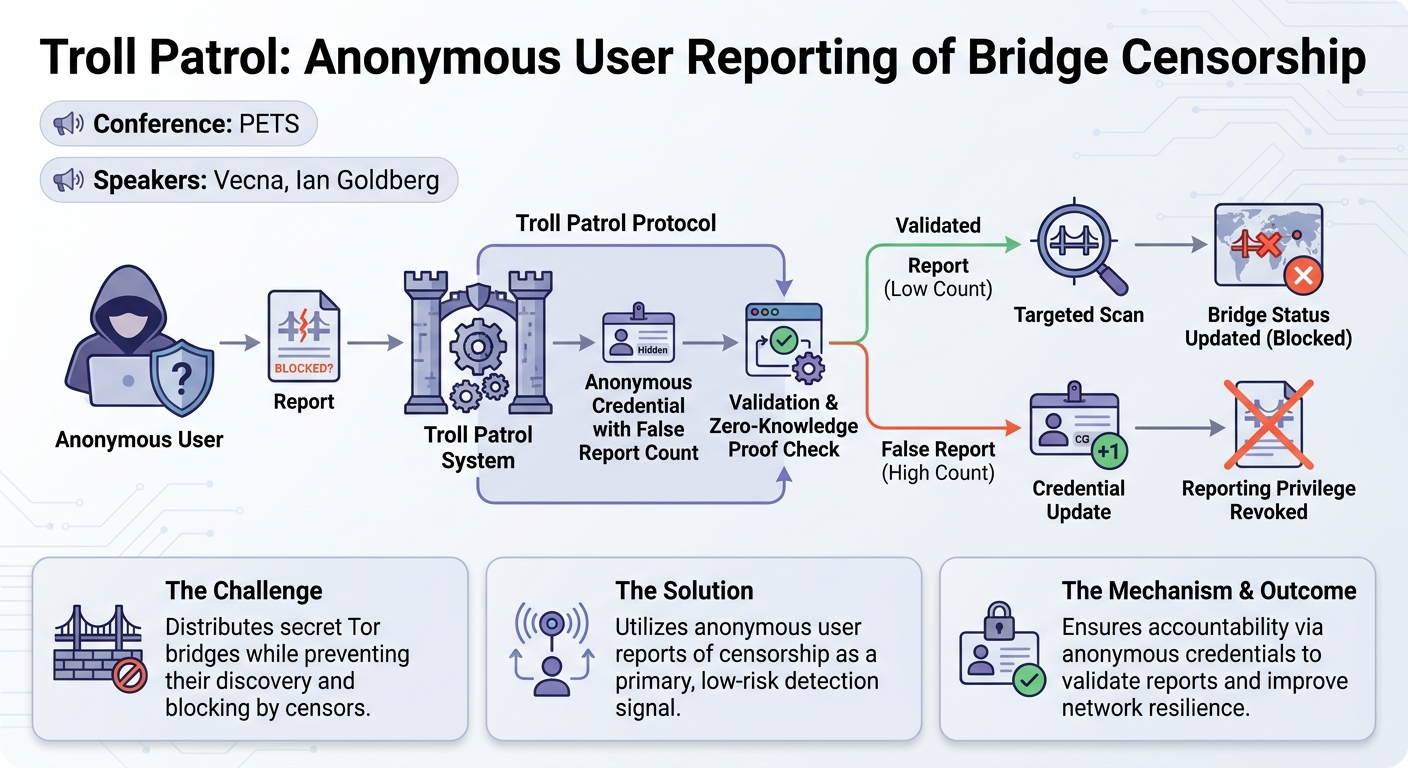
The "Troll Patrol" protocol focuses on collecting censorship reports directly from users. Instead of relying solely on risky active scanning methods, which can expose secret bridges, the system leverages anonymous user reports to identify blocked bridges. The core innovation lies in its ability to validate these reports and revoke the reporting privileges of malicious or inaccurate users, all while preserving their anonymity. This crucial mechanism ensures the integrity of the collected data without compromising the privacy of the users who are most at risk, thereby enhancing the effectiveness and sustainability of censorship circumvention efforts.
Authored by Vecna and Ian Goldberg, this research from the University of Waterloo proposes a significant step forward in the ongoing cat-and-mouse game between censors and circumvention tool developers. By providing a privacy-preserving and robust method for bridge status assessment, Troll Patrol contributes to the resilience of censorship-resistant networks, ultimately empowering users in restricted environments to maintain their right to information and free expression.
Background
▶ Watch: Introduction: Bridge censorship and Tor (0:00)
The internet, while a global network, is not universally free. Many authoritarian regimes employ sophisticated internet censorship techniques to control information flow, block access to specific websites, and prevent their citizens from accessing independent news or communicating freely. One of the most prominent tools for circumventing such censorship is Tor (The Onion Router). Tor routes internet traffic through a decentralized network of relays operated by volunteers worldwide, obscuring the user's IP address and making it difficult to trace their online activities.
However, censors are aware of Tor's existence and often attempt to block access to the entire network by identifying and blocking the IP addresses of publicly known Tor relays. To counter this, Tor introduced bridges. A Tor bridge is an unlisted Tor relay, meaning its IP address is not publicly disclosed in the main Tor directory. Users in censored regions can obtain bridge addresses through various distribution mechanisms and use them as their entry point into the Tor network, bypassing direct blocking of public relays.
This introduces the bridge distribution problem: how can these secret bridge addresses be distributed to legitimate users who need them, without also revealing them to the censors who would then block them? If a censor learns a bridge's IP address, they can simply add it to their blocklist, rendering it useless. Various solutions have been proposed, including reputation-based bridge distribution systems. These systems, such as Locks, aim to distribute bridges more securely by assigning users a reputation score. Users with good reputations might receive more bridges or be able to invite trusted friends to use existing bridges. The theory is that it should be difficult for a censor to accumulate a good reputation or gain invitations into these trusted networks.
For reputation-based systems like Locks to function effectively, they need accurate and timely information about which bridges are currently blocked and which are still operational. If a user is given a bridge, and that bridge is subsequently blocked, it could indicate that the user (or someone they invited) might have inadvertently or maliciously revealed the bridge to the censor, thus affecting their reputation. Therefore, a reliable mechanism to detect blocked bridges is paramount.
The traditional approach to censorship measurement often involves active scanning. This entails initiating connections from hosts within the region of interest to the resource being measured (e.g., a news website, a specific IP address) and observing whether the connection succeeds or fails. While effective for public resources, applying active scanning directly to secret Tor bridges presents a significant risk. Repeatedly connecting to a secret bridge from a known scanning server could draw the attention of the censor, who might then investigate what other resources that server is connecting to. This "noisy" activity could inadvertently reveal a cluster of secret bridges to the censor, leading to their mass blocking. The "Troll Patrol" research acknowledges the necessity of some active scanning for validation but emphasizes minimizing its use to mitigate this inherent danger. The central motivation for Troll Patrol, therefore, is to find a less risky, privacy-preserving alternative to primarily inform bridge status, leading to the development of a system that prioritizes anonymous user reports.
Key Findings
▶ Watch: Why active scanning fails for secret bridges (3:30)
The central finding of the "Troll Patrol" research is the design and implementation of a novel protocol that enables anonymous user reporting of bridge censorship while simultaneously ensuring the integrity of these reports. This system provides a critical mechanism for reputation-based bridge distribution systems like Locks to accurately assess the operational status of secret Tor bridges without unduly exposing them to censors.
The key discoveries and contributions are:
- Leveraging Anonymous User Reports for Censorship Measurement: The research identifies and formalizes the concept of using direct feedback from users, who are already attempting to use the bridges, as a primary signal for bridge blocking. This shifts the paradigm from purely active, external scanning to a more distributed, user-centric approach. This is crucial because users are the first to experience censorship, and their reports offer real-time, ground-truth data.
- Addressing the Challenge of Report Integrity in Anonymous Systems: A significant hurdle in relying on anonymous reports is the potential for abuse, such as users submitting false reports to trigger unnecessary scans or disrupt the system. Troll Patrol's core innovation lies in demonstrating how to prevent such malicious behavior without compromising the reporter's anonymity.
- Integration of Anonymous Credentials for Accountable Anonymity: The protocol ingeniously integrates with existing anonymous credential systems (specifically those used in Locks). By embedding a mutable, yet privacy-preserving, "false report count" (
Fvalue) within a user's credential, the system can track reporting accuracy. This allows the bridge distributor to revoke the ability of users to submit further inaccurate reports if they exceed a predefined threshold, all without ever learning the user's identity or their exactFvalue. This concept of accountable anonymity is a major contribution, ensuring system robustness while upholding user privacy. - Minimizing Risky Active Scanning: The protocol significantly reduces the reliance on active scanning. Instead of proactively scanning all bridges, active scans are only triggered by a user report and are used primarily for validation. This restriction drastically lowers the "noise" that could alert censors to the existence of secret bridges, thereby preserving their secrecy for longer periods.
In essence, Troll Patrol provides a secure, privacy-preserving, and efficient method to gather vital intelligence on bridge censorship, directly supporting the resilience and effectiveness of Tor's censorship circumvention infrastructure.
Technical Deep Dive
▶ Watch: Introducing anonymous user reports as a signal (4:55)
The "Troll Patrol" protocol addresses the fundamental problem of how to gather reliable censorship reports from users of secret Tor bridges while maintaining their anonymity and preventing abuse. The solution builds upon existing concepts of anonymous credentials and zero-knowledge proofs (ZKPs).
Initially, a simple design for anonymous reporting might involve a user hashing their bridge line (which includes the protocol, IP address, port, and cryptographic key for the bridge), adding a nonce and the current date, and submitting this hash as proof they know the bridge and are reporting it. The nonce and date prevent replay attacks, where an attacker resubmits an old report. However, this simple design is vulnerable to report spamming: a user with access to a working bridge could submit many false reports claiming it's blocked. This would trigger excessive active scans, which are dangerous as they can draw the censor's attention to the bridge, leading to its discovery and blocking. The system needs a way to revoke the ability of malicious users to submit further false reports without compromising their anonymity.
The key insight of Troll Patrol is to leverage anonymous credentials from systems like Locks. These credentials allow users to prove certain attributes about themselves without revealing their identity or other sensitive information. The protocol modifies these credentials to include a hidden attribute: a false report count (F value). This F value tracks how many inaccurate reports a user has submitted.
Here's a step-by-step breakdown of the enhanced protocol:
- User Initialization (Implicit): Alice, a Tor user in a censored region, possesses an anonymous credential issued by the bridge distributor. This credential includes various attributes, one of which is her
Fvalue, initially zero. The credential is cryptographically designed such that Alice can prove properties about its attributes (e.g.,F <= 2) without revealing the exact value ofFor her identity. Importantly, she cannot forge or arbitrarily change the values within the credential; only the issuer can update them through a specific protocol.
- Report Submission:
- Alice attempts to connect to a bridge she possesses and finds it blocked (or claims it is blocked).
- She constructs a report containing the hashed bridge line, a nonce, and the date.
- Crucially, she also generates a zero-knowledge proof (ZKP). This ZKP proves that her
Fvalue, as contained within her anonymous credential, is less than or equal to a predefined maximum allowed threshold (e.g.,F <= 2). She does not reveal her actualFvalue or her identity. - Alice sends this report (hashed bridge line, nonce, date, ZKP) to the bridge distributor.
- Session Identifier and Scan Initiation:
- The bridge distributor receives the report. It verifies the ZKP to ensure Alice's
Fvalue is within the acceptable range. If the ZKP is invalid (meaning herFvalue is too high), the report is rejected. - If the ZKP is valid, the distributor issues a unique session identifier (P value). This
Pvalue is cryptographically linked to Alice's current credential state (specifically, a hidden attribute within it) and serves as a temporary, anonymous handle for this specific report. ThisPvalue is then embedded into Alice's credential as part of the protocol. - The distributor then initiates an active scan. It contacts a scanning server located in the region Alice is reporting from (or a similar region) and asks it to attempt connecting to the reported bridge.
- Scan Validation and Report Status:
- The scanning server attempts to connect to the bridge.
- It reports the outcome (success or failure) back to the bridge distributor.
- If the scanning server confirms the bridge is indeed blocked, Alice's report is marked as accurate.
- If the scanning server successfully connects to the bridge, Alice's report is marked as inaccurate (false).
- Credential Update (Enforcement):
- Alice later queries the bridge distributor for the status of her report, using her credential.
- If her report was marked as accurate, her
Fvalue remains unchanged, and she can continue submitting reports. - If her report was marked as inaccurate, the bridge distributor, as part of the protocol, instructs Alice's credential to increment her
Fvalue by one. This is not a request but an enforced protocol step; Alice's credential must update itsFvalue. The anonymous credential system ensures this update happens correctly without revealing Alice's identity.
- Revocation of Reporting Ability:
- Suppose Alice has now submitted two false reports, and the maximum allowed
Fvalue is two. HerFvalue is now three. - If Alice attempts to submit another report, she must generate a ZKP that
F <= 2. Since her actualFvalue is three, she cannot truthfully generate this ZKP. - Consequently, her subsequent reports will be rejected by the bridge distributor because she cannot prove her
Fvalue is within the allowed limit. Her ability to submit further reports is effectively revoked, but her anonymity is preserved because neither her identity nor the exactFvalue was revealed at any point.
The strength of this protocol lies in its reliance on the non-falsifiable nature of anonymous credentials and the mathematical guarantees of zero-knowledge proofs. Users cannot lie about their F value, nor can they circumvent the update mechanism. This provides a robust, privacy-preserving method to collect actionable intelligence on bridge censorship while mitigating the risks of malicious reporting and excessive active scanning.
Demo / Proof of Concept
▶ Watch: Protocol example: Anonymous revocation of false reporters (7:15)
The talk primarily focuses on the theoretical design and protocol specification of "Troll Patrol," outlining how anonymous user reporting and anonymous credentials can be leveraged to address the bridge censorship problem. While the presentation provides a detailed walkthrough of the protocol's mechanics and an illustrative example involving a user named Alice, it does not describe a live demonstration or a deployed proof of concept system. The emphasis is on the cryptographic and architectural feasibility of the proposed solution.
Defensive Implications
▶ Watch: Summary of the anonymous reporting protocol (8:20)
The "Troll Patrol" protocol offers significant defensive implications for users, operators, and developers involved in censorship circumvention:
- Enhanced Bridge Longevity and Resilience: By providing a privacy-preserving mechanism to identify blocked bridges, Troll Patrol helps bridge distributors maintain a fresher, more accurate list of operational bridges. This means users are less likely to receive a bridge that is already blocked, improving their chances of connecting to Tor. More importantly, by minimizing risky active scanning, the protocol reduces the exposure of secret bridges to censors, thus prolonging their operational lifespan. This directly contributes to the overall resilience of the Tor bridge ecosystem against state-level blocking.
- Improved Trust and Reputation Management in Bridge Distribution: For systems like Locks, which rely on user reputation to distribute bridges, Troll Patrol offers a crucial feedback loop. It allows the bridge distributor to assess the reliability of users' reports without knowing their identity. This helps in identifying potentially malicious actors (e.g., censors trying to poison the system with false reports) or simply users who consistently provide inaccurate information, thus refining the reputation mechanism and ensuring that bridges are distributed to genuinely trustworthy users.
- Reduced Risk for Users in Censored Regions: The anonymity guarantees of Troll Patrol are paramount. Users reporting censorship are often in high-risk environments where their activities are monitored. By ensuring that their identity and reporting history remain hidden, the protocol protects these users from potential retaliation or further surveillance, encouraging more widespread and honest reporting.
- Optimized Resource Allocation for Scanning: Active scanning is resource-intensive and, more critically, risky for secret bridges. Troll Patrol allows bridge distributors to be much more strategic about when and where they deploy active scans. Scans are primarily triggered for validation of user reports, rather than for broad, proactive discovery. This targeted approach conserves resources and, most importantly, reduces the "noise" that could alert censors to the presence of secret bridges, making the entire system more efficient and secure.
- A Model for Privacy-Preserving Feedback in Adversarial Environments: Beyond Tor bridges, the principles demonstrated by Troll Patrol — collecting sensitive, ground-truth data from anonymous users, validating it, and managing reporting privileges without compromising privacy — could serve as a model for other security and human rights applications operating in adversarial environments. It shows how cryptographic tools can enable accountable feedback mechanisms where trust is scarce and anonymity is essential.
Key Takeaways
- Tor bridges are critical for censorship circumvention, but their secrecy is constantly threatened by censors who seek to discover and block them, creating the bridge distribution problem.
- Traditional active scanning for blocked bridges is risky, as it can reveal secret bridge IP addresses to censors, necessitating alternative, less conspicuous methods.
- Anonymous user reports offer a valuable, real-time signal for identifying blocked bridges, directly from those experiencing censorship.
- The "Troll Patrol" protocol leverages anonymous credentials and zero-knowledge proofs to validate user reports and revoke reporting privileges for malicious actors without compromising user anonymity.
- By embedding a "false report count" (F value) within a user's anonymous credential, the system can enforce accountability, ensuring report integrity while preserving privacy.
- This approach minimizes reliance on risky active scanning, deploying it only for targeted validation, thereby prolonging the lifespan and effectiveness of secret Tor bridges.
About the Speaker(s)
Vecna and Ian Goldberg are identified as the authors of the paper "Troll Patrol: Anonymous User Reporting of Bridge Censorship" and are affiliated with the University of Waterloo. Vecna delivered the presentation at the PETS conference. Their work focuses on enhancing the security and privacy of censorship circumvention tools, particularly within the context of the Tor network. Ian Goldberg is a well-known figure in the privacy and security research community, with a long history of contributions to privacy-enhancing technologies. Their research contributes to making the internet more accessible and secure for individuals facing censorship worldwide.
Reviews
Dr. Zero (Offensive Security Researcher) — SOLID
Goldberg and Vecna propose a clever cryptographic fix to Tor bridge poisoning using anonymous credentials and zero-knowledge proofs. It solves the report spamming problem mathematically by burning the reporting privileges of liars without unmasking them. Good math, but without a deployed proof-of-concept, it remains purely theoretical paper-ware.
Heather Calloway (CISO) — WEAK
This is academic cryptographic research demonstrating how Tor can use zero-knowledge proofs to crowdsource blocked-bridge reports without exposing the reporting users. It elegantly solves a hard problem in accountable anonymity for censorship circumvention. While it is excellent engineering for its intended domain, it has no immediate bearing on enterprise security programs or board-level risk.
→ Top-rated talks at Privacy Enhancing Technologies Symposium (PETS) 2026
All talks from Privacy Enhancing Technologies Symposium (PETS) 2026