“I don’t think it needs to be political”: Privacy Experiences and Concerns of FemHealth App Users in the United States
Ina Kaleva (Paper author · King's College London), Alisa Frik (Paper author · International Computer Science Institute), Lisa Malki (Paper author · University College London), Mark Warner (Paper author · University College London), Ruba Abu-Salma (Paper author · King's College London)
Privacy Enhancing Technologies Symposium (PETS) 2026 · Day 1 · Caribou
Overview
This talk, presented at PETS, delves into the critical and evolving landscape of privacy concerns among users of female health (FemHealth) applications in the United States. Authored by a collaborative team from King's College London, International Computer Science Institute, and University College London, the research provides an in-depth understanding of the lived experiences, fears, and expectations of individuals who rely on these increasingly popular digital health tools. The presentation highlights a significant gap between the highly sensitive nature of data collected by FemHealth apps and the current privacy protections and user transparency offered.
Key moments
- 1:20 Roe v. Wade's impact on fem health app privacy concerns
- 3:00 Key reasons why fem health data is extremely sensitive
- 4:00 Common privacy risks identified by fem health app users
- 5:30 User mitigation strategies and desired app privacy features
- 6:50 Participants' confusion regarding existing regulatory protections
- 8:00 Practical recommendations for improving fem health app privacy
- 8:30 Policy recommendations for stronger federal privacy legislation
“I don’t think it needs to be political”: Privacy Experiences and Concerns of FemHealth App Users in the United States
Speakers: Ina Kaleva (Paper author, King's College London); Alisa Frik (Paper author, International Computer Science Institute); Lisa Malki (Paper author, University College London); Mark Warner (Paper author, University College London); Ruba Abu-Salma (Paper author, King's College London)
Conference: PETS
YouTube: https://www.youtube.com/watch?v=XBoJs8yz7T4
Overview
This talk, presented at PETS, delves into the critical and evolving landscape of privacy concerns among users of female health (FemHealth) applications in the United States. Authored by a collaborative team from King's College London, International Computer Science Institute, and University College London, the research provides an in-depth understanding of the lived experiences, fears, and expectations of individuals who rely on these increasingly popular digital health tools. The presentation highlights a significant gap between the highly sensitive nature of data collected by FemHealth apps and the current privacy protections and user transparency offered.
The urgency and gravity of this topic have been dramatically amplified by the overturning of Roe v. Wade in 2022, which eliminated the federal right to abortion in the US. This landmark legal shift has transformed theoretical privacy risks into tangible fears of intimate surveillance, criminalization, and prosecution for individuals seeking or providing abortion care or contraception. The researchers conducted semi-structured interviews with 14 FemHealth app users across various US states to uncover their perceptions of privacy risks, mitigation strategies, information-seeking behaviors, and views on data protection laws.
The talk underscores that FemHealth apps, while offering convenient and affordable access to vital healthcare services like menstrual tracking, fertility monitoring, and contraception management, simultaneously aggregate deeply personal information. This data, ranging from sexual and reproductive health details to location and browsing activity, can be used to infer highly sensitive attributes such as health conditions, reproductive decisions, sexual orientation, and even political or religious beliefs. The findings present a stark picture of user anxiety, distrust, and a strong desire for more robust, transparent, and consistent privacy protections across states and at the federal level.
Background
▶ Watch: Roe v. Wade's impact on fem health app privacy concerns (1:20)
The proliferation of FemHealth applications has been a defining trend in digital health, with over 200 million downloads globally. These platforms offer unparalleled convenience, affordability, and accessibility to a spectrum of healthcare services, empowering users to track intricate details of their reproductive lives, including menstrual cycles, fertility windows, symptoms, sexual activity, pregnancy progression, and contraception usage. This granular data empowers users to manage their health proactively and make informed personal decisions.
However, the efficacy of these apps is predicated on the collection of an extraordinary volume of highly sensitive personal information. Beyond explicit reproductive health data, apps often gather contact details, precise location data, browsing activity, and other personal identifiers. The inherent danger lies not only in the raw data but also in the sophisticated inferences that can be drawn from it. Analytical techniques applied to this aggregated data can deduce deeply personal and potentially incriminating information, such as specific health conditions (e.g., early pregnancy, miscarriage), reproductive decisions (e.g., abortion, contraception use), sexual orientation, and even political or religious affiliations. This capability creates significant and often unacknowledged privacy risks for users.
The landscape of these privacy concerns underwent a seismic shift in 2022 with the overturning of Roe v. Wade by the US Supreme Court. This ruling revoked the federal constitutional right to abortion, devolving authority to individual states, many of which subsequently enacted stringent abortion bans or severe restrictions. This legal development catalyzed widespread fears among FemHealth app users regarding intimate surveillance and the potential for their highly personal data to be weaponized for criminalization and prosecution. Individuals seeking abortion care or contraception, or those who assist them, now face unprecedented legal jeopardy, making the privacy posture of FemHealth apps a matter of personal safety and legal consequence. Prior research has touched upon public attitudes towards these apps, but a comprehensive, in-depth understanding of the lived experiences and specific privacy anxieties of users in this new legal and social context remained largely unexplored, which this study sought to address.
Key Findings
▶ Watch: Common privacy risks identified by fem health app users (4:00)
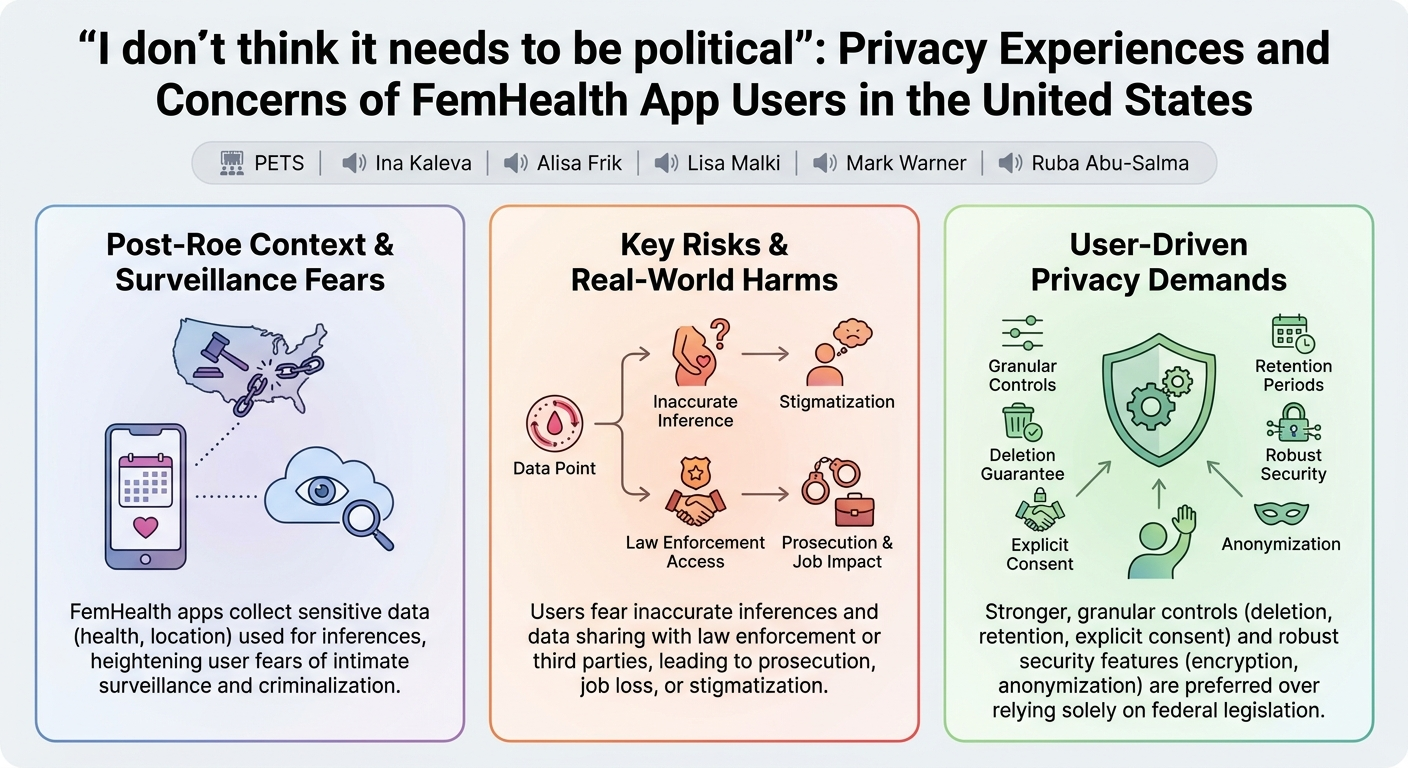
The research revealed a profound level of concern among participants regarding the sensitivity of their FemHealth data, driven by several interconnected factors. A primary worry was the potential for inaccurate inferences or misinterpretations of their data. For instance, a missed period logged in an app could be wrongly interpreted as an abortion rather than a miscarriage, a hormonal imbalance, or simply inconsistent app usage. This fear highlights the risk of automated systems or external parties drawing incorrect, yet legally consequential, conclusions from incomplete or ambiguous data.
Beyond misinterpretation, participants articulated specific fears related to the socio-economic and legal ramifications of data exposure:
- Job Impact and Workplace Discrimination: Concerns were raised that sensitive reproductive health data could lead to discrimination in employment, affecting career progression or even job security.
- Stigmatization and Social Judgments: Participants feared social stigma related to reproductive health decisions and judgmental attitudes regarding their sexual activity, underscoring the deeply personal and often private nature of this information.
- Criminalization: The most prominent and urgent concern was the potential for criminalization, particularly in states with anti-abortion or anti-birth control laws. This fear was a direct consequence of the post-Roe v. Wade legal environment, leading many participants to cease using their apps altogether.
Participants also identified several specific privacy risks within FemHealth apps:
- Hacking and Data Breaches: A common concern across all app types, but amplified here due to the extreme sensitivity of the data.
- Selling Data to Third Parties: Many participants found the practice of apps selling data for marketing purposes "creepy," fearing their intimate details would be exploited commercially.
- Location Tracking: This was a particularly acute concern, especially for users traveling to non-restrictive states for abortion care or visiting abortion clinics, as location data could be used to infer highly sensitive activities.
- Sharing Data with Government and Law Enforcement: A significant fear was that app data could be subpoenaed or voluntarily shared with authorities to prosecute individuals suspected of seeking or providing abortion or birth control care.
- Cross-Country/Cross-State Differences in Privacy Risks: Participants anticipated greater data protection in regions like Europe compared to the US and feared that data leaked in a state or country with stricter laws could have more severe consequences.
To mitigate these risks, users often resorted to self-censorship, either by choosing not to disclose specific details within the app or by providing deliberately fake information. Many also took the drastic step of stopping app usage, deleting the app, or deleting their data entirely. However, participants expressed a strong desire for more robust, systemic privacy protections, including greater privacy transparency regarding data sharing with government and law enforcement, more granular privacy controls over who can access data, and better security features such as face recognition, PINs, or two-factor authentication (2FA). They also advocated for stronger back-end privacy measures, including encryption, data minimization, and anonymization not just of personal identifiers but also device identifiers. Finally, participants desired discrete interface designs and notifications to prevent accidental disclosure, for example, during "shoulder surfing."
The study also highlighted significant user confusion regarding existing regulatory protections. Participants were often unclear about minors' privacy in FemHealth apps and whether the Health Insurance Portability and Accountability Act (HIPAA) applied to these platforms. They advocated for classifying FemHealth apps as covered entities under medical privacy regulations at a federal level, given their confusion about differing privacy regulations across states and how these interact with abortion laws.
Technical Deep Dive
▶ Watch: User mitigation strategies and desired app privacy features (5:30)
While the talk primarily focused on user experience and policy, the participants' expressed desires and the researchers' recommendations illuminate critical technical and architectural considerations for enhancing privacy in FemHealth applications. The core technical challenge lies in securing highly sensitive, inferential data against diverse threats, ranging from commercial exploitation to governmental surveillance and potential criminalization.
Participants articulated a clear need for granular privacy controls. This extends beyond simple on/off switches to encompass fine-grained management over specific data points, allowing users to select precisely who can access what data, under what circumstances, and for how long. This level of control necessitates robust access control mechanisms implemented at the application and potentially data storage layers. The demand for user-defined data retention periods and explicit consent before any data sharing further underscores the need for flexible and auditable data lifecycle management systems.
Security features were also a key technical concern. Users desired improved authentication mechanisms such as face recognition, PINs, or two-factor authentication (2FA) to prevent unauthorized access to their personal health data stored within the app. Implementing strong authentication is a foundational security practice, but its absence or weakness in FemHealth apps was a notable point of user anxiety.
The concept of back-end privacy emerged as a crucial area for improvement. This encompasses several core technical principles:
- Encryption: Data at rest and in transit must be encrypted using strong, modern cryptographic algorithms. This protects data from unauthorized access even if storage systems are compromised or network traffic is intercepted.
- Data Minimization: This principle dictates that apps should only collect the absolute minimum amount of data necessary to provide their stated functionality. This reduces the attack surface and the potential harm from a breach.
- Anonymization: Beyond removing personal identifiers like names, participants stressed the need for anonymization of device identifiers. This is a more challenging technical endeavor, requiring sophisticated techniques to prevent re-identification through device fingerprints, IP addresses, or usage patterns that could link seemingly anonymous data back to an individual. True anonymization, rather than mere pseudonymization, is critical given the inferential power of FemHealth data.
Furthermore, the recommendation for discrete interface designs and notifications points to user interface/user experience (UI/UX) security. This involves designing the app in a way that minimizes accidental disclosure, for example, through subtle notifications or screen layouts that prevent "shoulder surfing" – where an unauthorized person views sensitive information on a user's screen.
From a policy perspective, the confusion around HIPAA and the call for federal legislation highlight a significant technical-legal interface. HIPAA, while a cornerstone of medical privacy in the US, generally applies to "covered entities" (healthcare providers, plans, clearinghouses) and their business associates, often excluding direct-to-consumer apps not integrated with traditional healthcare systems. Classifying FemHealth apps as covered entities would impose stringent technical and administrative safeguards, including requirements for risk analyses, audit controls, integrity controls, and transmission security (e.g., encryption). This would mandate a higher standard of technical privacy infrastructure than many current apps may possess.
Finally, the advocacy for free and open-source apps that run entirely on the user's device represents a radical architectural shift. Such a design would eliminate the need for centralized servers, drastically reducing the risk of large-scale data breaches, third-party data sharing, and government surveillance. Data would reside solely on the user's device, under their direct control, requiring robust on-device encryption and secure local storage. This approach, while technically feasible for many tracking functions, presents challenges for features requiring cloud synchronization, multi-device access, or complex analytics that might exceed typical smartphone processing capabilities. Nevertheless, it represents the ultimate user desire for data sovereignty.
Demo / Proof of Concept
▶ Watch: Practical recommendations for improving fem health app privacy (8:00)
This technical article is based on a research paper and conference talk that primarily focused on qualitative user research, specifically semi-structured interviews and thematic analysis. The presentation detailed the methodologies used to gather and analyze participant experiences and concerns regarding FemHealth app privacy. As such, the talk did not include a live demonstration or a proof of concept of any specific exploit, defensive tool, or application. The findings presented were derived from user feedback and expert analysis, rather than a technical showcase of vulnerabilities or mitigation implementations.
Defensive Implications
▶ Watch: Policy recommendations for stronger federal privacy legislation (8:30)
The findings from this research offer critical insights for app developers, policymakers, and privacy advocates striving to enhance the defensive posture of FemHealth applications against privacy risks. The overarching implication is the need for a paradigm shift from minimal compliance to a privacy-by-design approach that prioritizes user autonomy and data security above all else.
For app developers, the immediate defensive actions should center on implementing the user controls participants desired. This includes developing accessible features for data deletion that come with a robust guarantee of no backup retention, ensuring that once data is deleted, it is permanently purged from all systems. Developers must also provide features that allow users to choose their data retention period, granting explicit control over how long their sensitive information is stored. Crucially, explicit user consent should be mandated before any data sharing occurs, moving beyond vague privacy policies to clear, actionable opt-ins. Furthermore, implementing privacy by default settings ensures that the most privacy-protective options are pre-selected, requiring users to actively opt-in to less private configurations.
Improved transparency around data flows is another vital defensive measure. Apps must clearly disclose when, why, and with whom data is shared. This includes transparent communication about any inferences made by the app from collected data, allowing users to understand the full scope of derived information. The researchers' recommendation for dynamic privacy prompts is particularly innovative; for example, notifying users when they travel to states or countries with stricter reproductive rights laws could empower them to make informed decisions about app usage or data entry in real-time.
From a broader defensive strategy, the recommendations extend to policy and industry-wide changes:
- Federal Legislation: The call for federal legislation to ensure consistent and fair protections across all states is paramount. A patchwork of state laws creates confusion and vulnerability. A unified federal standard, potentially classifying FemHealth apps as covered entities under medical privacy regulations, would impose a higher, consistent baseline for technical and administrative safeguards, including robust encryption, access controls, and audit trails.
- Public Awareness Campaigns: Running campaigns to educate the public about their privacy rights and existing regulatory protections can empower users to demand better privacy from apps and make more informed choices.
- App Store Mandates and Verification: App stores, as gatekeepers, have a significant role to play. They should mandate and actively verify full privacy disclosures by FemHealth app developers. This could include requiring standardized privacy labels (similar to nutrition labels) that clearly outline data collection, usage, and sharing practices, making it easier for users to compare apps.
- Independent and External Reports: Encouraging and funding independent, external reports on data privacy practices in FemHealth apps provides unbiased assessments and holds developers accountable, fostering trust and transparency.
- Open-Source and On-Device Solutions: Promoting the development and adoption of free and open-source apps that run entirely on the user's device is a radical but potentially highly effective defensive strategy. This architecture minimizes centralized data storage, reducing the attack surface for large-scale breaches and governmental data requests.
Ultimately, the defensive implications underscore that protecting FemHealth data requires a multi-faceted approach involving technical enhancements, transparent communication, strong policy frameworks, and empowered users.
Key Takeaways
- FemHealth apps collect extremely sensitive personal information, including sexual and reproductive health data, location, and browsing activity, which can be used to infer highly personal attributes and decisions.
- The overturning of Roe v. Wade significantly heightened user fears of intimate surveillance, criminalization, and prosecution, leading many to self-censor data or stop using apps entirely.
- Users are deeply concerned about inaccurate inferences from their data (e.g., missed period misinterpreted as abortion), job discrimination, stigmatization, and data sharing with government/law enforcement or third parties.
- There is a strong demand for enhanced privacy transparency, more granular privacy controls, improved security features (e.g., 2FA), and robust back-end privacy measures like encryption, data minimization, and anonymization of both personal and device identifiers.
- Users are confused about existing data protection laws like HIPAA and advocate for federal legislation to ensure consistent privacy protections across states, potentially classifying FemHealth apps as medical entities.
- Key recommendations include user-centric controls (data deletion guarantees, retention periods, explicit consent, privacy by default), dynamic privacy prompts, app store mandates for privacy disclosures, and the development of free and open-source apps running entirely on-device.
About the Speaker(s)
The talk was presented by Ina Kaleva, a paper author affiliated with King's College London. She was part of a collaborative research team that included Alisa Frik from the International Computer Science Institute, Lisa Malki from University College London, Mark Warner also from University College London, and Ruba Abu-Salma, also from King's College London. Their collective expertise spans computer science, privacy research, and human-computer interaction, bringing a comprehensive understanding to the complex interplay of technology, user experience, and policy in the realm of FemHealth app privacy.
Reviews
Dr. Zero (Offensive Security Researcher) — SOLID
Ina Kaleva and team tackle the post-Roe threat model for FemHealth apps, where data brokers and state police are suddenly the primary adversaries. It's a qualitative study showing exactly what we already knew—users are terrified, commercial apps leak like sieves, and nobody understands HIPAA. Solid HCI work, even if the technical takeaways mostly just boil down to 'build local-first apps.'
Heather Calloway (CISO) — SOLID
A stark, necessary look at the privacy reality of FemHealth apps in a post-Roe legal environment where data can become criminal evidence. It clearly maps the gap between user expectations, vendor practices, and the limitations of HIPAA. For any enterprise offering digital health benefits or managing a BYOD fleet, this is a wake-up call on third-party data exposure.
→ Top-rated talks at Privacy Enhancing Technologies Symposium (PETS) 2026
All talks from Privacy Enhancing Technologies Symposium (PETS) 2026