CensorLess: Cost-Efficient Censorship Circumvention Through Serverless Cloud Functions
Dayeon Kang (Paper author · University of Massachusetts Amherst), Jade Sheffey (Paper author · University of Massachusetts Amherst), Mingshi Wu (Paper author · GFW Report), Pubali Datta (Paper author · University of Massachusetts Amherst), Amir Houmansadr (Paper author · University of Massachusetts Amherst)
Privacy Enhancing Technologies Symposium (PETS) 2026 · Day 1 · Caribou
Overview
The talk "CensorLess: Cost-Efficient Censorship Circumvention Through Serverless Cloud Functions," presented by Dayeon Kang from the University of Massachusetts Amherst, introduces a groundbreaking approach to censorship circumvention. CensorLess is presented as the first censorship circumvention tool built entirely upon serverless cloud functions, a modern cloud architecture that abstracts away infrastructure management. The core motivation behind CensorLess stems from the exorbitant operational costs associated with traditional circumvention tools, which often rely on dedicated proxy servers or Virtual Private Servers (VPS). These costs become a significant barrier for both service providers and individual users.
Key moments
- 0:00 Introduction and the high cost of circumvention
- 1:59 Serverless cloud functions and their key properties
- 3:00 Sensorless cost savings and serverless proxy challenge
- 4:10 HTTP-based proxy solution and workflow
- 8:00 Domain fronting discovery in AWS Lambda
- 8:30 Demonstrating significant cost savings compared to alternatives
- 9:30 Real-world circumvention effectiveness in China
CensorLess: Cost-Efficient Censorship Circumvention Through Serverless Cloud Functions
Speakers: Dayeon Kang, Paper author, University of Massachusetts Amherst; Jade Sheffey, Paper author, University of Massachusetts Amherst; Mingshi Wu, Paper author, GFW Report; Pubali Datta, Paper author, University of Massachusetts Amherst; Amir Houmansadr, Paper author, University of Massachusetts Amherst
Conference: PETS
YouTube: https://www.youtube.com/watch?v=2l7hskQ6gQQ
Overview
The talk "CensorLess: Cost-Efficient Censorship Circumvention Through Serverless Cloud Functions," presented by Dayeon Kang from the University of Massachusetts Amherst, introduces a groundbreaking approach to censorship circumvention. CensorLess is presented as the first censorship circumvention tool built entirely upon serverless cloud functions, a modern cloud architecture that abstracts away infrastructure management. The core motivation behind CensorLess stems from the exorbitant operational costs associated with traditional circumvention tools, which often rely on dedicated proxy servers or Virtual Private Servers (VPS). These costs become a significant barrier for both service providers and individual users.
CensorLess directly addresses this cost challenge by leveraging the unique properties of serverless platforms, such as request-based billing, ephemeral IP addresses, and elastic scalability. The research demonstrates that by strategically utilizing AWS Lambda, CensorLess can achieve remarkable cost savings—up to 97% compared to existing least-cost solutions like Spot Proxy. Beyond cost-efficiency, the system also proves highly effective in bypassing sophisticated censorship, as validated through both simulations and real-world deployments in censored regions like Nanjing, China. This work represents a significant leap forward in making censorship circumvention more accessible and sustainable.
Background
▶ Watch: Introduction and the high cost of circumvention (0:00)
Censorship circumvention has long been a critical area of research and development, enabling users in restricted regions to access information and communicate freely. Traditional circumvention tools, such as VPNs, Tor, and various proxy services, typically route client traffic through intermediary servers located in uncensored cloud networks. While effective, this model inherently incurs substantial operational costs. Cloud providers charge based on data transfer, server uptime, and bandwidth usage, leading to expenses that quickly escalate with the number of users and the volume of traffic. For instance, the Tor Project reported spending $11,000 solely on third-party CDN fees in 2018, a figure that continues to rise. On the user side, surveys consistently show that cost is one of the top three factors influencing decisions about VPN services, highlighting a pervasive affordability problem across the entire ecosystem.
This dual challenge—the need for affordable infrastructure for providers and affordable tools for users—motivates the objective behind CensorLess: to build a censorship circumvention proxy that maximizes cost savings without introducing additional overhead. The proposed solution hinges on serverless cloud functions. Serverless computing represents a paradigm shift in cloud architecture, where developers upload code functions, and the cloud provider automatically provisions, scales, and maintains the underlying infrastructure. Key characteristics of serverless functions that make them ideal for this objective include request-based billing (paying only for actual execution time and resources consumed, rather than continuous server uptime), ephemeral IP addresses, ephemeral storage and containers, and elastic scalability with high concurrency. These properties not only drive down costs but also inherently contribute to censorship resistance by making it difficult for censors to block stable IP addresses or identify long-lived infrastructure.
However, building a proxy on serverless functions is not straightforward. Unlike Infrastructure-as-a-Service (IaaS) products, serverless environments typically restrict network visibility to the application layer. This means direct socket communication at the transport or IP layer, fundamental for many traditional proxy implementations, is generally disabled. Serverless functions are typically invoked via URL addresses, with DNS resolution and internal IP mapping handled entirely by the cloud provider, abstracting away lower-level network control from the developer. This limitation required a novel approach to proxy design, which CensorLess addresses through an HTTP-based circumvention mechanism.
Key Findings
▶ Watch: Sensorless cost savings and serverless proxy challenge (3:00)
CensorLess introduces several significant contributions and findings that redefine the landscape of censorship circumvention:
- First Serverless Circumvention Tool: CensorLess is presented as the pioneering censorship circumvention proxy built entirely upon serverless cloud functions, specifically implemented on AWS Lambda. This novel architecture represents a paradigm shift from traditional proxy deployments.
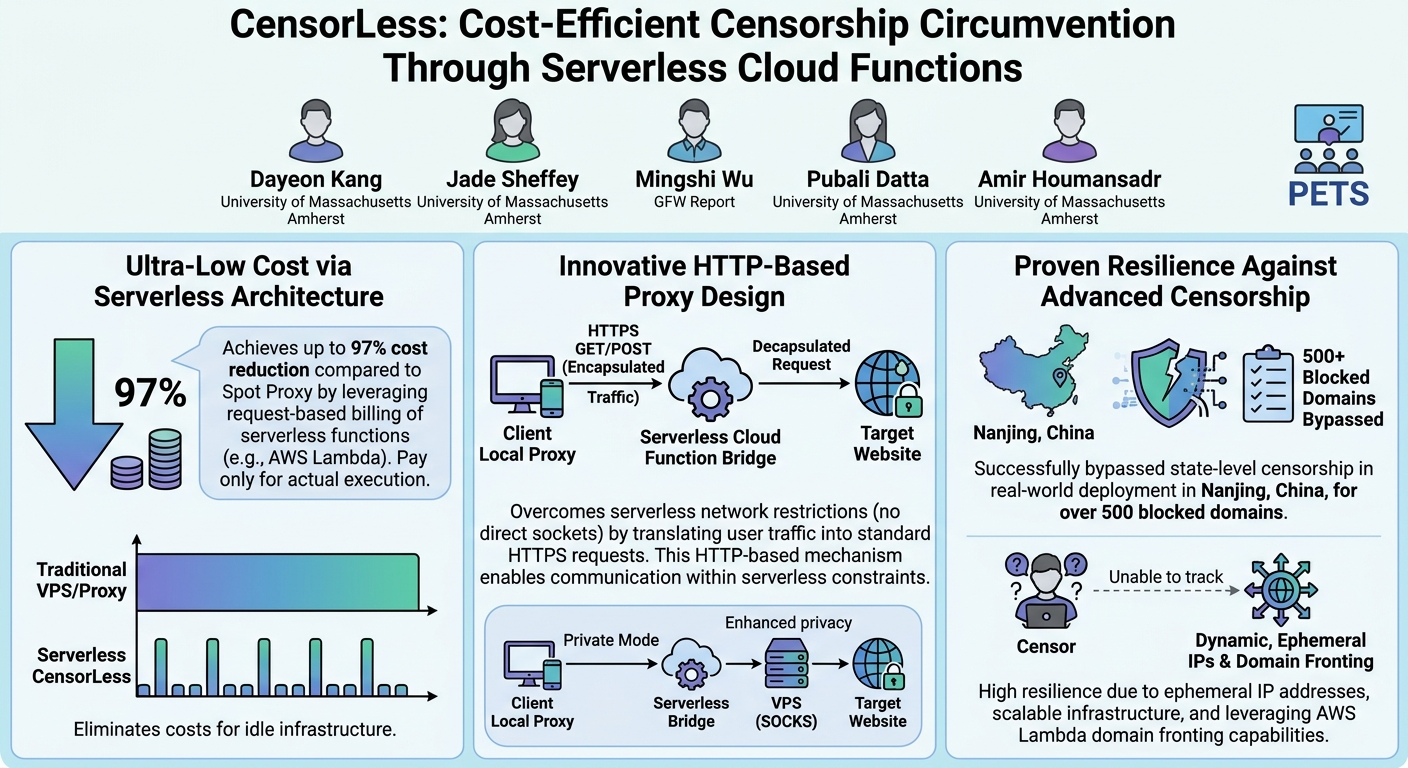
- Unprecedented Cost Savings: The most striking finding is the dramatic reduction in operational costs. In its "vanilla" configuration, CensorLess achieved a 97% cost reduction compared to Spot Proxy, a leading least-cost circumvention tool that leverages spot instances. Even in its "private mode," which incurs additional costs for enhanced anonymity via a VPS, CensorLess still delivered a 63% cost saving relative to Spot Proxy's optimal, least-cost configuration. This efficiency is attributed to the request-based, pay-as-you-go billing model of serverless functions.
- Real-World Effectiveness Against Advanced Censorship: CensorLess demonstrated robust circumvention capabilities. In real-world deployment on Alibaba Cloud in Nanjing, China, CensorLess successfully bypassed censorship for 500 well-known blocked domains. The vanilla mode achieved 100% success, while the private mode failed in only one instance, attributed to the target website not supporting HTTPS rather than a system limitation.
- High Connectivity and Resilience: Through game theory censorship simulations, assuming 50% of clients as censoring agents capable of discovering and blocking proxies, CensorLess maintained approximately 95% user connectivity and ensured proxies remained unblocked. This highlights its inherent resilience against dynamic blocking strategies.
- Discovery of AWS Lambda Domain Fronting: An interesting and unexpected technical finding was that AWS Lambda's network still allows domain fronting, a technique previously thought to be largely mitigated by major cloud providers. CensorLess leverages this by allowing its local proxy to send HTTPS requests over fabricated subdomains, providing an additional layer of censorship resistance and obfuscation.
- HTTP-Based Proxy Design: To overcome the inherent network visibility restrictions of serverless functions (which operate at the application layer and disable direct socket communication), CensorLess employs an innovative HTTP-based circumvention proxy. This design intercepts user traffic and translates it into standard HTTPS GET and POST methods, enabling communication within the serverless environment's constraints.
These findings collectively establish CensorLess as a highly effective, remarkably cost-efficient, and resilient solution for censorship circumvention, leveraging the unique advantages of serverless cloud functions.
Technical Deep Dive
▶ Watch: HTTP-based proxy solution and workflow (4:10)
The fundamental technical challenge in building a censorship circumvention proxy on serverless cloud functions like AWS Lambda is the restricted network visibility. Serverless functions are typically invoked via URL addresses, with the cloud provider managing DNS resolution and internal IP mapping. This architecture limits developers to the application layer, effectively disabling direct socket communication at the transport or IP layer. CensorLess ingeniously navigates this limitation by implementing an HTTP-based circumvention proxy that exclusively utilizes standard HTTPS GET and POST methods.
The CensorLess architecture comprises four main components:
- Controller: This component is responsible for orchestrating the rotation of serverless bridges, ensuring that clients are always directed to fresh, unblocked instances.
- Function Refresher: Periodically activated, the Function Refresher is tasked with generating new serverless bridge instances and retiring older ones. This dynamic rotation is crucial for maintaining censorship resistance by preventing censors from identifying and blocking stable endpoints.
- Local Proxy: Residing on the client side in the censored region, the Local Proxy is the initial point of contact for user traffic. Its primary function is to intercept client requests and translate them into HTTPS GET or POST methods suitable for serverless communication, thereby circumventing the socket communication limitation.
- Serverless Function Pool: This pool contains the actual serverless bridges, which are instances of the CensorLess proxy deployed on a serverless platform (e.g., AWS Lambda). These bridges are located in uncensored regions and act as intermediaries between the client and the target destination.
The workflow for CensorLess operates as follows:
In the vanilla mode, a client in a censored region routes its traffic to a serverless bridge. These bridges inherently offer censorship resistance due to their use of ephemeral IP addresses, isolated containers, and temporary storage, making it difficult for censors to establish persistent blocking rules. To enhance this resistance, the operator periodically rotates the serverless bridges. The Controller informs the current bridge of the URL of the next bridge. The client's Local Proxy then fetches this migration information and seamlessly redirects subsequent requests to the new serverless bridge. This process ensures continuous operation without direct communication between the client and the operator for bridge updates.
For enhanced privacy and anonymity, CensorLess offers a private mode. This mode integrates a VPS server into the architecture. At the bootstrap stage, managed by the operator, the client and the VPS exchange public keys to establish an encrypted channel. When a client initiates communication, it sends a SOCKS message embedded within an HTTPS request. This HTTPS request is directed to the serverless bridge. The bridge, upon receiving the request, parses the HTTPS payload to extract the encapsulated SOCKS message. It then forwards this SOCKS message to the VPS, which in turn routes it to the real destination. This approach maintains the cost-efficiency of serverless functions for the initial hop while leveraging the VPS for end-to-end privacy. The private mode utilizes the same four core components, with the VPS acting as an additional, privacy-enhancing intermediary.
A noteworthy technical discovery made during the development of CensorLess was that AWS Lambda's network infrastructure still permits domain fronting. Domain fronting is a technique where a client makes a request to a legitimate domain (the "front" domain) that is hosted on a CDN or cloud service, but the request's Host header specifies a different, blocked domain (the "covert" domain) also hosted on the same service. The cloud service then routes the request to the covert domain. While many cloud providers have taken steps to mitigate this, CensorLess found that AWS Lambda continues to allow it. This capability is leveraged by the Local Proxy to send HTTPS requests over fabricated subdomains, providing an additional layer of obfuscation and censorship resistance by making circumvention traffic appear as legitimate traffic destined for a benign cloud service.
Demo / Proof of Concept
▶ Watch: Demonstrating significant cost savings compared to alternatives (8:30)
While the talk did not feature a live, interactive demonstration, the research meticulously evaluated CensorLess's performance and effectiveness through a series of rigorous tests, serving as a comprehensive proof of concept. These evaluations covered throughput, operational cost, and circumvention efficacy in both simulated and real-world censored environments.
Performance Evaluation:
The performance of CensorLess was measured across three common internet applications:
- Browsing cnn.com with heavy objects: This simulated typical web browsing with rich media content.
- Downloading PDF files: Representing file transfer scenarios.
- Watching short stream video: Testing performance for real-time media consumption.
The results indicated that the overall throughput with CensorLess proxy in place was "almost the same" as without a proxy. While burst timing and total durations varied depending on bridge migration events, the system maintained comparable performance, demonstrating that the HTTP-based proxy design does not introduce significant latency or bandwidth bottlenecks that would degrade user experience.
Operational Cost Evaluation:
This was a cornerstone of the CensorLess project. The system's operational costs were compared against two established least-cost censorship circumvention tools: Spot Proxy and Mess Browser.
- Vanilla CensorLess vs. Spot Proxy: In its most cost-efficient configuration (vanilla mode), CensorLess achieved an astounding 97% reduction in cost when compared to Spot Proxy's optimal scenario, which consistently utilized the most affordable spot instances. This significant saving is attributed to CensorLess's request-based, pay-as-you-go pricing model, eliminating the need for continuously running, even if cheap, instances.
- Private Mode CensorLess vs. Spot Proxy: Even with the added cost of a VPS server for enhanced privacy and anonymity, CensorLess in private mode still delivered a substantial 63% cost reduction compared to Spot Proxy's optimal configuration.
- Scalability and Cost: The evaluation also showed that CensorLess remains highly cost-effective even under increased load. When the number of processes (presumably concurrent users or connections) increased to 300, the total cost for CensorLess remained remarkably low, staying under $3.5. This highlights its scalability without a proportional increase in expenditure, a critical factor for widespread adoption.
Circumvention Effectiveness:
CensorLess's ability to bypass censorship was rigorously tested in two environments:
- Simulations: A game theory censorship simulator was employed, modeling a scenario where 50% of clients were assumed to be censoring agents capable of discovering and blocking proxies. In this challenging environment, CensorLess achieved approximately 95% user connectivity and ensured that its proxies remained unblocked, demonstrating its resilience against active censorship.
- Real-World Deployment (Nanjing, China): CensorLess was deployed on Alibaba Cloud in Nanjing, China, a region known for sophisticated internet censorship (the Great Firewall). The system's accessibility was tested against a list of 500 well-known blocked domains in mainland China.
- Vanilla CensorLess: Successfully bypassed censorship for all 500 domains without being blocked.
- Private Mode CensorLess: Failed in only one instance. This failure was attributed not to the CensorLess system itself, but to the specific website simply not allowing any HTTPS requests, indicating it was an issue with the target content, not the circumvention method.
These comprehensive evaluations unequivocally demonstrate CensorLess's viability as a highly cost-efficient, performant, and robust solution for censorship circumvention, capable of operating effectively against advanced state-level censorship.
Defensive Implications
▶ Watch: Real-world circumvention effectiveness in China (9:30)
From the perspective of internet censors, the advent of tools like CensorLess presents significant and escalating challenges. The core difficulty lies in the inherent characteristics of serverless cloud functions, which CensorLess fully exploits. Traditional censorship mechanisms often rely on blocking IP addresses, deep packet inspection, or identifying specific protocol signatures. However, serverless functions undermine these strategies:
- Ephemeral and Dynamic IP Addresses: Serverless functions are provisioned dynamically, meaning their underlying IP addresses are ephemeral and constantly changing. This renders IP-based blocking largely ineffective, as censors would be chasing a moving target. Even if a specific IP associated with a serverless function is identified and blocked, the next invocation could originate from a completely different IP address, making sustained blocking impossible.
- Shared Infrastructure and Domain Fronting: Serverless functions operate within massive cloud provider networks, sharing IP ranges with countless legitimate services. Blocking these IP ranges would inevitably lead to massive collateral damage, disrupting essential cloud services and causing significant economic and political backlash. Furthermore, CensorLess's discovery that AWS Lambda still allows domain fronting adds another layer of obfuscation. By making circumvention traffic appear as legitimate traffic destined for a benign cloud service (e.g.,
amazon.com), censors face an even greater challenge in distinguishing malicious or circumvention traffic from legitimate cloud communication without causing widespread disruption. - Application-Layer Obfuscation: CensorLess's reliance on HTTPS GET and POST methods to encapsulate SOCKS messages (in private mode) means that its traffic closely resembles standard, legitimate web traffic. This makes it exceedingly difficult for deep packet inspection systems to differentiate circumvention traffic from regular encrypted web browsing without resorting to highly intrusive and resource-intensive decryption and analysis, which is often impractical at scale.
- Cost-Efficiency and Scalability: The extreme cost-efficiency of CensorLess means that circumvention providers can deploy and scale their operations with minimal financial burden. This lowers the barrier to entry for new services and allows existing ones to absorb higher numbers of users, making it harder for censors to completely suppress access by simply outspending or out-resourcing circumvention efforts.
For network defenders focused on protecting corporate or national networks, CensorLess itself is designed for circumvention, not direct attack. However, the underlying principles (e.g., using serverless functions for proxying, or even the domain fronting technique) could, in theory, be adapted by malicious actors for command-and-control (C2) channels or data exfiltration. Therefore, understanding how serverless platforms can be leveraged for obfuscated communication is crucial for developing robust detection and prevention strategies against advanced persistent threats (APTs) that might employ similar techniques. Overall, CensorLess represents a powerful tool for users seeking to bypass censorship, simultaneously posing a substantial and evolving challenge for those aiming to enforce it.
Key Takeaways
- Serverless functions enable highly cost-efficient censorship circumvention: CensorLess demonstrates that leveraging modern serverless architectures like AWS Lambda can drastically reduce the operational costs associated with censorship circumvention tools, making them more accessible and sustainable.
- Dramatic cost savings achieved: CensorLess reduced costs by up to 97% in vanilla mode and 63% in private mode compared to existing least-cost solutions like Spot Proxy, proving the economic viability of serverless-based circumvention.
- Effective against advanced censorship: The system successfully bypassed the Great Firewall in real-world tests in Nanjing, China, for 500 blocked domains, showcasing its robustness against sophisticated state-level censorship.
- Innovative HTTP-based proxy design overcomes serverless limitations: By translating client traffic into standard HTTPS GET/POST requests, CensorLess circumvents the inherent network visibility restrictions (lack of socket communication) in serverless environments.
- Private mode balances privacy and cost: The integration of a VPS server for SOCKS communication provides enhanced privacy and anonymity while still maintaining significant cost savings compared to traditional methods.
- Domain fronting remains a viable technique on AWS Lambda: The discovery that AWS Lambda still permits domain fronting offers an additional layer of obfuscation and censorship resistance, which CensorLess leverages for increased resilience.
About the Speaker(s)
The talk "CensorLess: Cost-Efficient Censorship Circumvention Through Serverless Cloud Functions" was presented by Dayeon Kang from the University of Massachusetts Amherst. Dayeon is one of the paper's authors, along with Jade Sheffey and Pubali Datta also from the University of Massachusetts Amherst, Mingshi Wu from GFW Report, and Amir Houmansadr, a faculty member at the University of Massachusetts Amherst. Their collective research focuses on developing innovative solutions for censorship circumvention, exploring novel network architectures, and enhancing internet freedom. The work presented reflects their expertise in network security, cloud computing, and the practical challenges of combating internet censorship.
Reviews
Dr. Zero (Offensive Security Researcher) — SOLID
Kang and the UMass team turned AWS Lambda's billing model into an economic weapon against the Great Firewall, cutting proxy infrastructure costs by up to 97%. Testing it live in Nanjing instead of relying on local simulations proves they actually give a damn about real-world viability. It's a clever, pragmatic abuse of serverless constraints to keep the circumvention ecosystem breathing.
Heather Calloway (CISO) — SOLID
The authors built a highly effective censorship circumvention tool using AWS Lambda, but the enterprise takeaway is strictly defensive. They proved serverless infrastructure and domain fronting can be combined to create near-untraceable, resilient proxies. You must assume threat actors will adopt this architecture for C2 and data exfiltration.
→ Top-rated talks at Privacy Enhancing Technologies Symposium (PETS) 2026
All talks from Privacy Enhancing Technologies Symposium (PETS) 2026