SoK: Verifiable Integrity Claims for Privacy-Preserving Federated Learning
Marco Esposito (Paper author · Politecnico di Milano), Andrea Rizzini (Paper author · Politecnico di Milano, Horizen Labs), Tommaso Gagliardoni (Paper author · Horizen Labs), Francesco Bruschi (Paper author · Politecnico di Milano)
Privacy Enhancing Technologies Symposium (PETS) 2026 · Day 1 · Beaver
Overview
In an era increasingly reliant on distributed computing and data privacy, Federated Learning (FL) has emerged as a crucial paradigm for training machine learning models while keeping sensitive data localized. However, the inherent distributed nature of FL introduces significant security challenges, particularly concerning the integrity and correctness of participants' contributions. This talk, presented by Andrea Rizzini from Politecnico di Milano, alongside co-authors Marco Esposito, Tommaso Gagliardoni, and Francesco Bruschi, addresses these critical vulnerabilities by presenting a Systematization of Knowledge (SoK) on verifiable federated learning. The researchers not only survey existing solutions but also propose a novel framework and a set of concrete claims to achieve end-to-end verifiable federated learning.
Key moments
- 0:00 Introduction to Federated Learning and verifiability need
- 2:00 Defining verifiability: technologies and framework claims
- 4:00 Proposed framework: client-side verifiable training explained
- 6:14 Analyzing existing work with their framework
- 8:00 How verifiability mitigates various attacks
- 9:28 Practical costs and overheads of verifiability
- 10:35 Future research directions and open challenges
SoK: Verifiable Integrity Claims for Privacy-Preserving Federated Learning
Speakers: Marco Esposito (Paper author, Politecnico di Milano); Andrea Rizzini (Paper author, Politecnico di Milano, Horizen Labs); Tommaso Gagliardoni (Paper author, Horizen Labs); Francesco Bruschi (Paper author, Politecnico di Milano)
Conference: PETS
YouTube: https://www.youtube.com/watch?v=lUYJLkZ_xr0
Overview
In an era increasingly reliant on distributed computing and data privacy, Federated Learning (FL) has emerged as a crucial paradigm for training machine learning models while keeping sensitive data localized. However, the inherent distributed nature of FL introduces significant security challenges, particularly concerning the integrity and correctness of participants' contributions. This talk, presented by Andrea Rizzini from Politecnico di Milano, alongside co-authors Marco Esposito, Tommaso Gagliardoni, and Francesco Bruschi, addresses these critical vulnerabilities by presenting a Systematization of Knowledge (SoK) on verifiable federated learning. The researchers not only survey existing solutions but also propose a novel framework and a set of concrete claims to achieve end-to-end verifiable federated learning.
The core problem tackled is the lack of guarantees regarding participant behavior in FL. While some sensitive applications like healthcare or finance might assume honest clients, general FL scenarios offer no such assurances. The distributed architecture increases the attack surface, allowing for various malicious activities, including subtle model poisoning and backdoor attacks that can remain undetectable even post-training. The authors contend that verifiability—the ability for an executor to provide demonstrable evidence that a protocol was executed correctly—is the key to mitigating these sophisticated threats, thereby fostering trust and reliability in FL systems.
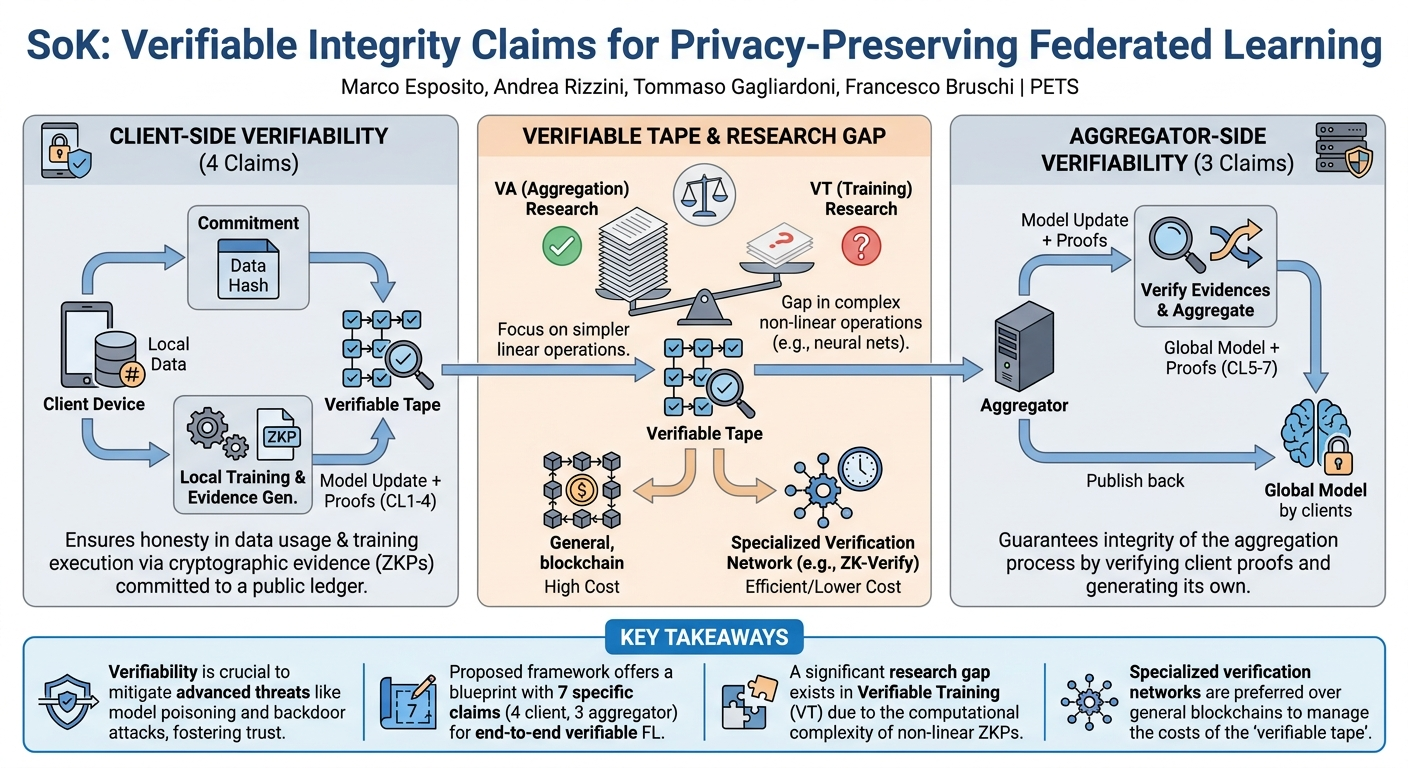
This work is particularly significant because it moves beyond mere problem identification to offer a structured path forward. By introducing a comprehensive framework and a set of seven distinct claims (four for client-side and three for aggregator-side verifiability), the researchers provide a blueprint for constructing robust and auditable FL systems. Their analysis of 13 existing papers reveals gaps in current research, particularly concerning the verifiability of the training process itself, and offers practical recommendations for both researchers and practitioners aiming to enhance the security posture of their federated learning deployments.
Background
▶ Watch: Introduction to Federated Learning and verifiability need (0:00)
Federated Learning (FL) is a distributed machine learning paradigm that enables multiple clients to collaboratively train a shared global model without directly sharing their raw, sensitive data. Instead, each client trains a local model on its private dataset and then sends only model updates (e.g., gradients) to a central aggregator. The aggregator combines these updates to improve the global model, which is then sent back to the clients for the next round of local training. This approach is highly beneficial for privacy-preserving applications in domains such as healthcare, finance, and mobile computing, where data localization is paramount.
However, the distributed nature of FL, while beneficial for privacy, significantly expands the attack surface. Unlike traditional centralized training where a single, trusted entity controls the data and training process, FL involves numerous participants, any of whom could be malicious. The talk highlights that while many common attacks are somewhat mitigated, sophisticated threats persist. Recent research, for instance, has demonstrated the feasibility of planting backdoor attacks into the global model in a way that makes them extremely difficult to discover post-hoc. Other significant threats include model poisoning, where malicious clients inject corrupted updates to degrade model performance or introduce specific vulnerabilities, and free-riding, where clients benefit from the collective training without contributing meaningful work.
To counter these threats, the concept of verifiability is introduced. Informally, verifiability means that an executor of a protocol not only performs its task but also produces an "attestation" or "evidence" that its execution was performed correctly. This evidence can then be independently verified by other participants or an external auditor. The talk identifies two primary technological approaches to achieving verifiability:
- Zero-Knowledge Proofs (ZKPs): These are cryptographic methods that allow one party (the prover) to prove to another party (the verifier) that a statement is true, without revealing any information beyond the validity of the statement itself. ZKPs rely on strong cryptographic assumptions and are highly flexible, able to prove arbitrary computations.
- Trusted Execution Environments (TEEs): These are hardware-based isolation technologies (e.g., Intel SGX, AMD SEV) that create a secure enclave within a processor. Code and data executed within a TEE are protected from external access, even from privileged software like the operating system or hypervisor. TEEs can produce a cryptographic "quote" as evidence that specific code was executed correctly within a genuine TEE.
Within the FL pipeline, the talk pinpoints three critical phases where malicious behavior can occur and thus where verifiability is most needed:
- Usage of data: Ensuring clients use their actual, committed datasets for training.
- Training algorithm: Verifying that clients execute the agreed-upon training algorithm correctly and honestly.
- Aggregation: Confirming that the central aggregator combines the client updates accurately and without manipulation.
The existing landscape of verifiable FL solutions is fragmented, with many works focusing on specific aspects or employing ad-hoc methods. This lack of a unified framework or systematic approach motivated the authors' Systematization of Knowledge, aiming to bring order and clarity to the field while also proposing a concrete path forward.
Key Findings
▶ Watch: Proposed framework: client-side verifiable training explained (4:00)
The central contribution of this work is not merely a survey, but the proposal of a comprehensive framework and a defined set of claims designed to bring structure and end-to-end verifiability to federated learning. Instead of just systematizing existing literature, the authors introduce a novel lens through which to analyze and build verifiable FL systems.
Their framework articulates seven distinct claims, crucial for achieving full verifiability:
- Four claims for client-side verifiability: These relate to ensuring the honesty and correctness of individual client contributions, from data usage to local model training.
- Three claims for aggregator-side verifiability: These focus on guaranteeing the integrity of the central aggregation process, ensuring model updates are combined correctly.
The authors assert that by implementing these seven claims, it is possible to achieve an end-to-end verifiable federated learning system. This holistic approach is a significant step beyond fragmented solutions that only address isolated aspects of the FL pipeline.
To validate and illustrate their framework, the researchers systematized 13 papers from the existing literature. They categorized these works based on which of their proposed claims they addressed, using abbreviations: VD for verifiability of data, VT for verifiability of training, and VA for verifiability of aggregation. A key insight derived from this analysis, visualized through a radar plot, is that the majority of existing research disproportionately focuses on VA (verifiability of aggregation). While aggregation is a critical point of potential attack, this emphasis leaves significant gaps in ensuring the integrity of client-side operations, particularly the actual training process.
Furthermore, the analysis revealed a notable disconnect: many works neglect claims that the authors identified as "particularly easy" to implement, yet capable of providing "interesting guarantees of verifiability." This suggests that practitioners and researchers might be overlooking straightforward improvements that could significantly enhance the security of their FL systems.
Another significant finding pertains to the common architectural choices in verifiable FL. Many of the surveyed works leverage blockchain technology to serve as the verifiable tape or bulletin board within their frameworks. This is primarily used to verify Zero-Knowledge Proofs (ZKPs) related to training and aggregation. The benefit of using a blockchain in this context is that it provides an immutable, transparent ledger where proofs and attestations can be published and verified. This setup also allows a third-party auditor to independently check that all entities have verified proofs correctly before proceeding with their tasks, thereby enhancing accountability and trust.
Finally, the talk explicitly links specific verifiability claims to the mitigation of various attacks. For example, the claim for verifiable training (CL2) directly mitigates model poisoning. By requiring clients to prove that they ran a specific, approved algorithm and to provide evidence of this execution, it becomes significantly harder for malicious clients to inject harmful updates. This also implicitly addresses free-riding, as clients must demonstrate genuine participation through verifiable proofs. The ability to link specific verifiability mechanisms to concrete security outcomes is a powerful finding, providing clear guidance for defenders.
Technical Deep Dive
▶ Watch: Analyzing existing work with their framework (6:14)
The proposed framework for verifiable federated learning revolves around a central, immutable ledger referred to as a "tape" or "bulletin board." This tape acts as a public record where all critical steps and their corresponding proofs are published, enabling transparency and auditability. The framework delineates distinct processes for client-side training and global aggregation, each fortified with verifiability mechanisms.
Client-Side Verifiability (Training)
The client's role in the verifiable FL framework is significantly enhanced beyond merely submitting gradients. The process unfolds in several key stages:
- Data Commitment: Before commencing training, each client must commit to their local dataset. This involves generating a cryptographic commitment (e.g., a hash or a Merkle root) of their data and publishing it on the verifiable tape. This commitment serves as an anchor, later allowing the client to prove that the data used for training was indeed the committed dataset. This step, identified as relatively cheap, often involves a Merkle proof alongside the commitment.
- Training Execution and Evidence Generation: The client then performs local model training using their committed data and the specified algorithm. Crucially, during or immediately after training, the client must generate evidence (a proof) for several properties:
- Data Usage: Proof that the training was performed on the committed dataset.
- Training Algorithm: Proof that the correct, agreed-upon training algorithm was executed without deviation.
- Properties of Updates: Proof of certain characteristics of the generated gradients (e.g., boundedness, differential privacy guarantees, or other constraints).
- Uniqueness: Proof to prevent replay attacks, ensuring that the submitted gradients and evidence correspond to a unique, current training round.
- These proofs are often in the form of Zero-Knowledge Proofs (ZKPs), demonstrating correct computation without revealing the underlying data or gradients.
- Publication: Finally, the client publishes a tuple on the tape, consisting of a handle to their computed gradients (which might be encrypted or directly published depending on the privacy model) and the generated evidence.
Aggregator-Side Verifiability (Aggregation)
The aggregator, responsible for combining client updates, also operates under a verifiable regime:
- Evidence Verification and Admission Set: The aggregator first retrieves all submitted tuples (gradients + evidence) from the tape. It then rigorously verifies all client evidences against the specified claims. Only correctly verified evidences are admitted. The aggregator compiles an admission set comprising all valid client contributions. This ensures that only honest and correctly executed client updates contribute to the global model.
- Aggregation Execution and Evidence Generation: The aggregator then performs the global model aggregation, combining the gradients from the admission set to produce the new global model parameters, denoted as
theta global. After aggregation, the aggregator generates its own evidence, proving that the aggregation was performed correctly on the admitted set of client updates. - Publication: The aggregator publishes
theta global(or a handle to it) and its corresponding evidence on the tape. - Client Verification of Aggregation: Before starting the next training round, clients can retrieve
theta globaland the aggregator's evidence from the tape. They can then verify the correctness of the aggregation themselves, closing the loop of end-to-end verifiability.
The Verifiable Tape and External Auditing
The "tape" or "bulletin board," often implemented using a blockchain or a similar distributed ledger, is fundamental to the framework. It provides an immutable, transparent, and publicly verifiable record of all interactions and proofs. This design choice is crucial because it allows not only participants to verify each other's actions but also enables an external auditor to inspect the entire process retrospectively. An auditor can retrieve all commitments, evidences, and aggregated models from the tape and independently verify that all claims were met throughout the FL lifecycle.
Cost and Feasibility Analysis
The talk provides an insightful analysis of the computational costs associated with implementing verifiability for different stages:
- Verifiability of Data (VD): This is deemed "relatively cheap." Proving the use of a specific dataset and its properties typically involves cryptographic commitments combined with Merkle proofs. These operations have logarithmic complexity with respect to data size, making them efficient.
- Verifiability of Training (VT): This is identified as the most challenging and research-intensive area. Training algorithms often involve numerous non-linear operations (e.g., activation functions, multiplications in neural networks). These operations are notoriously not circuit-friendly for Zero-Knowledge Proofs, leading to extremely large and computationally expensive ZKP circuits. The authors explicitly state that "further research is needed" in this area.
- Verifiability of Aggregation (VA): This is considered more feasible for ZKPs. Aggregation operations, such as summing gradients, are primarily linear operations. These fit "pretty well in a zero-knowledge circuit," although they still introduce some computational overhead compared to non-verifiable aggregation.
The reliance on blockchain as a verifiable tape, while offering strong guarantees of immutability and decentralization, also comes with significant costs. The authors acknowledge that sometimes these costs are "really costly," especially for general-purpose blockchains. They suggest exploring specialized solutions like ZK-Verify, which is a blockchain specifically designed for verifying ZKPs, or other modular verification networks to optimize efficiency.
Finally, the talk touches upon emerging research directions, such as collaborative SNARKs. These allow multiple clients to jointly generate a single Zero-Knowledge Proof, potentially removing the need for a separate aggregation step altogether. This concept, while nascent, could revolutionize the architecture of verifiable FL by tightly integrating proof generation with model updates.
Demo / Proof of Concept
▶ Watch: Practical costs and overheads of verifiability (9:28)
While the talk primarily focuses on a systematization of existing work and the proposal of a new framework for verifiable federated learning, it does not detail a specific live demo or proof-of-concept implementation of the entire framework. The presentation outlines the conceptual architecture and the theoretical underpinnings of the proposed claims and their integration, rather than showcasing a working software prototype. The "tape" and the processes described are presented as a high-level idea, with the understanding that different cryptographic primitives and execution environments (ZKPs, TEEs) could be used for implementation.
Defensive Implications
▶ Watch: Future research directions and open challenges (10:35)
The insights from this talk provide crucial guidance for organizations and practitioners seeking to secure their Federated Learning (FL) deployments against sophisticated attacks. Implementing the proposed verifiability framework can significantly bolster the integrity and trustworthiness of FL systems.
- Embrace End-to-End Verifiability: Defenders should move beyond partial security measures and strive for end-to-end verifiable federated learning. This means adopting a holistic approach that incorporates both client-side and aggregator-side verifiability. The proposed framework with its four client-side and three aggregator-side claims offers a structured blueprint for achieving this. By ensuring every critical step—from data usage to training execution and final aggregation—is provable, the system becomes resilient to a much broader range of attacks.
- Prioritize Verifiable Training (VT): The talk highlights a critical gap: existing research disproportionately focuses on aggregation verifiability while neglecting the more challenging, but equally vital, verifiability of training. Defenders should recognize this as a significant vulnerability. While computationally intensive, investing in research and development for robust Zero-Knowledge Proofs (ZKPs) for non-linear operations in training, or exploring alternative mechanisms like Trusted Execution Environments (TEEs), is essential to mitigate potent attacks like model poisoning and undetectable backdoors.
- Leverage Verifiable Data Usage (VD): The talk notes that verifying data usage is "relatively cheap" using commitments and Merkle proofs. Defenders should implement these easily accessible mechanisms to ensure that clients are indeed training on their committed datasets and not fabricating or manipulating data inputs. This simple step can prevent foundational data-level integrity attacks.
- Strategic Use of Blockchain and Specialized Networks: While blockchain serves as an excellent "verifiable tape" for immutability and auditability, its computational and financial costs can be prohibitive for general-purpose chains. Defenders should consider specialized solutions like ZK-Verify or other modular verification networks that are optimized for verifying cryptographic proofs. This can provide the necessary security guarantees without incurring excessive overhead, making verifiable FL more practical.
- Mitigate Specific Attack Vectors:
- Model Poisoning and Free-Riding: By implementing verifiable training (CL2), defenders can significantly mitigate these threats. Requiring cryptographic evidence that a client has executed the correct training algorithm on their data ensures genuine participation and makes it harder to inject malicious or nonsensical updates.
- Backdoor Attacks: While challenging, comprehensive verifiability, especially of the training algorithm and data usage, can make it much harder for attackers to subtly introduce backdoors that are undetectable post-training. The evidence generated for training correctness would ideally expose such deviations.
- Enable External Auditing: The framework's reliance on a public "tape" for publishing proofs and results inherently supports external auditing. Defenders should design their FL systems to facilitate independent verification by third parties, enhancing transparency and trust. This capability is particularly valuable in regulated industries or multi-party collaborations.
- Explore Emerging Technologies: Defenders should keep an eye on nascent technologies like collaborative SNARKs. These could potentially streamline the verifiability process, reducing the need for separate aggregation and proof generation steps, leading to more efficient and secure FL architectures in the future.
By adopting these defensive strategies, organizations can build more robust, trustworthy, and auditable federated learning systems, unlocking the full potential of collaborative AI while safeguarding against sophisticated integrity attacks.
Key Takeaways
- Verifiability is Critical for FL Security: The distributed nature of Federated Learning introduces significant integrity risks, including sophisticated model poisoning and backdoor attacks. Verifiability, through cryptographic evidence or TEE attestations, is essential to ensure correct protocol execution and build trust.
- A Unified Framework and Claims are Proposed: The talk introduces a comprehensive framework and a set of seven specific claims (four client-side, three aggregator-side) to achieve end-to-end verifiable federated learning, moving beyond fragmented solutions.
- Verifiable Training (VT) is a Key Research Gap: While aggregation verifiability is well-studied, proving the correctness of the training algorithm itself (VT) remains a significant challenge due to the computational complexity of non-linear operations in Zero-Knowledge Proofs. More research is urgently needed here.
- Blockchain as a Verifiable Tape Comes with Costs: Many existing works use blockchain for publishing proofs, offering immutability and auditability. However, general-purpose blockchains can be costly; specialized networks like ZK-Verify or modular verification solutions offer more efficient alternatives.
- Easy-to-Implement Claims are Often Overlooked: The analysis reveals that many works neglect simpler, yet impactful, verifiability claims that can provide substantial security guarantees with relatively low overhead (e.g., data commitment via Merkle proofs).
- Future Directions Include Formalization and Collaborative SNARKs: The authors plan to formalize their claims using UC-style or game-based frameworks and highlight the potential of collaborative SNARKs to simplify proof generation and aggregation in FL.
About the Speaker(s)
The talk was presented by Andrea Rizzini from Politecnico di Milano, who is also affiliated with Horizen Labs. He is one of the paper's authors, along with Marco Esposito and Francesco Bruschi from Politecnico di Milano, and Tommaso Gagliardoni from Horizen Labs. Their collective expertise, spanning both academia (Politecnico di Milano) and industry (Horizen Labs), underscores a strong foundation in cryptographic research and its practical application to decentralized and privacy-preserving technologies. Their work at PETS (Privacy Enhancing Technologies Symposium) reflects their commitment to advancing the security and integrity of emerging paradigms like federated learning.
Reviews
Dr. Zero (Offensive Security Researcher) — SOLID
This is an academic Systematization of Knowledge (SoK) paper that maps out the massive gaps in verifiable Federated Learning. They read 13 papers, built a 7-claim theoretical framework, and proved what we already suspected: verifying the aggregation math is easy, but proving a client actually trained a non-linear model honestly using ZKPs is currently a computational nightmare.
Heather Calloway (CISO) — MUST SEE
Federated learning is frequently pitched to boards as the privacy-safe way to train collaborative AI, but this research exposes a massive integrity gap. The authors provide a rigorous framework for verifying that distributed AI participants aren't poisoning the model, while openly admitting the math to do this at scale doesn't exist yet. Essential reading for any CISO dealing with cross-organizational AI initiatives.
→ Top-rated talks at Privacy Enhancing Technologies Symposium (PETS) 2026
All talks from Privacy Enhancing Technologies Symposium (PETS) 2026